Noradrenaline kalceks
Ukraine
Table of Contents
INSTRUCTIONS FOR MEDICAL USE OF THE MEDICINAL PRODUCT NOREPINEPHRINE KALCEKS (NOREPINEPHRINE KALCEKS)
Composition:
Active substance: norepinephrine;
1 ml of solution (1 ampoule) contains norepinephrine (noradrenaline) 1 mg (as norepinephrine (noradrenaline) tartrate 2 mg);
2 ml of solution (1 ampoule) contains norepinephrine (noradrenaline) 2 mg (as norepinephrine (noradrenaline) tartrate 4 mg);
4 ml of solution (1 ampoule) contains norepinephrine (noradrenaline) 4 mg (as norepinephrine (noradrenaline) tartrate 8 mg);
5 ml of solution (1 ampoule) contains norepinephrine (noradrenaline) 5 mg (as norepinephrine (noradrenaline) tartrate 10 mg);
8 ml of solution (1 ampoule) contains norepinephrine (noradrenaline) 8 mg (as norepinephrine (noradrenaline) tartrate 16 mg);
10 ml of solution (1 ampoule) contains norepinephrine (noradrenaline) 10 mg (as norepinephrine (noradrenaline) tartrate 20 mg);
Excipients: sodium chloride, hydrochloric acid concentrated, water for injections.
Pharmaceutical form. Concentrate for solution for infusion.
Main physicochemical properties: clear, colorless or slightly yellow solution.
Pharmacotherapeutic group. Non-glycoside cardiotonic agents.
ATC code C01CA03.
Pharmacological properties.
Pharmacodynamics.
Norepinephrine has a very potent effect on alpha-receptors and a more moderate effect on beta-1 receptors. Norepinephrine causes generalized vasoconstriction, except for coronary vessels, which it indirectly dilates by increasing oxygen demand. This leads to an increase in the force and (if there is no vagal inhibition) rate of myocardial contraction. Peripheral resistance increases, and both diastolic and systolic pressures rise.
The vascular effects of norepinephrine at doses usually used clinically result from simultaneous stimulation of alpha- and beta-adrenergic receptors in the heart and vascular system. Except for the heart, it predominantly acts on alpha-receptors. This leads to an increase in the force and (if there is no vagal inhibition) rate of myocardial contraction. Peripheral resistance increases, and both diastolic and systolic pressures rise.
Pharmacokinetics.
There are two stereoisomers of norepinephrine, one of which—the biologically active L-isomer—is present in the medicinal product Norepinephrine Calceks 1 mg/mL.
Absorption
- Subcutaneously: weak;
- Orally: norepinephrine is rapidly inactivated in the gastrointestinal tract after oral administration;
- After intravenous administration, norepinephrine has a plasma half-life of approximately 1 to 2 minutes.
Distribution
Norepinephrine is rapidly removed from plasma via a combination of cellular reuptake and metabolism. It does not easily cross the blood-brain barrier.
Biotransformation
- Methylation by catechol-O-methyltransferase;
- Deamination by monoamine oxidase (MAO);
- The final metabolite of both pathways is 4-hydroxy-3-methoxymandelic acid;
- Intermediate metabolites include normetanephrine and 3,4-dihydroxymandelic acid.
Elimination
Norepinephrine is primarily excreted in urine as glucuronide or sulfate conjugates of metabolites.
Up to 16% of an intravenous dose is excreted unchanged in urine, along with methylated and deaminated metabolites in free and conjugated forms.
Paediatric population
There are no data on experience with pharmacokinetic studies in paediatric age groups.
Clinical characteristics.
Indications.
Norepinephrine Kalceks is indicated in adults as an emergency measure to restore arterial pressure in cases of acute hypotension.
Contraindications.
Hypersensitivity to the active substance or to any of the excipients.
Hypotension caused by reduced blood volume (hypovolemia).
Concomitant use with anesthetics containing cyclopropane and halothane. For interaction information, see section "Interaction with other medicinal products and other forms of interaction".
The use of pressor amines during anesthesia with cyclopropane or halothane may cause serious cardiac arrhythmias. Due to the potential increased risk of ventricular fibrillation, norepinephrine (noradrenaline) should be used with caution in patients receiving these or any other drugs that increase cardiac sensitivity, or in patients experiencing severe hypoxia or hypercapnia.
Avoid intravenous administration into veins of the lower extremities in elderly patients and patients with occlusive vascular diseases due to possible vasoconstriction (see section "Special precautions for use").
Interaction with other medicinal products and other forms of interaction.
Inadvisable combinations:
- volatile halogenated anesthetics: severe ventricular arrhythmia (increased cardiac excitability);
- imipramine-type antidepressants: paroxysmal hypertension with possible arrhythmia (inhibition of uptake of sympathomimetics into sympathetic nerve fibers);
- serotonergic-adrenergic antidepressants: paroxysmal hypertension with possible arrhythmia (inhibition of uptake of sympathomimetics into sympathetic nerve fibers);
- digitalis glycosides;
- levodopa;
- chlorpheniramine hydrochloride, tripelennamine hydrochloride, and desipramine: significantly increase the toxicity of norepinephrine;
- antihistamines, since some of them may block tissue uptake of catecholamines and increase the toxicity of administered norepinephrine.
Combinations requiring caution during use:
- non-selective monoamine oxidase inhibitors (MAOIs): moderate enhancement of the pressor effect of sympathomimetics. Should be used only under close medical supervision;
- selective MAO-A inhibitors: extrapolation from non-selective MAOIs, risk of enhanced pressor effect. Should be used only under close medical supervision;
- linezolid: extrapolation from non-selective MAOIs: risk of enhanced pressor effect. Should be used only under close medical supervision.
Norepinephrine should be administered with particular caution to patients receiving MAO inhibitors, or within 14 days after discontinuation of such therapy, as well as to patients receiving tricyclic antidepressants, adrenergic-serotonergic agents, or linezolid, as this may lead to severe, prolonged hypertension.
The use of pressor amines with cyclopropane, halothane, chloroform, enflurane, or other halogenated anesthetics may cause serious cardiac rhythm disturbances; therefore, due to the potential increased risk of ventricular fibrillation, norepinephrine should be used cautiously in patients receiving cardiac sensitizers or in those exhibiting profound hypoxia or hypercarbia.
The effects of norepinephrine may be enhanced by guanethidine, guanadrel, reserpine, methyldopa, tricyclic antidepressants, amphetamine, doxapram, mazindol, or rauwolfia alkaloids.
Caution is required when using norepinephrine with alpha- and beta-blockers, as this may result in severe hypertension.
Caution is required when using norepinephrine with the following drugs, as they may potentiate cardiac effects: thyroid hormones, cardiac glycosides, antiarrhythmic agents.
Ergot alkaloids (ergoloid mesylates, ergotamine, dihydroergotamine, ergometrine, methylergometrine, and methysergide) or oxytocin may enhance the vasopressor and vasoconstrictive effects.
Concomitant administration of propofol and norepinephrine may lead to propofol infusion syndrome (PRIS).
Desmopressin or vasopressin: their antidiuretic effect is reduced.
Lithium reduces the effect of norepinephrine.
Infusion solutions of norepinephrine should not be mixed with other medicinal products (except those mentioned in section "Special precautions for use").
Special precautions for use.
Do not use undiluted.
Norepinephrine should not be administered to patients suffering from hypotension due to blood volume deficiency, except as an emergency measure to maintain perfusion of coronary and cerebral arteries until volume replacement therapy is completed. Norepinephrine should be used only in conjunction with appropriate blood volume replacement.
If norepinephrine is continuously infused without adequate blood volume replacement, severe peripheral and visceral vasoconstriction may occur, leading to reduced renal perfusion and urine output, poor systemic circulation despite "normal" arterial pressure, tissue hypoxia, and lactic acidosis. Blood volume expanders may be administered before and/or simultaneously with this medicinal product; however, if whole blood or plasma is indicated for increasing blood volume, it must be administered separately (e.g., if given simultaneously, use Y-tubing and separate containers).
Prolonged infusion of any potent vasoconstrictor may lead to depletion of plasma volume, which should be continuously corrected with appropriate fluid and electrolyte replacement therapy. If plasma volume is not adequately maintained, hypotension may recur upon discontinuation of norepinephrine, or maintenance of arterial pressure may carry the risk of severe peripheral and visceral vasoconstriction (e.g., reduced renal perfusion), resulting in decreased blood flow and tissue perfusion, tissue hypoxia, lactic acidosis, and possible ischemia. Rarely, limb gangrene has been reported.
During norepinephrine administration, arterial pressure and infusion rate should be frequently monitored to avoid hypertension, which may be associated with bradycardia, headache, and peripheral ischemia, including rare cases of limb gangrene. Extravasation may cause local tissue necrosis (see section "Extravasation" below).
Use with caution in patients with severe left ventricular dysfunction associated with acute hypotension. Supportive therapy should be initiated simultaneously with diagnostic evaluation. Norepinephrine should be reserved for patients with cardiogenic shock and refractory hypotension, particularly those without elevated systemic vascular resistance.
If cardiac arrhythmias occur during treatment, the dosage should be reduced.
Cardiac arrhythmias may occur when norepinephrine is used concomitantly with cardiac sensitizing agents and may be more likely in patients with hypoxia or hypercarbia.
Particular caution is advised in patients with thrombosis of coronary, mesenteric, or peripheral vessels, as norepinephrine may exacerbate ischemia and extend the infarct area, unless, in the physician’s opinion, its use is life-saving. Similar caution should be exercised in patients with hypotension following myocardial infarction and in patients with angina pectoris, especially those with Prinzmetal's variant angina, diabetes mellitus, hypertension, or hyperthyroidism (see section "Adverse reactions").
Caution is advised in diabetic patients, as this medicinal product increases blood glucose levels (due to glycogenolytic effects in the liver and inhibition of insulin release from the pancreas).
Elderly patients may be particularly sensitive to the effects of norepinephrine due to a higher prevalence of impaired hepatic, renal, or cardiac function, as well as concomitant diseases or other medicinal therapies.
The use of norepinephrine in children is not recommended (see sections "Dosage and administration" and "Pharmacokinetics").
Norepinephrine should be administered only by physicians familiar with its selective indications.
Where indicated, appropriate blood or fluid replacement therapy must be initiated and maintained before and/or during treatment with this agent, with the patient lying supine with legs elevated. During norepinephrine infusion, arterial pressure and infusion rate should be frequently monitored to avoid hypertension. Therefore, arterial pressure should preferably be monitored every two minutes from the start of infusion until the desired blood pressure is achieved, and then every five minutes thereafter if continued infusion is required. The infusion rate must be continuously monitored, and the patient must never be left unattended during norepinephrine administration. Hypertension over time may lead to acute pulmonary edema, arrhythmias, or cardiac arrest.
Norepinephrine infusion should be tapered off gradually, as abrupt discontinuation may result in catastrophic hypotension.
Extravasation
The infusion site should be frequently checked for free flow. Care should be taken to avoid extravasation of norepinephrine into surrounding tissues, as its vasoconstrictive action may cause local necrosis. Blanching of soft tissues along the vein used for administration, sometimes without obvious extravasation, may be explained by constriction of the vasa vasorum, increased venous wall permeability, and minor leakage. In rare cases, this may progress to superficial phlebitis, particularly during infusion into leg veins in elderly patients or in those with obliterative vascular disease. If blanching occurs, consideration should be given to changing the infusion site at intervals to reduce the consequences of local vasoconstriction.
IMPORTANT – Antidote for extravasation-induced ischemia
To prevent sloughing and necrosis at sites of extravasation, the area should be infiltrated as soon as possible with 10–15 mL of saline solution containing 5–10 mg of phentolamine, an alpha-adrenergic blocking agent. A syringe with a fine subcutaneous needle should be used to infiltrate the entire affected area, easily identified by its cold, hard, and pale appearance. Sympathetic blockade by phentolamine results in immediate and marked local hyperemic changes if infiltration is performed within 12 hours. Phentolamine should be administered as promptly as possible after extravasation is detected and infusion discontinued.
Ampoules of this medicinal product containing 1 mL, 2 mL, 4 mL, or 5 mL of concentrate for infusion solution contain less than 1 mmol of sodium (23 mg) per ampoule, i.e., practically sodium-free.
Each ampoule of the medicinal product containing 8 mL of concentrate for infusion solution contains 26.4 mg (1.12 mmol) of sodium. Caution is advised when administering to patients on a sodium-restricted diet.
Each ampoule of the medicinal product containing 10 mL of concentrate for infusion solution contains 33 mg (1.40 mmol) of sodium. Caution is advised when administering to patients on a sodium-restricted diet.
Use during pregnancy or breastfeeding.
Pregnancy
Norepinephrine may impair placental perfusion and cause fetal bradycardia. It may also have a uterotonic effect and lead to fetal asphyxia in late pregnancy. Therefore, these potential risks to the fetus should be weighed against the potential benefit to the mother.
Breastfeeding period
It is not known whether this medicinal product passes into breast milk. Since many drugs are excreted in breast milk, caution should be exercised when administering norepinephrine to a breastfeeding woman.
Fertility
No studies have been conducted to determine the effect of norepinephrine on fertility.
Ability to influence reaction speed when driving or operating machinery.
Information is not available. Therefore, driving vehicles or operating machinery is not recommended.
Administration and Dosage
Adults
Add 2 ml of Noradrenaline Kalceks to 48 ml of 50 mg/ml (5%) glucose solution (or another diluent specified in the section "Special Instructions for Use") for administration. The final concentration of the infusion solution is 80 mg/l of norepinephrine tartrate, equivalent to 40 mg/l of norepinephrine. If other dilutions are used, the calculation should be carefully checked before starting treatment.
Initial Infusion Rate
The initial infusion rate should be from 10 ml/hour to 20 ml/hour (from 0.16 ml/min to 0.32 ml/min). This is equivalent to 0.8 mg/hour to 1.6 mg/hour of norepinephrine tartrate (or 0.4 mg/hour to 0.8 mg/hour of norepinephrine).
Dose Titration
After initiating norepinephrine infusion, the dose should be titrated according to the observed pressor effect. There is considerable individual variability in the dose required to achieve and maintain normotension. The goal should be to achieve a low-normal systolic blood pressure (100–120 mm Hg) or to reach an adequate mean arterial pressure (greater than 65–80 mm Hg—depending on the patient's condition).
Dose Titration of Norepinephrine Infusion Solution
Table 1
| Norepinephrine infusion solution 40 mg/l (40 mcg/ml) norepinephrine |
|||
| Patient body weight |
Dosing (mcg/kg/min) of norepinephrine |
Dose rate (mg/h) norepinephrine |
Infusion rate (ml/h) |
| 50 kg |
0.05 |
0.15 |
3.75 |
| 0.1 |
0.3 |
7.5 |
|
| 0.25 |
0.75 |
18.75 |
|
| 0.5 |
1.5 |
37.5 |
|
| 1 |
3 |
75 |
|
| 60 kg |
0.05 |
0.18 |
4.5 |
| 0.1 |
0.36 |
9 |
|
| 0.25 |
0.9 |
22.5 |
|
| 0.5 |
1.8 |
45 |
|
| 1 |
3.6 |
90 |
|
| 70 kg |
0.05 |
0.21 |
5.25 |
| 0.1 |
0.42 |
10.5 |
|
| 0.25 |
1.05 |
26.25 |
|
| 0.5 |
2.1 |
52.5 |
|
| 1 |
4.2 |
105 |
|
| 80 kg |
0.05 |
0.24 |
6 |
| 0.1 |
0.48 |
12 |
|
| 0.25 |
1.2 |
30 |
|
| 0.5 |
2.4 |
60 |
|
| 1 |
4.8 |
120 |
|
| 90 kg |
0.05 |
0.27 |
6.75 |
| 0.1 |
0.54 |
13.5 |
|
| 0.25 |
1.35 |
33.75 |
|
| 0.5 |
2.7 |
67.5 |
|
| 1 |
5.4 |
135 |
|
Duration of treatment and monitoring
Norepinephrine should be continued until adequate arterial pressure and tissue perfusion are maintained without therapy. The patient should be closely monitored during norepinephrine therapy.
Norepinephrine must be administered only by an experienced healthcare professional equipped with appropriate means for adequate patient monitoring.
Discontinuation of therapy
Infusions should be tapered gradually, avoiding abrupt withdrawal, which may lead to acute hypotension.
Hepatic/renal impairment
There is no experience with the treatment of patients with hepatic or renal impairment.
Elderly patients
In general, dose selection for elderly patients should be cautious, usually starting at the lower end of the dosing range, reflecting the greater frequency of decreased hepatic, renal, or cardiac function and of concomitant disease or other drug therapy.
Children
The safety and efficacy of norepinephrine in children under 18 years of age have not been established.
Method of administration
Route of administration
Intravenous use after dilution.
Norepinephrine Kalceks should be diluted and administered through a central venous catheter. The infusion must be delivered at a controlled rate using a syringe pump, infusion pump, or infusion set with drop counter.
Instructions for dilution of the medicinal product prior to administration are provided below.
Instructions for use
The solution should be visually inspected prior to use. The solution must not be used if it contains visible particles or particulate matter.
Do not use infusion solution if it is brown in color.
Instructions for opening the ampoule:
- Turn the ampoule so that the colored dot faces you. If solution is present in the upper part of the ampoule, gently tap with the finger to ensure all solution moves to the lower part of the ampoule.
- Open with both hands; hold the lower part of the ampoule in one hand and, with the other hand, snap off the top part of the ampoule in the direction away from the colored dot (see illustrations below).
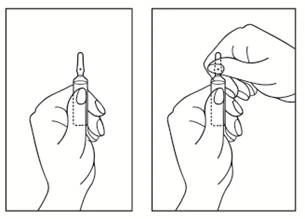
For single use only. Any unused portion of the ampoule contents must be discarded.
Dilute before use with:
- glucose 50 mg/ml (5%) solution, or
- sodium chloride 9 mg/ml (0.9%) solution, or
- sodium chloride 9 mg/ml (0.9%) with glucose 50 mg/ml (5%) solution.
Add 2 ml of concentrate to 48 ml of glucose 50 mg/ml (5%) solution (or any of the above diluents) for administration via syringe pump, or add 20 ml of concentrate to 480 ml of glucose 50 mg/ml (5%) solution (or any of the above diluents) for administration via infusion set with drop counter. In both cases, the final concentration of the infusion solution is 40 mg/L norepinephrine (equivalent to 80 mg/L norepinephrine tartrate). Dilutions other than 40 mg/L norepinephrine may also be used. If dilutions other than 40 mg/L norepinephrine are used, the infusion rate calculation must be carefully checked before initiating treatment.
The product is compatible with infusion bags made of polyvinyl chloride (PVC), ethylene vinyl acetate (EVA), or polyethylene (PE).
Any unused medicinal product or waste material must be disposed of in accordance with local requirements.
Children
The safety and efficacy of norepinephrine in children under 18 years of age have not been established.
Overdose
Symptoms and signs
Overdose may result in headache, severe hypertension, reflex bradycardia, marked increase in peripheral resistance, and reduced cardiac output. These may be accompanied by severe headache, cerebral hemorrhage, photophobia, chest pain, pallor, fever, profuse sweating, pulmonary edema, and vomiting.
Treatment
In case of accidental overdose, confirmed by excessive elevation of blood pressure, the drug should be discontinued until the patient's condition stabilizes.
Adverse reactions.
Table 2 lists adverse reactions observed after treatment with norepinephrine. These data were mainly collected from spontaneous reports, and due to difficulties in estimating reporting rates from spontaneous reports, the frequencies of the listed adverse reactions are considered "unknown" (cannot be estimated from the available data). Adverse reactions are listed in decreasing order of frequency within each System Organ Class (SOC).
Adverse reactions reported during norepinephrine use via spontaneous reporting
Table 2
| Psychiatric disorders |
Anxiety, insomnia, confusion, weakness, psychotic state |
| Nervous system disorders |
Transient headache, tremor |
| Cardiac disorders |
Bradycardia1, arrhythmia, electrocardiogram changes, tachycardia, cardiogenic shock, stress cardiomyopathy, palpitations, increased myocardial contractility due to beta-adrenergic cardiac effects (inotropic and chronotropic) |
| Vascular disorders |
Hypertension, peripheral ischemia2, including limb gangrene, reduced plasma volume with prolonged use, ischemic injury due to potent vasoconstrictive effect may lead to coldness and pallor of extremities |
| Gastrointestinal disorders |
Nausea, vomiting |
| Skin and subcutaneous tissue disorders |
Pallor, skin necrosis, cyanosis, flushing or redness of the skin, skin rash, urticaria or pruritus |
| Renal and urinary disorders |
Urinary retention |
| Respiratory, thoracic and mediastinal disorders |
Dyspnea |
| General disorders and administration site reactions |
Extravasation, injection site necrosis |
1 Bradycardia, possibly as a reflex response to increased blood pressure.
2 Ischemia due to potent vasoconstrictive action and tissue hypoxia.
Prolonged administration of a vasopressor to maintain blood pressure in the absence of volume replacement may cause the following symptoms:
- severe peripheral and visceral vasoconstriction;
- reduced renal blood flow;
- decreased urine output;
- hypoxia;
- elevated serum lactate levels.
In cases of hypersensitivity or overdose, the following effects may occur more frequently: hypertension, photophobia, retrosternal pain, throat pain, pallor, profuse sweating, and vomiting.
The vasopressor effect (resulting from adrenergic action on blood vessels) may be reduced by concomitant administration of an alpha-blocking agent (phentolamine mesylate), whereas administration of a beta-blocking agent (propranolol) may reduce the cardiac stimulatory effect and enhance the hypertensive effect (due to reduced arteriolar dilation) resulting from beta1-adrenergic stimulation.
Prolonged administration of any potent vasopressor may lead to plasma volume depletion, which should be continuously corrected with appropriate fluid and electrolyte replacement therapy. If plasma volume is not corrected, hypotension may recur upon discontinuation of norepinephrine infusion or upon vasopressor support, with risk of severe peripheral and visceral vasoconstriction and reduced blood flow.
Hypertension may occur, which may be associated with bradycardia, headache, and peripheral ischemia, including limb gangrene.
Cardiac arrhythmias may occur when norepinephrine is used concomitantly with cardiac sensitizing agents, most commonly in patients with hypoxia or hypercapnia. Norepinephrine should be administered only with appropriate blood volume replacement. Prolonged administration may lead to reduced blood plasma volume. Arterial pressure and infusion rate should be monitored frequently during norepinephrine administration to avoid hypertension, which may be associated with bradycardia, headache, and peripheral ischemia, including limb gangrene. Extravasation may cause local tissue necrosis.
Particular caution should be exercised in patients with hepatic insufficiency, severe renal dysfunction, ischemic heart disease, and increased intracranial pressure. Overdose or usual doses in hypersensitive individuals (e.g., patients with hyperthyroidism) may cause severe hypertension with severe headache, photophobia, stabbing chest pain, pallor, profuse sweating, and vomiting. Hypertension may eventually lead to acute pulmonary edema, arrhythmias, or cardiac arrest.
Shelf life.
2 years.
Do not use after the expiry date.
Shelf life after ampoule opening
After opening the ampoule, the diluted solution should be prepared immediately.
Shelf life after dilution
Chemical and physical stability in use has been demonstrated for 48 hours at 25 °C and at 2–8 °C when diluted to 4 mg/L and to 40 mg/L norepinephrine in 9 mg/mL (0.9%) sodium chloride solution, or in 50 mg/mL (5%) glucose solution, or in 9 mg/mL (0.9%) sodium chloride solution with 50 mg/mL (5%) glucose solution.
From a microbiological standpoint, the diluted solution should be used immediately. If not used immediately, the responsibility for storage duration and conditions lies with the user, and generally should not exceed 24 hours at a temperature of 2 to 8 °C, unless dilution is performed under controlled and validated aseptic conditions.
Storage conditions.
Store at a temperature not exceeding 25 °C. Keep in the original packaging to protect from light.
Keep out of reach of children.
Incompatibilities.
It has been reported that infusion solutions containing norepinephrine tartrate are incompatible with the following substances: iron salts, alkalis and oxidizing agents, barbiturates, chlorpheniramine, chlorothiazide, nitrofurantoin, novobiocin, phenytoin, sodium bicarbonate, sodium iodide, streptomycin, sulfadiazine, sulfadiazine.
This medicinal product must not be mixed with other medicinal products except those specified in the section "Instructions for use".
Packaging.
1 mL, 2 mL, 4 mL, 5 mL, 8 mL or 10 mL in a colorless glass ampoule of hydrolytic class with marking rings and a break point.
5 ampoules in a blister pack made of polyvinyl chloride film.
1 or 2 blister packs together with the instructions for medical use in a cardboard box.
Prescription status.
Prescription only.
Manufacturer.
Manufacturer responsible for batch release:
JSC "Kalceks".
Manufacturer's address and place of business.
71E Krustpils Street, Riga, LV-1057, Latvia.
Marketing Authorization Holder.
JSC "Kalceks".
Address of the Marketing Authorization Holder.
71E Krustpils Street, Riga, LV-1057, Latvia.