Nivalin
Ukraine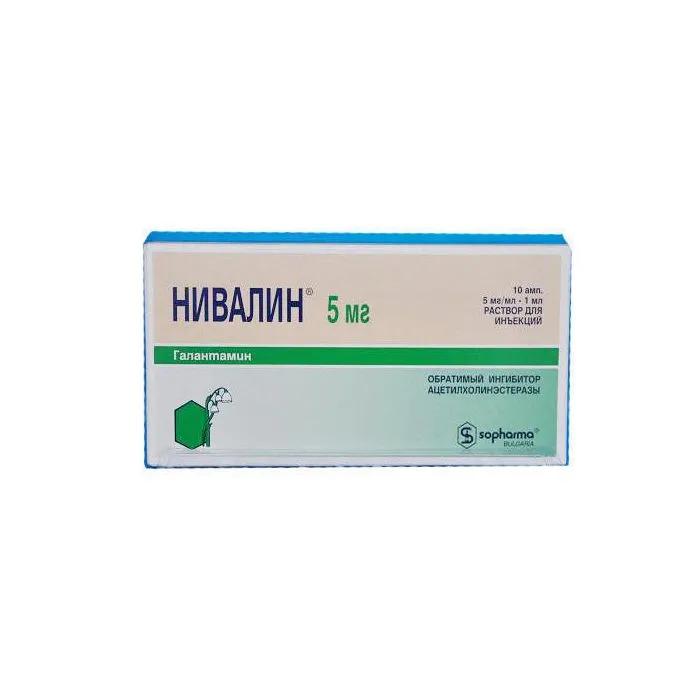
Table of Contents
INSTRUCTION FOR MEDICAL USE OF THE MEDICINAL PRODUCT NIVALIN (NIVALIN®)
Composition:
Active substance: galantamine;
1 ml of solution contains 1 mg or 2.5 mg or 5 mg of galantamine hydrobromide;
Excipients: sodium chloride, water for injections.
Pharmaceutical form. Injection solution.
Main physicochemical characteristics: clear liquid, practically free from particles.
Pharmacotherapeutic group.
Drugs used in dementia. Cholinesterase inhibitors. Galantamine.
ATC code N06D A04.
Pharmacological Properties
Pharmacodynamics
Galantamine belongs to the group of tertiary alkaloids of indirect-acting parasympathomimetics. It is a selective, competitive, and reversible inhibitor of the enzyme acetylcholinesterase. It increases the level of acetylcholine in the central nervous system (CNS). In addition to its action as an acetylcholinesterase inhibitor, it acts as an allosteric ligand of the most prevalent nicotinic acetylcholine receptors in the CNS, the alpha 4/beta 2 subtype, directly stimulating nicotinic receptors. It also enhances the sensitivity of postsynaptic receptors to acetylcholine. Galantamine crosses the blood-brain barrier, facilitates impulse transmission in the CNS, and accelerates excitation processes. It enhances the activity of the cholinergic system, thereby improving cognitive functions. Compared to neostigmine, galantamine has significantly weaker effects on muscarinic receptors. It improves and facilitates transmission of excitation at neuromuscular synapses and restores neuromuscular conduction in cases of blockade by non-depolarizing neuromuscular blockers. It increases smooth muscle tone, enhances secretion of digestive and sweat glands, and causes miosis.
It is considered that the use of parasympathomimetics carries a risk of seizures (although they have not been observed with galantamine). This necessitates careful monitoring of patients with Alzheimer's disease, in whom the risk of seizures is increased.
Pharmacokinetics
Resorption: galantamine hydrobromide is rapidly absorbed after subcutaneous administration. Pharmacokinetic studies of galantamine have not revealed statistically significant differences in mean values of the area under the pharmacokinetic curve (AUC) between oral and parenteral administration of a 10 mg dose. Maximum plasma concentration after subcutaneous administration is reached approximately within 1–2 hours.
Distribution: galantamine is weakly bound to plasma proteins – up to 18%. It readily crosses the blood-brain barrier and is found in brain tissues at concentrations 2–3 times higher than in plasma. The volume of distribution is approximately 175 L.
Metabolism: up to 75% of the administered dose of galantamine is metabolized in the liver via the cytochrome P450 system (isoenzymes CYP3A4 and CYP2D6). In vitro studies have shown that the isoenzyme CYP2D6 is involved in the formation of O-desmethylgalantamine, while CYP3A4 is involved in the formation of N-oxide-galantamine. Biotransformation of galantamine is slow and minimal, occurring via demethylation by 5–6%. In individuals with low enzyme activity (slow metabolizers), higher levels (up to 50%) of unchanged galantamine are observed compared to those with normal enzyme activity (fast metabolizers). Metabolites of galantamine—epigalantamine, galantaminone, and norgalantamine—are detected in plasma and urine, but there is no data on their pharmacological activity.
Elimination: the elimination half-life is approximately 5 hours. The central compartment is cleared faster than the peripheral compartment. Galantamine is excreted unchanged and as metabolites (galantaminone, epigalantamine), primarily via glomerular filtration (up to 74 ± 23% within 72 hours). Renal clearance of galantamine is 1.4 mL/min/kg. Unchanged galantamine and its metabolites are excreted in urine after subcutaneous administration. Renal clearance of galantamine has been determined to be approximately 100 mL/min, which is close to the clearance of inulin relative to creatinine. Galantamine is not conjugated in the liver, and its biliary excretion is minimal – 0.2 ± 0.1% within 24 hours.
The pharmacokinetics of galantamine are linear within the therapeutic dose range. No accumulation of galantamine is observed with repeated administration. No correlation has been established between plasma concentrations and therapeutic or adverse reactions of galantamine.
In patients with moderate hepatic impairment, the clearance of galantamine is reduced by approximately 25%.
In patients with moderate to severe hepatic impairment, AUC values increase by 37–67%.
Study data indicate that galantamine elimination may be delayed in patients with reduced creatinine clearance. In elderly patients (aged 65 years and older), galantamine plasma concentrations may be 30–40% higher.
No differences in pharmacokinetic parameters of galantamine have been observed between men and women, or among individuals of different races.
Clinical Characteristics.
Indications.
Neurology.
- Diseases of the peripheral nervous system (polyradiculoneuritis, radiculoneuritis, neuritis, polyneuritis, polyneuropathies);
- treatment of conditions associated with damage to the anterior horns of the spinal cord (post-polio, myelitis, spinal muscular atrophy);
- cerebral palsy (conditions following cerebral stroke, cerebral palsy in children, post-CNS trauma);
- disorders of the neuromuscular junction (myasthenia gravis, muscular dystrophy);
- cognitive impairments in various CNS diseases (trauma, intoxication, multiple sclerosis, autism).
Anesthesiology and Surgery.
For reversal of the effect of non-depolarizing neuromuscular blockers (muscle relaxants) and in the treatment of postoperative paralytic ileus of the small intestine and urinary bladder.
Physical Therapy.
Iontophoresis in neurological lesions of the peripheral nervous system, nocturnal enuresis.
Toxicology.
In poisoning with anticholinergic agents.
Contraindications.
Hypersensitivity to the components of the medicinal product;
bronchial asthma;
bradycardia;
AV-blockade;
ischemic heart disease;
severe heart failure (NYHA class III-IV);
epilepsy;
hyperkinesia;
mechanical intestinal obstruction;
mechanical disorders of urinary tract patency;
severe renal failure (creatinine clearance below 10 mL/min);
severe hepatic insufficiency (> 9 points according to Child-Pugh classification).
Interaction with other medicinal products and other types of interactions.
Pharmacodynamic drug interactions.
Galantamine antagonizes the inhibitory effect of morphine and its analogs on the respiratory center.
When galantamine is used concomitantly with other cholinomimetics (such as ambenonium, donepezil, neostigmine, pyridostigmine, or systemically administered pilocarpine), an enhanced cholinomimetic effect may be observed; therefore, they should not be used simultaneously.
Galantamine antagonizes the action of anticholinergic agents (atropine and similar substances), hexamethonium and other ganglionic blockers, non-depolarizing muscle relaxants (tubocurarine).
Additive interactions between galantamine and medicinal products that slow heart rate (e.g., digoxin, beta-blockers, calcium channel blockers, amiodarone) are possible when used concomitantly, resulting in enhanced effects of the latter.
Procainamide, whose therapeutic effect is partly due to anticholinergic activity, should not be used simultaneously with galantamine, as it may reduce its therapeutic effect.
Aminoglycosides (gentamicin, amikacin) may reduce the therapeutic effect of galantamine on neuromuscular conduction and also reduce the therapeutic effect of galantamine in myasthenia gravis.
An enhanced effect of depolarizing neuromuscular blockers (succinylcholine) may occur when used concomitantly with galantamine, especially in cases of pseudocholinesterase deficiency.
Pharmacokinetic drug and other interactions
Galantamine is metabolized by hepatic isoenzymes CYP3A4 and CYP2D6. Inhibitors of CYP2D6 (quinidine, paroxetine, fluoxetine) or CYP3A4 (ketoconazole, zidovudin, ritonavir, erythromycin) may affect galantamine metabolism, leading to increased plasma concentration and enhanced bioavailability. Medicinal products metabolized by the same isoenzymes may interact with galantamine at the pharmacokinetic level. In such cases, the risk of adverse reactions is increased; therefore, a reduction in the maintenance dose of galantamine is recommended.
Cimetidine may increase galantamine bioavailability.
Galantamine does not affect the pharmacokinetics of warfarin.
Special precautions for use
Parasympathomimetic agents may cause vagotonic effects on heart rhythm (bradycardia, AV block) due to their pharmacological action. Therefore, galantamine should be administered with caution to patients with sick sinus syndrome or other supraventricular conduction disorders; to patients concurrently receiving drugs that significantly reduce heart rate, such as digoxin or beta-blockers; or to patients with uncorrected electrolyte imbalances (hyper- or hypokalemia).
Extreme caution is required when administering galantamine to patients with cardiovascular disorders, such as those in the immediate post-myocardial infarction period, recent atrial fibrillation, second- or higher-degree heart block, unstable angina, or congestive heart failure, particularly NYHA functional class III-IV.
Cases of QTc interval prolongation have been reported in patients receiving therapeutic doses of galantamine, as well as cases of torsade de pointes associated with overdose (see section "Overdose"). Therefore, galantamine should be used cautiously in patients with prolonged QTc interval, in patients receiving medications that affect the QTc interval, and in patients with underlying cardiac conditions or electrolyte disturbances.
The drug should be prescribed with caution to patients with peptic ulcer disease, as cholinesterase inhibitors (including galantamine) may increase and enhance gastric acid secretion due to elevated cholinergic activity, potentially causing gastrointestinal adverse reactions. Such patients require monitoring for related symptoms. The risk is higher in patients with a history of peptic ulcer, during the recovery period after gastric surgery, and in patients receiving concomitant nonsteroidal anti-inflammatory drugs (NSAIDs). During galantamine treatment, these patients should be closely monitored due to the potential risk of acute gastrointestinal bleeding.
Galantamine should be used with caution in patients with acute and chronic lung diseases (chronic obstructive pulmonary disease).
Administration of galantamine is not recommended in patients with urinary retention, following recent prostatectomy, or bladder resection.
Parasympathomimetics may potentiate the effects of succinylcholine-type muscle relaxants during anesthesia.
Treatment with cholinesterase inhibitors, including galantamine, may in individual cases be associated with weight loss; therefore, patients' body weight should be monitored periodically.
Parasympathomimetics are known to potentially induce seizures. Increased seizure activity has been observed in patients with Alzheimer's disease. In individual cases, parasympathomimetics may increase cholinergic tone and may exacerbate symptoms of parkinsonism.
When treating patients with mild renal impairment, Nivalin should be used with caution and at lower doses, taking into account creatinine clearance values.
The medicinal product Nivalin, injection solution, 1 mg/ml, 2.5 mg/ml, and 5 mg/ml, contains less than 1 mmol of sodium (23 mg) per dose, i.e., it is practically sodium-free.
Use during pregnancy or breastfeeding
Animal studies have not revealed any direct or indirect adverse effects on pregnancy, embryonal/fetal development, parturition, or postnatal development.
There are no data on the passage of galantamine into breast milk. Clinical studies have not been conducted in breastfeeding women.
Due to the lack of clinical data, the medicinal product is not recommended for use during pregnancy and breastfeeding.
Ability to influence the ability to drive and use machines
Nivalin has a mild to moderate effect on the ability to drive vehicles or operate machinery requiring rapid mental or physical reactions. It may cause visual disturbances, dizziness, or drowsiness, especially at the beginning of treatment. In such cases, patients should refrain from driving vehicles and operating machinery.
Administration and Dosage.
Nivalin, injection solution, is intended for subcutaneous, intramuscular, and intravenous administration.
The dosage and duration of galantamine treatment depend on the nature and course of the disease, as well as the treatment efficacy.
Neurology.
Nivalin injection solution is used for short-term treatment and for patients in whom oral administration is not possible. As soon as feasible, switch to Nivalin tablets.
Adults.
Nivalin injection solution is usually administered at a dose of 0.03–0.28 mg/kg.
The recommended initial dose is 2.5 mg per day. The daily dose should be gradually increased by 2.5 mg every 3–4 days, divided into 2–3 equal doses.
The maximum single dose for adults is 10 mg subcutaneously, and the maximum daily dose is 20 mg.
Children.
The dosage of Nivalin injection solution for children is determined by the physician according to the child's body weight. The drug is administered subcutaneously at the following daily doses:
children aged 1 to 2 years: 0.25–1 mg (0.02–0.08 mg/kg);
children aged 3 years and older: Nivalin injection solution is administered at a dose of 0.03–0.28 mg/kg or:
children aged 3 to 5 years: 0.5–5 mg;
children aged 6 to 8 years: 0.75–7.5 mg;
children aged 9 to 11 years: 1–10 mg;
children aged 12 to 15 years: 1.25–12.5 mg;
children aged 15 years and older: 1.25–15 mg.
The duration of treatment depends on the specific characteristics and severity of the disease. It usually lasts 40–60 days. The course can be repeated 2–3 times with intervals of 1–2 months. Higher therapeutic doses are generally divided into 2 daily doses.
Anesthesiology, Surgery, and Toxicology.
As an anticholinergic agent and antidote in cases of overdose with peripheral non-depolarizing neuromuscular blockers, Nivalin is administered intravenously at a dose of 10–20 mg/day. For postoperative gastrointestinal and urinary bladder paresis, the drug is administered subcutaneously, intramuscularly, or intravenously in age-appropriate doses, divided into 2–3 daily administrations.
Children.
The dosage of Nivalin injection solution for children is determined by the physician according to the child's body weight. The drug is administered intravenously at the following daily doses:
children aged 1 to 2 years: 0.25–1 mg (0.03–0.08 mg/kg);
children aged 3 years and older: Nivalin injection solution is administered at a dose of 0.03–0.28 mg/kg or:
children aged 3 to 5 years: 0.5–5 mg;
children aged 6 to 8 years: 0.75–7.5 mg;
children aged 9 to 11 years: 1–10 mg;
children aged 12 to 15 years: 1.25–12.5 mg;
children aged 15 years and adults: 1.25–15 mg.
Physiotherapy.
Iontophoretically, Nivalin is administered at a dose of 2.5–5 mg of galantamine (with an electric current of 1 to 2 mA) for 10 minutes daily over a period of 10–15 days.
Treatment Duration.
The duration of treatment varies widely—from several weeks to several years—and depends on the disease and individual tolerance to therapy. If adverse reactions occur, the dose should be reduced or treatment interrupted for 2–3 days, after which therapy can be continued at lower doses. If treatment must be discontinued for a longer period, re-administration should start at the lowest dose and be gradually increased to the optimal maintenance dose.
Patients with Hepatic Impairment.
In patients with moderate hepatic impairment (7–9 points according to the Child-Pugh classification), plasma concentrations of galantamine may be increased; therefore, the daily dose of galantamine in this patient group should be reduced to 15 mg.
Patients with Renal Impairment.
Galantamine and its metabolites are primarily excreted by the kidneys.
In patients with moderate renal insufficiency, the daily dose of galantamine should not exceed 15 mg.
Children.
The drug is not recommended for use in children under 1 year of age.
Overdose.
Symptoms: symptoms of galantamine overdose are similar to those of other parasympathomimetics. These effects usually involve the CNS, parasympathetic nervous system, and neuromuscular junctions. In addition to muscle weakness or fasciculations, some or all signs of cholinergic crisis may develop: severe nausea, vomiting, abdominal cramps, diarrhea, salivation, lacrimation, sweating, bradycardia, hypotension, collapse, and seizures. Increased muscle weakness combined with tracheal hypersecretion and bronchospasm may lead to an acute respiratory episode.
Treatment: in case of overdose, monitor respiratory and cardiovascular functions, provide general supportive measures, and administer symptomatic therapy. In case of overdose following oral administration, if the patient is conscious, perform gastric lavage. Atropine is used as an antidote at a dose of 0.5–1 mg intravenously; the dose may be repeated depending on the clinical condition.
Adverse Reactions.
Adverse reactions are classified by organ systems.
The most common adverse reactions of galantamine are related to its pharmacodynamics and may primarily manifest as nicotinic or, less frequently, muscarinic effects typical of the pharmacological class.
Cardiovascular system: bradycardia, first-degree atrioventricular block, sinus bradycardia, angina pectoris, palpitations, supraventricular extrasystoles, arterial hypotension or arterial hypertension, flushing.
Nervous system: dizziness, headache, insomnia, somnolence, lethargy (lethargic sleep), syncope (loss of consciousness), hallucinations, visual and auditory hallucinations, depression, tremor, paresthesia, dysgeusia (taste disturbance), hypersomnia.
Eye disorders: blurred vision, miosis, increased lacrimation.
Ear and labyrinth disorders: tinnitus (ringing in the ears).
Respiratory, thoracic and mediastinal disorders: tachypnea, bronchospasm, increased nasal and bronchial secretions.
Gastrointestinal disorders: nausea, vomiting, diarrhea, increased salivation, increased intestinal peristalsis, abdominal pain, dyspepsia, gastrointestinal discomfort.
Hepatobiliary disorders: hepatitis.
Metabolism and nutrition disorders: loss of appetite, anorexia, dehydration.
Skin and subcutaneous tissue disorders: hyperhidrosis (excessive sweating).
Musculoskeletal and connective tissue disorders: muscle spasms, muscle weakness.
Immune system disorders: pruritus, rash, urticaria, rhinitis. In isolated cases, acute hypersensitivity reactions have been observed, including anaphylaxis with loss of consciousness.
General disorders and administration site conditions: asthenia, fatigue, weakness, weight loss, injection site pain, possible local reactions following parenteral administration.
Laboratory findings: weight loss, elevated liver enzymes.
Injury: falls.
In case of pronounced parasympathomimetic effects during galantamine treatment, the daily dose should be reduced or treatment discontinued for 2–3 days, after which therapy may be continued at lower doses.
Shelf life. 5 years.
Storage conditions.
Keep out of reach of children. Store in the original packaging at a temperature not exceeding 25 °C. Do not freeze.
Incompatibility.
The drug must not be mixed with other medicinal products in the same syringe.
Packaging.
1 ml of solution in ampoules. 10 ampoules in a blister pack. 1 blister pack in a cardboard box.
Prescription category. Prescription only.
Manufacturer.
JSC "Sofarma".
Manufacturer's address and place of business.
16 Iliensko Shose Str., Sofia, 1220, Bulgaria.