Nitrogranulon
Ukraine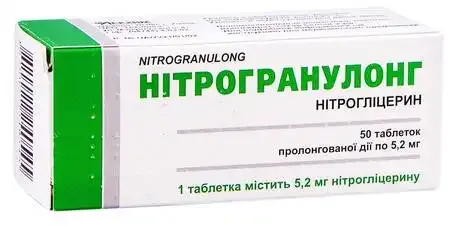
Table of Contents
INSTRUCTIONS FOR MEDICAL USE OF THE MEDICINAL PRODUCT NITROGRANULONG (NITROGRANULONG)
Composition:
Active substance: nitroglycerin;
1 tablet contains 2.9 mg or 5.2 mg of nitroglycerin;
Excipients: lactose monohydrate, potato starch, talc, magnesium stearate, povidone, white sugar, corn starch, colloidal anhydrous silicon dioxide, titanium dioxide (E 171), gelatin, polyethylene glycol 6000 (macrogol 6000).
Pharmaceutical form. Prolonged-release tablets.
Main physicochemical properties: round tablets coated with a film, white or almost white, with convex upper and lower surfaces. When broken and examined under a magnifying lens, the core surrounded by a single continuous layer is visible.
Pharmacotherapeutic group. Vasodilators used in cardiology. Glyceryl trinitrate. ATC code C01D A02.
Pharmacological properties.
Pharmacodynamics.
Prolonged-action antianginal agent. Nitroglycerin, belonging to the group of organic nitrates, is an effective vasodilator acting on both arterial and venous vessels. The mechanism of the antianginal effect of prolonged-action nitroglycerin preparations is associated with their peripheral vasodilating action. Along with reducing resistance in coronary vessels, nitroglycerin primarily dilates postcapillary venous vessels, leading to decreased venous return to the heart; at higher doses, it also dilates precapillary arterioles regulating peripheral vascular resistance, thereby reducing cardiac workload and oxygen demand. The drug promotes redistribution of coronary blood flow to areas with impaired circulation. Increases exercise tolerance in patients with angina pectoris.
Pharmacokinetics.
After oral administration, nitroglycerin is gradually absorbed in the small intestine; onset of action occurs within 30–60 minutes and lasts for 4–6 hours. The drug is extensively metabolized in the liver by nitrate reductase (first-pass effect), and subsequently biotransformed into nitric oxide (NO) within smooth muscle cells. Bioavailability is no more than 10% compared to sublingually administered nitroglycerin. Metabolites include dinitrates and mononitrates (only isosorbide-5-mononitrate is active), with glycerol being the final metabolite. The elimination half-life of metabolites is 4 hours. In plasma, it binds to proteins (60%). Metabolites are primarily excreted by the kidneys.
Clinical characteristics.
Indications.
Prevention of angina attacks in patients with ischemic heart disease (IHD), including in the postinfarction period.
Contraindications.
Hypersensitivity to nitrates and excipients of the drug; cerebral ischemia, hemorrhagic stroke, intracranial hemorrhage, increased intracranial pressure, recent head trauma, bradycardia (less than 50 beats/min), arterial hypotension (systolic blood pressure below 90 mm Hg), shock, collapse, hypertrophic obstructive cardiomyopathy, aortic stenosis, conditions associated with reduced left ventricular filling pressure (acute myocardial infarction, isolated mitral stenosis, constrictive pericarditis), cardiac tamponade, toxic pulmonary edema, closed-angle glaucoma with high intraocular pressure, concomitant use of phosphodiesterase-5 (PDE-5) inhibitors (sildenafil, tadalafil, vardenafil).
Interaction with other medicinal products and other types of interactions.
Concomitant use with other vasodilators, antihypertensive agents, angiotensin-converting enzyme (ACE) inhibitors, "slow" calcium channel blockers, diuretics, tricyclic antidepressants, monoamine oxidase (MAO) inhibitors, ethanol and ethanol-containing medications, beta-adrenoblockers, procainamides, quinidine, and procainamide enhances the hypotensive effect of nitroglycerin.
Phosphodiesterase inhibitors (sildenafil, tadalafil, vardenafil) – concomitant use of nitroglycerin with these drugs is contraindicated due to the potential risk of uncontrolled arterial hypotension and life-threatening cardiovascular complications.
Atropine and other drugs exhibiting M-cholinolytic activity may reduce the effect of nitroglycerin due to decreased secretion and bioavailability of the drug.
Concomitant use with dihydroergotamine may lead to increased plasma concentration of dihydroergotamine and elevated blood pressure (due to increased bioavailability of dihydroergotamine).
Concomitant use with heparin may reduce the anticoagulant effect of the latter (after discontinuation of the drug, a significant decrease in blood coagulation may occur, which may require dose reduction of heparin).
Phenobarbital enhances the metabolism of nitrates in the liver. Alpha-adrenergic agonists, histamine, pituitrin, corticosteroids, central nervous system (CNS) stimulants, bee and snake venom, and sunlight reduce the antianginal effect of nitroglycerin. Salicylates increase the blood level of nitroglycerin; barbiturates accelerate its metabolism. Sulfhydryl group donors (captopril, acetylcysteine, unithiol) restore reduced sensitivity to nitroglycerin.
Special precautions.
Nitrogranulong is not intended for the treatment of acute angina attacks.
The drug should be administered with caution, carefully weighing the risks and benefits, in patients with uncontrolled hypovolemia, heart failure with normal or low pulmonary arterial pressure, severe anemia, hyperthyroidism, and severe renal and/or hepatic insufficiency (risk of developing methemoglobinemia).
Extreme caution is required when administering the drug to patients with pronounced cerebral atherosclerosis and elderly patients. Alcohol consumption is strictly prohibited during treatment; visiting saunas, baths, and taking hot showers is contraindicated.
The tablet must not be chewed, as an excessive amount of the active substance may enter systemic circulation through the oral mucosa.
With frequent use, tolerance (tolerance development) may develop to nitroglycerin, as with other organic nitrates, necessitating dose escalation. To prevent the development of tolerance during prolonged nitroglycerin therapy, intermittent dosing throughout the day is recommended, or concurrent administration of calcium antagonists, ACE inhibitors, or diuretics. If tolerance develops, it may sometimes be necessary to temporarily discontinue nitroglycerin (for several days) and substitute antianginal agents from other pharmacotherapeutic groups.
Patients must inform their physician about any previous reactions to drugs of this group.
Significant decrease in blood pressure and dizziness upon sudden change to an upright position from lying or sitting, as well as during alcohol consumption, or physical exertion in hot weather, may occur during nitroglycerin therapy.
If blurred vision or dry mouth persists or is markedly pronounced, treatment should be discontinued.
The risk of methemoglobinemia, manifested by cyanosis and blood discoloration, increases with prolonged uncontrolled use of nitroglycerin and administration of high doses in patients with hepatic insufficiency.
The preparation contains lactose; therefore, patients with rare hereditary forms of galactose intolerance, lactase deficiency, or glucose-galactose malabsorption syndrome should not take this drug.
Use during pregnancy or breastfeeding.
The use of nitroglycerin during pregnancy or breastfeeding is contraindicated.
Ability to affect reaction speed when driving or operating machinery.
During treatment with this drug, patients should not drive vehicles, operate machinery, or perform work requiring heightened attention and rapid psychomotor reactions.
Dosage and Administration.
The dosage depends on the individual patient's condition and the severity of the disease. To prevent the development of tolerance, the dosing regimen must include a 10–12-hour nitrate-free interval.
In mild cases, Nitrogranulong is administered at a dose of 1–2 tablets of 2.9 mg twice daily, in the morning and after lunch. In more severe cases, the dose is 1–2 tablets of 5.2 mg twice daily, in the morning and after lunch. The absence of an evening dose ensures a 12-hour interval. If necessary, the drug may be administered three times daily, provided that a 10–12-hour nitrate-free interval is maintained.
If attacks occur predominantly at night, Nitrogranulong should be taken after lunch and in the evening.
The tablets should be taken on an empty stomach, swallowed whole without chewing or crushing, with a small amount of liquid.
The maximum daily dose should not exceed 30 mg.
Children.
The drug is not used in children.
Overdose.
Symptoms: decreased blood pressure (below 90 mm Hg) with orthostatic dysregulation, headache, severe dizziness, fainting, rapid heartbeat, nausea and vomiting, shortness of breath, pronounced weakness, drowsiness, elevated body temperature, sensation of warmth, arterial hypotension, increased sweating, chills.
When high doses are used (more than 20 mcg/kg) – collapse, cyanosis of lips, nails or palms, methemoglobinemia, dyspnea and tachypnea.
Treatment: gastric lavage, administration of activated charcoal, laxatives, placing the patient in a horizontal position with legs elevated; in severe cases – plasma substitutes, sympathomimetics, oxygen; in case of methemoglobinemia – methylene blue.
Adverse reactions.
Central nervous system side effects: blurred vision, "nitrate" headache (especially at the beginning of treatment; decreases with prolonged therapy), dizziness and feeling of weakness, anxiety, psychotic reactions, drowsiness, disorientation.
Cardiovascular system side effects: orthostatic reactions, decreased arterial blood pressure, tachycardia, paradoxical bradycardia (in acute hypotension or syncope), facial hyperemia, cyanosis, pallor, methemoglobinemia.
Gastrointestinal tract side effects: dry mouth, nausea, vomiting, abdominal pain.
Immune system side effects: allergic reactions, including skin rashes, urticaria, itching; skin hyperemia, pallor, anaphylactic shock.
Other side effects: restlessness, visual disturbances, exacerbation of glaucoma, hypothermia, sensation of warmth, respiratory disturbances, weakness.
There have also been isolated reports of adverse reactions: exacerbation of ischemic heart disease due to hypoxia, complete heart block, asystole, angioneurotic edema.
Occasionally, paradoxical "nitrate" reactions (increased angina symptoms) may occur due to sudden drop in arterial blood pressure.
Shelf life. 3 years.
Storage conditions.
Store in original packaging at a temperature not exceeding 25 °C. Keep out of reach of children.
Packaging.
10 tablets in blisters;
10 tablets in a blister, 5 blisters per cardboard pack;
50 tablets in a container, 1 container per cardboard pack.
Prescription category. Prescription only.
Manufacturer.
JSC "Tekhnologiya".
Manufacturer's name and address of manufacturing site.
8 Stara Prorina Street, City of Uman, Cherkasy Region, 20300, Ukraine.