Nicotinic acid-zdorovya
Ukraine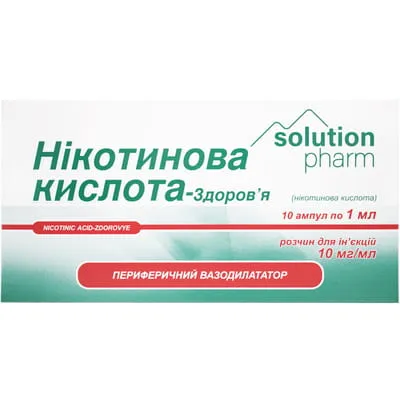
Instructions for Use
Table of Contents
INSTRUCTIONS FOR MEDICAL USE | consumption | of the medicinal product NICOTINIC ACID-ZDOROVYE (NICOTINIC ACID-ZDOROVYE)
Composition:
Active ingredient: 1 ml | of solution contains | contains | nicotinic acid 10 mg;
Excipients: sodium bicarbonate, water for injections.
Pharmaceutical form. Solution for injection.
Main physicochemical properties: clear, colorless solution.
Pharmacotherapeutic group. Peripheral vasodilators. Nicotinic acid and its derivatives.
ATC code C04AC01.
Pharmacological Properties.
Pharmacodynamics. A drug that replenishes the deficiency of nicotinic acid (vitamin PP, B3); exerts vasodilating, hypolipidemic, and hypocholesterolemic effects.
Nicotinic acid and its amide (nicotinamide) are components of nicotinamide adenine dinucleotide (NAD) and nicotinamide adenine dinucleotide phosphate (NADP), which play an essential role in normal body function. NAD and NADP are compounds that mediate the transfer of hydrogen in redox reactions, as well as phosphate transfer. Participating in metabolism, tissue respiration, and synthetic processes, nicotinic acid normalizes blood levels of lipoproteins and triglycerides: it reduces levels of triglycerides, total cholesterol, low-density lipoproteins, and increases high-density lipoprotein content; it exerts an antiatherogenic effect. It inhibits lipolysis in adipose tissue and reduces the rate of synthesis of very low-density lipoproteins.
The drug is a specific anti-pellagric agent (deficiency of nicotinic acid in humans leads to the development of pellagra).
It exerts a transient vasodilating effect, including on cerebral vessels, improves microcirculation, enhances fibrinolytic activity of blood, and reduces platelet aggregation (decreases thromboxane A2 production).
It exhibits detoxifying properties by enhancing detoxification functions of the liver and kidneys.
Pharmacokinetics. Nicotinic acid is rapidly absorbed from the site of administration following parenteral administration. It is evenly distributed throughout all organs and tissues. It is mainly inactivated via methylation and, to a lesser extent, via conjugation. The metabolites are excreted in urine. Nicotinic acid may be detected in urine in its active form when excessive amounts are administered into the body.
Clinical characteristics.
Indications. Treatment of pellagra (vitamin PP deficiency).
Ischemic disorders of cerebral circulation. Vasospasm of extremities (obliterating endarteritis, Raynaud's disease). Renal vessel spasm.
Wounds and ulcers with prolonged non-healing. Diabetic complications (diabetic polyneuropathy, microangiopathy).
Hypochlorhydric gastritis, enterocolitis, colitis. Liver diseases (acute and chronic hepatitis).
Facial nerve neuritis.
Intoxications of various origins: occupational, alcohol-related, drug-induced (aniline derivatives, barbiturates, antituberculosis agents, sulfonamides).
Contraindications. Hypersensitivity to the components of the drug. Peptic ulcer of the stomach and duodenum (in the stage of exacerbation), gout, hyperuricemia, severe hepatic insufficiency (including cirrhosis), severe forms of arterial hypertension and atherosclerosis (intravenous administration), decompensated diabetes mellitus, recent myocardial infarction, history of sudden decrease in peripheral vascular resistance.
Interaction with other medicinal products and other types of interactions.
Oral contraceptives and isoniazid reduce the conversion of tryptophan into nicotinic acid and thus may increase the requirement for nicotinic acid.
Nicotinic acid reduces the efficacy and toxicity of probenecid, neomycin, barbiturates, antituberculosis agents, and sulfonamides.
Antibiotics may enhance skin flushing caused by nicotinic acid.
Acetylsalicylic acid reduces the skin flushing effect induced by nicotinic acid.
Ciprofibrate is not recommended to be combined with nicotinic acid.
Lovastatin and pravastatin are not recommended to be combined with nicotinic acid due to increased risk of adverse reactions. Cases of rhabdomyolysis have been reported with the concomitant use of nicotinic acid and lovastatin.
Caution is required when combining with antihypertensive agents (possible enhancement of hypotensive effect), anticoagulants, and acetylsalicylic acid (due to the risk of hemorrhages).
The drug potentiates the action of fibrinolytic agents, spasmolytics, and cardiac glycosides, as well as the hepatotoxic effect of alcohol.
Special precautions for use. Use with caution in hyperchlorhydric gastritis, peptic ulcer of the stomach and duodenum (outside the stage of exacerbation), hemorrhages, glaucoma, renal insufficiency, moderate arterial hypotension, alcohol abuse, unstable angina (in patients receiving nitrates, calcium channel antagonists, β-blockers).
Since prolonged use of the drug may lead to fatty degeneration of the liver, methionine-rich foods should be included in the patient's diet or methionine and other lipotropic agents should be prescribed for prophylaxis. Liver function should be monitored during treatment. In case of hypersensitivity to the drug (except when used as a vasodilator), nicotinamide should be prescribed.
The use of the drug may increase insulin requirements in patients with diabetes mellitus. It is not advisable to use for correction of dyslipidemia in patients with diabetes mellitus.
Regular monitoring of serum glucose and uric acid levels is necessary.
This medicinal product contains less than 1 mmol (23 mg)/dose of sodium, i.e., it is practically sodium-free.
Use during pregnancy or breastfeeding. The drug is contraindicated during pregnancy. If it is necessary to use the drug, breastfeeding should be discontinued.
Ability to influence reaction rate while driving or operating machinery. Studies on the effect of the drug on reaction speed have not been conducted; however, if dizziness or drowsiness occurs during treatment, patients should refrain from operating complex machinery.
Administration and dosage. Administered intravenously (slowly), intramuscularly, and subcutaneously (intramuscular and subcutaneous injections are painful) to adults and children aged 15 years and older.
For intravenous bolus injection, dilute a single dose in 10 ml of 0.9% sodium chloride solution; administer over no less than 5 minutes (no more than 2 mg of nicotinic acid per minute). For intravenous infusion, dilute a single dose in 100–200 ml of 0.9% sodium chloride solution; infusion rate – 30–40 drops per minute.
Pellagra. Administer intravenously or intramuscularly, 10 mg (1 ml) 1–2 times daily. Treatment course: 10–15 days.
Ischemic disorders of cerebral circulation. Administer intravenously (slowly) 10 mg (1 ml).
Other indications. Administer subcutaneously or intramuscularly, 10 mg (1 ml) once daily for 10–15 days. It is possible to add 10 mg (1 ml) of nicotinic acid to 100–200 ml of infusion solution.
Higher doses for intravenous administration: single dose – 100 mg (10 ml), daily dose – 300 mg (30 ml).
Children. The drug is indicated for children aged 15 years and older.
Overdose.
Symptoms. Exaggeration of adverse effects on the cardiovascular system: arterial hypotension, headache, possible loss of consciousness, dizziness, sensation of flushing.
Treatment. Discontinuation of the drug, detoxification therapy, symptomatic treatment. No specific antidote is available.
Adverse Reactions.
Cardiovascular system: sensation of flushing, which may be accompanied by dyspnea, tachycardia, palpitations, sweating, chills, edema, tingling and burning sensations; with rapid intravenous administration – significant decrease in arterial pressure, orthostatic hypotension, collapse.
Nervous system: headache, dizziness, paresthesias.
Local reactions: pain at the site of subcutaneous and intramuscular injections.
Other: allergic reactions (including rash, exhausting pruritus, urticaria), dryness of the skin and conjunctiva of the eyes; rarely – retinal edema; very rarely in patients with ischemic heart disease – arrhythmias, acanthosis (brown skin patches with velvety surface). These symptoms are transient and disappear after discontinuation of the drug.
With prolonged use in high doses: hyperpigmentation, cramps, diarrhea, nausea, vomiting, anorexia, exacerbation of gastric ulcer, amblyopia, jaundice, hyperuricemia, fatty liver dystrophy, increased blood levels of glucose (reduced tolerance), uric acid, aspartate aminotransferase, lactate dehydrogenase and alkaline phosphatase, hypophosphatemia, decreased platelet count, prolonged prothrombin time, insomnia, myalgia, decreased arterial pressure, rhinitis, blurred vision, eyelid edema, myopathy, exfoliative dermatitis.
Shelf life. 5 years.
Storage conditions. Store in original packaging at a temperature not exceeding 25 °C.
Keep out of reach of children.
Incompatibility. Should not be mixed with thiamine chloride solutions (results in thiamine degradation), pyridoxine hydrochloride, cyanocobalamin, ephedrine, salicylates, tetracycline, sympathomimetics, hydrocortisone.
Packaging. 1 ml in vials, 10 in a box; 5×2, 10 in blister packs in a box.
Prescription status. Prescription only.
Manufacturer. LIMITED LIABILITY COMPANY "CORPORATION "ZDOROVYA".
Manufacturer's address and location of business activity. Ukraine, 61013, Kharkiv region, city of Kharkiv, Shevchenko Street, building 22.
Frequently Asked Questions
What is Nicotinic acid-zdorovya prescribed for?
The drug is used to treat pellagra (vitamin PP deficiency), ischemic cerebral circulation disorders, spasms of the vessels of the extremities or kidneys, as well as for the treatment of non-healing wounds, complications of diabetes mellitus, liver diseases, gastritis, colitis, and facial nerve neuritis. It is also used in various intoxications.
How should Nicotinic acid-zdorovya be taken correctly?
For adults and children from 15 years of age, the drug is administered intravenously (slowly), intramuscularly, or subcutaneously. For pellagra, 10 mg (1 ml) is usually prescribed 1–2 times daily for 10–15 days. The route of administration and dosage must be determined by a physician.
What are the possible side effects of Nicotinic acid-zdorovya?
Possible sensations include flushing, redness, palpitations, sweating, headache, and dizziness. Allergic reactions (itching, rash), dry eyes, or pain at the injection site may also occur. With prolonged use of high doses, nausea, diarrhea, changes in liver function, and increased blood sugar levels are possible.
Who should not use this drug?
Contraindications include hypersensitivity to the components, exacerbation of gastric or duodenal ulcers, gout, severe hepatic insufficiency, severe forms of hypertension and atherosclerosis, decompensated diabetes mellitus, recent myocardial infarction, and pregnancy.
Can the drug be combined with other medicines?
Caution is required when combining with antihypertensive agents, anticoagulants, and acetylsalicylic acid. It is not recommended to combine with ciprofibrate, lovastatin, and pravastatin. Some antibiotics may enhance skin flushing, while oral contraceptives and isoniazid may reduce the efficacy of the drug.
Does the drug affect the ability to drive a vehicle?
If you experience dizziness or drowsiness during treatment, you should refrain from driving a vehicle or operating complex machinery.
Similar Medications
-
Nicotinic acid-darnitsa
Form: solution for injection
Active substance Dosage nicotinic acid 10 mg/ml Manufacturer: PJSC «Pharmaceutical Company «Darnitsa»
This page has been machine-translated and may contain inaccuracies. The original data is available in the manufacturing country's language.
Last data check: July 21, 2026 · Data source: Державний реєстр лікарських засобів України