Nicorette ice mint
Ukraine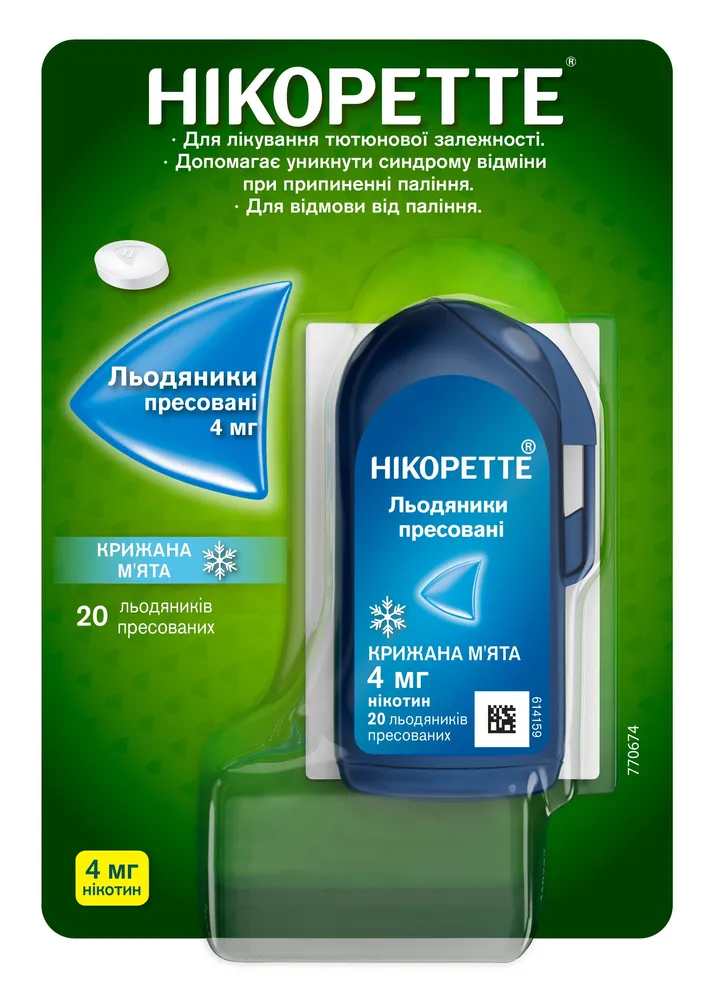
Table of Contents
INSTRUCTIONS FOR MEDICAL USE OF THE MEDICINAL PRODUCT NICORETTE® ICYMINT (NICORETTE® ICYMINT)
Composition:
Active substance: nicotine;
One compressed lozenge contains 10.5 mg or 21 mg of nicotine resinate, equivalent to 2 mg or 4 mg of nicotine;
Excipients: core – mannite (E 421); xanthan gum; Winterfresh RDE4-149 flavoring, spray-dried; anhydrous sodium carbonate; sucralose; acesulfame potassium; magnesium stearate; coating – hypromellose; Winterfresh RDE4-149 flavoring; titanium dioxide (E 171); sucralose, polishing agent Sepifilm; acesulfame potassium; polysorbate 80.
Pharmaceutical form. Compressed lozenges.
Main physicochemical properties: oval tablets with a film coating, white to almost white in color, embossed with “n” on one side and “2” (2 mg lozenges) or “4” (4 mg lozenges) on the other side.
Pharmacotherapeutic group. Agents acting on the nervous system. Agents used in addictive disorders. Agents used in nicotine dependence.
ATC code N07BA01.
Pharmacological Properties
Pharmacodynamics
Nicotine – the main alkaloid of tobacco products, occurring naturally as an independent substance – is an agonist of nicotinic receptors in both the peripheral and central nervous systems and exerts a pronounced effect on the CNS and cardiovascular system. It has been proven that when consumed in tobacco products, nicotine causes addiction, and cessation of its use leads to craving for smoking and withdrawal symptoms. This craving and withdrawal symptoms include the urge to smoke, depressed mood, insomnia, irritability, frustration or anger, anxiety, difficulty concentrating, restlessness, and increased appetite or weight gain. Nicotine lozenges replace a portion of the nicotine previously obtained from tobacco and help reduce the urge to smoke and alleviate withdrawal symptoms.
After administration of "Nicorette® Ice Mint" compressed lozenges, reduction of the urge to smoke (i.e., reduced need to smoke) was observed in most subjects of the bioequivalence study starting from the 5th minute.
Pharmacokinetics
Absorption
The "Nicorette® Ice Mint" compressed lozenges completely dissolve in the oral cavity, and all the nicotine contained in the lozenges is absorbed through the oral mucosa or after swallowing. Complete dissolution of the "Nicorette® Ice Mint" compressed lozenges is usually achieved within 16–19 minutes. Concurrent intake of liquids that lower the pH in the oral cavity, such as coffee, juice, or soft drinks, may significantly reduce nicotine absorption from the oral cavity. The maximum plasma nicotine concentration achieved after a single dose is approximately 5 ng/mL (for 2 mg lozenges) or 8 ng/mL (for 4 mg lozenges). If the recommended administration instructions for "Nicorette® Ice Mint" compressed lozenges are not followed (chewing, holding in the oral cavity and swallowing; chewing and immediately swallowing), nicotine absorption is slowed and somewhat reduced.
Distribution
Since plasma protein binding of nicotine is low (4.9–20%), the volume of distribution of nicotine is large (2.5 L/kg). Nicotine distribution into tissues is pH-dependent, with the highest concentrations found in the brain, stomach, kidneys, and liver.
Biotransformation
Nicotine is actively metabolized, forming numerous metabolites that are less active than the parent compound. Nicotine metabolism occurs primarily in the liver, but also in the lungs and kidneys. The main metabolite formed is cotinine, along with nicotine-N-oxide. The elimination half-life of cotinine is 15–20 hours, and its blood levels exceed nicotine concentrations by 10-fold. Cotinine is further oxidized to form trans-3-hydroxycotinine, the most prevalent nicotine metabolite in urine. Both nicotine and cotinine undergo glucuronidation.
Excretion
The elimination half-life of nicotine is approximately 2 hours (range 1–4 hours). Total nicotine clearance ranges from 62 to 89 L/h. It is estimated that extrarenal clearance accounts for about 75% of total nicotine clearance. Nicotine and its metabolites are excreted almost exclusively in urine. Renal excretion of unchanged nicotine is highly dependent on urine pH: the highest excretion occurs at acidic pH.
Preclinical safety data. The general toxicity of nicotine is well known and has been taken into account when determining the recommended dosage. Appropriate analyses have not revealed mutagenic potential of nicotine. Carcinogenicity studies have not provided clear evidence of a tumorigenic effect of nicotine. In studies on pregnant animals, nicotine showed maternal toxicity as well as mild fetal toxicity. Other effects included pre- and postnatal growth retardation and delays and changes in postnatal CNS development. These effects were observed only after nicotine exposure exceeding that achieved with "Nicorette® Ice Mint" compressed lozenges at recommended doses.
Clinical characteristics.
Indications.
Treatment of tobacco dependence by alleviating nicotine withdrawal symptoms and reducing the urge to smoke.
The product "Nicorette® Ice Mint", compressed lozenges, is preferably used in combination with a psychological support program.
Contraindications.
Hypersensitivity to nicotine or to any of the excipients of the product.
Use is contraindicated in individuals who have never smoked.
Interaction with other medicinal products and other forms of interaction.
Cessation of smoking, with or without nicotine replacement therapy, may affect the response to concomitant drug treatment in former smokers. Dose adjustment of certain drugs may be required, and in the case of drugs with a narrow therapeutic profile, such as theophylline, smoking cessation should be accompanied by careful clinical and even laboratory monitoring; patients should also be informed about the risk of overdose.
Clinically significant interactions between nicotine replacement therapy products and other medicinal products have not been clearly established. However, nicotine may enhance the hemodynamic effects of adenosine, such as increased blood pressure and heart rate, as well as intensify the pain response (chest pain resembling angina) caused by adenosine administration. For additional information, see section "Special precautions for use" regarding changes in drug metabolism upon smoking cessation.
Smoking cessation may necessitate dose adjustment of the following medicinal products:
| Dose reduction may be required when stopping smoking |
Possible mechanism of action |
| Caffeine, theophylline, imipramine, pentazocine, phenacetin, phenylbutazone, tacrine, clomipramide, olanzapine, fluvoxamine, clozapine, flecainide, ropinirole. |
Reduced CYP 1A2 induction |
| Insulin |
Enhanced subcutaneous insulin absorption |
| Adrenergic antagonists, e.g. prazosin, propranolol |
Reduced levels of circulating catecholamines |
| Dose increase may be required when stopping smoking |
Possible mechanism of action |
| Adrenergic agonists, e.g. isoprenaline, salbutamol |
Reduced levels of circulating catecholamines |
Special precautions for use
The benefits of quitting smoking generally outweigh all risks associated with nicotine replacement therapy (NRT), provided it is properly administered.
For patients with the following conditions, a qualified healthcare professional should assess the risk/benefit ratio.
- Recent myocardial infarction, unstable or progressive angina, including Prinzmetal's angina, severe cardiac arrhythmias, uncontrolled arterial hypertension, recent cerebrovascular accident, unstable hemodynamics. These patients should be encouraged to quit smoking through non-pharmacological interventions (e.g., counseling). If this is ineffective, use of the medicinal product "Nicorette® Ice Mint", compressed lozenges, may be considered. However, due to limited safety data in this patient group, treatment should be initiated under close medical supervision.
- Stable cardiovascular diseases, such as arterial hypertension, stable angina, peripheral arterial occlusive disease, and heart failure.
- Diabetes mellitus. Patients with diabetes mellitus should be monitored more closely for blood glucose levels than usual when they stop smoking and start NRT, as the reduction in nicotine-induced catecholamine release may affect carbohydrate metabolism.
- Allergic reactions: predisposition to angioedema and urticaria.
- Renal and hepatic impairment. Use of the medicinal product in patients with moderate or severe hepatic dysfunction and/or severe renal impairment requires caution, as reduced clearance of nicotine or its metabolites may increase the risk of adverse effects.
- Phaeochromocytoma and uncontrolled hyperthyroidism. Use of the medicinal product in patients with uncontrolled hyperthyroidism or phaeochromocytoma requires caution, as nicotine induces catecholamine release.
- Gastrointestinal disorders. Nicotine, if swallowed, may exacerbate symptoms of esophagitis, gastric or peptic ulcer; therefore, oral NRT should be used with caution in these conditions. Cases of ulcerative stomatitis have been reported.
- Seizures: caution is advised in patients receiving anticonvulsant therapy or with a history of epilepsy, as seizures have been reported in association with nicotine use.
Lozenges may pose a choking hazard. Use with caution in individuals with swallowing difficulties or aspiration risk.
Risk to young children. Nicotine doses well tolerated by adults and adolescents may cause severe toxicity (including fatal outcomes) in young children. Nicotine-containing products must not be left within reach of children (see also section "Overdose").
Smoking cessation. Polycyclic aromatic hydrocarbons present in tobacco smoke induce the metabolism of drugs metabolized by CYP1A2 (and possibly CYP1A1). When a smoker stops smoking, this may lead to reduced metabolism and consequently increased blood levels of such drugs. This may have clinical significance for drugs with a narrow therapeutic window, such as theophylline, tacrine, clozapine, and ropinirole.
Transfer of dependence. Transfer of dependence is infrequent; it is less harmful than tobacco dependence and easier to overcome.
This medicinal product contains less than 1 mmol (23 mg) of sodium per lozenge and is therefore considered essentially "sodium-free".
Use during pregnancy or breastfeeding.
Pregnancy
The harmful effects of smoking on the health of both mother and child (fetus) are well established. These include low birth weight, increased risk of preterm delivery, and increased perinatal mortality. Smoking cessation is the single most effective intervention to improve health outcomes for both the pregnant woman and her unborn child, and the earlier she stops smoking, the better. Nicotine crosses the placenta and may cause dose-dependent changes in placental blood flow as well as in fetal circulation and respiratory movements. Pregnant women or those planning to become pregnant should be advised to stop smoking without using nicotine replacement therapy. Use of "Nicorette® Ice Mint", compressed lozenges, in pregnant women with strong nicotine dependence may be considered only under medical supervision after careful risk/benefit assessment. NRT should be initiated as early as possible in pregnancy and only for a duration of 2–3 months.
Intermittent dosage forms may be a better choice, as they generally provide lower daily nicotine doses than patches. However, if a woman experiences nausea and/or vomiting during pregnancy, a transdermal patch may be preferred.
Breastfeeding
Nicotine passes freely into breast milk in amounts that may affect the infant, even when used at therapeutic doses. Therefore, women should be advised to stop smoking without using nicotine replacement therapy. If this is not possible, use of "Nicorette® Ice Mint", compressed lozenges, in breastfeeding women may be considered only on medical advice and after careful risk/benefit assessment. To minimize nicotine levels in breast milk during NRT, women should breastfeed immediately before taking the lozenge and wait as long as possible (preferably 2 hours) between taking the lozenge and the next breastfeeding session.
Fertility
Smoking increases the risk of infertility in both women and men. In vitro studies have demonstrated a negative effect of nicotine on human sperm quality. In rats, effects on sperm quality and reduced fertility have been observed (see section Preclinical safety data).
In women, smoking delays time to conception, reduces success rates of in vitro fertilization, and significantly increases the risk of infertility.
In men, smoking reduces sperm production, increases oxidative stress, and causes DNA damage.
Spermatozoa from smokers have reduced fertilizing capacity.
The specific role of nicotine in these effects in humans is not fully understood.
Women of childbearing potential / Contraception in men and women
Unlike the well-known adverse effects of smoking on conception and pregnancy in humans, the effects of therapeutic nicotine treatment are unknown. Currently, there are no specific recommendations regarding the need for female contraception. It is more appropriate for women attempting to conceive to abstain from both smoking and NRT. Although smoking may adversely affect male fertility, there is no evidence to support the need for contraceptive measures in men during NRT.
Ability to affect reaction speed when driving or operating machinery.
The medicinal product "Nicorette® Ice Mint", compressed lozenges, has no or negligible effect on the ability to drive or operate machinery. However, individuals undergoing nicotine replacement therapy should be aware that smoking cessation may lead to behavioral changes.
Method of Administration and Dosage.
Dosage
The appropriate dose of active ingredient contained in the lozenges is determined by individual smoking habits.
Nicorette® Ice Mint, compressed lozenges, 4 mg dose, is recommended for patients with high nicotine dependence, for example, those who smoke their first cigarette within 30 minutes after waking up, or those who smoke more than 20 cigarettes per day. Other smokers should begin treatment with the 2 mg dose.
The product should not be used for longer than 9 months. If the patient feels the need for continued treatment after this period, they should consult a physician.
Behavioural therapy in the form of advice and support generally increases the likelihood of success.
Method of Administration
For oral use.
Place one lozenge in the mouth and allow it to dissolve. The lozenge should be moved periodically from one side of the mouth to the other and this repeated until the lozenge is completely dissolved (approximately 16–19 minutes). The lozenge should not be chewed or swallowed whole.
Eating or drinking should be avoided while the lozenge is in the mouth, as well as within 15 minutes before or after administration of the product. Liquids that lower the pH in the oral cavity, such as coffee, juice, or soft drinks, may reduce the effectiveness of the product.
Immediate smoking cessation
The patient should make every effort to stop smoking completely during treatment with the product.
Lozenges should be used whenever the urge to smoke arises.
A sufficient number of lozenges should be used daily; most smokers typically require 8–12 lozenges per day, but the number should not exceed 15 lozenges. For maximum success, it is important to use an adequate dose.
The duration of treatment is individual, but a 6-week treatment period is recommended to help eliminate the smoking habit. After this, the nicotine dose should be gradually reduced by decreasing the total number of lozenges used per day. Treatment should be discontinued when daily consumption decreases to 1–2 lozenges.
Gradual smoking cessation through continuous reduction of cigarette consumption
For smokers who do not wish or are unable to stop smoking immediately.
Use the lozenge between smoking episodes to reduce the urge to smoke, extend smoke-free intervals, and reduce the number of cigarettes smoked as much as possible.
The number of lozenges per day varies and depends on the patient's needs. In any case, no more than 15 lozenges per day should be used.
If a reduction in the number of cigarettes per day has not been achieved after 6 weeks, the patient should consult a physician.
Reduced tobacco consumption should lead to complete smoking cessation. An attempt to quit smoking should be made as soon as the patient feels ready, but no later than 6 months after starting treatment. If the number of cigarettes smoked per day has decreased to a level at which the smoker feels capable of quitting completely, the above-described immediate smoking cessation regimen should be applied. If a complete cessation attempt has not been made within 6 months of starting treatment, consultation with a physician is recommended.
Children
The safety and efficacy of Nicorette® Ice Mint compressed lozenges in children (under 18 years of age) have not been specifically studied.
The product should not be used in children without medical advice.
Contraindicated in children under 12 years of age.
Overdose
The acute minimum lethal oral dose of nicotine is considered to be 40–60 mg in children or 0.8–1.0 mg/kg in non-smoking adults. When used according to instructions, symptoms of nicotine overdose may occur in patients with low nicotine intake prior to treatment or when other sources of nicotine exposure coexist.
Nicotine doses well tolerated by adult smokers during treatment may cause severe, sometimes fatal, symptoms of poisoning in children. Suspected nicotine poisoning in a child should be considered a medical emergency, and treatment should be initiated immediately.
Symptoms of overdose are the same as those of acute nicotine poisoning and include nausea, vomiting, increased salivation, abdominal pain, diarrhoea, sweating, headache, dizziness, hearing disturbances, and pronounced general weakness. At high doses, these symptoms may be accompanied by arterial hypotension, weak and irregular pulse, breathing difficulties, exhaustion, circulatory collapse, and terminal convulsions.
Treatment of overdose: Nicotine administration should be stopped immediately, and symptomatic treatment should be initiated. In cases of excessive nicotine ingestion, activated charcoal reduces nicotine absorption from the gastrointestinal tract. Artificial ventilation should be applied if necessary.
Adverse Reactions
Nicotine replacement therapy may cause adverse reactions similar to those associated with nicotine intake via other routes, including smoking. These can be explained by the pharmacological effects of nicotine, some of which are dose-dependent. No serious adverse effects have been identified with the use of Nicorette® Ice Mint compressed lozenges at recommended doses. Excessive use of Nicorette® Ice Mint compressed lozenges by individuals who do not smoke may lead to nausea, dizziness, and headache.
Some symptoms have been reported, such as depression, low mood, frustration, or anger, irritability, anxiety, difficulty concentrating, restlessness, increased appetite, or weight gain, insomnia, which may represent withdrawal symptoms associated with smoking cessation. Emotional and cognitive effects such as decreased heart rate, headache, dizziness or pre-syncope symptoms, sleep disturbances, increased coughing or colds, constipation, bleeding gums, aphthous ulcers, or nasopharyngitis may be expected in individuals who stop smoking by any method. In addition, clinically significant nicotine craving may lead to frequent urges to smoke.
Irritation of the mouth and throat may occur at the beginning of treatment, but most individuals adapt to these symptoms with continued use of the product.
Allergic reactions (including symptoms of anaphylactic shock) may occur rarely during use of Nicorette® Ice Mint compressed lozenges.
The adverse reactions listed below were identified during clinical studies and post-marketing use.
Each category is presented by frequency: very common (≥1/10), common (≥1/100 to <1/10), uncommon (≥1/1,000 to <1/100), rare (≥1/10,000 to <1/1,000), very rare (<1/10,000), frequency not known (cannot be estimated from available data). Adverse effects are listed in decreasing order of severity within each category.
Immune System Disorders
Common: hypersensitivity.
Frequency not known: allergic reactions, including anaphylactic reactions and angioedema.
Psychiatric Disorders
Common: irritability, anxiety, sleep disturbances.
Uncommon: nervousness, depression, unusual dreams.
Nervous System Disorders
Very common: headache.
Common: dizziness, dysgeusia, paraesthesia.
Frequency not known: convulsions*.
Cardiac Disorders
Uncommon: palpitations, increased heart rate, hot flushes, arterial hypertension, atrial fibrillation.
Respiratory, Thoracic and Mediastinal Disorders
Very common: cough, hiccups, sore throat, throat irritation.
Uncommon: bronchospasm, dysphonia, dyspnoea, nasal congestion, oropharyngeal pain, sneezing, throat tightness.
Gastrointestinal Disorders
Very common: nausea, irritation of mouth/throat and tongue.
Common: vomiting, diarrhoea, bloating, heartburn, dyspepsia, abdominal pain, dry mouth, stomatitis, hypersalivation.
Uncommon: belching, glossitis, blistering and peeling of the oral mucosa, oral paraesthesia.
Rare: dysphagia, oral hypaesthesia, belching.
Frequency not known: dry throat, lip soreness, gastrointestinal discomfort.
Skin and Subcutaneous Tissue Disorders
Uncommon: rash, urticaria, hyperhidrosis, pruritus.
Frequency not known: erythema.
Eye Disorders
Frequency not known: blurred vision, increased lacrimation.
Musculoskeletal and Connective Tissue Disorders
Very rare: muscle tension, jaw pain.
General Disorders
Common: burning sensation, increased fatigue.
Uncommon: asthenia, malaise, chest discomfort and pain.
*Seizures have been reported in patients receiving anticonvulsant therapy or with a history of epilepsy.
Reporting of Adverse Reactions
Reporting suspected adverse reactions after product authorization is important. It allows continuous monitoring of the benefit-risk balance of the medicinal product. Healthcare professionals, pharmacists, patients, and their legal representatives are encouraged to report all suspected adverse reactions and lack of efficacy through the Automated Information System for Pharmacovigilance at: https://aisf.dec.gov.ua.
Shelf Life. Polypropylene flip-top container: 3 years.
Multi-dose cardboard box: 3 years. Use within 3 months after opening the outer packaging.
Storage Conditions. Store in the original packaging at temperatures not exceeding 25 °C, in a place inaccessible to children.
Packaging. 20 compressed lozenges in a polypropylene flip-top container in a plastic blister on a cardboard backing. 40 lozenges in a multi-dose cardboard box with resealable closure, sealed with transparent plastic film, with 1 multi-dose box in a cardboard outer box.
20 compressed lozenges in a polypropylene flip-top container in a plastic blister on a cardboard backing.
Prescription Status. Over-the-counter.
Manufacturer.
McNeil AB.
Manufacturer's Location and Address of Business Premises.
Norrbroplatsen 2, Helsingborg, 25442, Sweden / Norrbroplatsen 2, Helsingborg, 25442, Sweden.
Marketing Authorisation Holder.
McNeil AB, Sweden / McNeil AB, Sweden.
Address of Marketing Authorisation Holder.
Box 941, Helsingborg, 25109, Sweden / Box 941, Helsingborg, 25109, Sweden.
Representative of the Marketing Authorisation Holder.
Johnson & Johnson Ukraine LLC, Ukraine.
Address of the Representative.
32/2 Knyaziv Ostrozkykh St., Kyiv, 01010, Ukraine.
+38 (044) 498 0888
+38 (044) 498 7392