Nicorette® fruit-mint
Ukraine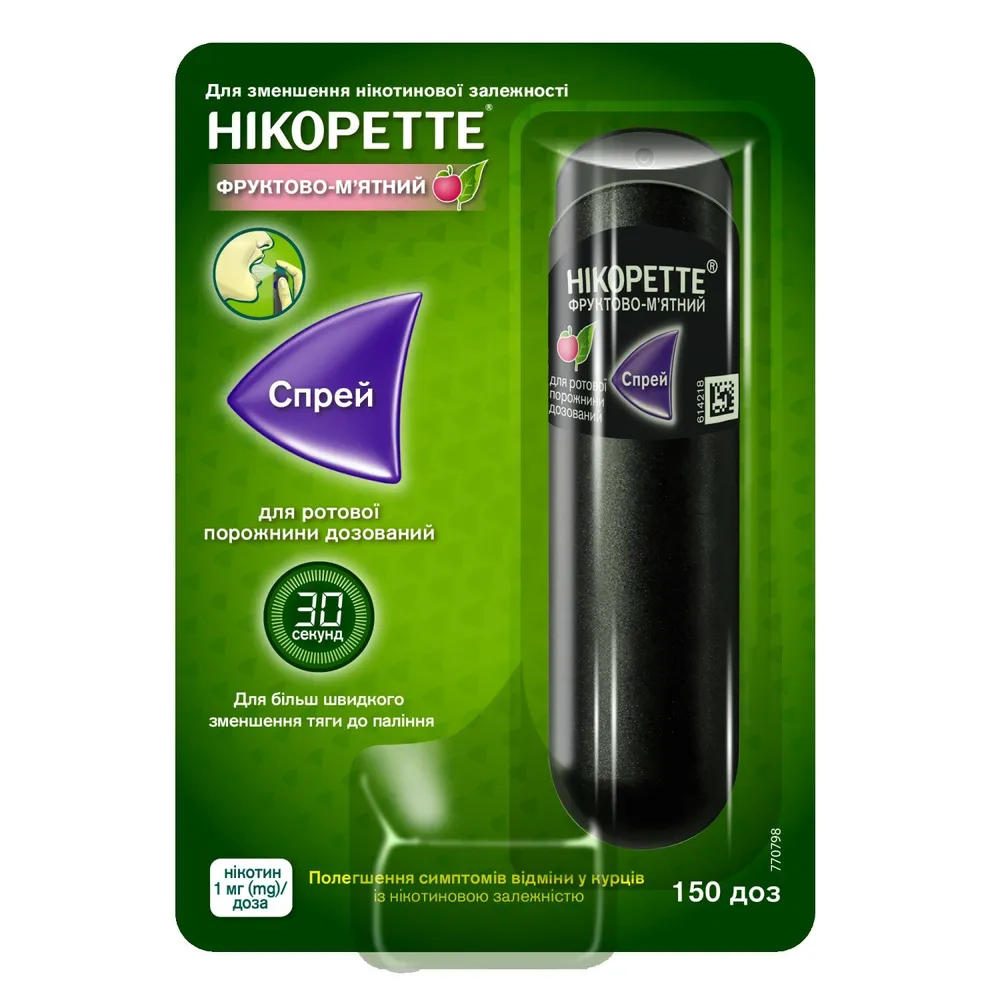
Table of Contents
INSTRUCTIONS FOR MEDICAL USE OF THE MEDICINAL PRODUCT NICORETTE® FRUIT-MINT (NICORETTE® FRUIT-MINT)
Composition:
Active substance: nicotine;
1 ml of solution contains 13.6 mg of nicotine; one spray delivers 1 mg of nicotine in 0.07 ml of solution;
Excipients: propylene glycol (E 1520), anhydrous ethanol, tromethamine, poloxamer 407, glycerol, sodium hydrogen carbonate, levomenthol, red fruit flavor 911441, flavor Cooler 2 SN046680, sucralose, potassium acesulfame, hydrochloric acid (10%), purified water.
Pharmaceutical form. Metered oral spray.
Main physicochemical properties: solution from clear to slightly opalescent, colorless to yellow.
Pharmacotherapeutic group. Nervous system. Other drugs for the nervous system. Drugs used in dependence. Drugs used in nicotine dependence. Nicotine. ATC code N07B A01.
Pharmacological Properties
Pharmacodynamics
Mechanism of Action
Relief of withdrawal symptoms in smokers with nicotine dependence.
Nicotine is an agonist of nicotinic receptors in the peripheral and central nervous systems and affects the central nervous system as well as the heart and blood vessels.
Abrupt cessation of regular tobacco use leads to the development of a characteristic withdrawal syndrome, including craving for smoking (intense desire to smoke), as described in the section "Adverse Reactions". According to clinical studies, nicotine replacement therapy products can help smokers quit or reduce tobacco consumption, as these medicinal products alleviate withdrawal symptoms.
Compared to nicotine gums or lozenges, nicotine absorption from the spray is faster (see section "Pharmacokinetics"). Based on previous data on nicotine replacement therapy products, the use of the spray facilitates a more rapid reduction in smoking craving and relief of other symptoms, as confirmed by study data.
Reduction of smoking craving
Compared to nicotine chewing gums and lozenges, nicotine in the form of a spray is absorbed more rapidly (see "Absorption").
In a single-dose study involving 200 healthy smokers, it was demonstrated that two 1 mg sprays significantly reduced the desire to smoke starting from 1 minute (60 seconds) after administration, compared to sucking on 4 mg lozenges, during the first 1, 3, 5, and 10 minutes. The observed time to a 25% and 50% reduction in the desire to smoke, compared to baseline, was three times shorter with two 1 mg sprays than with 4 mg lozenges (25% reduction: 1.19 vs. 3.40 minutes; 50% reduction: 3.49 vs. 9.20 minutes).
It has not been established that the formulation properties of the spray confer any difference in smoking cessation rates.
Another open-label, controlled, single-dose study involving 61 healthy smokers showed that two 1 mg doses of nicotine spray significantly reduced smoking craving within 30 seconds after administration compared to a reference product. A separate analysis of the subgroup of participants who rated their craving as strong before treatment initiation was performed. In the trial participants, a significant difference between the two treatment methods was also observed as early as 30 seconds after administration. Furthermore, the percentage of participants who achieved a 25%, 50%, 75%, and 90% reduction in craving within the 2-hour period was 91%, 78%, 53%, and 35%, respectively.
Clinical Efficacy
Overcoming Tobacco Dependence
A total of 479 smokers motivated to quit smoking participated in a 52-week, randomized, double-blind, placebo-controlled, multicenter study. During the first 6 weeks, patients received full-dose treatment, which was tapered over the following 6 weeks. As-needed use of the study product was allowed up to week 24. The study aimed to evaluate the efficacy of Nicorette® spray in achieving sustained abstinence from smoking from week 2 to week 6, week 24, and week 52, compared to placebo.
At week 52, the efficacy rate in the group of participants who used Nicorette® spray to quit smoking was 13.8%, compared to 5.6% in the placebo group. The risk ratio for smokers who stopped smoking after 52 weeks of treatment was 2.48 compared to placebo (p = 0.007), see Table 1. Thus, the chance of participants using Nicorette® spray remaining abstinent from smoking after 12 months was 2.5 times higher than in the placebo group. However, treatment longer than 3 months is not recommended.
Table 1
Sustained abstinence from smoking from week 2, confirmed by CO (carbon monoxide) levels. Data obtained from a phase III study involving 479 patients
| Time period |
Nicorette® Spray (n = 318) |
Placebo Spray (n = 161) |
p-value |
Odds Ratio [95 % CI] |
Relative Risk [95 % CI] |
| Week 6 |
26.1 % (n = 83) |
16.1 % (n = 26) |
0.014 |
1.83 [1.12; 3.00] |
1.62 [1.09; 2.41] |
| Week 24 |
15.7 % (n = 50) |
6.8 % (n = 11) |
0.006 |
2.54 [1.28; 5.04] |
2.30 [1.23; 4.30] |
| Week 52 |
13.8 % (n = 44) |
5.6 % (n = 9) |
0.007 |
2.71 [1.29; 5.71] |
2.48 [1.24; 4.94] |
Another safety and efficacy study included 1198 smokers motivated to quit smoking. This was a randomized, multicenter, placebo-controlled, double-blind study lasting 26 weeks without supportive behavioral psychotherapy. During the first 6 weeks, participants received treatment with full therapeutic doses, after which the dose size was gradually reduced in several steps over the following 6 weeks. Occasional use of the medication was permitted until the end of week 24. The primary objective of the study was to evaluate the efficacy of Nicorette® spray in achieving sustained smoking cessation from week 2 to week 6 inclusive, compared to the placebo group, confirmed by carbon monoxide (CO) measurements. With 6-month supportive therapy using Nicorette® spray, the probability of successful smoking cessation was twice as high (relative risk – 2.00, p = 0.021) compared to the placebo group (5.0% vs. 2.5%).
Pharmacokinetics
Nicotine is a dibasic compound with a pKa1 value of approximately 3 and a pKa2 value of approximately 8. Nicotine is weakly basic, and its penetration through cell membranes depends on pH. Depending on the degree of ionization, nicotine is both water- and lipid-soluble. Nicotine has two stereoisomers: (S) and (R) forms. However, only (S)-nicotine is biologically active.
Pharmacokinetic studies of Nicorette® spray were conducted in adult smokers.
Absorption
When administered as a spray, the nicotine dose is released immediately, resulting in rapid absorption from the spray. Studies have demonstrated that nicotine absorption occurred as early as 2 minutes after administration of Nicorette® spray, corresponding to the first measurement point.
Maximum concentration of 5.3 ng/mL was reached within 13 minutes after administration of a 2 mg dose. When comparing the area under the concentration-time curve (AUC) of nicotine during the first 10 minutes after administration, the values for the 1 mg and 2 mg spray doses exceeded those for 4 mg nicotine gum and 4 mg nicotine lozenges (0.48 and 0.64 hr × ng/mL compared to 0.33 and 0.33 hr × ng/mL, respectively).
AUC∞ data indicate that the bioavailability of nicotine in spray form is similar to or slightly higher than that of nicotine gum and lozenges. AUC∞ after administration of the 2 mg spray was 14.0 hr × ng/mL compared to 23.0 hr × ng/mL and 26.7 hr × ng/mL after administration of 4 mg nicotine gum and 4 mg nicotine lozenge, respectively.
The average steady-state plasma nicotine concentration after administration of the maximum dose (i.e., 2 sprays of 1 mg each every 30 minutes) is approximately 28.8 ng/mL compared to 23.3 ng/mL with 4 mg nicotine gum (1 piece per hour) and 25.5 ng/mL with 4 mg nicotine lozenge (1 lozenge per hour).
Distribution
The volume of distribution after intravenous administration of nicotine is 2–3 L/kg. Protein binding of nicotine to plasma proteins is less than 5%. Therefore, changes in nicotine binding due to concomitant medications or altered plasma protein levels in certain diseases are unlikely to significantly affect nicotine pharmacokinetics.
In addition to crossing the placental barrier, nicotine penetrates the blood-brain barrier and is excreted into breast milk.
Metabolism
Pharmacokinetic study results indicate that the metabolism and elimination of nicotine do not depend on its pharmaceutical form. Therefore, results from intravenous nicotine administration studies can be used to describe distribution, metabolism, transformation, and elimination.
Nicotine is primarily metabolized in the liver. Nicotine is also minimally metabolized in the lungs and brain. The enzyme CYP2A6 is primarily involved in nicotine metabolism. Seventeen different nicotine metabolites have been identified, each less potent than the parent compound. The main metabolite in plasma, cotinine, reaches concentrations 10 times higher than nicotine and is eliminated with a half-life of 14 to 20 hours.
Elimination
The elimination half-life is 2–3 hours. The mean total plasma clearance of nicotine is 66.6–90.0 L/h.
Approximately 10–15% of nicotine is typically excreted unchanged in urine. However, with high filtration rates and acidified urine (pH below 5), up to 23% may be excreted. The most important urinary metabolites of nicotine are cotinine and trans-3-hydroxycotinine. Only a small percentage of cotinine (10–12% of dose) is excreted unchanged in urine. Cotinine is further metabolized to polar, water-soluble compounds and can be detected in urine (28–37% of dose), particularly in its hydroxylated form (trans-3-hydroxycotinine). There are no significant differences in nicotine pharmacokinetics between men and women.
Linearity/Non-linearity
After administration of single doses of 1, 2, 3, and 4 sprays of 1 mg, only minor deviations from linearity were observed in the AUC∞ and Cmax dose-dependence.
Pharmacokinetics in Special Patient Populations
Renal Impairment
Severe renal impairment is expected to reduce the clearance of nicotine and its metabolites. In study participants with severe renal impairment, nicotine clearance was reduced by 50%. Increased nicotine concentrations have been observed in smokers undergoing dialysis.
Hepatic Impairment
Nicotine clearance in smokers with liver cirrhosis and mild hepatic dysfunction (Child-Pugh score of 5) is unchanged, but is reduced in patients with severe hepatic insufficiency (Child-Pugh score of 7) (total clearance reduced by an average of 40–50%). Pharmacokinetic data in smokers with a Child-Pugh score >7 are lacking.
Elderly Patients
A slight reduction in total nicotine clearance has been demonstrated in elderly patients. However, these variations are not considered clinically significant and do not require general dose adjustment based on age.
Preclinical Safety Data
Preclinical safety data for Nicorette® spray are not available. However, the toxicity of nicotine as a component of tobacco is well known. Typical symptoms of acute poisoning include weak and irregular pulse, dyspnea, and generalized seizures.
Mutagenicity/Carcinogenicity
Genotoxicity studies of nicotine in both in vitro and in vivo tests have yielded conflicting results. Available data on the carcinogenic potential of nicotine are also inconclusive. Although analysis of long-term carcinogenicity studies of nicotine or cotinine, the most important metabolite of nicotine, showed that nicotine does not have significant or relevant carcinogenic activity, more recent studies suggest that nicotine may promote the development of certain tumors. The established carcinogenicity of tobacco smoke is primarily associated with substances formed during tobacco combustion. Nicorette® Fruit-Mint spray does not contain any of these substances.
Reproductive Toxicity
Reproductive toxicity studies of nicotine in various animal species have demonstrated non-specific fetal growth retardation. In rats, impaired fertility, prolonged gestation, and behavioral disorders in offspring were observed. In mice, skeletal defects in the limbs of offspring were observed following administration of very high doses. Nicotine crosses the placental barrier and is excreted in breast milk.
Clinical Characteristics
Indications
Nicorette® Fruit-Mint, oral spray, metered, is indicated to reduce nicotine dependence in smokers by minimizing withdrawal symptoms, with the aim of achieving smoking cessation.
Contraindications
This medicinal product is contraindicated in non-smokers, children under 12 years of age, and individuals under 18 years of age without medical prescription.
Hypersensitivity to nicotine or to any of the excipients contained in this medicinal product.
Interaction with other medicinal products and other forms of interaction
There are no known clinically significant interactions between nicotine replacement therapy and other medications. However, nicotine may potentiate the hemodynamic effects of adenosine, such as increased blood pressure and heart rate, and may enhance the pain response (chest pain of angina type) caused by adenosine administration.
For further information regarding changes in the metabolism of certain medicinal products after nicotine cessation, see section "Special Instructions for Use".
Effect of Nicorette® Fruit-Mint, oral spray, metered, on the action of other medicinal products
Smoking cessation. Smoking cessation, with or without partial nicotine replacement, may alter the response to concomitant medication. Polycyclic aromatic hydrocarbons present in tobacco smoke induce the metabolism of drugs metabolized via CYP1A2. Smoking cessation may lead to reduced metabolism and consequently increased plasma concentrations of these drugs.
This may be clinically relevant for certain drugs with a narrow therapeutic index, such as theophylline, tacrine, clozapine, and ropinirole.
Special precautions for use
The physician should weigh the risks and benefits for patients with the conditions listed below.
Cardiovascular disorders. Smokers with recently experienced myocardial infarction (˂ 4 weeks), unstable or progressive angina, including Prinzmetal's angina, severe cardiac arrhythmias, uncontrolled arterial hypertension, or recent stroke should be encouraged to quit smoking without pharmacological aid (e.g. through counseling). If this approach fails, use of Nicorette® Fruit-Mint Spray may be considered. However, due to limited safety data in these patients, Nicorette® Fruit-Mint Spray should be used only under close medical supervision.
Epilepsy and seizures. Patients with epilepsy or a history of seizures should exercise caution when using nicotine replacement therapy. Tobacco smoke contains substances, including nicotine, that affect brain receptors. Transitioning from smoking to nicotine products alters the intake of these substances, which may lower the seizure threshold.
Renal and hepatic impairment. The benefit-risk ratio of treatment with Nicorette® Fruit-Mint Spray should be carefully evaluated in patients with moderate to severe hepatic impairment or severe renal impairment, as reduced clearance of nicotine or its metabolites may occur, increasing the risk of adverse effects.
Gastrointestinal disorders. Nicotine may exacerbate symptoms in patients with esophagitis, gastric or peptic ulcers, and chronic throat conditions. Therefore, Nicorette® Fruit-Mint Spray should be used with caution in such patients.
Pheochromocytoma and uncontrolled hyperthyroidism. The use of the product in patients with uncontrolled hyperthyroidism or pheochromocytoma should be approached with caution, as nicotine may trigger catecholamine release.
Diabetes mellitus. Patients with diabetes mellitus should be monitored more closely for blood glucose levels than usual when quitting smoking and starting nicotine replacement therapy, as reduced nicotine-induced catecholamine release may affect carbohydrate metabolism. It is important that patients engage in other activities to prevent relapse to smoking.
At the beginning of treatment, patients should be encouraged to stop smoking completely. Patients who continue to smoke at the same level while using Nicorette® Fruit-Mint Spray are at risk of adverse effects due to higher nicotine levels than those achieved through regular smoking.
Excipients. The spray contains a small amount of ethanol (alcohol), less than 100 mg per spray. It also contains propylene glycol (E 1520), which may cause symptoms similar to those experienced after alcohol consumption.
This medicinal product contains 0.1 mg/puff of potassium. Caution is advised when administering to patients with impaired renal function or those on a potassium-controlled diet.
The spray contains 1.1 mg/puff of sodium. Caution is advised when administering to patients on a sodium-controlled diet.
Patients should be cautious to avoid contact of the product with eyes and respiratory tract (i.e., do not inhale it), as it may contain inhalable particles.
Potential for dependence. Dependence on nicotine products may occur. However, it is rare and less harmful to health than nicotine dependence from smoking, and is easier to overcome.
Special warning regarding children. Nicotine is a highly active substance. Even a dose well tolerated by adults during treatment with Nicorette® Fruit-Mint Spray may cause life-threatening toxicity in children (see section "Overdose"). Therefore, Nicorette® Fruit-Mint Spray must always be stored and disposed of in places inaccessible to children.
Use during pregnancy or breastfeeding
Women of childbearing potential / contraception in men and women
Unlike the well-known adverse effects of smoking on fertility and pregnancy, the side effects of smoking cessation treatment are unknown. For women planning pregnancy, it is safer to abstain from both smoking and nicotine replacement therapy.
Fertility
In women, tobacco use delays conception, reduces in vitro fertilization success rates, and significantly increases the risk of infertility. In men, tobacco use leads to reduced sperm production, increased oxidative stress, and DNA damage. Spermatozoa from smokers have reduced fertilizing capacity.
In animal studies, nicotine has shown adverse effects on fertility (see "Preclinical safety data"). The extent to which nicotine causes such effects in humans is unknown.
Pregnancy
Nicotine in any form, whether in cigarettes or as replacement therapy with Nicorette® Fruit-Mint Spray, should not be used during pregnancy.
There is limited information on the effects of Nicorette® Fruit-Mint Spray on fetal development.
Nicotine crosses the placenta and affects fetal respiratory movements and circulation. The circulatory effect is dose-dependent. Nicotine, including when used as replacement therapy, may lead to reduced birth weight and increased risk of pregnancy loss and perinatal death. Experimental studies have demonstrated the toxic effects of nicotine on reproductive function in animals (see "Preclinical safety data").
Early cessation of nicotine use is an effective individual measure to improve the health of a pregnant smoker and her child.
Whenever possible, pregnant smokers should undergo smoking cessation treatment without pharmacological nicotine replacement therapy. Use of Nicorette® Fruit-Mint Spray during pregnancy may be considered by a physician only if the likelihood of successful smoking cessation justifies the risk of nicotine exposure, and otherwise the patient would continue to smoke.
Breastfeeding
Nicotine in any form, whether in cigarettes or as replacement therapy with Nicorette® Fruit-Mint Spray, should not be used during breastfeeding.
The use of Nicorette® Fruit-Mint Spray during breastfeeding has not been studied. Nicotine passes into breast milk in small amounts and may have harmful effects on the infant, even when the spray is used at therapeutic doses. Therefore, use of Nicorette® Fruit-Mint Spray should be avoided during breastfeeding. If smoking cessation is not achieved, use of Nicorette® Fruit-Mint Spray should only occur after consultation with a physician. If nicotine replacement therapy is necessary during breastfeeding, Nicorette® Fruit-Mint Spray should be used immediately after breastfeeding, with the longest possible interval (at least 2 hours) between administration and the next breastfeeding session.
Effect on ability to drive and use machines
Since Nicorette® Fruit-Mint Spray may cause adverse effects such as headache and nausea, it may affect reaction speed and the ability to work with tools and machinery or to drive vehicles.
Method of Administration and Dosage
The patient must completely stop smoking during treatment with Nicorette® Fruit-Mint Spray. It is essential to have strong motivation to quit smoking.
Instructions for Use
Prepare the spray for use, then hold the spray nozzle as close as possible to the open mouth. Press the top of the dispenser to administer one spray into the mouth. Avoid contact of the spray with the lips. Do not inhale during spraying to prevent the spray and inhalation particles from entering the respiratory tract. For optimal effect, do not swallow for several seconds after spraying. If the spray gets into the eyes, rinse thoroughly with water. If symptoms of nicotine overdose occur, nicotine use should be temporarily discontinued. If symptoms of nicotine overdose persist, reduce nicotine intake by decreasing the frequency of administration.
Dosage and Duration of Use
Adults
Nicorette® Fruit-Mint Spray should be used each time the smoker would normally have smoked a cigarette or whenever a craving to smoke occurs.
Dosage is individual and determined by the amount of nicotine needed to reduce withdrawal symptoms in a particular patient.
Below is the recommended schedule for spray use during complete smoking cessation (Step I) and during gradual reduction of nicotine dose (Steps II and III). Up to 4 sprays per hour may be used. Do not use more than 2 sprays at once or more than 64 sprays within 24 hours (4 sprays per hour for 16 hours).
Step I (Weeks 1–6)
Administer 1 or 2 sprays at times when cigarettes would normally have been smoked, or each time a craving occurs. If the craving does not subside within a few minutes after one spray, administer a second spray. If 2 sprays are needed, they may be used consecutively next time. Most smokers require 1–2 sprays every 30–60 minutes.
Step II (Weeks 7–9)
During this period, begin reducing the number of daily sprays. By the end of week 9, the daily number of sprays should be HALF the average daily number used during Step I.
Step III (Weeks 10–12)
Continue reducing the number of daily sprays so that by week 12, no more than 4 sprays per day are used. When the number of sprays is reduced to 2–4 per day, discontinue use of the spray completely.
Example. If an average of 15 cigarettes per day are smoked, use 1 or 2 sprays at least 15 times daily.
To prevent relapse to smoking, use the spray in situations when a strong urge to smoke occurs. In such situations, first use one spray; if the first spray does not help within a few minutes, use a second spray. Do not use more than four sprays per day during this period.
Prolonged regular use beyond 3 months is not recommended. Some former smokers may require longer treatment to prevent relapse to smoking. Unused spray should be kept for use in case of sudden cravings.
Children
Individuals under 18 years of age should not use Nicorette® Fruit-Mint Spray without medical advice. There is insufficient data from controlled studies supporting the use of Nicorette® Fruit-Mint Spray in individuals under 18 years of age (see section "Contraindications").
Overdose
Overdose may occur if the patient has very low tolerance to nicotine at the beginning of treatment or simultaneously receives nicotine from other sources (e.g., continued smoking). Acute and chronic toxicity of nicotine in humans primarily depends on the method and route of administration. It is known that nicotine dependence (e.g., in smokers) leads to increased tolerance compared to non-smokers. The acute lethal dose of nicotine in children (after oral absorption from cigarettes) is 40–60 mg, and 0.8 to 1.0 mg/kg in non-smoking adults.
Signs and Symptoms
Symptoms of overdose are the same as those of acute nicotine poisoning. These include nausea, vomiting, increased salivation, stomach pain, diarrhea, sweating, headache, dizziness, hearing disturbances, and marked weakness. In the most severe cases, hypotension, weak irregular pulse, dyspnea, exhaustion, circulatory collapse, and generalized seizures may occur.
Nicotine doses normally tolerated by adult smokers may cause severe, sometimes fatal, nicotine poisoning symptoms in children. Suspected nicotine poisoning in a child is a medical emergency requiring immediate treatment.
Treatment
In cases of severe intoxication, the following measures are recommended: immediate discontinuation of nicotine intake and symptomatic treatment (maintenance of normal body temperature, artificial ventilation in case of respiratory failure, and standard treatment of arterial hypotension or cardiovascular collapse as needed). If nicotine is ingested, activated charcoal reduces its absorption in the gastrointestinal tract.
Adverse Reactions
Effects of nicotine cessation
Users of tobacco products who stop smoking by any method should expect to experience nicotine withdrawal syndrome due to discontinuation of nicotine use. Nicotine withdrawal syndrome includes emotional and cognitive effects such as dysphoria or depressed mood, insomnia, irritability, frustration or anger, anxiety, difficulty concentrating, and restlessness or impatience. Physical effects may also occur, such as decreased heart rate, increased appetite or weight gain, dizziness or presyncopal symptoms, cough, constipation, oral ulcers, gum bleeding, and nasopharyngitis. In addition, craving for nicotine with an irresistible urge to smoke is a clinically significant symptom and an important additional manifestation of nicotine withdrawal syndrome after smoking cessation.
Adverse effects of the medicine NICORETTE® Fruit-Mint, spray
Overall, the medicine NICORETTE® Fruit-Mint, spray, may cause adverse effects similar to those associated with nicotine delivered by other routes. These adverse effects are predominantly dose-dependent. Local adverse effects are similar to those observed with other oral forms of the product. During the first few days of treatment, irritation of the oral cavity and throat may occur, and hiccups are the most commonly reported event. Treatment may also increase the frequency of aphthous ulcers. With prolonged use, tolerance often develops.
Daily data collection from study participants demonstrated that the most frequently observed adverse events were recorded during the first 2–3 weeks after initiation of treatment, after which their frequency decreased. Allergic reactions (including symptoms of anaphylactic shock) occur rarely with the use of NICORETTE® Fruit-Mint, spray.
The frequency of adverse effects was determined based on a meta-analysis of clinical trials and adverse reactions observed during the post-marketing period. The frequency of adverse effects is defined as follows: very common (≥ 1/10), common (≥ 1/100, < 1/10), uncommon (≥ 1/1000, < 1/100), rare (≥ 1/10000, < 1/1000), very rare (<1/10000); frequency not known (cannot be estimated based on available data).
Table 2
Adverse reactions that may occur during the use of NICORETTE® Fruit-Mint, spray
| Immune system disorders |
|
| Common |
Hypersensitivity1 |
| Frequency unknown |
Anaphylactic reactions1 |
| Psychiatric disorders |
|
| Uncommon |
Sleep disturbances1 |
| Nervous system disorders |
|
| Very common |
Headache1,2 (23.2%), dysgeusia (12.2%) |
| Common |
Paraesthesia1 |
| Frequency unknown |
Convulsions1 |
| Eye disorders |
|
| Uncommon |
Increased lacrimation |
| Frequency unknown |
Blurred vision |
| Cardiac disorders |
|
| Uncommon |
Palpitations1, tachycardia1 |
| Vascular disorders |
|
| Uncommon |
Flushing1, arterial hypertension1 |
| Respiratory, thoracic and mediastinal disorders |
|
| Very common |
Hiccups (49.4%), cough (10.5%), throat irritation (13.5%) |
| Common |
Sensation of throat tightness |
| Uncommon |
Dysphonia, dyspnea1, rhinorrhea, bronchospasm, sneezing, nasal congestion, oropharyngeal pain |
| Gastrointestinal disorders |
|
| Very common |
Nausea1 (29.8%), dyspepsia (26.0%), pain and paraesthesia of oral soft tissues (37.3%), stomatitis (25.4%), increased salivation (22.3%), dryness of mouth and/or throat (12.7%) |
| Common |
Vomiting1, flatulence, abdominal pain, diarrhea3 |
| Uncommon |
Glossitis, belching, sloughing of oral mucosa (formation of blisters and peeling) |
| Rare |
Dysphagia, nausea, oral hypoaesthesia3 |
| Frequency unknown |
Dryness of throat, gastrointestinal symptoms1, lip soreness |
| Skin and subcutaneous tissue disorders |
|
| Uncommon |
Hyperhidrosis1, pruritus1, rash1, urticaria1 |
| Frequency unknown |
Angioedema1, erythema1 |
| General disorders and administration site conditions |
|
| Very common |
Burning sensation of lips (13.2%) |
| Common |
Increased fatigue1, chest pain and discomfort1 |
| Uncommon |
Asthenia1, malaise1 |
1 Systemic effects.
2 Although the frequency in the active treatment group is lower than in the placebo group, the frequency when using a specific dosage form, for which the term predominantly used to denote the adverse reaction is defined as a systemic adverse reaction, was higher in the active treatment group than in the placebo group.
3 The reported frequency is the same or lower than with placebo.
Reporting of adverse reactions
Reporting adverse reactions after marketing authorization of the medicinal product is of great importance. It enables ongoing monitoring of the benefit-risk balance of the medicinal product. Healthcare professionals and patients or their legal representatives should report all suspected adverse reactions and lack of efficacy of the medicinal product via the Automated Pharmacovigilance Information System at the following link: https://aisf.dec.gov.ua.
Shelf life. 24 months.
Storage conditions. Store at a temperature not exceeding 25 °C in a place inaccessible to children.
Packaging
150 doses of spray in a 15 ml PET bottle. The PET bottle with a mechanical atomizer and protective cap is placed in a polypropylene plastic case. One or two plastic cases with the instruction for medical use are packed in a plastic blister pack with a cardboard backing.
Availability category. Over-the-counter.
Manufacturer
McNeil AB / McNeil AB
Manufacturer's location and address of its place of business
Norrbroplatsen 2, Helsingborg, 25442, Sweden / Norrbroplatsen 2, Helsingborg, 25442, Sweden
Marketing Authorization Holder
McNeil AB / McNeil AB
Address of the Marketing Authorization Holder
Norrbroplatsen 2, Helsingborg, 25109, Sweden / Norrbroplatsen 2, Helsingborg, 25109, Sweden
Representative of the Marketing Authorization Holder
Johnson & Johnson Ukraine LLC.
Address of the representative of the Marketing Authorization Holder
32/2 Knyaziv Ostrozkykh St., Kyiv, 01010, Ukraine.
If adverse reactions occur, please contact us at:
+38 (044) 498 0888
+38 (044) 498 7392