Nifuroxazide
Ukraine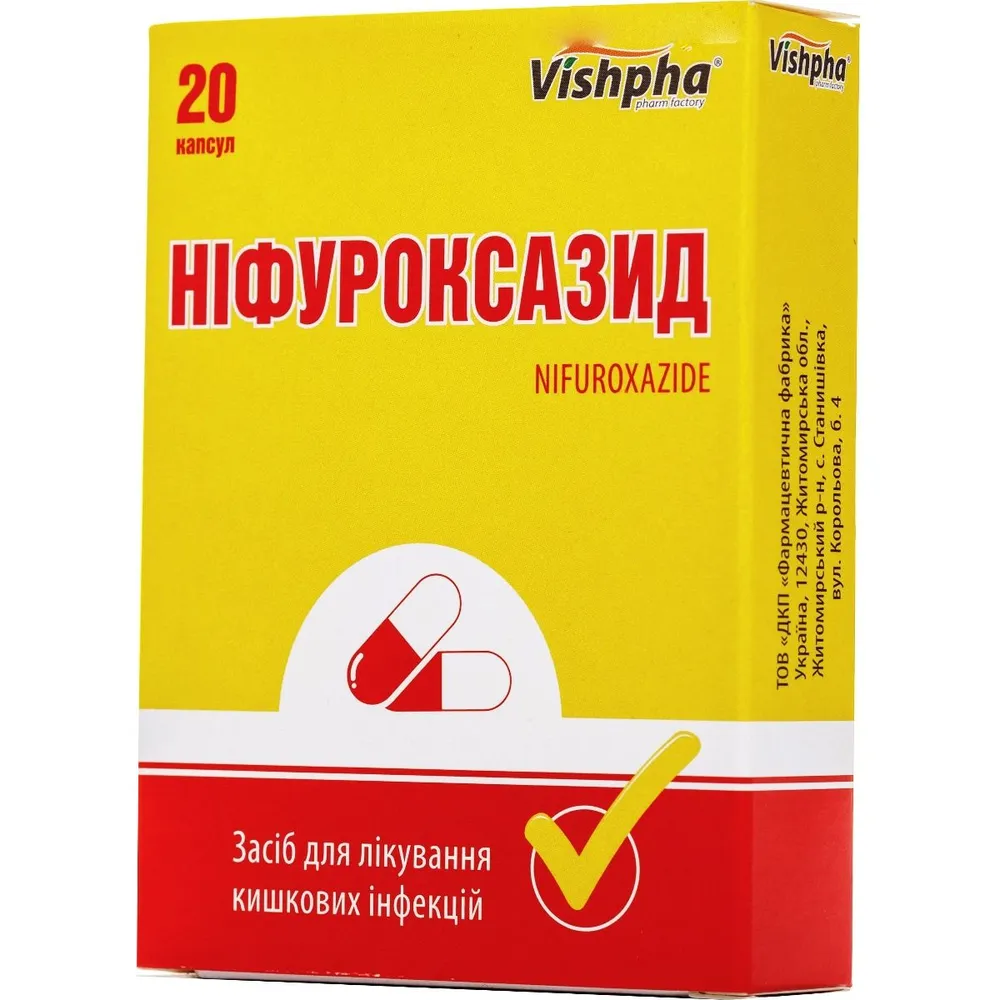
Table of Contents
INSTRUCTIONS FOR MEDICAL USE OF THE MEDICINAL PRODUCT NIFUROXAZIDE (NIFUROXAZIDE)
Composition:
Active substance: nifuroxazide;
1 capsule contains nifuroxazide – 200 mg;
Excipients: microcrystalline cellulose, maize starch, sucrose, magnesium stearate;
gelatin capsule: gelatin; titanium dioxide (E171), iron oxide red (E172), tartrazine (E102).
Pharmaceutical form. Capsules.
Main physicochemical properties: hard gelatin capsules with a yellow body and reddish-brown cap. The contents of the capsules – bright yellow powder.
Pharmacotherapeutic group. Antimicrobial agents used in intestinal infections. Nifuroxazide. ATC code A07AX03.
Pharmacological Properties
Pharmacodynamics
Nifuroxazide is an antimicrobial agent, a derivative of nitrofuran. Its mechanism of action is not fully understood. The antimicrobial and antiparasitic properties of nifuroxazide are possibly due to the presence of an amino group. Local activity and lack of penetration into organs and body tissues determine the uniqueness of nifuroxazide compared to other nitrofuran derivatives, as this antidiarrheal agent lacks systemic effects. It is effective against Gram-positive and Gram-negative bacteria: Streptococcus pyogenes, Staphylococcus aureus, Escherichia coli, Salmonella, Shigella.
Pharmacokinetics
After oral administration, nifuroxazide is partially absorbed (10–20%) from the gastrointestinal tract and is largely metabolized, with the main circulating components in the blood being metabolites.
Nifuroxazide and its metabolites are excreted in feces. The rate of metabolite elimination depends on the amount of drug administered and gastrointestinal motility. Overall, elimination of nifuroxazide is slow, and it remains in the gastrointestinal tract for a prolonged period.
At therapeutic doses, nifuroxazide practically does not suppress normal intestinal microflora, does not induce the emergence of resistant microbial forms, and does not promote the development of cross-resistance of bacteria to other antibacterial agents. Therapeutic effect is achieved within the first hours of treatment.
Preclinical Safety Data
Nifuroxazide demonstrates a potential mutagenic effect.
The carcinogenic potential of nifuroxazide was evaluated in mice (50/sex/group) and rats (52/sex/group) that received nifuroxazide in the diet for 2 years at doses of 0, 200, 600, or 1800 mg/kg/day. Despite its mutagenic properties, carcinogenicity of nifuroxazide was not demonstrated in either mice or rats.
Studies with nifuroxazide were conducted over two years in mice and rats at doses of 5400 mg/m² and 10800 mg/m², respectively, based on body surface area normalization. These doses exceeded the maximum human dose of 1800 mg (493 mg/m² for a 60 kg patient) by 11 and 22 times, respectively.
Clinical characteristics.
Indications.
Acute infectious diarrhea.
Contraindications.
Hypersensitivity to nifuroxazide, other 5-nitrofuran derivatives, or any of the excipients of the medicinal product.
Children under 6 years of age. For treatment of children under 6 years of age, nifuroxazide should be administered as a suspension.
Interaction with other medicinal products and other forms of interaction.
Nifuroxazide may be used in combination with agents commonly used in the treatment of diarrhea: rehydration solutions, antibiotics, chemotherapeutic agents, spasmolytics, and analgesics.
Nifuroxazide should not be used concomitantly with adsorbents, alcohol-containing preparations, agents that may cause disulfiram-like reactions, and agents that depress the central nervous system.
Special precautions for use.
Treatment with rifaximin does not exclude dietary regimen and rehydration. If diarrhea does not stop after 3 days of treatment, dosage should be reviewed and a decision on rehydration therapy should be made. If necessary, concomitant rehydration therapy should be administered depending on patient's age, condition, and severity of diarrhea.
In case of prescription of oral or intravenous rehydration, instructions for dilution and use of appropriate solutions must be strictly followed. If such rehydration is not required, fluid loss should be compensated by drinking large amounts of fluids containing salt and sugar (based on average daily requirement of 2 liters of water).
Dietary recommendations during diarrhea should be observed: avoid consumption of fresh vegetables and fruits, spicy food, frozen products and beverages. Rice should be preferred. Consumption of dairy products should be decided on a case-by-case basis.
If diarrhea is accompanied by clinical signs indicating severe disease (worsening of general condition, fever, symptoms of intoxication), rifaximin should be prescribed together with antibacterial agents used for treatment of intestinal infections, as the drug is not absorbed in the gastrointestinal tract and does not enter systemic circulation. The medication should not be prescribed as monotherapy for intestinal infections complicated by sepsis.
Rifaximin contains sucrose, which should be taken into account when prescribing to patients with diabetes mellitus. The drug is not recommended for patients with hereditary sucrose intolerance or fructose malabsorption.
The gelatin capsule contains the coloring agent tartrazine (E 102), which may cause allergic reactions.
Alcohol consumption is strictly prohibited during treatment due to the risk of developing a disulfiram-like reaction, manifested by exacerbation of diarrhea, vomiting, abdominal pain, facial flushing, hyperemia, sensation of heat in the face and upper body, tinnitus, breathing difficulty, and tachycardia.
Use during pregnancy or breastfeeding.
Pregnancy
Clinical data on the use of rifaximin in pregnant women are limited. Animal studies on reproductive toxicity are insufficient. Rifaximin exhibits potential mutagenic activity. Therefore, rifaximin is not recommended during pregnancy and should not be prescribed to women of childbearing potential who are not using effective contraception.
Lactation
It is unknown whether rifaximin or its metabolites are excreted in breast milk. Since rifaximin has low bioavailability (approximately 10–20% of the dose is absorbed from the gastrointestinal tract), its concentration in milk is likely to be low. However, an effect on the gut microbiome of breastfed infants cannot be excluded. Due to the lack of clinical experience with rifaximin-containing medications during breastfeeding, their use is not recommended.
Fertility
There is insufficient data from animal studies regarding the effect of rifaximin on fertility.
Ability to influence reaction rate while driving or operating machinery.
No effect.
Dosage and Administration
Take orally, regardless of food intake.
Adults and children aged 15 years and older: 200 mg (1 capsule of 200 mg) 4 times daily. Maximum daily dose of nifuroxazide is 800 mg.
Children aged 6 years and older: 1 capsule of 200 mg 3–4 times daily. Daily dose of nifuroxazide — 600–800 mg.
Duration of treatment with Nifuroxazide 200 mg should not exceed 3 days.
Children.
For treatment of children under 6 years of age, Nifuroxazide suspension should be prescribed.
Overdose.
Cases of overdose have not been reported. In case of overdose, gastric lavage and symptomatic treatment are recommended.
Adverse reactions.
Immune system side effects: allergic reactions are possible, including itching, skin rashes, urticaria, angioedema (Quincke's edema), anaphylactic shock. If an allergic reaction occurs, the drug must be discontinued. The patient should thereafter avoid taking nifuroxazide and other nitrofuran derivatives.
Gastrointestinal side effects: temporary abdominal pain, nausea, vomiting, and increased diarrhea are possible.
Shelf life.
3 years.
Storage conditions.
Store in the original packaging at a temperature not exceeding 25 °C.
Keep out of reach of children.
Packaging.
10 capsules per blister pack, 1 or 2 blisters per carton.
Prescription status.
Prescription only.
Manufacturer.
LLC "DKP "Pharmaceutical Factory".
Manufacturer's address and place of business.
4, Korolyova St., Stanishevska village, Zhytomyr district, Zhytomyr region, 12430, Ukraine.