Neuroplant
Ukraine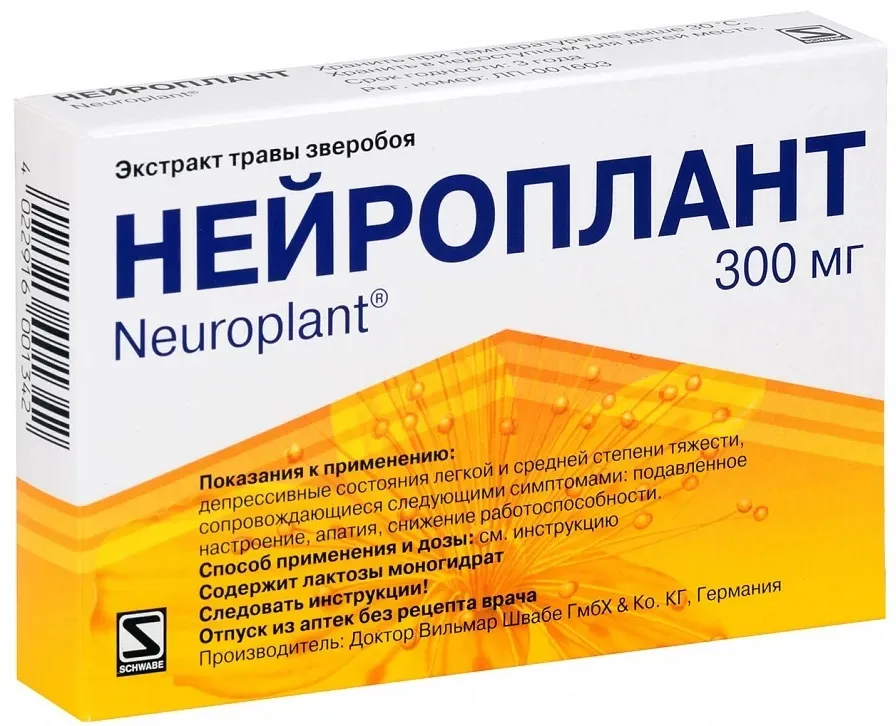
Table of Contents
INSTRUCTION FOR MEDICAL USE OF THE MEDICINAL PRODUCT NEUROPLANT
Composition:
Active substance: dry extract of St. John's wort herb (Hypericum perforatum L.)
One film-coated tablet contains 300 mg of dry extract of St. John's wort herb (Hypericum perforatum L.) (3−7:1) [extractant: methanol 80% (v/v)];
Excipients: ascorbic acid, microcrystalline cellulose, sodium croscarmellose, hypromellose, lactose monohydrate, macrogol 4000, magnesium stearate, sodium saccharin, silicon dioxide, talc, vanillin, titanium dioxide (E 171), iron oxide yellow (E 172), pregelatinized starch, anti-adherent emulsion (containing methylcellulose, simethicone, sorbic acid).
Pharmaceutical form. Film-coated tablets.
Main physicochemical properties: round brownish-yellow (ochre-colored) film-coated tablets.
Pharmacotherapeutic group.
Antidepressants. ATC code N06A X25.
Pharmacological properties.
Pharmacodynamics.
Dry extract of St. John's wort herb inhibits synaptosomal uptake of the neurotransmitters serotonin, norepinephrine, and dopamine. Subchronic treatment leads to down-regulation of beta-adrenergic receptors; this alters animal behavior in certain antidepressant models (e.g., forced swimming test) similarly to synthetic antidepressants. Naphthodianthrones (e.g., hypericin, pseudohypericin), phloroglucinol derivatives (e.g., hyperforin), and flavonoids are responsible for this effect.
Pharmacokinetics.
The pharmacokinetics of hypericin and pseudohypericin, characteristic marker compounds of St. John's wort preparations, were studied in a Hypericum study with 300 mg at steady-state conditions: with 10-day administration of 1200 mg per day of methanolic St. John's wort extract, maximum plasma concentrations of 2.3–7.6 ng/mL for hypericin and 1.1–7 ng/mL for pseudohypericin were achieved.
Pharmacokinetic data for hyperforin were obtained after administration of the specified ethanolic extract (3–6% hyperforin): following single oral doses of 600 mg and 1200 mg of extract, maximum plasma concentrations were determined to be 301.8 ng/mL at 3.5 hours and 437.3 ng/mL at 2.8 hours, respectively. The elimination half-life was 8.5 hours and 9.6 hours, respectively. During continuous treatment for 8 days with 900 mg of extract once daily, the minimum plasma concentration of 35.5 ng/mL and the maximum plasma concentration of 246 ng/mL were detected on day 8 of treatment. The elimination half-life was 11.2 hours.
Clinical Characteristics.
Indications.
Treatment of mild depressive episodes.
Contraindications.
Hypersensitivity to the components of the medicinal product. Known photosensitivity of the skin, photosensitization. Concomitant treatment with drugs metabolized by cytochrome P450 3A4, CYP2C9, CYP2C19, and P-glycoproteins:
- protease inhibitors used for the treatment of HIV infection (cyclosporine, tacrolimus, indinavir, or others);
- protease inhibitors of hepatitis C virus;
- immunosuppressants;
- cytostatic agents used in cancer treatment (irinotecan, imatinib, and others);
- amitriptyline, nortriptyline;
- midazolam;
- theophylline;
- lipid-lowering agents (statins);
- cardiac glycosides;
- coumarin-derived anticoagulants (warfarin);
- other antidepressants;
- oral contraceptives, injectable contraceptives, and contraceptive implants.
Severe depressive disorders. Arterial hypertension.
Interaction with other medicinal products and other types of interactions.
When taken concomitantly, Neuroplanth may reduce the effectiveness of the following medicinal products: coumarin-derived anticoagulants (e.g., phenprocoumon, warfarin); amitriptyline, nortriptyline; midazolam; theophylline; antibiotics; sulfonamides; calcium channel blockers; female sex hormones, lipid-lowering agents (statins), cardiac glycosides; therefore, their concomitant use is contraindicated.
When taken concomitantly with oral contraceptives, intermenstrual bleeding may occur; the reliability of contraceptive methods may be reduced.
In case of concomitant therapy with drugs that increase skin sensitivity to light, increased sensitivity to solar radiation is possible.
Medicinal products containing extract of Hypericum perforatum may decrease plasma concentrations of drugs metabolized by cytochrome P450 3A4, CYP2C9, CYP2C19, and P-glycoproteins (e.g., amitriptyline, nortriptyline, fexofenadine, benzodiazepines and their derivatives, methadone, simvastatin, finasteride), antidepressants, and other serotonergic substances (such as buspirone, citalopram, escitalopram, fluoxetine, sertraline, triptans, nefazodone, tramadol, and others).
Special precautions for use.
The effect of coumarin-type anticoagulants (e.g., phenprocoumon, warfarin), digoxin, theophylline, and certain depressants may be reduced when used concomitantly with Neuronal. Treatment of patients with drugs containing any of these substances should be carried out under monitoring (e.g., by measuring plasma or whole blood concentrations of these substances at the beginning and after completion of treatment).
During Neuronal intake, prolonged unprotected exposure to intense sunlight and procedures involving ultraviolet radiation (quartz, UV lamps, solarium) should be avoided.
When used concomitantly with certain antidepressants (nefazodone, paroxetine, sertraline), adverse reactions (nausea, vomiting, feelings of fear, anxiety, and confusion) may be more pronounced in individual cases.
Patients with rare hereditary galactose intolerance, lactase deficiency, or glucose-galactose malabsorption should not take Neuronal.
Information for diabetic patients: 1 coated tablet contains 0.048 g of carbohydrates.
Prior to surgical intervention, it is recommended to assess potential interactions with drugs used for general or local anesthesia. If necessary, treatment with the medicinal product should be discontinued.
Preparations containing St. John's wort extract should be used with caution together with serotonin inhibitors or other serotonergic medicinal products, as very rare undesirable effects (serotonin syndrome) may occur, manifesting as autonomic dysfunction (e.g., increased sweating, tachycardia, diarrhea, fever), mental symptoms (e.g., agitation, confusion), and motor changes (e.g., tremor or myoclonus).
Due to insufficient data, the use of the medicinal product in children and adolescents under 18 years of age is not recommended.
Use during pregnancy and breastfeeding.
Since there are insufficient studies, Neuronal must not be used during pregnancy or breastfeeding.
Ability to influence reaction rate while driving or operating machinery.
Unknown.
Dosage and Administration.
For adults and elderly patients:
Single dose – 300 mg.
Frequency of administration – 3 times a day.
Daily dose – 900 mg.
Duration of treatment
To achieve a clear improvement of symptoms, treatment for 4 weeks is required. If symptoms persist beyond four weeks or if the condition worsens despite correct administration, consult a physician.
Film-coated tablets should be taken whole, without chewing, and swallowed with sufficient liquid. The administration of tablets is independent of food intake.
Children
The medicinal product should not be used in children.
Overdose.
After ingestion of excessive doses of the medicinal product, phototoxic reactions may occur. In such cases, the skin should be protected from sunlight and UV radiation for one week (reduce time spent outdoors, wear appropriate clothing, and use high-protection sunscreen). Treatment of phototoxic skin reactions is symptomatic.
Cases of seizures and confusion have been reported after taking 4.5 g of dry hypericum extract per day for two weeks, followed by an additional 15 g of dry extract. In case of overdose, a bitter taste in the mouth and discomfort in the liver area may also occur.
Side effects.
Skin, subcutaneous tissues/immune system: allergic reactions (redness, swelling, itching, rash). Photosensitivity: in isolated cases, Neuropant may cause, particularly in individuals with fair skin, reactions similar to sunburn in areas of skin exposed to intense sunlight or other forms of UV radiation (photosensitization), as well as dysesthesias (e.g., tingling, increased sensitivity to cold or pain, burning sensations).
Nervous system: apathy or anxiety.
Rarely, gastrointestinal disturbances may occur.
If any side effects occur, treatment should be discontinued and medical advice should be sought.
Shelf life.
2 years.
Do not use the medicinal product after the expiry date stated on the packaging.
Storage conditions.
Store at a temperature not exceeding 25 °C, in a place inaccessible to children.
Packaging.
Blister packs containing 15 film-coated tablets; 1 or 2 blisters in a cardboard box.
Supply category.
Over-the-counter (without prescription).
Manufacturer.
Dr. Willmar Schwabe GmbH & Co. KG.
Manufacturer's address and place of business.
Willmar-Schwabe-Strasse 4,
76227 Karlsruhe, Germany.