Neurobion
Ukraine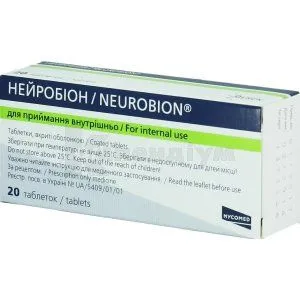
Table of Contents
INSTRUCTIONS FOR MEDICAL USE OF THE MEDICINAL PRODUCT NEUROBION (NEUROBION®)
Composition:
Active substances:
One coated tablet contains: thiamine disulfide (vitamin B1) 100 mg, pyridoxine hydrochloride (vitamin B6) 200 mg, cyanocobalamin (vitamin B12) 200 mcg;
Excipients:
magnesium stearate, methylcellulose, sodium starch glycolate (type A), gelatin, mannitol, talc, glycerol (85%), colloidal anhydrous silicon dioxide, purified water;
Coating: montan wax, gelatin, methylcellulose, acacia, glycerol (85%), povidone 25, calcium carbonate, colloidal anhydrous silicon dioxide, kaolin, titanium dioxide (E 171), talc, sucrose.
Pharmaceutical form. Coated tablets.
Main physicochemical properties: round, biconvex, shiny, almost white coated tablets.
Pharmacotherapeutic group. Vitamin B1 preparations in combination with vitamin B6 and/or vitamin B12. ATC code A11DB.
Pharmacological properties.
Pharmacodynamics
Thiamine (vitamin B1)
Thiamine pyrophosphate is the active form of vitamin B1, which acts as a coenzyme for several enzymes (such as pyruvate dehydrogenase and transketolase). Thus, vitamin B1 is primarily involved in carbohydrate metabolism and also plays a role in the synthesis of lipids and amino acids. Nerve cells derive energy exclusively through the enzymatic oxidation and decarboxylation of glucose, making it essential to ensure an adequate supply of vitamin B1. Thiamine is also involved in the conduction of nerve impulses.
Pyridoxine (vitamin B6)
Pyridoxal phosphate, the biologically active form of pyridoxine, is a key coenzyme in amino acid metabolism. Through decarboxylation, it participates in the formation of physiologically active amines (such as serotonin, histamine, and adrenaline), as well as in anabolic and catabolic processes via transamination.
Pyridoxal phosphate plays an essential role in the function of the central nervous system, particularly in enzyme-controlled neurotransmitter metabolism. It is also crucial in sphingolipid metabolism, as it catalyzes the first step in sphingosine biosynthesis. Sphingolipids are essential components of the myelin sheath of nerve cells.
Cobalamin (vitamin B12)
Vitamin B12, in its active forms (5-deoxyadenosylcobalamin and methylcobalamin), participates in enzyme-catalyzed intramolecular transfer of hydrogen and intramolecular transfer of methyl groups. Vitamin B12 also influences methionine synthesis (closely related to nucleic acid synthesis) and lipid metabolism through the conversion of propionic acid to succinic acid.
Vitamin B12 participates in the methylation of myelin basic protein, a component of the myelin sheath of nerve cells. Methylation enhances the lipophilic properties of myelin basic protein, improving its incorporation into the myelin sheath.
Combination of vitamins B1, B6, and B12
Due to their biochemical functions, vitamins B1, B6, and B12 are particularly important for metabolic processes in the nervous system, both individually and in combination. Deficiency of all three vitamins is commonly observed in vulnerable patient groups, such as elderly patients and patients with diabetes mellitus.
Animal studies show that the combination of B vitamins accelerates the regeneration of damaged neural pathways, leading to faster functional recovery and muscle reinnervation.
Administration of B vitamin combinations in rats with diabetes mellitus prevented or reduced characteristic nerve damage, thereby counteracting the deterioration of functional properties (antineuropathic effect). Administration of vitamins B1, B6, and B12 in several rat models of pain demonstrated antinociceptive activity, with the combination showing superior efficacy compared to individual components.
Pharmacokinetics
Combined administration of vitamins B1, B6, and B12 does not affect the pharmacokinetics of the individual vitamins.
Thiamine (vitamin B1)
The transport mechanism after oral administration is dose-dependent and has a dual nature: active absorption up to a concentration of 2 µmol and passive diffusion at concentrations exceeding 2 µmol.
Studies using radiolabeled thiamine have demonstrated that duodenal absorption is the highest, while absorption in the upper and middle segments of the small intestine is somewhat lower. Absorption in the stomach and distal segments of the small intestine is almost negligible. Thiamine produced in the large intestine is not absorbed.
After absorption through the intestinal mucosa, thiamine is transported to the liver via the hepatic portal system. In the liver, thiamine is phosphorylated by thiamine kinase to thiamine pyrophosphate (TPP) and thiamine triphosphate (TTP).
The elimination half-life of thiamine is approximately 4 hours (1 hour in the beta phase), while the biological half-life in the human body ranges from 9.5 to 18.5 days.
The human body can store 20–30 mg of thiamine (mainly in the heart, brain, liver, and kidneys). Due to rapid metabolism, reserve stores are very limited and are depleted within 4–10 days. The main excretion products are: thiamine carboxylic acid, pyramin, thiamine, and several unidentified metabolites (renal excretion). The higher the dose of thiamine administered, the greater the amount of unchanged thiamine excreted in urine within 4–6 hours.
Pyridoxine (vitamin B6)
Vitamin B6 (pyridoxine, pyridoxal, and pyridoxamine) is rapidly absorbed, primarily in the upper segments of the gastrointestinal tract, and transported to organs and tissues. The vitamins bind to albumins. Approximately 80% of pyridoxal phosphate is protein-bound. Vitamin B6 crosses the blood-brain barrier, is secreted into breast milk, and passes through the placental barrier. The main excretion product is 4-pyridoxic acid, the amount of which depends on the administered dose of vitamin B6.
Vitamin B6 is predominantly phosphorylated in the liver, forming the biologically active pyridoxal phosphate. To cross the cell membrane, phosphorylated vitamin B6 must be hydrolyzed by alkaline phosphatase to release free vitamin B6. Transport into the cell occurs via diffusion, followed by re-phosphorylation. The biological half-life of pyridoxal phosphate is 15–25 days, while the elimination half-life is approximately 3 hours. The body can accumulate 40–150 mg of vitamin B6, with accumulation occurring over 14–42 days.
Cyanocobalamin (vitamin B12)
Absorption from the gastrointestinal tract is based on two different mechanisms. The active mechanism involves intrinsic factor, secreted by parietal cells of the gastric mucosa. After release of haptocorrin by gastric juice, vitamin B12 binds to intrinsic factor, forming a vitamin B12–intrinsic factor complex. This complex binds to a specific receptor protein on the luminal surface of the ileal mucosa.
Independently of intrinsic factor, vitamin B12 can enter the bloodstream via non-saturable passive diffusion. Passive diffusion can occur throughout the small intestine, accounts for approximately 1–2% of total absorbed vitamin B12, and remains unchanged in patients who have undergone gastroduodenal surgical resection or in those with other gastrointestinal disorders affecting vitamin B12 absorption via intrinsic factor. Passive absorption plays an important role when therapeutic doses are administered—doses that are 100 times or more higher than the recommended daily intake of vitamin B12.
Studies in healthy volunteers show that a maximum of 1.5 µg of orally administered vitamin B12 is absorbed via intrinsic factor. As the oral dose increases, intrinsic factor-mediated absorption becomes saturated, while diffusion-induced absorption increases. Approximately 90% of plasma cobalamin is bound to proteins (transcobalamins). Vitamin B12 is stored in the body, primarily in the liver (about 1.5 mg), as well as in the kidneys, heart, spleen, and brain. Total body stores of vitamin B12 vary, but are generally estimated at ~2–3 mg. The daily turnover rate is 2.5 µg of vitamin B12 per day, or 0.05% of the total body content. The biological half-life is approximately 1 year. Vitamin B12 is predominantly secreted into bile and extensively reabsorbed via enterohepatic circulation. If the body's storage capacity is exceeded due to high-dose administration, particularly parenteral, the excess is excreted in urine.
Clinical characteristics.
Indications.
Neurological disorders caused by vitamin B group deficiencies.
Contraindications.
Hypersensitivity to the active substances or to any of the excipients. Use in children and adolescents is contraindicated due to the high content of active substances.
Vitamin B1 is contraindicated in patients with allergic disorders in case of hypersensitivity reaction to vitamin B1.
Vitamin B6 is contraindicated in peptic ulcer of the stomach and duodenum in the stage of exacerbation (since it may increase gastric juice acidity).
Vitamin B12 is contraindicated in erythremia, erythrocytosis, and thromboembolism.
Interaction with other medicinal products and other forms of interaction.
5-Fluorouracil. Thiamine is inactivated by 5-fluorouracil, as the latter competitively inhibits phosphorylation of thiamine to thiamine pyrophosphate.
Antacids. Antacids reduce thiamine absorption.
Loop diuretics. Loop diuretics, such as furosemide, which inhibit tubular reabsorption, during long-term therapy may lead to increased excretion of vitamin B1 (thiamine) and thus reduce thiamine levels.
Levodopa. When taken concomitantly with levodopa, vitamin B6 may reduce the effect of levodopa.
Pyridoxine antagonists. Concomitant use of pyridoxine antagonists (e.g., isoniazid (INH), hydralazine, D-penicillamine, or cycloserine) may reduce the efficacy of vitamin B6 (pyridoxine).
Products containing sulfites. Beverages containing sulfites (e.g., wine) enhance degradation of thiamine.
Alcohol consumption and black tea reduce thiamine absorption.
Special precautions for use
When using vitamin B12, the clinical picture as well as laboratory findings in funicular myelosis or pernicious anemia may lose their specificity.
Since Neurobion contains vitamin B6, this medication should be prescribed with caution to patients with a history of peptic ulcer of the stomach or duodenum, or with severe hepatic or renal insufficiency.
This medication must not be used in patients with neoplasms, except in cases associated with megaloblastic anemia and vitamin B12 deficiency. The drug is contraindicated in severe or acute forms of cardiac decompensation and angina pectoris.
If symptoms of peripheral sensory neuropathy (paresthesia) occur, dosage should be reviewed and administration of the drug should be discontinued if necessary. Neuropathies have been observed with prolonged use (more than 6–12 months) of daily doses exceeding 50 mg of vitamin B6, as well as with short-term use (more than 2 months) of more than 1 g of vitamin B6 per day. Therefore, ongoing monitoring is recommended during long-term treatment.
This medicinal product contains sucrose. Patients with rare hereditary fructose intolerance, glucose-galactose malabsorption, or sucrase-isomaltase deficiency should not take this medicinal product.
This medicinal product contains less than 1 mmol (23 mg) of sodium per tablet, i.e. it is essentially "sodium-free".
Use during pregnancy or breastfeeding
Pregnancy
During pregnancy and breastfeeding, the recommended daily intake of vitamin B1 is generally 1.4 mg and vitamin B6 is 1.9 mg. These doses should be exceeded only in pregnant women with clear deficiencies of vitamins B1 and B6, as the safety of doses higher than the recommended daily amounts has not yet been established.
Animal studies investigating the effect of the drug on pregnancy, embryofetal, prenatal, and postnatal development are insufficient. The potential risk for humans is unknown. The physician must determine the appropriateness of using the medicinal product during pregnancy after carefully evaluating the potential benefit-risk ratio.
Breastfeeding
Vitamins B1, B6, and B12 are excreted in human breast milk. High doses of vitamin B6 (600 mg per day) may suppress breast milk production. Data from animal studies on the extent of excretion into breast milk are lacking. The decision to discontinue breastfeeding or to discontinue treatment with the drug should be made considering the potential benefits of breastfeeding for the child and the potential benefits of treatment for the woman.
Ability to influence reaction speed when driving or operating machinery
This medicinal product has no effect or has a negligible effect on the ability to drive or operate machinery. However, if dizziness occurs during treatment, patients should refrain from driving or operating machinery.
Method of Administration and Dosage
One coated tablet once daily. In individual cases, the dose may be increased to one coated tablet three times daily.
The tablet should be swallowed whole with plenty of fluid, after a meal.
The duration of treatment is determined by a physician.
After a maximum of 4 weeks, the need for dose reduction should be assessed (see section "Special Warnings and Precautions for Use").
Children. Not recommended for use in children (under 18 years of age).
Overdose.
With chronic use at high doses, possible worsening of hepatic enzyme activity, chest pain, and hypercoagulability may occur.
Vitamin B1
Thiamine has a wide therapeutic range. Very high intravenous doses (over 10 g) may produce a ganglion-blocking effect similar to that of curare and may inhibit nerve impulse conduction.
Vitamin B6
Vitamin B6 is considered to have very low toxicity. However, long-term use (more than 6–12 months) of vitamin B6 at doses exceeding 50 mg daily may cause peripheral sensory neuropathy. Symptoms gradually resolve after discontinuation of the vitamin.
Continuous use of vitamin B6 at doses exceeding 1 g daily for more than two months may lead to neurotoxic effects.
Neuropathies with ataxia and sensory disturbances, cerebral seizures with EEG changes, as well as, in rare cases, hypochromic anemia and seborrheic dermatitis, have been reported with daily doses exceeding 2 g.
Vitamin B12
After parenteral administration (and in rare cases also after oral administration) of high doses, allergic reactions, eczematous skin disorders, and acneiform eruptions have been observed.
Adverse reactions.
The adverse reactions listed below are classified by system organ class and frequency. The assessment of adverse reactions by frequency is based on the following classification:
very common (≥ 1/10); common (≥ 1/100, < 1/10); uncommon (≥ 1/1000, < 1/100); rare (≥ 1/10000, < 1/1000); very rare (< 1/10000); not known (cannot be estimated from available data).
Immune system disorders: anaphylaxis.
Very rare: hypersensitivity reactions, such as sweating, tachycardia and skin reactions like pruritus, urticaria, rash.
Nervous system disorders: dizziness, headache, nervous excitation, malaise.
Frequency not known: long-term use (more than 6–12 months) of vitamin B6 in doses exceeding 50 mg per day may lead to peripheral sensory neuropathy. Symptoms gradually diminish after discontinuation of the vitamin.
Gastrointestinal disorders: increased gastric acidity.
Frequency not known: gastrointestinal complaints such as nausea, vomiting, diarrhea, abdominal pain.
Renal and urinary disorders. Frequency not known: chromaturia (red discoloration of urine observed within the first eight hours after administration, which usually disappears).
Shelf life. 2 years.
Storage conditions. Store at temperatures not exceeding 25 °C. Keep out of reach of children.
Packaging. 10 tablets in a blister. 2 blisters in a cardboard box.
Prescription category. Prescription only.
Manufacturer.
P&G Health Austria GmbH & Co. OHG, Austria.
Manufacturer's name and address.
Hößlgasse 20, 9800 Spittal an der Drau, Austria.