Neurobion
Ukraine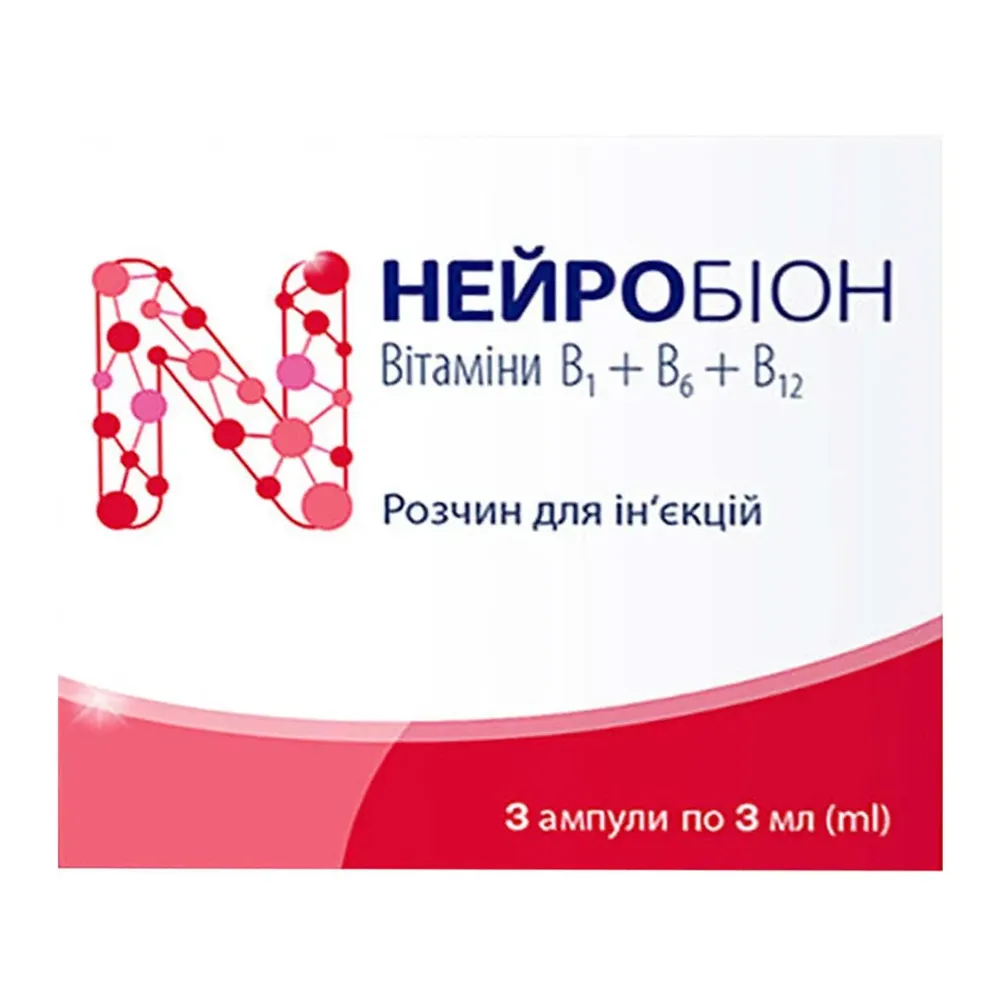
Table of Contents
INSTRUCTIONS FOR MEDICAL USE OF THE MEDICINAL PRODUCT NEUROBION® (NEUROBION®)
Composition:
One ampoule (3 mL) contains: thiamine hydrochloride (vitamin B1) 100 mg, pyridoxine hydrochloride (vitamin B6) 100 mg, cyanocobalamin (vitamin B12) 1 mg;
Excipients: sodium hydroxide 1M solution, potassium cyanide, water for injections.
Pharmaceutical form. Solution for injection.
Main physicochemical properties: red, clear solution.
Pharmacotherapeutic group. Vitamin B1 preparations in combination with vitamin B6 and/or vitamin B12. ATC code A11D B.
Pharmacological Properties.
Pharmacodynamics.
The medicinal product in the form of an injectable solution in ampoules contains a combination of neurotropic active substances – the vitamin B complex. The vitamins contained in the medicinal product, namely thiamine (B1), pyridoxine (B6), and cobalamin (B12), play a special role as coenzymes in intermediary metabolism occurring in the central and peripheral nervous systems. Like all vitamins, they are essential nutrients that the body cannot synthesize independently. Therapeutic use of vitamins B1, B6, and B12 compensates for their insufficient intake with food and thus ensures the presence in the body of the necessary amount of coenzymes.
Thiamine (vitamin B1). Thiamine pyrophosphate (TPP) is the active form of vitamin B1 and acts as a coenzyme for several enzymes (e.g., pyruvate dehydrogenase and transketolase). Thus, vitamin B1 is primarily involved in carbohydrate metabolism, while it also participates in the synthesis of lipids and amino acids. Nerve cells meet their energy requirements exclusively through the enzymatic oxidation and decarboxylation of glucose; therefore, an adequate supply of vitamin B1 is of great importance. Thiamine participates in the conduction of nerve impulses.
Pyridoxine (vitamin B6). Pyridoxal phosphate, the biologically active form of pyridoxine, is a key coenzyme in amino acid metabolism. It participates in the formation of physiologically active amines (e.g., serotonin, histamine, adrenaline) through decarboxylation processes, as well as in anabolic and catabolic processes via transamination. Pyridoxal phosphate plays an important role in the central nervous system, particularly in enzyme-regulated neurotransmitter metabolism. As a catalyst in the initial steps of sphingosine biosynthesis, pyridoxal phosphate also plays a crucial role in sphingolipid metabolism – important components of the myelin sheaths of nerve cells.
Cobalamin (vitamin B12). Vitamin B12 in its active forms (5-deoxyadenosylcobalamin and methylcobalamin) participates in enzyme-catalyzed intramolecular transfer of hydrogen and intramolecular transfer of methyl groups. Vitamin B12 also participates in the synthesis of methionine (closely related to nucleic acid synthesis) and in lipid metabolism through the conversion of propionic acid to succinic acid. Vitamin B12 is involved in the methylation of the main myelin protein, a component of the myelin sheaths of the nervous system. Methylation enhances the lipophilic properties of the main myelin protein, improving its integration into the myelin sheath.
Combination of vitamins B1, B6, and B12. Due to their biochemical functions, vitamins B1, B6, and B12 are particularly important for metabolic processes in the nervous system, both individually and in combination. Moreover, most vulnerable patient groups, such as elderly patients and patients with diabetes mellitus and other conditions, often exhibit deficiencies in all three of these neurotropic vitamins. Animal studies have shown that this combination of neurotropic B vitamins accelerates regenerative processes in damaged nerve fibers, leading to faster restoration of function and muscle innervation. The use of combined B vitamins in rats with diabetes mellitus prevented nerve damage or reduced it to such an extent that the deterioration of functional properties was diminished (neuroprotective effect).
Antinociceptive effects of vitamins B1, B6, and B12 have been demonstrated in animal experiments and clinical studies.
Pharmacokinetics.
Combined administration of vitamins B1, B6, and B12 does not affect the pharmacokinetics of individual vitamins in any way.
Thiamine (vitamin B1)
The biological half-life in the human body is approximately 9.5–18.5 days, with an elimination half-life of about 4 hours. The human body can store 20–30 mg of thiamine (mainly in the heart, brain, liver, and kidneys). Due to rapid metabolism, reserve stores are very limited and are depleted within 4–10 days.
Pyridoxine (vitamin B6)
Vitamin B6 is primarily phosphorylated in the liver, forming the biologically active form pyridoxal phosphate. To cross the cell membrane, phosphorylated vitamin B6 must be hydrolyzed by alkaline phosphatase to release vitamin B6. Transport into the cell occurs via diffusion, followed by re-phosphorylation. The biological half-life of pyridoxal phosphate is 15–25 days, and the elimination half-life is approximately 3 hours. The human body can store approximately 40–150 mg, with accumulation occurring over 14–42 days, and urinary excretion amounts to 1.7–3.6 mg per day.
Cobalamin (vitamin B12)
Orally administered vitamin B12 has low absorption rates, which may be further reduced after bariatric surgery, in elderly patients, in patients undergoing dialysis, and in patients with other forms of malabsorption. In addition to saturated active absorption of orally administered vitamin B12, with a maximum daily absorption level of approximately 1.5 mcg, vitamin B12 can also be absorbed via passive diffusion. The fraction absorbed through passive diffusion is only about 1–2% of the administered dose. This fraction may be even lower in patients who have undergone bariatric surgery or who have gastrointestinal malabsorption due to other diseases. For such patients, parenteral administration may be appropriate.
Approximately 90% of cobalamin in blood plasma binds to proteins (transcobalamins). Vitamin B12 does not circulate freely in plasma but is predominantly stored in the liver. Daily requirement is approximately 1 mcg. The rate of metabolism is 2.5 mcg/day, or 0.05% of the stored amount.
Vitamin B12 is primarily secreted into bile and extensively reabsorbed via enterohepatic circulation. If the body's storage capacity is exceeded due to administration of high doses, especially parenterally, the excess is excreted in urine.
Clinical characteristics.
Indications. Neurological disorders associated with severe deficiency of vitamins B1, B6, and B12, which cannot be corrected by oral therapy.
Contraindications. Hypersensitivity to the active substances or to any of the excipients.
Vitamin B1 is contraindicated in allergic diseases.
Vitamin B6 is contraindicated in peptic ulcer of the stomach and duodenum in the acute phase (since it may increase gastric juice acidity).
Vitamin B12 is contraindicated in erythremia, erythrocytosis, and thromboembolism.
The use in children (under 18 years of age) is contraindicated.
Special precautions.
Use syringes and needles (which are not included in the Neurobion package) only once. Used syringes and needles must be disposed of immediately after use. Any unused medicinal product or waste material should be destroyed in accordance with applicable legislation.
It is not recommended to mix Neurobion, solution for injection, with other medicinal products in the same syringe.
Interaction with other medicinal products and other forms of interaction.
5-Fluorouracil. Thiamine is inactivated by 5-fluorouracil, as the latter competitively inhibits the phosphorylation of thiamine to thiamine pyrophosphate.
Loop diuretics. Loop diuretics, such as furosemide, may enhance thiamine excretion during prolonged use by inhibiting tubular reabsorption, thereby reducing serum levels of vitamin B1 (thiamine).
Levodopa. When used concomitantly with levodopa, vitamin B6 may reduce the effect of levodopa.
Pyridoxine antagonists. Concomitant use of pyridoxine antagonists (e.g., isoniazid, hydralazine, D-penicillamine, or cycloserine) may reduce the efficacy of vitamin B6 (pyridoxine).
Special precautions for use
The drug must not be administered intravenously.
Since Neurobion contains vitamin B6, caution should be exercised when administering the drug to patients with a history of peptic ulcer of the stomach and duodenum, or pronounced impairments of renal and hepatic function.
The drug should not be administered to patients with neoplastic diseases, except in cases associated with megaloblastic anemia and vitamin B12 deficiency.
The drug should not be used in severe or acute forms of cardiac decompensation and angina pectoris.
Continuous monitoring for signs of peripheral sensory neuropathy is recommended during prolonged use.
Short-term parenteral administration of vitamin B12 may temporarily complicate the diagnosis of funicular myelosis or pernicious anemia.
If symptoms of peripheral sensory neuropathy (paresthesia) occur, the dosage should be reassessed and, if necessary, the drug discontinued. Cases of neuropathy have been observed during long-term use (more than 6–12 months) of vitamin B6 at daily doses exceeding 50 mg, as well as during short-term use (over 2 months) of vitamin B6 at doses exceeding 1 g per day.
This medicinal product contains less than 1 mmol (23 mg) of sodium per ampoule, i.e. it is practically sodium-free.
This medicinal product contains less than 1 mmol (39 mg) of potassium per ampoule, i.e. it is practically potassium-free.
Use during pregnancy or breastfeeding
Pregnancy
Animal studies investigating the effects of the medicinal product on pregnancy, embryofetal, prenatal, and postnatal development are insufficient. The potential risk for humans is unknown; therefore, the drug is not recommended for use during pregnancy.
Breastfeeding
Vitamins B1, B6, and B12 are excreted in human breast milk. High concentrations of vitamin B6 (600 mg per day) may suppress lactation. Data from animal studies regarding the extent of excretion into breast milk are lacking. Therefore, the medicinal product is not recommended during breastfeeding. A decision on whether to discontinue breastfeeding or discontinue the drug should be made based on the benefits of breastfeeding for the child and the benefits of treatment for the mother.
Ability to influence reaction speed when driving or operating machinery. If dizziness occurs during treatment with this drug, patients should refrain from driving or operating machinery. This medicinal product has no effect or has a negligible effect on the ability to drive or operate machinery.
Method of Administration and Dosage
The medicinal product is intended for intramuscular administration.
Dosage
In severe (acute) cases: one ampoule daily until the intensity of acute symptoms decreases.
After symptom relief: one ampoule 1–3 times per week.
To maintain or continue the initial course of injectable therapy and for prevention of relapse, the medicinal product in the form of film-coated tablets is recommended.
Children
Experience with the use of this medicinal product in children is limited. Therefore, the product should not be administered to patients in this age group.
Method of Administration
The medicinal product should be administered by deep intramuscular injection into the gluteal muscle.
Children. Not for use in children (under 18 years of age).
Overdose. Prolonged use in high doses may lead to impaired liver enzyme activity, chest pain, and hypercoagulability.
Vitamin B1
Thiamine has a wide therapeutic range. Very high doses (over 10 g) exert a ganglion-blocking effect and suppress nerve impulse conduction in a curare-like manner.
Vitamin B6
The toxicity of vitamin B6 is considered to be very low.
However, prolonged use (> 6–12 months) of vitamin B6 at daily doses exceeding 50 mg may cause peripheral sensory neuropathy. Symptoms gradually resolve after discontinuation of the product.
Continuous use of vitamin B6 at daily doses exceeding 1 g for more than two months may lead to neurotoxic adverse reactions.
Administration of more than 2 g daily has been associated with cases of neuropathy with ataxia and sensory disturbances, cerebral seizures with EEG changes, and in isolated cases, hypochromic anemia and seborrheic dermatitis.
In animal studies, high doses of vitamin B6 disrupted spermatogenesis.
Vitamin B12
After parenteral administration in high doses, eczematous skin lesions and acneiform rashes have been observed.
Adverse Reactions
The adverse reactions listed below are classified by system organ class and frequency. The assessment of adverse reactions is based on the following frequency classification:
very common (≥ 1/10); common (≥ 1/100, < 1/10); uncommon (≥ 1/1000, < 1/100); rare (≥ 1/10,000, < 1/1000); very rare (< 1/10,000); frequency not known (cannot be estimated from available data).
Immune system disorders:
Very rare: hypersensitivity reactions, such as sweating, tachycardia, and skin reactions including acne, eczema, pruritus, and urticaria, as well as anaphylaxis.
Skin rash, skin hyperemia.
Nervous system disorders:
Nervous excitement, malaise, dizziness, headache.
Frequency not known: long-term use (more than 6–12 months) of vitamin B6 at doses exceeding 50 mg per day may lead to peripheral sensory neuropathy. Symptoms gradually subside after discontinuation of the vitamin.
Gastrointestinal disorders:
Increased gastric acidity.
Frequency not known: gastrointestinal complaints such as nausea, vomiting, diarrhea, and abdominal pain.
Skin and subcutaneous tissue disorders:
Frequency not known: eczematous skin lesions, acne, and acneiform rashes have been observed following administration of high doses of vitamin B12.
Renal and urinary disorders:
Frequency not known: chromaturia (red discoloration of urine observed during the first hours after drug administration; normalization usually occurs shortly after discontinuation of the drug).
General disorders and administration site conditions:
Frequency not known: injection site reactions.
Shelf life. 3 years.
Storage conditions. Store at 2–8 °C in a place protected from light. Keep out of reach of children.
Incompatibility. It is not recommended to mix Neurobion, solution for injection, with other medicinal products in the same syringe.
Vitamin B1 is completely destroyed by sulfite-containing solutions.
Other vitamins, particularly cyanocobalamin (vitamin B12), may be inactivated in the presence of medicinal products that act destructively on vitamin B1.
Packaging. 3 ml in an ampoule; 3 ampoules in a cardboard box.
Prescription status. Prescription only.
Manufacturer.
SENECIS HSC, France.
Manufacturer's address and place of business.
2, rue Louis Pasteur, Erquy Saint-Clair, 14200, France.