Neuro-norm
Ukraine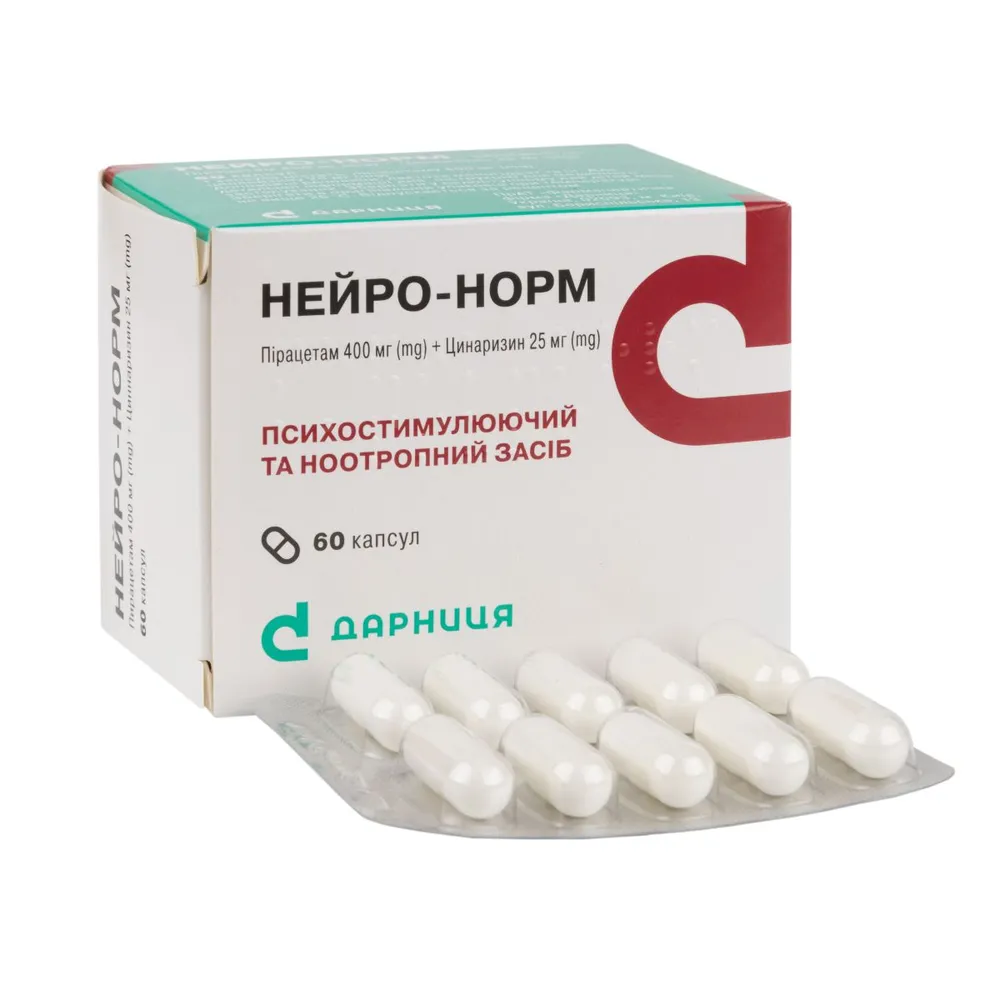
Table of Contents
INSTRUCTIONS FOR MEDICINAL USE OF NEURO-NORM (NEURO-NORM)
Composition:
Active substances: piracetam, cinnarizine.
1 capsule contains: piracetam 400 mg, cinnarizine 25 mg;
Excipients: lactose monohydrate, colloidal silicon dioxide anhydrous, magnesium stearate;
hard gelatin capsules: gelatin, titanium dioxide (E 171).
Pharmaceutical form. Capsules.
Main physicochemical properties: hard gelatin capsules with white cap and body, containing white powder.
Pharmacotherapeutic group.
Other psychostimulants and nootropics. ATC code N06BX.
Pharmacological Properties.
Pharmacodynamics.
Neuro-Norm is a combined medicinal product. The active components of the medicinal product are piracetam – a cyclic derivative of γ-aminobutyric acid, and cinnarizine – a selective calcium channel antagonist.
Piracetam is a nootropic agent acting on the brain, improving cognitive functions such as learning ability, memory, attention, and mental performance. The mechanisms of the drug's action on the central nervous system (CNS) are likely multiple: alteration of the rate of excitation spread in the brain; enhancement of metabolic processes in nerve cells; improvement of microcirculation by affecting the rheological properties of blood, without causing vasodilatory effects. It improves interhemispheric connections and synaptic conduction in neocortical structures. After prolonged use of the drug in patients with impaired brain functions, improvement in cognitive functions and attention is observed.
Cinnarizine inhibits the contraction of vascular smooth muscle cells by blocking calcium channels. In addition to direct calcium antagonism, cinnarizine reduces the contractile effect of vasoactive substances such as noradrenaline and serotonin by blocking their receptor-mediated calcium channels. The blockade of calcium influx into cells depends on the tissue type, resulting in an antivasoconstrictor effect without affecting arterial pressure or heart rate. Cinnarizine may further improve impaired microcirculation by increasing erythrocyte membrane elasticity and reducing blood viscosity. Cellular resistance to hypoxia is increased. Cinnarizine suppresses vestibular system stimulation, leading to suppression of nystagmus and other autonomic disturbances. Cinnarizine prevents the occurrence of acute vertigo attacks.
Pharmacokinetics.
The combined medicinal product is rapidly and completely absorbed in the gastrointestinal tract.
Therapeutic effect appears within 1–6 hours.
Maximum plasma concentration of piracetam is reached within 2–6 hours. Piracetam is rapidly distributed to all major organs. Piracetam does not bind to plasma proteins and is not metabolized in the body, penetrates well into tissues, crosses the blood-brain barrier and placenta. Piracetam is excreted unchanged in urine within approximately 30 hours.
Maximum levels of cinnarizine within 1–4 hours are observed not only in blood but also in the liver, kidneys, heart, lungs, spleen, and brain. Cinnarizine is 91% bound to plasma proteins. Cinnarizine is actively metabolized in the liver. Approximately 30% of metabolites are excreted in urine, the remainder through the intestine. Elimination half-life is about 4 hours.
Clinical characteristics.
Indications.
Cerebrovascular disorders
Supportive treatment of symptoms of cerebrovascular origin, including memory and cognitive function disorders, reduced attention span, mood disturbances (irritability).
Balance disorders
Supportive treatment of symptoms of labyrinthine disorders, including dizziness, tinnitus, nystagmus, nausea, vomiting.
Motion sickness
Prevention of motion sickness.
Contraindications.
Hypersensitivity to piracetam, cinnarizine, or to any excipient of the medicinal product; individual sensitivity to pyrrolidone derivatives.
Terminal stage of renal failure, acute cerebrovascular accident (hemorrhagic stroke), Huntington's chorea, parkinsonism, increased intraocular pressure, psychomotor agitation.
Interaction with other medicinal products and other types of interactions.
Piracetam.
Thyroid hormones.
Concomitant use with thyroid hormones may result in increased irritability, disorientation, and sleep disturbances.
Acenocoumarol.
Clinical studies have shown that in patients with severe recurrent thrombosis, administration of high-dose piracetam (9.6 g/day) did not affect the dosing of acenocoumarol required to achieve a prothrombin time value (INR - International Normalized Ratio) of 2.5–3.5. However, when used concomitantly, a significant reduction in platelet aggregation, fibrinogen levels, von Willebrand factors (VIII:C; VIII:vW:Ag; VIII:vW:Rco), blood and plasma viscosity was observed.
Pharmacokinetic interactions.
The likelihood of changes in the pharmacodynamics of piracetam due to other medicinal products is low, as 90% of the drug is excreted unchanged in urine.
In vitro, piracetam does not inhibit cytochrome P450 isoenzymes CYP1A2, 2B6, 2C8, 2C9, 2C19, 2D6, 2E1, and 4A9/11 at concentrations of 142, 426, and 1422 µg/mL.
At a concentration of 1422 µg/mL, slight inhibition of CYP2A6 (21%) and 3A4/5 (11%) was observed. However, the Ki values for these two CYP isomers are sufficiently high above 1422 µg/mL. Therefore, metabolic interaction with medicinal products undergoing biotransformation by these enzymes is unlikely.
Antiepileptic drugs.
Administration of piracetam at a dose of 20 mg/day for 4 weeks or longer did not alter the serum concentration-time curve or maximum concentration (Cmax) of antiepileptic drugs (carbamazepine, phenytoin, phenobarbital, sodium valproate) in patients with epilepsy.
Alcohol.
Concomitant intake with alcohol did not affect the serum concentration of piracetam, and serum alcohol concentration was not altered after intake of 1.6 g of piracetam.
Vasodilators enhance the effect of the medicinal product.
Cinnarizine.
When used concomitantly with CNS depressants, tricyclic antidepressants, and ethanol, their sedative effects may be enhanced.
Diagnostic procedures.
Due to its antihistaminic effect, cinnarizine may mask positive reactions to skin sensitivity factors during skin testing; therefore, the use of the medicinal product should be discontinued 4 days prior to the procedure.
Special precautions for use
Neuro-Norm may cause gastric irritation; taking the medication after food may reduce gastric irritation symptoms.
Concomitant use of alcohol or antidepressants should be avoided, as the drug may cause drowsiness, especially at the beginning of treatment.
The drug should be avoided in cases of porphyria.
Regarding piracetam: since piracetam reduces platelet aggregation, the medicinal product should be prescribed with caution to patients with disorders of hemostasis, conditions that may be associated with bleeding (e.g., gastrointestinal ulcer), during major surgical procedures (including dental interventions), in patients with symptoms of severe hemorrhage, or in patients with a history of hemorrhagic stroke; also in patients taking anticoagulants, platelet antiaggregants, including low-dose acetylsalicylic acid.
The drug is eliminated by the kidneys; therefore, special attention should be paid to patients with renal impairment. During long-term therapy in elderly patients, regular monitoring of renal function parameters is recommended, and dose adjustment should be considered based on creatinine clearance test results.
The medicinal product should be used with caution in patients with hepatic insufficiency.
Regarding cinnarizine: the drug should be prescribed to patients with Parkinson’s disease only if the benefits of treatment outweigh the potential risk of worsening the course of the disease.
Important information about excipients
The medicinal product contains lactose. Therefore, the drug should not be administered to patients with rare hereditary forms of galactose intolerance, lactase deficiency, or glucose-galactose malabsorption syndrome.
Use during pregnancy or breastfeeding
The drug should not be used during pregnancy or breastfeeding.
If treatment is necessary, breastfeeding should be discontinued.
Ability to influence reaction rate while driving or operating machinery
Due to the possibility of adverse reactions affecting the central nervous system, caution should be exercised when driving or operating machinery.
Method of Administration and Dosage
Neuro-Norm capsules should be taken orally after meals, without chewing, with water.
Cerebral circulation disorders: 1 capsule three times a day.
Balance disorders: 1 capsule three times a day.
Motion sickness: 1 capsule half an hour before travel, repeated every 6 hours.
Children
Not recommended.
Overdose
Symptoms: Exaggerated manifestations of adverse drug reactions. In isolated cases of acute overdose, dyspeptic symptoms (diarrhea with blood, abdominal pain), altered consciousness ranging from drowsiness to stupor and coma, vomiting, extrapyramidal symptoms, and arterial hypotension have been observed.
Treatment: There is no specific antidote. Gastric lavage should be performed within the first hour after ingestion. If indicated, activated charcoal may be administered. Symptomatic therapy should be provided. Hemodialysis is effective (eliminates 50−60% of piracetam and up to 10% of cinnarizine).
Adverse Reactions.
From the vestibular system: dizziness.
From the gastrointestinal tract: dry mouth, dyspepsia, abdominal pain, epigastric pain, gastric discomfort, diarrhea, obstructive jaundice, increased salivation, nausea, vomiting.
From metabolism and nutritional disorders: weight gain may occur during prolonged treatment in isolated cases.
From the nervous system: increased excitability, confusion, nervousness, dizziness, disorientation, headache, sleep disturbances (e.g., insomnia, hypersomnia, lethargy, somnolence), possible risk of worsening epilepsy and increased frequency of seizures, vestibular disorders, loss of balance, hyperkinesia, ataxia, tremor, dyskinesia, parkinsonism. Prolonged use in elderly patients may lead to the development of extrapyramidal symptoms.
From the psychiatric side: depression, anxiety, hallucinations.
From the cardiovascular system: arterial hypertension, thrombophlebitis.
From the blood: hemorrhagic disorders.
From the immune system: hypersensitivity, including anaphylaxis, allergic skin reactions.
From the skin and subcutaneous tissue: angioneurotic edema, dermatitis, pruritus, rash, urticaria, photosensitivity, hyperhidrosis (increased sweating), lichenoid keratosis, subacute cutaneous lupus erythematosus, and discoid lupus erythematosus.
From the musculoskeletal system: muscle rigidity.
General disorders: asthenia, fatigue, hyperthermia, increased sexual activity.
Reporting of suspected adverse reactions.
Reporting of suspected adverse reactions after marketing authorization of a medicinal product is an important procedure. It enables ongoing monitoring of the benefit-risk balance of the medicinal product. Healthcare professionals are required to report any suspected adverse reactions through the national reporting system.
Shelf life. 3 years.
Storage conditions.
Store in the original packaging at a temperature not exceeding 25 °C.
Keep out of reach of children.
Packaging.
10 capsules in a blister pack; 2 or 6 blister packs in a carton.
Prescription category. Prescription only.
Manufacturer. JSC "Pharmaceutical Company "Darnytsia".
Manufacturer's address and place of business.
13 Borispilska Street, Kyiv, 02093, Ukraine.