Nevanac
Ukraine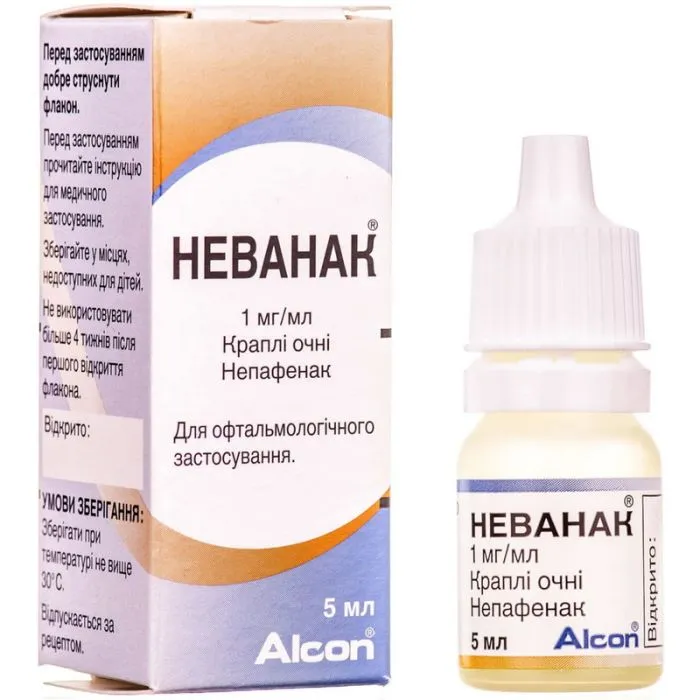
Table of Contents
INSTRUCTIONS FOR MEDICAL USE OF THE MEDICINAL PRODUCT NEVANAC® (NEVANAC®)
Composition:
Active substance: nepafenac; 1 ml of suspension contains 1 mg of nepafenac;
Excipients: benzalkonium chloride, carbomer 974P, tyloxapol, edetate disodium dihydrate, mannitol (E 421), sodium chloride, sodium hydroxide and/or concentrated hydrochloric acid (for pH adjustment), purified water.
Pharmaceutical form. Eye drops.
Main physicochemical properties: homogeneous suspension, light yellow to light orange in color.
Pharmacotherapeutic group. Ophthalmological agents. Non-steroidal anti-inflammatory agents. Nepafenac. ATC code S01BC10.
Pharmacological properties.
Pharmacodynamics.
Mechanism of action
Nepafenac belongs to nonsteroidal anti-inflammatory and analgesic prodrugs. After topical ocular administration, nepafenac penetrates into the cornea and is converted by ocular tissue hydrolases into amfenac, a nonsteroidal anti-inflammatory agent. Amfenac inhibits prostaglandin H synthase (cyclooxygenase), an enzyme required for prostaglandin production.
Secondary pharmacology
In animal studies, nepafenac was shown to reduce blood-retinal barrier permeability while simultaneously inhibiting PGE2 (prostaglandin E2) synthesis in rabbits. Under ex vivo conditions, a single topical ocular dose of nepafenac was confirmed to suppress prostaglandin synthesis in the iris/ciliary body (85–95%) and retina/choroid (55%) for up to 6 hours and 4 hours, respectively.
Pharmacodynamic properties
Most hydrolytic conversion occurs in the retina/choroid, followed by the iris/ciliary body and cornea, depending on the degree of tissue vascularization.
Clinical study results indicate that Nevanac® eye drops do not significantly affect intraocular pressure.
Clinical effects
Prevention and treatment of postoperative pain and inflammation associated with cataract surgery.
Three pivotal studies were conducted to evaluate the efficacy and safety of Nevanac® (one drop instilled into the conjunctival sac of the affected eye(s) three times daily) compared with placebo and/or ketorolac tromethamine for the prevention and treatment of postoperative pain and inflammation in patients undergoing cataract surgery. During the studies, the drug was initiated one day before surgery, continued on the day of surgery, and administered for an additional 2–4 weeks in the postoperative period. Additionally, nearly all patients received antibiotics for prophylactic purposes according to the clinical practice at each study site.
In two double-blind, randomized, placebo-controlled studies, patients treated with Nevanac® showed significantly less inflammation (aqueous flare and cells) during the early postoperative period and through the end of treatment compared to patients receiving placebo.
In one double-blind, randomized, placebo-controlled study with an active comparator, patients treated with Nevanac® showed significantly less inflammation than those receiving placebo. Furthermore, Nevanac® demonstrated non-inferior efficacy in reducing ocular pain and inflammation compared to 5 mg/mL ketorolac and was found to be more convenient to administer.
A significantly higher proportion of patients treated with Nevanac® reported absence of ocular pain after cataract surgery compared to patients receiving placebo.
Reduction of the risk of postoperative macular edema associated with cataract surgery in patients with diabetes mellitus.
Three studies were conducted to evaluate the efficacy and safety of Nevanac® for the prevention of macular edema following cataract surgery (one study in patients with diabetes, two in non-diabetic patients). In these studies, the drug was administered one day before surgery, on the day of surgery, and throughout the postoperative period lasting up to 90 days.
In one double-blind, randomized, placebo-controlled study in patients with diabetic retinopathy, macular edema occurred significantly more frequently in patients receiving placebo (16.7%) compared to those treated with Nevanac® (3.2%). A higher proportion of patients receiving placebo experienced a decrease in best-corrected visual acuity of more than 5 lines between day 7 and day 90 (or at early termination) (11.5%) compared to patients treated with Nevanac® (5.6%). A greater proportion of patients treated with Nevanac® achieved an improvement of 15 letters in best-corrected visual acuity compared to placebo: 56.8% vs. 41.9%, respectively, p=0.019.
Preclinical safety data
Preclinical data revealed no special risk to humans based on standard safety pharmacology, repeated-dose toxicity, and genotoxicity studies.
Long-term carcinogenicity studies with nepafenac have not been conducted.
In reproductive toxicity studies in rats, maternal toxicity was observed at doses ≥10 mg/kg, with dystocia, increased post-implantation loss, reduced fetal body weight, delayed embryonic development, and decreased fetal survival. Administration of 30 mg/kg to pregnant rabbits, causing minor maternal toxicity, resulted in a statistically significant increase in fetal malformations.
Pharmacokinetics.
Absorption
After instillation of Nevanac® eye drops three times daily in both eyes, plasma concentrations of nepafenac and amfenac in most patients were low but quantifiable at 2 and 3 hours after administration, respectively. The mean peak plasma concentration (Cmax) of nepafenac and amfenac after topical administration was 0.310±0.104 ng/mL and 0.422±0.121 ng/mL, respectively.
Distribution
Amfenac has high affinity for serum albumin. In vitro, the percentage bound to rat albumin, human albumin, and human serum was 98.4%, 95.4%, and 99.1%, respectively.
Studies in rats showed that after single or multiple oral doses of 14C-nepafenac, radioactivity associated with the active substance distributed throughout the body.
Biotransformation
Nepafenac is rapidly bioactivated to amfenac by intraocular hydrolases. Amfenac is then extensively metabolized to more polar metabolites, including aromatic ring hydroxylation, leading to glucuronide conjugate formation. Radiochromatographic analysis before and after β-glucuronidase hydrolysis showed that all metabolites except amfenac were in the form of glucuronide conjugates. Amfenac was the predominant compound in plasma, accounting for approximately 13% of total plasma radioactivity. The second major metabolite present in plasma in significant amounts was 5-hydroxynepafenac, representing approximately 9% of total radioactivity at Cmax.
Interaction with other medicinal products: In vitro, nepafenac and amfenac do not inhibit the metabolism of major cytochrome P450 enzymes (CYP1A2, 2C9, 2C19, 2D6, 2E1, and 3A4) in humans at concentrations up to 300 ng/mL. Therefore, CYP-mediated drug interactions with concomitantly administered drugs are unlikely. Protein binding-mediated interactions are also unlikely.
Elimination
After oral administration of 14C-nepafenac to healthy volunteers, the substance was primarily excreted in urine (approximately 85%), with only about 6% eliminated via feces. The amounts of nepafenac and amfenac in urine were below the limit of quantification.
After a single dose of Nevanac® was administered to 25 patients following cataract surgery, drug concentrations in aqueous humor were measured at 15, 30, 45, and 60 minutes post-dose. Maximum drug concentration in aqueous humor was observed at 1 hour (nepafenac concentration: 177 ng/mL; amfenac concentration: 44.8 ng/mL). These data indicate rapid penetration of the active substance into the cornea.
Clinical characteristics.
Indications.
Nevanac® is indicated in adults for:
- prevention and treatment of pain and inflammation following cataract surgery;
- reduction of the risk of developing macular edema after cataract surgery in patients with diabetes mellitus (see section "Pharmacological properties").
Contraindications.
Hypersensitivity to the active substance, to any of the excipients, or to other nonsteroidal anti-inflammatory drugs (NSAIDs).
Nevanac® is contraindicated in patients in whom acetylsalicylic acid or other NSAIDs induce asthma attacks, urticaria, or acute rhinitis.
Interaction with other medicinal products and other forms of interaction.
Concomitant use of topical NSAIDs and corticosteroids may impair wound healing. Concomitant use of Nevanac® with medicinal products that prolong blood clotting time increases the risk of bleeding.
In vitro studies have demonstrated a very low likelihood of interaction with other medicinal products and the possibility of plasma protein binding.
Prostaglandin analogs.
There are very limited data regarding concomitant use of prostaglandin analogs and Nevanac®. Due to their mechanism of action, concomitant administration of these medicinal products is not recommended.
Special precautions for use.
Do not use for injections. Inform patients that they should not swallow the Nevanac® medication and must avoid exposure to sunlight during treatment with Nevanac®.
NSAIDs for topical use may cause keratitis. In some patients with increased sensitivity, prolonged use of topical NSAIDs may lead to epithelial damage, corneal thinning, corneal erosion, ulcer formation, or corneal perforation. These events may threaten vision. Patients experiencing signs of corneal epithelial damage should immediately discontinue Nevanac® and undergo corneal examination.
Topical use of NSAIDs may delay or impair wound healing. It is known that topical corticosteroids also delay or impair wound healing. Concomitant use of topical NSAIDs and corticosteroids may complicate wound healing.
Post-marketing experience with topical NSAIDs confirms that patients undergoing repeated and/or complex ophthalmic surgeries, patients with corneal denervation, corneal epithelial defects, diabetes mellitus, ocular surface diseases (e.g., dry eye syndrome), or rheumatoid arthritis are at increased risk of corneal adverse reactions that may threaten vision. These patients should be treated with NSAIDs with particular caution. Prolonged use of topical NSAIDs may increase the risk and severity of corneal adverse reactions.
Cases have been reported where concomitant use of NSAIDs in ophthalmology and performance of ophthalmic surgery may cause severe ocular tissue bleeding (including hyphema). Nevanac® should be used with particular caution in patients with known bleeding tendencies or those currently using other medicinal products that may prolong bleeding time.
There is very limited data on concomitant use of Nevanac® with prostaglandin analogs. Due to their mechanism of action, concomitant use of these agents is not recommended.
Nevanac® contains benzalkonium chloride, which may cause eye irritation and discolor soft contact lenses. Additionally, wearing contact lenses is not recommended after cataract surgery.
Patients should be advised not to wear contact lenses during treatment with Nevanac®. If it is necessary to wear contact lenses during the treatment period, patients should be advised to remove contact lenses before applying the medication and wait at least 15 minutes before reinserting them.
Cases have been reported where benzalkonium chloride, widely used as a preservative in ophthalmic medicinal products, caused punctate keratopathy and/or toxic ulcerative keratopathy. Since Nevanac® contains benzalkonium chloride, careful monitoring is required with frequent or prolonged use of the medication.
Topical use of anti-inflammatory medicinal products may mask the development of acute ocular infection. NSAIDs have no antimicrobial properties. In case of ocular infection, NSAIDs should be used with particular caution when combined with antibacterial agents.
Use in patients with hepatic or renal impairment
The use of Nevanac® in patients with hepatic or renal impairment has not been studied. Nepafenac is primarily eliminated from the body via biotransformation, and systemic effects after topical administration are very minimal. Dose adjustment is not required for this patient group.
Cross-sensitivity
Cross-sensitivity between nepafenac and acetylsalicylic acid, phenylacetic acid derivatives, and other NSAIDs is possible.
Use during pregnancy or breastfeeding
Reproductive function
There are no data available on the effect of Nevanac® on human reproductive function.
Nevanac® should not be administered to women of reproductive potential who are not using appropriate contraceptive methods.
Pregnancy
There are inadequate data on the use of this medication in pregnant women. Reproductive toxicity was observed in animal studies (see section "Pharmacological properties"). The potential risk to human reproductive function is unknown. Since systemic exposure to Nevanac® in non-pregnant women is minimal, the risk of using this medication during pregnancy can be considered low. However, because inhibition of prostaglandin synthesis may adversely affect pregnancy and/or embryonic/fetal development, and/or labor, and/or postnatal development, Nevanac® is not recommended during pregnancy and in women of reproductive potential who are not using contraception.
Breastfeeding
It is unknown whether nepafenac is excreted in human breast milk. Animal studies have shown that nepafenac passes into the milk of rats. However, a negative effect on the nursing infant is not expected due to the very minimal systemic exposure of nepafenac in breastfeeding women. Therefore, Nevanac® may be used during breastfeeding.
Ability to affect reaction speed when driving or operating machinery.
As with other eye drops, transient blurred vision or other visual disturbances may affect the ability to drive or operate machinery. If blurred vision occurs after instillation, the patient should wait until vision clears before driving or operating machinery.
Method of Administration and Dosage
Use in adults, including elderly patients
Do not exceed the recommended dosage.
To prevent and treat pain and inflammation, instill 1 drop of Nevanac® into the conjunctival sac of the affected eye(s) 3 times daily, starting 1 day before cataract surgery, on the day of surgery, and during the postoperative period for up to 21 days as directed by the physician. An additional drop should be administered 30–120 minutes before surgery.
To reduce the risk of postoperative macular edema after cataract surgery in patients with diabetes mellitus, instill 1 drop of Nevanac® into the conjunctival sac of the affected eye(s) 3 times daily, starting 1 day before cataract surgery, on the day of surgery, and during the postoperative period for up to 60 days as directed by the physician. An additional drop should be administered 30–120 minutes before surgery.
Administration method
For ophthalmic use only.
Patients should be instructed to shake the bottle well before use.
If several ophthalmic topical medications are being used simultaneously, they should be administered at least 5 minutes apart.
To prevent contamination of the dropper tip and solution, avoid touching the eyelids, surrounding areas, or other surfaces with the dropper tip. The bottle should be kept tightly closed when not in use.
Children
The safety and efficacy of Nevanac® in children have not been established; therefore, the drug is not recommended for use in pediatric patients.
Overdose
There are no data regarding overdose with ocular administration of the drug. It is highly unlikely that administering more than 1 drop per eye would lead to adverse reactions. Adverse reactions following accidental ingestion of the drug are not expected.
Adverse Reactions
During clinical studies involving 800 patients treated with Nevanac®, adverse reactions were observed in approximately 3% of patients. These led to discontinuation of the drug in 0.6% of patients, which was lower than in the placebo group (1.3%). The most commonly reported adverse events during clinical studies were keratitis, eye pain, and formation of scales at the eyelid margins, observed in 0.5% of patients.
The adverse reactions listed below, considered during clinical studies to be related to the use of Nevanac®, are classified according to the following frequency categories: very common (≥1/10), common (≥1/100 to <1/10), uncommon (≥1/1000 to <1/100), rare (≥1/10,000 to <1/1000), very rare (<1/10,000). Within each frequency category, adverse reactions are listed in order of decreasing severity.
| System organ classes |
Adverse reactions according to MedDRA classification |
| Immune system disorders |
Single cases: hypersensitivity. |
| Nervous system disorders |
Single cases: dizziness, headache. |
| Ophthalmic disorders |
Uncommon: keratitis, punctate keratitis, corneal epithelial defect, allergic conjunctivitis, eye pain, foreign body sensation in the eye, scaling of eyelid margins. Single cases: blurred vision, photophobia, dry eye, blepharitis, eye pruritus, eye discharge, increased lacrimation, iritis, choroidal effusion, corneal deposits, eye discomfort, conjunctival hyperemia. |
| Gastrointestinal disorders |
Single cases: nausea. |
| Skin and subcutaneous tissue disorders |
Single cases: dermatochalasis, allergic dermatitis. |
During the post-marketing surveillance period, the following additional adverse reactions have been identified. Based on available data, the frequency of their occurrence cannot be estimated. Within each organ system class, adverse reactions are listed in order of decreasing severity.
| Organ system classes |
Adverse reactions according to MedDRA classification |
| Eye disorders |
ulcerative keratitis, corneal thinning, corneal opacity, corneal scar, impaired healing (cornea), decreased visual acuity, eye swelling, eye irritation, eye hyperemia |
| Gastrointestinal disorders |
vomiting |
| Investigations |
elevated blood pressure |
Patients with Diabetes Mellitus
In a limited study of patients with diabetes (N=126), the drug Nevanac® was administered for 60 days or longer to prevent the occurrence of macular edema following cataract surgery. Adverse reactions occurred in approximately 2% of these patients, leading to discontinuation of the drug in 0.8%, with similar results observed in patients receiving placebo (0.8%). No serious adverse reactions related to the use of Nevanac® were reported.
The adverse reactions listed below were considered related to the use of Nevanac®; they are classified as follows: very common (≥1/10), common (≥1/100 to <1/10), uncommon (≥1/1000 to <1/100), rare (≥1/10,000 to <1/1000), or very rare (<1/10,000). Within each category, adverse reactions are listed in order of decreasing severity.
| Organ system classes |
Adverse reactions |
| Eye disorders |
Common: punctate keratitis. Uncommon: corneal epithelial defect. |
Specific adverse effects
The clinical experience with long-term use of Nevanac® for prevention of macular edema after cataract surgery in patients with diabetes mellitus is limited. Adverse reactions affecting the eye may occur more frequently in diabetic patients than in other patient groups (see section "Special precautions for use").
Patients who experience signs of corneal epithelial damage should discontinue Nevanac® immediately and undergo corneal examination (see section "Special precautions for use").
Post-marketing data on the use of Nevanac® eye drops have reported cases of corneal epithelial damage/disorders. The severity of these adverse events varies from non-serious disruption of corneal epithelial integrity to more serious conditions requiring surgical intervention and/or treatment to restore visual acuity.
According to post-marketing experience with topical NSAIDs, patients undergoing complex ophthalmic surgery, patients with corneal denervation, patients with corneal epithelial defects, diabetes mellitus, ocular surface diseases (e.g., dry eye syndrome), rheumatoid arthritis, and patients undergoing repeated ophthalmic surgeries with short intervals between procedures are at increased risk of developing corneal adverse reactions that may threaten vision. When prescribing nepafenac to diabetic patients for prevention of macular edema after cataract surgery and in the presence of other risk factors, the benefit-risk ratio should be reassessed and careful patient monitoring should be performed.
Shelf life. 2 years.
Storage period after first opening of the bottle – 4 weeks.
Storage conditions.
Store at temperatures not exceeding 30 °C.
Keep out of reach of children.
Packaging.
5 ml in a dropper bottle; 1 dropper bottle per cardboard box.
Prescription status. Prescription only.
Manufacturer.
Novartis Manufacturing NV / Novartis Manufacturing NV.
Manufacturer's address and location of manufacturing site.
Rijksweg 14, Puurs-Sint-Amands, 2870, Belgium / Rijksweg 14, Puurs-Sint-Amands, 2870, Belgium.