Nemotan
Ukraine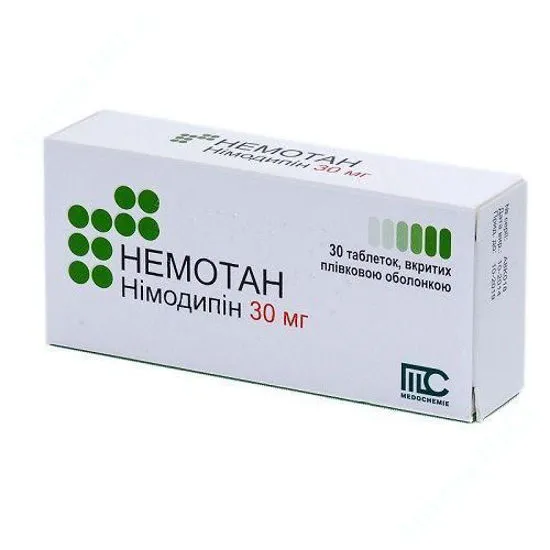
Table of Contents
INSTRUCTIONS FOR MEDICAL USE OF THE MEDICINAL PRODUCT NEMOTAN (NEMOTAN)
Composition:
Active substance: nimodipine;
1 tablet contains 30 mg of nimodipine;
Excipients: povidone K25, microcrystalline cellulose, corn starch, crospovidone, magnesium stearate;
Coating: talc, Opadry white OY-28920 (polyvinyl alcohol, titanium dioxide (E 171), talc, lecithin (E 322), xanthan gum (E 415)).
Pharmaceutical form. Film-coated tablets.
Main physico-chemical properties: white or almost white, biconvex, round film-coated tablets with a core diameter of approximately 10.3 mm.
Pharmacotherapeutic group. Selective calcium channel blockers with predominant vascular effect. Dihydropyridine derivatives. Nimodipine. ATC code C08CA06.
Pharmacological Properties.
Pharmacodynamics.
Nimodipine exerts a pronounced selective effect in certain areas of the brain. Its therapeutic properties are related to its ability to inhibit calcium ion-induced contraction of smooth muscle cells.
Nimodipine protects neurons and stabilizes their function; it favorably affects cerebral blood supply and increases tolerance to ischemia through interactions with neuronal and cerebrovascular receptors associated with calcium channels. Other studies have demonstrated that this does not lead to intracerebral steal phenomenon.
Clinically, it has been shown that nimodipine reduces memory impairments and improves attention concentration in patients with impaired brain function.
Nimodipine has a positive effect on other typical symptoms, as demonstrated by assessment of general clinical parameters, evaluation of individual disorders, behavioral observation, and psychometric testing.
Pharmacokinetics.
Absorption. The active substance of nimodipine is almost completely absorbed after oral administration. Maximum plasma concentration (Cmax) and area under the concentration-time curve (AUC) increase proportionally with dose up to the highest studied dose (90 mg).
The calculated volume of distribution (Vss, two-compartment model) following intravenous administration ranges from 0.9 to 1.6 L/kg body weight. Total (systemic) clearance ranges from 0.6 to 1.9 L/h/kg.
Protein binding and distribution. Protein binding in blood reaches 97–99%.
Metabolism, elimination, and excretion. Elimination of nimodipine occurs via metabolism through the cytochrome P450 3A4 system.
Bioavailability. Due to extensive presystemic metabolism (approximately 85–95%), absolute bioavailability is 5–15%.
Clinical characteristics.
Indications.
Prevention and treatment of ischemic neurological disorders caused by cerebral vasospasm following subarachnoid hemorrhage due to rupture of an aneurysm.
Contraindications.
Nemotan must not be used in patients with hypersensitivity to nimodipine or to any of the other components of the medicinal product.
The use of Nemotan in combination with rifampicin is contraindicated, as concomitant administration of these medicinal products leads to a significant reduction in the efficacy of Nemotan.
Antiepileptic agents (phenobarbital, phenytoin, carbamazepine) significantly reduce the bioavailability of nimodipine; therefore, concomitant use of Nemotan with these agents is contraindicated.
Nimodipine should not be used in unstable angina pectoris, myocardial infarction, and/or within 1 month after their occurrence (see section "Interaction with other medicinal products and other forms of interaction").
Interaction with other medicinal products and other forms of interaction.
Nemotan tablets should not be used concomitantly with other formulations of nimodipine.
Nimodipine is metabolized via the cytochrome P450 3A4 system, located both in the intestinal mucosa and in the liver. Therefore, medicinal products affecting this enzyme system may alter the first-pass metabolism or clearance of nimodipine.
When administering nimodipine concomitantly with the following medicinal products, the extent and duration of interaction should be taken into account.
Based on experience with other calcium channel antagonists, rifampicin enhances the metabolism of nimodipine due to enzyme induction. Thus, concomitant use of rifampicin and nimodipine leads to a significant reduction in the efficacy of the latter. The use of Nemotan in combination with rifampicin is contraindicated.
Antiepileptic agents (phenobarbital, phenytoin, carbamazepine) significantly reduce the bioavailability of nimodipine tablets; therefore, concomitant use of Nemotan with these agents is contraindicated.
When using the following inhibitors of the cytochrome P450 3A4 system concomitantly, blood pressure should be monitored and, if necessary, the dose of nimodipine should be adjusted.
No studies have been conducted on the interaction between nimodipine and macrolide antibiotics. It is known that some macrolide antibiotics (e.g., erythromycin) inhibit the cytochrome P450 3A4 system, and a potential interaction between medicinal products at this stage cannot be excluded. Therefore, macrolide antibiotics should not be used concomitantly with nimodipine.
Azithromycin, although structurally belonging to the class of macrolide antibiotics, does not inhibit CYP3A4.
No formal studies have been conducted to investigate the potential interaction between nimodipine and HIV protease inhibitors (e.g., ritonavir). It is known that drugs of this class are potent inhibitors of the cytochrome P450 3A4 system. Therefore, a pronounced and clinically significant increase in the plasma concentration of nimodipine cannot be excluded when used concomitantly with protease inhibitors.
No formal studies have been conducted to investigate the potential interaction between nimodipine and ketoconazole. It is known that azole antifungal agents inhibit the cytochrome P450 3A4 system, and various interactions have been reported for other dihydropyridine calcium channel antagonists. Therefore, when used concomitantly with nimodipine tablets, a significant increase in systemic bioavailability of nimodipine due to reduced first-pass metabolism cannot be excluded.
No formal studies have been conducted to investigate the potential interaction between nimodipine and nefazodone. It has been reported that this antidepressant is a potent inhibitor of cytochrome P450 3A4. Therefore, an increased plasma concentration of nimodipine cannot be excluded when used concomitantly with nefazodone.
Long-term concomitant use of Nemotan and fluoxetine resulted in an increase in the plasma concentration of nimodipine by almost 50%. The effect of fluoxetine was significantly reduced, whereas that of its active metabolite norfluoxetine was not.
Based on experience with nifedipine, concomitant use with quinupristin/dalfopristin may lead to increased plasma concentrations of nimodipine.
Concomitant use of Nemotan with the H2-receptor antagonist cimetidine or valproic acid preparations may lead to increased plasma concentrations of nimodipine.
Long-term use of nimodipine with the antidepressant nortriptyline leads to a slight increase in the plasma concentration of nimodipine; the concentration of nortriptyline remains unchanged.
Nimodipine may enhance the hypotensive effect of the following antihypertensive agents when used concomitantly:
- diuretics;
- β-blockers;
- ACE inhibitors (angiotensin-converting enzyme);
- α1-antagonists;
- other calcium antagonists;
- α-adrenergic blocking agents;
- phosphodiesterase 5 inhibitors;
- α-methyldopa.
However, if such combinations cannot be avoided, careful monitoring of the patient is necessary.
Animal studies have shown that concomitant intravenous administration of nimodipine and the HIV treatment drug zidovudine leads to a significant increase in AUC for zidovudine and a decrease in its volume of distribution and clearance.
Grapefruit juice inhibits the cytochrome P450 3A4 system. Concomitant use of dihydropyridine calcium channel antagonists with grapefruit juice leads to increased plasma concentrations and prolonged action of nimodipine due to reduced first-pass metabolism or clearance.
As a result, the hypotensive effect of the drug may be enhanced. This effect may persist for at least 4 days after consumption of grapefruit juice; therefore, concomitant use of grapefruit/grapefruit juice and nimodipine is not recommended.
Special precautions for use.
Although nimodipine administration is not associated with increased intracranial pressure, careful patient monitoring is recommended in such cases or when tissue water content in the brain is elevated (generalized cerebral edema).
Special caution is required when using nimodipine in arterial hypotension with systolic blood pressure below 100 mm Hg.
Nimodipine is metabolized via the cytochrome P450 3A4 system. Therefore, drugs affecting this enzyme system may alter the first-pass metabolism or clearance of nimodipine.
Drugs that are inhibitors or inducers of the cytochrome P450 3A4 system may thus lead to increased plasma concentrations of nimodipine:
- macrolides (e.g., erythromycin);
- anti-HIV protease inhibitors (e.g., ritonavir);
- azole antifungals (e.g., ketoconazole);
- antidepressants nefazodone and fluoxetine;
- quinupristin/dalfopristin;
- cimetidine;
- valproic acid.
When these drugs are used concomitantly, arterial blood pressure should be monitored and, if necessary, dose reduction of nimodipine should be considered.
Use during pregnancy or breastfeeding.
Pregnancy
Adequate studies on the effects in pregnant women have not been conducted. If administration of the drug during pregnancy is necessary, benefit and potential risk to the patient should be carefully weighed according to the severity of the clinical condition.
Breastfeeding period
It has been shown that concentrations of nimodipine and its metabolites in breast milk are of the same order of magnitude as those in maternal plasma. Breastfeeding is not recommended for mothers receiving this drug.
Fertility
In isolated cases under in vitro fertilization conditions, calcium antagonists have been associated with reversible biochemical changes in the sperm head region, which may lead to impaired sperm function. The significance of these changes during short-term treatment is unknown.
Ability to affect reaction speed when driving or operating machinery.
The ability to drive or operate machinery may be impaired due to possible occurrence of dizziness.
Dosage and Administration.
After initial infusion therapy, Nemotan should be administered orally at a dose of 60 mg (2 film-coated tablets) 6 times daily (total daily dose – 360 mg). Tablets should be swallowed whole, without chewing, with a small amount of liquid, independently of food intake, at intervals of not less than 4 hours. Grapefruit juice should not be taken simultaneously with the drug.
As an alternative option, preventive treatment may be started immediately with oral tablets at the above-mentioned dosage, beginning no later than day 4 after subarachnoid hemorrhage, and continued for 21 days.
If surgical intervention is performed, Nemotan tablet administration should be continued (using the dosage stated above) to complete the full 21-day treatment period.
In case of adverse reactions, the dose should be reduced or, if necessary, the drug discontinued.
Patients with hepatic impairment.
In cases of severe hepatic dysfunction, especially in liver cirrhosis, the bioavailability of nimodipine may increase due to reduced first-pass effect and decreased metabolic clearance. In such cases, the dose should be reduced or, if necessary, the drug discontinued.
Dose adjustment may be required when coadministering the drug with CYP3A4 inhibitors or inducers (see section "Interaction with other medicinal products and other types of interactions").
Children.
The drug is not recommended for use in children.
Overdose.
Symptoms. Acute overdose may manifest as marked arterial hypotension, tachycardia or bradycardia, nausea, and gastrointestinal disturbances.
Treatment. In case of acute overdose, the drug should be discontinued immediately. Emergency symptomatic therapy is indicated. As emergency treatment, gastric lavage followed by administration of activated charcoal is recommended.
If further reduction in arterial blood pressure occurs, intravenous administration of noradrenaline or dopamine is indicated. As no specific antidote is known, symptomatic treatment should also be provided for other adverse reactions.
Adverse Reactions
Listed below are adverse reactions to nimodipine based on clinical trials for the indication "subarachnoid hemorrhage due to aneurysm".
Blood and lymphatic system disorders: changes in blood test parameters, thrombocytopenia.
Immune system disorders: acute hypersensitivity reactions, allergic reaction,
rash.
Nervous system disorders: non-specific cerebrovascular symptoms, headache.
Cardiac disorders: non-specific arrhythmias, tachycardia, bradycardia.
Vascular disorders: non-specific cardiovascular symptoms, arterial hypotension, vasodilation.
Respiratory, thoracic and mediastinal disorders: unknown – hypoxia.
Gastrointestinal disorders: gastrointestinal disturbances, nausea, intestinal obstruction.
Hepatobiliary disorders: mild and moderate hepatic reactions, transient increase in liver enzyme activity.
Reporting of adverse reactions following marketing authorization of the medicinal product is of great importance. It allows continuous monitoring of the benefit-risk balance of the medicinal product. Healthcare and pharmaceutical professionals, as well as patients or their legal representatives, should report all suspected adverse reactions and lack of efficacy through the Automated Information System for Pharmacovigilance at: https://aisf.dec.gov.ua
Shelf life. 5 years.
Storage conditions. Store at a temperature not exceeding 25 °C in the original packaging, in a place inaccessible to children.
Incompatibilities. Unknown.
Packaging. 10 tablets per blister; 3 or 10 blisters per cardboard box.
Prescription status. Prescription only.
Manufacturer. Medocem Ltd. / Medochemie Limited.
Manufacturer's address and place of business.
Agios Athanassios Industrial Area, Michail Irakleous 2, Agios Athanassios, Limassol, 4101, Cyprus / Agios Athanassios Industrial Area, Michail Irakleous 2, Agios Athanassios, Limassol, 4101, Cyprus.