Neladex
Ukraine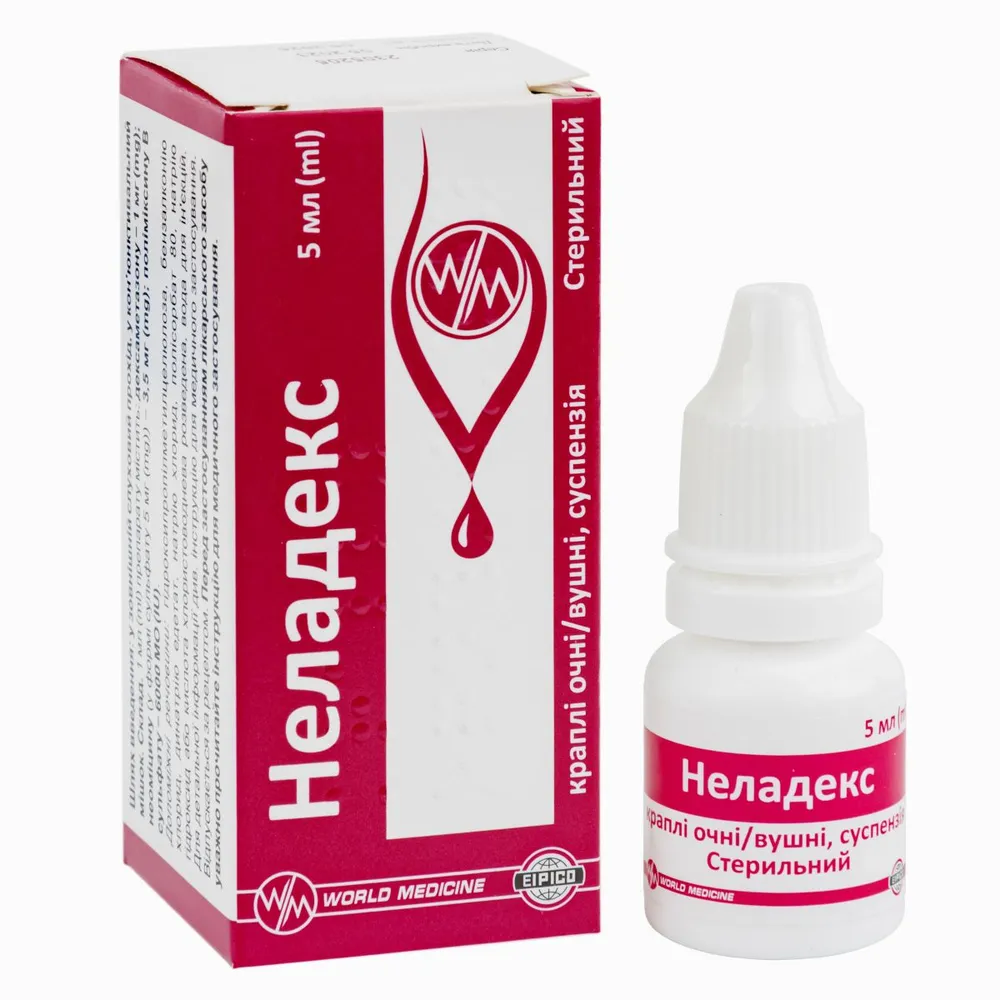
Table of Contents
INSTRUCTIONS for medical use of the medicinal product NELADEX (NELADEX)
Composition:
Active substances: dexamethasone, neomycin, polymyxin B;
1 ml of the preparation contains: dexamethasone − 1 mg; neomycin (as sulfate 5 mg) − 3.5 mg; polymyxin B sulfate − 6000 IU;
Excipients: hydroxypropylmethylcellulose, benzalkonium chloride, disodium edetate, sodium chloride, polysorbate 80, sodium hydroxide or hydrochloric acid diluted, water for injections.
Pharmaceutical form. Eye/ear drops, suspension.
Main physicochemical properties: white microdispersed suspension.
Pharmacotherapeutic group.
Agents used in ophthalmology. Corticosteroids in combination with antimicrobial agents. ATC code S01CA01.
Pharmacological properties.
Pharmacodynamics.
Neladex is a combined medicinal product with antibacterial and anti-inflammatory effects, containing neomycin, polymyxin B, and dexamethasone.
Neomycin is a broad-spectrum antibiotic from the aminoglycoside group. It exerts a bactericidal effect by disrupting protein synthesis in microbial cells. It is active against gram-positive and gram-negative microorganisms, including Staphylococcus aureus, Streptococcus pneumoniae, Escherichia coli, Proteus spp., Shigella spp. It has low activity against Pseudomonas aeruginosa and streptococci.
It is inactive against pathogenic fungi, viruses, and anaerobic flora. Microbial resistance to neomycin develops slowly and to a minor extent.
Polymyxin B is an antibiotic with a polypeptide structure. Its mechanism of action is based on its ability to bind to phospholipids in microbial cell membranes, leading to their destruction. It is active against gram-negative microorganisms, including Escherichia coli, Shigella spp., Enterobacter spp., Klebsiella spp., Haemophilus influenzae, Salmonella spp., Bordetella pertussis. It is highly active against Pseudomonas aeruginosa. It has no effect on Proteus spp., Neisseria spp., obligate anaerobes, or gram-positive bacteria.
Vibrio cholerae (except the eltor subtype) and Coccidioides immitis are also sensitive to polymyxin B, although fungi generally show resistance to this antibiotic.
Dexamethasone is a glucocorticoid agent. It lacks mineralocorticoid activity. It has pronounced anti-inflammatory, antiallergic, and desensitizing effects. Dexamethasone actively suppresses inflammatory processes and the release of inflammatory mediators by eosinophils, inhibits smooth cell migration, and reduces capillary permeability.
Pharmacokinetics.
When the drug is applied locally, systemic absorption is low.
Clinical characteristics.
Indications.
- Inflammation of ocular tissues where corticosteroid use is indicated and where there is superficial bacterial infection or risk of its development (conjunctivitis, keratitis).
- Acute and chronic external otitis, acute otitis media without perforation of the tympanic membrane.
Contraindications.
- Hypersensitivity to the active substances and/or to any of the excipients of the medicinal product;
- Hypersensitivity to other aminoglycosides;
- Keratitis caused by Herpes simplex (simplex virus);
- Viral diseases of the cornea and conjunctiva (including vaccinia and varicella);
- Untreated purulent ocular infections;
- Mycobacterial infections of the eye;
- Untreated parasitic infections of the eye;
- Fungal diseases of the eye and ear;
- Viral diseases of the ear;
- Presence or suspicion of tympanic membrane perforation;
- Tuberculosis;
- Contraindicated after uncomplicated removal of a foreign body from the cornea;
- Contraindicated in children.
Interaction with other medicinal products and other forms of interaction.
Concomitant use of locally applied corticosteroids and nonsteroidal anti-inflammatory drugs (NSAIDs) for local application increases the risk of corneal wound healing complications.
If more than one ophthalmic agent is used locally, the interval between applications should be at least 5 minutes. Ophthalmic ointments should be applied last.
In patients taking ritonavir, an increased plasma concentration of dexamethasone is possible (see section "Special precautions for use").
CYP3A4 inhibitors (including ritonavir and cobicistat) may reduce dexamethasone clearance, leading to more severe adverse reactions and adrenal cortex suppression/Cushing's syndrome. Concomitant use of these agents should be avoided unless the benefit outweighs the increased risk of systemic corticosteroid adverse reactions. If concomitant use is necessary, patients should be monitored for systemic corticosteroid adverse effects.
Special precautions for use.
Use in ophthalmology.
In some patients, sensitivity to topically applied aminoglycosides, particularly neomycin, may occur. The severity of hypersensitivity reactions may vary from local manifestations to generalized reactions such as erythema, itching, urticaria, skin rash, anaphylaxis, anaphylactoid reactions, or bullous-type reactions. If hypersensitivity occurs, the drug should be discontinued.
In addition, topical application of neomycin may lead to skin sensitization.
Cross-sensitivity to other aminoglycosides may occur. Also, patients who become sensitized to topical neomycin may also become sensitive to other aminoglycosides administered topically and/or systemically.
Serious adverse reactions, including neurotoxicity, ototoxicity, and nephrotoxicity, have occurred in patients receiving systemic neomycin therapy or when neomycin was applied topically to treat open wounds or damaged skin. Nephrotoxic and neurotoxic reactions have also been observed with systemic use of polymyxin B. Although such reactions have not been reported following topical ocular administration, the drug should be used with caution in patients concurrently receiving systemic aminoglycosides or polymyxin B. Plasma levels of neomycin should be monitored.
Prolonged topical ocular use of corticosteroids may lead to ocular hypertension and/or glaucoma, resulting in optic nerve damage, decreased visual acuity, visual field defects, and development of posterior subcapsular cataract. Patients undergoing prolonged topical ocular corticosteroid therapy (more than 10 days) should have intraocular pressure monitored regularly and frequently. This is particularly important in children, as corticosteroid-induced elevation in intraocular pressure may be greater and occur earlier in children than in adults. The risk of increased intraocular pressure and cataract formation due to corticosteroid use is higher in patients with predisposing factors (e.g., patients with diabetes mellitus).
Visual disturbances may occur during systemic or topical corticosteroid therapy. If a patient experiences symptoms such as blurred vision or other visual disturbances, an ophthalmologist should be consulted to determine possible causes, including cataract, glaucoma, or rare conditions such as central serous chorioretinopathy (CSC), which has been reported following systemic or topical corticosteroid use.
Direct use of the drug in the pre- and postoperative period is not recommended, as neomycin may in some cases cause neuromuscular blockade. This effect potentiates the action of skeletal muscle relaxants and may lead to respiratory depression or arrest.
Corticosteroids may reduce resistance to bacterial, fungal, parasitic, or viral infections to which the patient is insensitive and may mask the clinical signs of such infections, thereby interfering with their detection.
After intensive or prolonged continuous therapy, Cushing's syndrome and/or adrenal suppression may occur in predisposed patients, including children and patients receiving ritonavir, due to systemic absorption of dexamethasone following topical ophthalmic administration (see section "Interaction with other medicinal products and other forms of interaction"). In such cases, treatment should not be stopped abruptly—dose reduction should be gradual.
Persistent corneal ulceration should prompt consideration of possible fungal infection. If fungal infection occurs, the drug should be discontinued.
As with other antibacterial agents, prolonged use of neomycin and polymyxin may lead to overgrowth of nonsusceptible microorganisms, including fungi. If superinfection occurs, the drug should be discontinued and alternative therapy initiated.
It is known that in conditions causing thinning of the cornea or sclera, topical corticosteroid use may lead to perforation. Topically applied ocular corticosteroids may delay corneal wound healing. Topical NSAIDs are also known to delay or impair corneal wound healing. Concurrent topical use of NSAIDs and corticosteroids increases the risk of wound healing complications (see section "Interaction with other medicinal products and other forms of interaction").
Topical corticosteroids should never be used in cases of undiagnosed red eye, as inappropriate use may lead to complete blindness.
To prevent complications of herpes virus-induced corneal disease, frequent slit-lamp examinations are recommended.
Topical corticosteroids are ineffective in keratitis caused by mustard gas exposure or in Sjögren's keratoconjunctivitis.
Prolonged use of the drug should be avoided, as it may lead to skin hypersensitivity and the emergence of resistant microorganisms.
Cushing's syndrome and/or adrenal cortex suppression associated with systemic absorption of ophthalmic dexamethasone formulations may occur after intensive or long-term continuous therapy in predisposed patients, including children and patients receiving CYP3A4 inhibitors (e.g., ritonavir and cobicistat). In such cases, the drug should be tapered gradually.
Contact lenses should not be worn during treatment of eye inflammation or infection.
The drug contains benzalkonium chloride, which may cause eye irritation and is known to discolor soft contact lenses. Contact with soft contact lenses should be avoided. However, if the physician considers contact lens use acceptable, patients should be advised to remove contact lenses before instilling eye drops and to wait at least 15 minutes before reinserting them.
Use in otology.
Prior to initiating treatment, the integrity of the tympanic membrane must be examined (see section "Adverse reactions"). The drug must not be used if the tympanic membrane is perforated, as serious complications (e.g., deafness, balance disturbances) may occur.
Prolonged, uncontrolled use of the drug should be avoided, as it may lead to irreversible partial or complete deafness, particularly in elderly patients and in patients with renal impairment. Renal dysfunction reduces the plasma clearance of neomycin.
Topical use of antibacterial agents may cause sensitization to active ingredients and lead to systemic reactions.
The presence of a corticosteroid does not affect the manifestations of skin allergic reactions to antibiotics but may alter the clinical picture of the allergic reaction.
The drug should be discontinued immediately if skin rash or other local or systemic signs of allergic reactions occur.
Athletes should be informed that this medicinal product contains an active substance (dexamethasone) that may result in a positive doping test.
If symptoms do not resolve after 7 days of treatment, the patient should consult a physician for reassessment of diagnosis and treatment strategy.
Use during pregnancy or breastfeeding.
Pregnancy.
Data on the use of dexamethasone, neomycin, or polymyxin B in pregnant women are limited. Aminoglycoside antibiotics such as neomycin cross the placenta after intravenous administration to pregnant women. Preclinical and clinical systemic exposure to aminoglycosides can cause ototoxicity and nephrotoxicity. When this medicinal product is used topically at low doses, neomycin does not cause ototoxicity or nephrotoxicity following intrauterine exposure. In a rat study, oral administration of neomycin at doses up to 25 mg/kg body weight per day did not result in maternal toxicity, fetotoxicity, or teratogenicity. Prolonged or repeated use of corticosteroids during pregnancy is associated with an increased risk of intrauterine growth retardation. Infants born to mothers who received significant doses of corticosteroids during pregnancy should be closely monitored for signs of adrenal insufficiency.
Animal studies indicate reproductive toxicity following systemic and ophthalmic administration of dexamethasone. There are no data on the safety of polymyxin B in pregnant animals.
The drug is not recommended for use during pregnancy.
Breastfeeding.
It is unknown whether dexamethasone, neomycin, or polymyxin B, when applied topically to the eye, pass into human breast milk. Aminoglycosides are excreted in breast milk following systemic administration. There are no data on the penetration of dexamethasone and polymyxin B into breast milk. It is highly likely that dexamethasone, neomycin, and polymyxin B will not be present in significant amounts in breast milk and will not cause clinical effects in the newborn when the drug is used appropriately for topical application by the mother. However, the risk to the nursing infant cannot be entirely excluded. The possibility of temporarily discontinuing breastfeeding during treatment or discontinuing/withholding therapy should be considered, taking into account the benefits of breastfeeding for the child and the benefits of therapy for the mother.
Effect on fertility.
There are no data on the effects of neomycin or polymyxin B on fertility in men or women.
Clinical data on the effects of dexamethasone on fertility in men and women are insufficient. Dexamethasone did not adversely affect fertility in rats treated with chorionic gonadotropin.
Ability to affect performance and drive vehicles or operate machinery.
During use of the drug, transient blurred vision or other visual disturbances may occur, which could impair the ability to drive vehicles or operate machinery. If blurred vision occurs after instillation, the patient should wait until vision clears before driving or operating machinery.
Dosage and Administration
Ophthalmological Use
Before instillation, the bottle should be shaken well.
In mild cases of disease, administer 1–2 drops into the conjunctival sac 4–6 times daily.
In severe infections, the drops may be used hourly, but not for more than 2 days. The frequency should be gradually reduced to 2–3 times daily as the patient's condition improves. The duration of treatment is determined individually by the physician in each specific case.
After instillation, it is recommended to close the eyelids tightly or perform nasolacrimal occlusion. This reduces systemic absorption of drugs applied to the eye, thereby decreasing the likelihood of systemic adverse reactions.
The duration of treatment and the need for repeated courses depend on the nature of the disease and the treatment response. Typically, treatment lasts 6–10 days.
After the first opening of the bottle, remove the protective ring designed for tamper-evident control.
During treatment with eye drops, to prevent microbial contamination, avoid touching the eye, eyelids, adjacent areas, or other surfaces with the dropper tip.
If more than one ophthalmic agent is used locally, an interval of at least 5 minutes should be maintained between applications. Ophthalmic ointments should be applied last.
Otological Use
Administer 1–5 drops into each ear twice daily.
The duration of treatment depends on the nature and severity of the condition and is determined by the physician. The average duration of treatment is 7 days.
After the first opening of the bottle, remove the protective ring designed for tamper-evident control.
Before use, warm the bottle in the hand to avoid discomfort caused by instillation of cold liquid into the ear.
Do not inject under pressure. Tilt the head, instill the required number of drops into the ear, and keep the head tilted for several minutes. Repeat the procedure for each ear.
Patients with Hepatic or Renal Impairment
Studies have not been conducted in these patient populations. However, due to the low systemic absorption of the active ingredients following local administration, dosage adjustment is not considered necessary.
Children
The medicinal product should not be used in children, as safety and efficacy have not been established.
Overdose
Symptoms of overdose observed in some patients include punctate keratitis, erythema, increased lacrimation, eyelid edema, and itching. Manifestations of overdose may resemble adverse effects observed in some patients. Prolonged and intensive use of the medicinal product may lead to systemic adverse reactions.
In case of overdose during topical application, wash out the excess medicinal product from the eye(s) with warm water. If necessary, symptomatic treatment should be administered.
Adverse Reactions
The most frequently observed adverse reactions during clinical trials of the combination of dexamethasone/neomycin/polymyxin B sulfate, occurring in 0.7–0.9% of patients, were eye discomfort, keratitis, and eye irritation.
Adverse reactions were classified by frequency as follows: very common (≥ 1/10), common (≥ 1/100 to < 1/10), uncommon (≥ 1/1000 to < 1/100), rare (≥ 1/10,000 to < 1/1000), and very rare (< 1/10,000). Within each frequency group, adverse reactions are listed in order of decreasing severity. The data on adverse reactions were obtained from clinical trials.
Eye disorders:
Uncommon – keratitis, increased intraocular pressure, eye pruritus, eye discomfort, eye irritation.
Skin and subcutaneous tissue disorders:
Rare – local exfoliative dermatitis, skin atrophy, telangiectasia, striae, exacerbation of the underlying skin condition, including eczema.
General disorders and administration site conditions:
Rare – reactions at the site of application, including pain, irritation, swelling, burning sensation, rash.
Additional adverse reactions identified during post-marketing surveillance include the following. The frequency cannot be estimated from the available data. Within each system organ class, adverse reactions are listed in order of decreasing severity.
Immune system disorders:
Hypersensitivity.
Nervous system disorders:
Headache.
Eye disorders:
Ulcerative keratitis, blurred vision, photophobia, mydriasis, eyelid ptosis, eye pain, eye swelling, foreign body sensation in the eye, eye hyperemia, increased lacrimation, corneal pigmentation.
Ear and labyrinth disorders:
Vestibular or cochlear ototoxicity in case of tympanic membrane perforation (see section "Special precautions").
Skin and subcutaneous tissue disorders:
Hypersensitivity reactions, including rash, pruritus, irritation, swelling, erythema, contact dermatitis, Stevens-Johnson syndrome.
Endocrine disorders:
Cushing's syndrome, adrenal suppression.
Additional adverse reactions observed with dexamethasone and potentially expected with this medicinal product include dysgeusia, dizziness, conjunctivitis, dry eye syndrome, eyelid margin scaling, decreased visual acuity, corneal erosion.
With intensive use of the medicinal product, systemic adverse reactions may occur.
Some patients may develop sensitivity to locally applied aminoglycosides. In addition, neomycin for topical ophthalmic use may cause skin sensitization (see section "Special precautions").
Prolonged topical ocular use of corticosteroids may lead to elevated intraocular pressure, resulting in glaucoma, optic nerve damage, decreased visual acuity, visual field defects, and the formation of posterior subcapsular cataract (see section "Special precautions").
Secondary infections may be caused by the use of combinations containing corticosteroids and antimicrobial agents (see section "Special precautions").
Because the medicinal product contains corticosteroids, prolonged use increases the risk of corneal or scleral perforation in patients with conditions causing thinning of the cornea or sclera (see section "Special precautions").
Reporting of suspected adverse reactions.
Reporting of suspected adverse reactions after the medicinal product has been authorized is important. It allows continued monitoring of the benefit-risk balance of the medicinal product. Healthcare professionals should report any suspected adverse reactions via the national pharmacovigilance system.
Shelf life. 2 years.
After opening the bottle, the medicinal product should be used within 1 month.
Storage conditions.
Store at a temperature not exceeding 25 °C. Keep out of reach of children.
Packaging.
5 ml in a plastic dropper bottle with a screw cap, in a cardboard box.
Prescription status.
Prescription only.
Manufacturer.
UORLД MEDICINE ILAC SAN. VE TİC. A.Ş./
WORLD MEDICINE ILAC SAN. VE TIC. A.S.
Manufacturer's address.
COSB G.O.Pasa Mah. 6. Cad. No:30, Cerkezkoy/Tekirdag, Turkey.
Marketing Authorization Holder.
WORLD MEDICINE, LLC, Ukraine.