Non-infectious allergens (mixt-allergens) plant pollen group in the form of dragees
Ukraine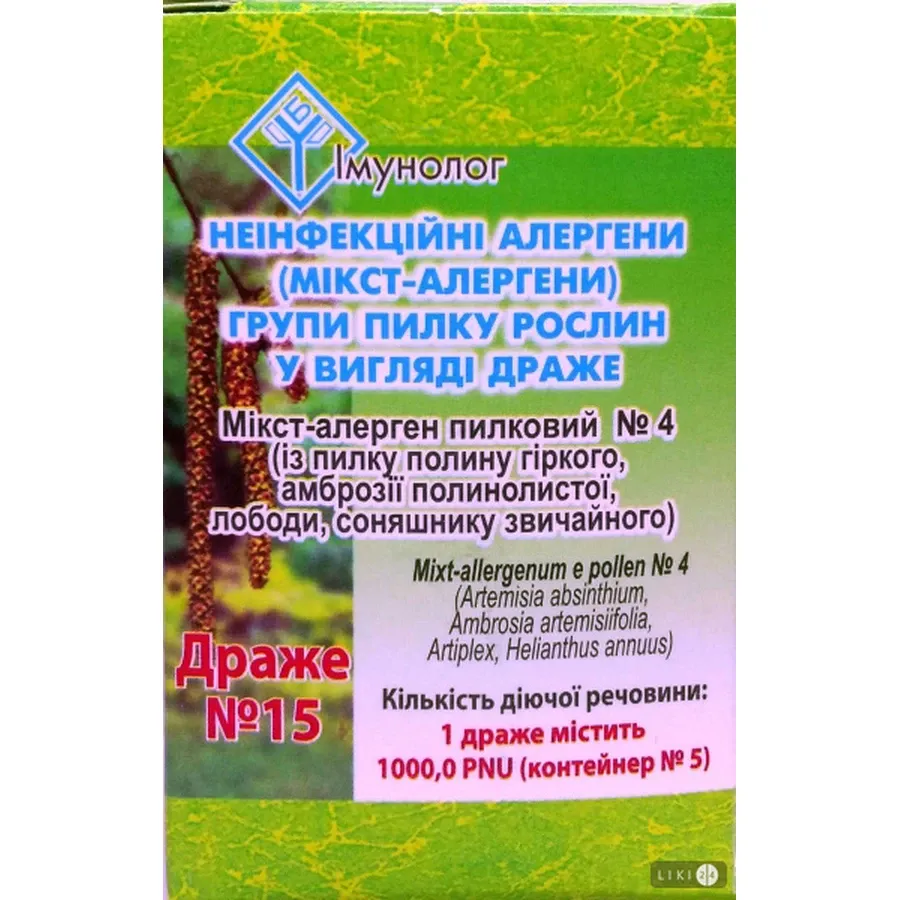
Table of Contents
INSTRUCTION FOR MEDICAL USE OF THE MEDICINAL PRODUCT Non-infectious allergens (mix-allergens) of plant pollen group in the form of tablets
Composition:
Active substances: mix-allergens of pollen (mixtures of allergens taken in equal proportions) (Mixt-allergena e pollen):
1 tablet contains mix-allergen pollen № 1 (from pollen of birch, alder, oak, common hazel) (Mixt-allergenum e pollen № 1 (Betula, Alnus aglutinosa, Quercus, Corylus avellana));
1 tablet contains mix-allergen pollen № 2 (from pollen of orchard grass, meadow grass, perennial ryegrass, meadow fescue, meadow foxtail) (Mixt-allergenum e pollen № 2 (Dactylis glomerata, Poa pratensis, Lolium perenne, Festuca pratensis, Alopecurus pratensis));
1 tablet contains mix-allergen pollen № 3 (from pollen of brome grass, couch grass, rye, timothy grass) (Mixt-allergenum e pollen № 3 (Bromus, Agropyrum repens, Secale cereale, Phleum pratense));
1 tablet contains mix-allergen pollen № 4 (from pollen of common wormwood, ragweed, orache, common sunflower) (Mixt-allergenum e pollen № 4 (Artemisia absinthium, Ambrosia artemisiifolia, Artiplex, Helianthus annuus));
1 tablet contains: 0.2 PNU (container № 1) or 2.0 PNU (container № 2), or 20.0 PNU (container № 3), or 200.0 PNU (container № 4), or 1000.0 PNU (container № 5);
Excipients: sucrose, syrup (glucose syrup), sodium chloride, disodium phosphate dodecahydrate (sodium phosphate dibasic), potassium dihydrogen phosphate (potassium phosphate monobasic), phenol, purified water.
The product does not contain impurities or dyes.
Note: 1 PNU (Protein Nitrogen Unit) – an international unit accepted for determining the concentration of protein nitrogen in allergens, equivalent to 0.00001 mg of protein nitrogen.
Pharmaceutical form. Tablet.
Main physicochemical properties: spherical tablet from white to various shades of grey.
Pharmacotherapeutic group. Allergen extracts. Pollen allergens. ATC code V01A A02.
Allergen extracts. Tree pollen allergens. ATC code V01A A05.
Immunological and biological properties.
Pharmacodynamics.
Mechanism of action. The active ingredient of allergens (mix-allergens) of the plant pollen group in the form of tablets is a protein-polysaccharide complex, whose multifactorial effect on the patient's immune system ensures the effect of allergen-specific immunotherapy (ASIT) (induction of tolerance to the corresponding allergens).
ASIT exerts a therapeutic effect affecting all stages of the allergic process, including its immunological phase, and leads to a shift in immune response from Th2-type to Th1-type, inhibits both early and late phases of IgE-mediated allergic reaction, suppresses the cellular component of allergic inflammation and non-specific tissue hyperreactivity.
During ASIT the following occurs: increased production of blocking antibodies, reduced release of allergy mediators, increased activity of suppressor cells and mechanisms; increased number of IL-2 producing cells, enhanced function of Th1 helper lymphocytes and reduced Th2 function, shift of CD4+ cells from Th2 to Th1 phenotype, increased functional activity of T-lymphocytes, enhanced function of isotype-specific T-suppressors, regulation of IgE induction by idiotypic antibodies, decreased reactivity of mediator-producing cells.
With oral/sublingual ASIT, allergens reach immunocompetent cells via two pathways: directly through the lymphoid pharyngeal ring and through the gastrointestinal tract when the allergen is swallowed with saliva. The efficacy of ASIT is thus determined not only by the phenomenon of oral tolerance, but also by contact of the ingested allergen with the immune system of the gastrointestinal tract. The positive effect of oral/sublingual ASIT is based on the influence of the allergen on dendritic cells of the oral mucosa, which possess allergen-presenting cell properties, modulating effects on T-helper and T-regulatory cells, changes in cytokine production, and synthesis of blocking antibodies.
Pharmacokinetics.
Not studied. The action of the drug is due to the combined effect of its protein components, making pharmacokinetic studies impossible, as all components cannot be traced using markers or bioassays. For the same reasons, metabolites of the drug cannot be identified.
Clinical characteristics.
Indications.
The medicinal product is intended for allergen-specific immunotherapy of hypersensitivity to relevant pollen allergens.
Allergen-specific immunotherapy (AIT) for hypersensitivity to pollen allergens is administered to patients in whom sensitization to these allergens has been confirmed by skin tests.
AIT is indicated when:
- IgE-mediated nature of the disease has been confirmed;
- the disease has a prolonged course with pronounced clinical manifestations;
- there is clear confirmation of the role of plant pollen allergens;
- complete allergen elimination is not possible;
- the necessary standardized allergens are available.
Contraindications.
To identify contraindications, the physician must examine the patient on the day of initiation of AIT.
Severe immunopathological conditions and immunodeficiencies (including HIV); oncological diseases; severe psychiatric disorders; acute infections and chronic infections in the phase of exacerbation; elevated body temperature (above 38.5 °C); infectious diseases (viral hepatitis, tuberculosis); lack of control of bronchial asthma (FEV1 less than 70 % despite adequate pharmacotherapy, including severe forms of bronchial asthma); exacerbation of bronchial asthma within 3 days prior to dose administration; cardiovascular diseases in which complications may arise from the use of adrenaline (epinephrine); use of beta-adrenergic antagonists (beta-blockers), including topical agents, and ACE inhibitors (for treatment of hypertension or ischemic heart disease); severe cardiovascular diseases; history of anaphylactic shock during AIT; age under 3 years; diabetes mellitus; uncontrolled thyrotoxicosis; myocardial infarction within the past year; active autoimmune diseases; pregnancy and breastfeeding (see section "Use during pregnancy or breastfeeding"); physical exertion immediately after dose administration; persistent mucosal damage in the oral cavity: ulcers, erosions; persistent periodontal disease; open wound in the oral cavity; recent tooth extraction or other surgical procedures in the oral cavity; gingivitis with bleeding gums; oral diseases (stomatitis, glossitis); severe inflammatory diseases of the oral mucosa (e.g., lichen planus, mycoses); acute or chronic gastrointestinal tract diseases (esophagitis, gastritis, peptic ulcer, enteritis, colitis, hepatitis, etc.); hypersensitivity to excipients of the medicinal product.
Special precautions.
No special warnings or precautionary measures are required for allergen medicinal products in the form of tablets.
Any unused medicinal product or waste material must be disposed of in accordance with local requirements.
Interaction with other medicinal products and other forms of interaction. AIT should not be performed during treatment with antibiotics, cytostatics, or immunobiological agents. AIT may be combined with medicinal products used for the treatment of allergic diseases (non-sedating antihistamines, cromones, bronchodilators, topical glucocorticosteroids, anti-leukotriene agents).
Do not use simultaneously with beta-blockers.
Special precautions for use.
AIT must be carried out only after the physician has obtained written informed consent from the patient!
Administration of AIT via tablets is prescribed exclusively by an allergist or pediatric allergist experienced in the treatment of allergic diseases and who has undergone special training, including management of emergency measures in cases of anaphylaxis.
AIT should be conducted on an outpatient basis; therefore, potential serious allergic reactions and the possibility of delayed systemic reactions to therapy must be thoroughly discussed with patients, and an action plan in such cases must be established.
Monitoring of treatment is advisable, with periodic patient examinations (initially daily, and later each time a new tablet dose is introduced). Based on evidence-based data from global medicine regarding the safety of oral AIT, disciplined patients (or parents of pediatric patients) may be trusted to self-administer the tablets, provided they periodically inform the allergist by phone or email about the course of treatment, well-being, and drug tolerability. In case of any signs of adverse events possibly related to AIT (appearance or worsening of allergic disease symptoms, nausea, vomiting, stomach pain, skin rash, or itching), the patient must immediately visit the allergist. The patient should also see the allergist at least once a month even if AIT is progressing normally.
Relative or temporary contraindications for AIT
Age over 55 years; skin diseases; chronic infectious diseases; weakly positive skin tests with allergens; previous AIT failure (if applicable); exacerbation of the underlying allergic disease; exacerbation of any concomitant disease; any intercurrent illness in the acute phase; concomitant use of MAO inhibitors in combination with sympathomimetics; vaccination (see section "Vaccination").
Restrictions for AIT use
Inadequate patient understanding of the necessity of AIT and poor patient compliance; long duration of allergic disease (10 years or more); delayed positive skin tests with allergens; presence of symptoms of non-specific hyperreactivity; sensitization to food, drug, or chemical allergens; pronounced hypersensitivity to 5 or more allergens.
Vaccination
Vaccination should not be performed during the first, dose-escalation phase of AIT.
It is advisable to carry out routine vaccination one month before starting AIT or, if possible, to postpone vaccination until after completion of the main AIT course. For long-term AIT (continuous administration for 3 or more years) during the second, maintenance phase, vaccination may be performed provided the following conditions are met:
- AIT and prophylactic vaccination should not be administered on the same day;
• vaccination should be performed no earlier than 2–3 weeks after the last allergen dose; - if no adverse reactions occur following vaccine administration, AIT may be resumed no earlier than:
- 2 weeks after administration of inactivated vaccines;
- 4 weeks after administration of live vaccines;
- 8–12 weeks after administration of BCG vaccine;
- 1 week after tuberculin skin testing.
AIT should be resumed at the same dose that was used prior to vaccination.
The medicinal product contains sucrose in the amount of 2.85–14.25 g/dose (depending on the number of tablets taken by the patient); therefore, the product is not prescribed for patients with diabetes mellitus.
The product contains glucose; therefore, patients with known intolerance to certain sugars should consult their physician before taking this medicinal product.
The medicinal product contains potassium and sodium compounds; however, their content is less than 1 mmol (39 mg)/dose of potassium and 1 mmol (23 mg)/dose of sodium, which allows the product to be considered practically free of potassium and sodium.
Use during pregnancy or breastfeeding.
Pregnancy is a contraindication for AIT (see section "Contraindications") due to the risk of systemic allergic reactions, which may lead to uterine contractions, and the potential need for epinephrine (adrenaline), which may cause constriction of the umbilical artery.
AIT should not be initiated during pregnancy. If pregnancy occurs during ongoing AIT, further administration of allergens should be determined jointly by the allergist and the obstetrician-gynecologist, considering the potential risk to mother and fetus in case of systemic allergic reaction or anaphylactic shock. Discontinuation of AIT is recommended if pregnancy occurs during the dose-escalation phase. AIT may be continued if pregnancy occurs during the maintenance phase.
AIT should not be initiated during breastfeeding.
Ability to affect reaction speed when driving or operating machinery.
Allergen preparations do not affect the ability to drive or operate machinery.
Method of Administration and Dosage
Allergen-Specific Immunotherapy (ASIT) with mixed plant pollen allergens in the form of tablets is administered to patients who have been diagnosed with sensitization to these allergens by skin testing, in the absence of contraindications and after obtaining the patient's written informed consent from the physician!
Mixed plant pollen allergen tablets are intended for oral/sublingual administration.
The tablet must be slowly dissolved in the mouth (do not chew or swallow whole), preferably placed under the tongue! Do not drink water after administration!
Administration of allergens in the form of tablets should be performed no sooner than 1–2 hours after eating or 1–2 hours before meals! If a large number of tablets is prescribed (4–5), they do not need to be taken at once; the dose may be divided into several administrations throughout the same day.
Regimen for Allergen-Specific Immunotherapy (ASIT)
- Tablets from container No. 1 (allergen content by protein nitrogen – 0.2 PNU) are administered as follows: Day 1 – 1 tablet, Day 2 – 2 tablets, Day 3 – 3 tablets, Day 4 – 4 tablets, Day 5 – 5 tablets.
Administration of tablets from container No. 2 should begin one day after taking the last tablets from container No. 1.
- Tablets from container No. 2 (allergen content by protein nitrogen – 2.0 PNU) are administered as follows: Day 1 – 1 tablet, Day 3 – 2 tablets, Day 5 – 3 tablets, Day 7 – 4 tablets, Day 9 – 5 tablets.
Administration of tablets from container No. 3 should begin two days after taking the last tablets from container No. 2.
- Tablets from container No. 3 (allergen content by protein nitrogen – 20.0 PNU) are administered as follows: Day 1 – 1 tablet, Day 3 – 2 tablets, Day 6 – 3 tablets, Day 9 – 4 tablets, Day 12 – 5 tablets.
Administration of tablets from container No. 4 should begin one week after taking the last tablets from container No. 3.
- Tablets from container No. 4 (allergen content by protein nitrogen – 200.0 PNU) are administered as follows: Week 1 – 1 tablet, Week 2 – 2 tablets, Week 3 – 3 tablets, Week 4 – 4 tablets, Week 5 – 5 tablets. Take every Monday each week.
Administration of tablets from container No. 5 should begin two weeks after taking the last tablets from container No. 4.
- Tablets from container No. 5 (allergen content by protein nitrogen – 1000.0 PNU) are administered at a dose of 1 tablet every 2 weeks (on the Monday of each second week).
Subsequently, tablets from container No. 5 should be taken (unless otherwise advised by the physician) once a month—2 tablets on the second Monday of each month—for a period of 3 years or longer.
During the pollen season of the corresponding plants, the physician may recommend a modified dosing regimen (e.g., 1 tablet from container No. 5 or another schedule).
The ASIT regimen for children is identical to that for adults.
The duration of ASIT is determined by the allergist. Typically, the maximum therapeutic effect of ASIT develops 1–2 years after initiation. The optimal duration of ASIT is considered to be 3–5 years. If no therapeutic effect is observed within one year, ASIT should be discontinued.
Children.
Allergen-specific immunotherapy with mixed plant pollen allergen tablets is not recommended for children under 3 years of age.
When administering allergen-specific immunotherapy to children, current orders of the Ministry of Health of Ukraine must be followed.
Overdose.
Exceeding the prescribed dose of allergens during allergen-specific immunotherapy may lead to the development of adverse reactions in the patient.
Adverse reactions.
When administering allergens as sublingual tablets, adverse reactions may occur very rarely.
Potential adverse reactions may develop 10 minutes or more after allergen administration and may manifest as follows:
- Disorders of the respiratory system, thoracic organs, and mediastinum: cough, dyspnea, bronchospasm, sneezing, nasal congestion and itching, throat irritation;
- Disorders of the skin and subcutaneous tissue: rash, facial flushing, urticaria, swelling, pruritus;
- Gastrointestinal disorders: nausea, vomiting, stomach or abdominal pain, diarrhea, which are partly dose-dependent;
- Nervous system disorders: headache, somnolence;
- Psychiatric disorders: excitement;
- Eye disorders: eye redness, lacrimation;
- Musculoskeletal and connective tissue disorders: arthralgia;
- Immune system disorders: anaphylactic reactions;
- General disorders and administration site reactions: general weakness, increased body temperature, sensation of warmth throughout the body, oral cavity itching, swelling of the oral mucosa and tongue.
In case of mild adverse reactions, dose adjustment is required. These adverse reactions usually resolve spontaneously and do not require discontinuation of treatment.
Reporting of suspected adverse reactions.
Reporting of adverse reactions after drug registration is of significant importance.
This enables continuous monitoring of the benefit-risk balance associated with the use of the medicinal product. Healthcare professionals should report any adverse reactions through the national reporting system.
Shelf life.
3 years.
Storage conditions.
Store at a temperature not exceeding 25 °C.
Keep out of reach of children.
Packaging.
15 tablets in containers for medicinal products and pharmaceuticals (5 containers containing allergens: 0.2 PNU (container No. 1), 2.0 PNU (container No. 2), 20.0 PNU (container No. 3), 200.0 PNU (container No. 4), 1000.0 PNU (container No. 5)).
Packed as a kit containing 75 tablets (15 tablets in each of containers No. 1, No. 2, No. 3, No. 4, and No. 5), placed in a cardboard box. The kit includes an instruction for medical use.
For maintenance allergen-specific immunotherapy, 15 tablets in container No. 5 containing 1000.0 PNU of allergens are supplied separately.
Prescription category. By prescription only.
Manufacturer.
LLC "Immunolog", Ukraine.
Manufacturer's location and address of its place of business.
5, Dmytro Mayborody Street, Vinnytsia, Vinnytsia region, 21036, Ukraine.