Non-infectious allergens epidermal group
Ukraine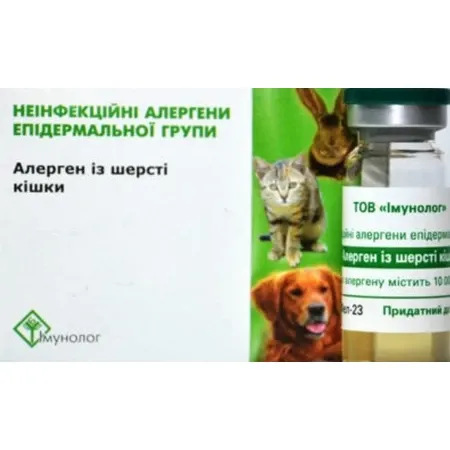
Table of Contents
INSTRUCTIONS FOR MEDICAL USE OF THE MEDICINAL PRODUCT Non-infectious Epidermal Allergens
Composition:
Active substances: epidermal allergens (Allergena ex epidermis):
1 ml of solution contains 10,000 PNU of cat hair allergen,
1 ml of solution contains 10,000 PNU of dog hair allergen,
1 ml of solution contains 10,000 PNU of sheep wool allergen,
1 ml of solution contains 10,000 PNU of rabbit hair allergen,
1 ml of solution contains 10,000 PNU of guinea pig hair allergen,
1 ml of solution contains 10,000 PNU of human hair allergen;
Excipients: sodium chloride, disodium phosphate dodecahydrate (sodium phosphate dibasic), potassium dihydrogen phosphate (potassium phosphate monobasic), phenol, water for injections.
1 vial contains 5 ml of allergen (10,000 PNU/ml).
Note: 1 PNU (Protein Nitrogen Unit) – an international unit accepted for determining the concentration of protein nitrogen in allergens, equal to 0.00001 mg of protein nitrogen.
Pharmaceutical form. Solution for injection.
Main physicochemical properties: clear liquid ranging in color from colorless to dark brown.
Pharmacotherapeutic group. Allergen extracts. Animal allergens.
ATC code: V01A A11.
Immunological and biological properties.
Pharmacodynamics.
Mechanism of action. The active component of epidermal allergens is a protein-polysaccharide complex which, when used in skin and provocation tests, enables diagnosis of patient sensitization to a given allergen. If necessary, the preparation may be used for allergen-specific immunotherapy (AIT) in patients with hypersensitivity to corresponding epidermal allergens. The ability of allergen components to interact with specific IgE class antibodies (reagins) in the patient and to provoke a reaction in a sensitized organism determines the diagnostic potential of the preparation, while multifactorial effects on the patient's immune system provide the therapeutic effect of allergen-specific immunotherapy (induction of tolerance to the respective allergens).
Allergen-specific immunotherapy exerts a therapeutic effect affecting all stages of the allergic process, including its immunological phase, and leads to a shift in immune response from Th2-type to Th1-type, suppresses both early and late phases of IgE-mediated allergic reactions, inhibits the cellular component of allergic inflammation and non-specific tissue hyperreactivity.
During allergen-specific immunotherapy the following occurs: increased production of blocking antibodies, reduced release of allergic mediators, increased activity of suppressor cells and mechanisms; increased number of IL-2 producing cells, enhanced function of Th1 helper lymphocytes and reduced Th2 activity, phenotypic switch of CD4+ cells from Th2 to Th1, enhanced functional activity of T-lymphocytes, strengthened function of isotopic T-suppressors, regulation of IgE induction by idiotypic antibodies, reduced reactivity of mediator-producing cells.
Pharmacokinetics.
Not studied. The effect of the preparation is due to the combined action of its protein components, making pharmacokinetic studies impossible, as individual components cannot be tracked using markers or bioassays. For the same reasons, metabolites of the preparation cannot be identified.
Clinical characteristics.
Indications.
Specific diagnosis of allergic diseases by detecting sensitization to epidermal allergens, and allergen-specific immunotherapy of hypersensitivity to epidermal allergens.
Specific diagnosis of allergic diseases
For diagnostic purposes, the preparations are used to perform skin tests by the prick-test method (scarification test and provocation tests may also be performed).
Allergen-specific immunotherapy of allergic diseases
Allergen-specific immunotherapy for hypersensitivity to epidermal allergens is carried out in patients in whom sensitization to these allergens has been confirmed by skin testing.
Allergen-specific immunotherapy is indicated when:
- IgE-mediated nature of the disease is confirmed;
- the disease has a prolonged course with pronounced clinical manifestations;
- there is clear evidence of the role of epidermal group allergens;
- complete elimination of the allergen is not possible;
- appropriate standardized allergens are available.
Contraindications.
To identify contraindications, the physician must examine the patient on the day of performing skin tests or administering allergen-specific immunotherapy (ASIT).
Contraindications for performing skin tests with allergens
Age under 1 year for prick-test and under 3 years for scarification test; acute exacerbation of the allergic disease being diagnosed; skin pathology at the test site (e.g., eczema); acute respiratory infections with fever; chronic diseases in decompensated stage; active tuberculosis in any location; acute exacerbation of psychiatric disorders; systemic diseases (collagenoses) and oncological diseases.
Pregnancy is a contraindication for skin testing (see section "Use during pregnancy or breastfeeding").
A risk factor for anaphylactic reactions is the use of beta-adrenergic antagonists (beta-blockers).
Contraindications for allergen-specific immunotherapy (ASIT)
Severe immunopathological conditions and immunodeficiencies (including HIV); oncological diseases; severe psychiatric disorders; acute infections and chronic infections in the phase of exacerbation; elevated body temperature (above 38.5 °C); infectious diseases (viral hepatitis, tuberculosis); uncontrolled bronchial asthma (FEV1 less than 70 % despite adequate pharmacotherapy, including severe bronchial asthma); asthma exacerbation within 3 days prior to dose administration; cardiovascular diseases in which complications may arise from the use of adrenaline (epinephrine); use of beta-adrenergic antagonists (beta-blockers), including topical agents, and ACE inhibitors (for treatment of hypertensive or ischemic heart disease); severe cardiovascular diseases; history of anaphylactic shock during previous ASIT; age under 5 years (for subcutaneous ASIT); diabetes mellitus; uncontrolled thyrotoxicosis; myocardial infarction within the past year; active autoimmune diseases; pregnancy and breastfeeding (see section "Use during pregnancy or breastfeeding"); physical exertion immediately after dose administration; hypersensitivity to excipients of the preparation.
Special precautions.
No special warnings or precautionary measures are required when using allergen preparations.
Any unused medicinal product or waste material must be disposed of in accordance with local requirements.
Interaction with other medicinal products and other forms of interaction. Specific diagnosis of allergic diseases
The use of antihistamines and glucocorticosteroids affects the reliability of skin tests with allergens (reduces papule size up to complete absence).
The use of H2 histamine receptor blockers, cromoglycate, corticosteroids in doses up to 15 mg of prednisolone, and derivatives of theophylline does not affect the results of allergy testing. A possible effect may occur with local application of steroid ointments. Beta-blockers may enhance skin reactivity.
Allergen-specific immunotherapy of allergic diseases
ASIT should not be performed during treatment with antibiotics, cytostatics, or immunobiological agents. It may be combined with medications used to treat allergic diseases (non-sedating antihistamines, cromones, bronchodilators, topical glucocorticosteroids, anti-leukotriene agents).
Do not use concurrently with beta-blockers.
The intake of food does not affect allergen diagnosis or treatment.
Special precautions for use.
Skin tests and allergen-specific immunotherapy (ASIT) must be prescribed exclusively by an allergist or pediatric allergist experienced in the management of allergic diseases and who has undergone special training, including emergency management of anaphylaxis. These procedures must be performed under the supervision of such a physician in an allergist’s office or inpatient setting.
Skin testing with allergens and ASIT must be performed only after obtaining written informed consent from the patient!
Specific diagnosis of allergic diseases
Indications for skin testing with allergens include patient history, clinical findings, and laboratory test results.
Skin tests are applied on the inner surface of the forearm, at a distance of (30 ± 10) mm from each other, or on the skin of the back. Up to 30 tests may be performed simultaneously if the prick test method is used, or up to 15 tests if the scarification method is used. Performing skin tests with allergens in children under 1 year of age using the prick test method, or in children under 3 years of age using the scarification method, is not recommended. For children, the number of allergen skin tests (using the prick test method) should not exceed the numerical value of their age (for scarification – half that number).
Skin tests are performed using allergen preparations containing 10,000 PNU per 1 mL. For patients with a high degree of sensitization, a preparation concentration of 5,000 PNU per 1 mL should be used.
Temporary contraindications for skin testing include the use of antihistamines (up to 10 days), systemic glucocorticosteroids (up to 14 days), or topical glucocorticosteroid creams applied to the skin area where testing will be performed (up to 30 days). Due to the large number of drugs used in the treatment of allergic diseases and the emergence of new medications, these time intervals are approximate and may vary depending on the specific drug used by the patient. Therefore, skin tests with allergens should only be performed after a positive skin reaction to histamine has been restored!
Allergen-specific immunotherapy for allergic diseases
ASIT with epidermal group allergens is performed in patients in whom sensitization to these allergens has been confirmed by skin testing. During ASIT, allergens are administered subcutaneously into the outer third of the upper arm (in the groove between the deltoid and triceps muscles). Other routes of allergen administration for therapeutic purposes may be used only based on regulatory documents (relevant instructions, protocols, standards, or methodological recommendations) approved by the Ministry of Health of Ukraine. The allergist is responsible for the preparation of allergen dilutions under aseptic conditions for ASIT and for the use of prepared dilutions.
ASIT regimens may vary – from accelerated to slow. The standard ASIT regimen for adults and children is described in this instruction. The decision to use alternative regimens is made by the allergist based on the patient’s condition, age, necessity of ASIT, and the etiology of the allergic disease. ASIT is usually initiated after allergometric titration (by performing a prick test or intradermal injection of serial allergen dilutions to determine the lowest allergen concentration that elicits a skin reaction). ASIT is initiated at a dose 10 times lower than the dose causing a skin reaction. If skin reactivity to a group of allergens is detected, the allergist must determine which specific allergen(s) should be used for ASIT. Performing ASIT with a mixture of allergens containing more than 4 components is considered undesirable.
During skin testing and ASIT, systemic allergic reactions and anaphylactic shock may occur in highly sensitive patients. After allergen injection, the patient must remain under the allergist’s supervision for at least 30 minutes! Every office where ASIT is performed must have an emergency kit available for immediate management of anaphylaxis.
In case of anaphylactic reactions, allergen administration must be stopped immediately, and actions must follow the protocol for emergency medical care in anaphylactic shock in children and adults, approved by the order of the Ministry of Health of Ukraine.
Relative or temporary contraindications for ASIT
Age over 55 years; skin diseases; chronic infectious diseases; weakly positive skin tests with allergens; ineffectiveness of previous ASIT (if performed); exacerbation of the primary allergic disease; exacerbation of any concomitant disease; any intercurrent illness in the acute phase; use of monoamine oxidase inhibitors (MAOIs) in combination with sympathomimetics; vaccination (see section "Vaccination").
Limitations for ASIT use
Insufficient patient understanding of the necessity of ASIT and poor compliance; long duration of allergic disease (10 years or more); delayed positive skin tests with allergens; presence of non-specific hyperreactivity; sensitization to food, drug, or chemical allergens; pronounced hypersensitivity to 5 or more allergens.
Vaccination
Vaccination should not be performed during the first (dose escalation) phase of ASIT.
It is recommended to perform routine vaccination one month before starting ASIT or, if possible, to postpone vaccination until after completion of the primary ASIT course. For long-term ASIT (continuous administration for 3 or more years), vaccination may be performed during the second (maintenance) phase, provided the following conditions are met:
- ASIT injection and prophylactic vaccination should not be performed on the same day;
• vaccination should be performed no earlier than 2–3 weeks after allergen injection;
• if no adverse reactions occur after vaccine administration, the next allergen injection may be administered no earlier than: - 2 weeks after administration of inactivated vaccines;
- 4 weeks after administration of live vaccines;
- 8–12 weeks after administration of BCG vaccine;
- 1 week after tuberculin skin testing.
In this case, ASIT should be continued using the same allergen dilution that was used before vaccination.
Skin tests with allergens may be performed 10–15 days before vaccination and 1.5–2 months after administration of vaccine preparations.
The medicinal product contains potassium and sodium compounds; however, their content is less than 1 mmol (39 mg)/dose for potassium and 1 mmol (23 mg)/dose for sodium, allowing the product to be considered practically free of potassium and sodium.
Use during pregnancy or breastfeeding.
Pregnancy is a contraindication for skin testing and ASIT (see section "Contraindications") due to the risk of systemic allergic reactions, which may lead to uterine contractions, and the potential need for epinephrine (adrenaline), which may cause constriction of the umbilical artery.
Treatment should not be initiated during pregnancy. If pregnancy occurs during ASIT, further use of allergens should be determined jointly by the allergist and the obstetrician-gynecologist, considering the potential risk to mother and fetus in case of systemic allergic reaction or anaphylactic shock. ASIT is recommended to be discontinued if pregnancy occurs during the dose escalation phase. ASIT may be continued if pregnancy occurs during the maintenance phase.
ASIT initiation is not recommended during breastfeeding.
Ability to affect reaction speed when driving or operating machinery.
Allergen preparations do not affect the ability to drive or operate machinery.
Method of Administration and Dosage.
Technique for Performing Skin Tests with Allergens
Skin tests are administered on the inner surface of the forearm or on the skin of the back.
Allergens, allergen diluent (negative control), and 0.01% histamine dihydrochloride solution for skin diagnosis of allergic diseases (positive control) are used under aseptic conditions. After disinfecting the skin with 70% ethyl alcohol, apply one drop each of the allergen, allergen diluent, and 0.01% histamine dihydrochloride solution for skin diagnosis of allergic diseases onto the skin using sterile dropper caps (see instructions for medical use).
Prick Test. Using sterile, disposable lancets for prick testing—individual for each patient and each preparation—puncture the skin through the drops of allergen, allergen diluent, and 0.01% histamine dihydrochloride solution for skin diagnosis of allergic diseases, until the lancet's stopper prevents further penetration.
Scarification Test. Using sterile scarifiers—individual for each patient and each preparation—make scratches through the drops of allergen, allergen diluent, and 0.01% histamine dihydrochloride solution for skin diagnosis of allergic diseases, each scratch up to 5 mm in length.
Evaluation of Skin Test Results
Evaluation of skin test results is performed within 15–20 minutes (immediate-type reaction). The skin reaction to histamine should be positive (typically a wheal of 3–5 mm in diameter forms); if the histamine reaction is negative, allergen testing is not valid. The skin reaction to the diluent should be negative; if the reaction to the diluent is positive, the allergen test result is not considered.
Skin Test Evaluation Scheme
| Types of allergic reactions |
Prick test |
Scarification test |
|
| Wheal size, mm |
|||
| Negative |
0 |
0 |
|
| Doubtful |
1–2 |
up to 3 |
|
| Positive |
3–7 |
3–10 |
|
| Strongly positive |
8–12 |
11–15 |
|
| Hyperergic |
13 and larger |
16 and larger |
|
Allergen-specific immunotherapy (AIT) procedure technique
The potential risk of developing severe allergic reactions and/or delayed systemic reactions during AIT, as well as the management plan in such cases, must be thoroughly discussed with patients.
During AIT, allergens are administered subcutaneously to patients in the outer third of the arm (in the groove between the deltoid and triceps muscles).
The interval between allergen doses during AIT is determined by the allergist physician. It may range from 1 day to a week or longer.
After allergen injection, the patient must remain under the supervision of the allergist physician for at least 30 minutes!
Standard protocol for allergen-specific immunotherapy
| Allergen dilution |
PNU per 1 ml |
Dose (ml) |
Frequency of administration |
||||
| 10-6 (1:1,000,000) |
0.01 |
0.1 |
0.2 |
0.4 |
0.6 |
0.8 |
daily |
| 10-5 (1:100,000) |
0.1 |
0.1 |
0.2 |
0.4 |
0.6 |
0.8 |
daily |
| 10-4 (1:10,000) |
1.0 |
0.1 |
0.2 |
0.4 |
0.6 |
0.8 |
daily |
| 10-3 (1:1,000) |
10.0 |
0.1 |
0.2 |
0.4 |
0.6 |
0.8 |
every 1–2 days |
| 10-2 (1:100) |
100.0 |
from 0.1 to 1.0 in increments of 0.1 |
every 2–3 days |
||||
| 10-1 (1:10) |
1000.0 |
from 0.1 to 1.0 in increments of 0.1 |
1–2 times per week |
||||
The standard protocol for conducting AIT in children corresponds to the protocol for AIT in adults.
The duration of AIT is determined by the allergist. Usually, the maximum effect of AIT develops after 1–2 years from its initiation. The optimal duration of AIT is considered to be 3–5 years. If AIT shows no effect within one year, it should be discontinued.
Children.
Skin testing with allergens using the prick test method is not recommended in children under 1 year of age, and using the scarification method is not recommended in children under 3 years of age.
For children, the number of allergen tests (using the prick test method) should not exceed the numerical value of their age (for scarification, half that number).
Subcutaneous allergen-specific immunotherapy (AIT) is not recommended in children under 5 years of age. Allergen-specific treatment in children is generally carried out according to the standard protocol; accelerated treatment protocols (AIT) are not recommended.
When conducting allergen-specific immunotherapy in children, current orders of the Ministry of Health of Ukraine must be followed.
Overdose.
Specific diagnosis of allergic diseases
Cases of overdose of allergen preparations during skin testing are unknown.
Allergen-specific immunotherapy of allergic diseases
Exceeding the dose of allergens administered to a patient during allergen-specific immunotherapy may lead to the occurrence of general and local adverse reactions.
Adverse reactions.
Adverse reactions are usually associated with violations of skin testing and allergen-specific immunotherapy (ASIT) procedures: incorrect prick test administration, performing skin tests on infected skin, exceeding allergen doses, erroneous preparation of allergen solutions for ASIT, treatment conducted by untrained personnel, incorrect allergen injection technique, direct intravascular injection of allergens, performing ASIT during undiagnosed intercurrent infections, lack of monitoring of vital signs before allergen administration (arterial pressure, pulse, baseline spirometry parameters, etc.).
Potential adverse reactions may develop 10 minutes or more after allergen injection and may manifest as:
- disorders of the respiratory system, thoracic organs, and mediastinum: cough, dyspnea, bronchospasm, sneezing, nasal congestion and itching;
- disorders of the skin and subcutaneous tissue: rash, facial flushing, urticaria, edema, pruritus;
- gastrointestinal disorders: abdominal pain;
- nervous system disorders: headache, somnolence;
- psychiatric disorders: excitement;
- eye disorders: eye redness, lacrimation;
- musculoskeletal and connective tissue disorders: arthralgia;
- immune system disorders: anaphylactic reactions;
- general disorders and injection site reactions: general weakness, increased body temperature, sensation of warmth throughout the body, pain and itching at the injection site, development of a papule, edema, and hyperemia at the injection site. Injection site reactions usually resolve spontaneously or require application of cold to the injection site.
Reporting of suspected adverse reactions.
Reporting of adverse reactions following drug registration is of significant importance.
This enables continuous monitoring of the benefit-risk balance associated with the use of the medicinal product. Healthcare professionals are required to report any adverse reactions through the national reporting system.
Shelf life.
2 years.
The shelf life of allergens closed with dropper caps, used for skin testing and stored in a refrigerator, is 1 year, but not exceeding the total shelf life indicated on the vial. The shelf life of allergens after dilution is 1 month; when diluted within the range of 0.01 to 1000 PNU/mL – 1 week.
Storage conditions.
Store in a light-protected place at a temperature of 2 to 8 °C. Do not freeze.
Keep out of reach of children.
Packaging.
5 mL of allergen in glass vials.
As a set in a cardboard box containing 1 vial of allergen – 5 mL (10000 PNU/mL), 1 sterile dropper cap.
Each box contains a package leaflet for medical use.
Prescription status. By prescription only.
Manufacturer.
LLC "Immunolog", Ukraine.
Manufacturer's address and location of business activity.
5 Dmytro Mayboroda Street, Vinnytsia, Vinnytsia Oblast, 21036, Ukraine.