Nazik
Ukraine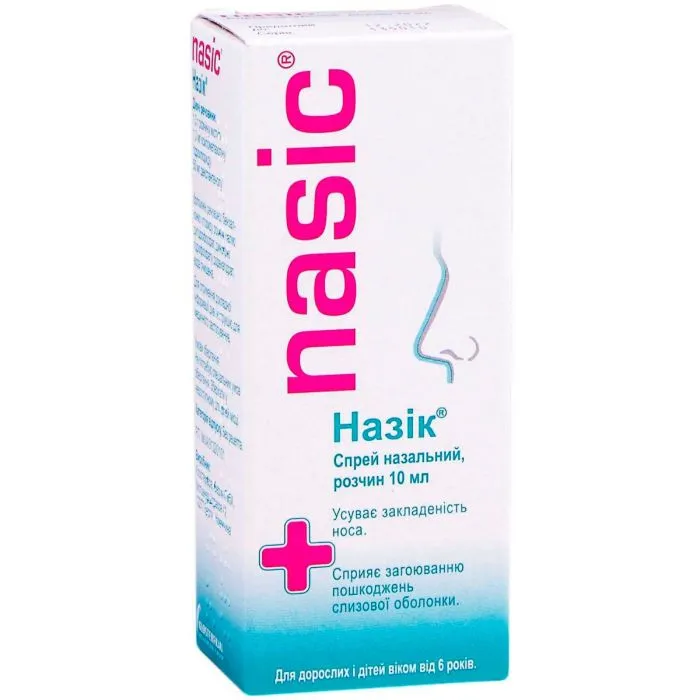
Table of Contents
INSTRUCTIONS FOR MEDICAL USE OF THE MEDICINAL PRODUCT NAZIK® (NASIC®)
Composition:
Active substances: xylometazoline hydrochloride and dexpanthenol;
1.0 g of solution contains 1.0 mg xylometazoline hydrochloride, 50 mg dexpanthenol;
one spray of 0.1 ml solution (equivalent to 0.10 g) contains 0.1 mg xylometazoline hydrochloride and 5.0 mg dexpanthenol;
Excipients: benzalkonium chloride solution, potassium dihydrogen phosphate, disodium hydrogen phosphate dodecahydrate, purified water.
Pharmaceutical form. Nasal spray, solution.
Main physicochemical properties: colorless clear liquid.
Pharmacotherapeutic group. Decongestants and other rhinological preparations for topical use. Sympathomimetics, combinations, excluding corticosteroids.
ATC code R01A B06.
Pharmacological Properties
Pharmacodynamics
A rhinological preparation, a combination of an alpha-sympathomimetic agent with a vitamin analogue for local application to the nasal mucosa. Xylometazoline has vasoconstrictive activity, thereby reducing swelling of the mucous membrane. Dexpanthenol is a derivative of pantothenic acid (vitamin B5) that promotes wound healing and protects mucous membranes.
Xylometazoline hydrochloride
Xylometazoline hydrochloride, an imidazole derivative, is an alpha-adrenergic sympathomimetic agent. The onset of action usually occurs within 5–10 minutes, resulting in relief of nasal congestion due to reduction of swelling and improved drainage of secretions.
Dexpanthenol
Dexpanthenol (D-(+)-pantothenyl alcohol) is an alcohol analogue of pantothenic acid and, through intermediate conversion, exhibits the same biological activity as pantothenic acid. However, only the dextrorotatory D-configuration is biologically active. Pantothenic acid and its salts are water-soluble vitamins that participate as coenzyme A in numerous metabolic processes, including supporting the synthesis of proteins and corticosteroids, as well as antibody production. Coenzyme A is also involved in the formation of lipids, including those secreted by sebaceous glands, which play an important protective role. Furthermore, coenzyme A plays a role in acetylation of amino sugars, which are key structural components of various mucopolysaccharides.
Dexpanthenol protects epithelial layers and promotes wound healing.
Pharmacokinetics
Xylometazoline hydrochloride
In some cases, intranasal administration results in significant absorption, leading to systemic effects, for example on the central nervous and cardiovascular systems.
Pharmacokinetic data in humans are lacking.
Dexpanthenol
Dexpanthenol is absorbed through the skin and undergoes enzyme-catalyzed oxidation to pantothenic acid in the body and skin cells. The vitamin is transported in blood plasma in protein-bound form. As an essential structural component, pantothenic acid combines with coenzyme A and is distributed throughout the body. Detailed studies on metabolism in the skin and mucous membranes are lacking. 60–70% of an orally administered dose is excreted in urine and 30–40% in feces.
Clinical characteristics.
Indications.
- Nasal congestion during acute rhinitis;
- promoting healing of the skin around the nasal passages and injuries of the mucous membrane in the nasal cavity;
- vasomotor rhinitis;
- impaired nasal breathing after surgical interventions in the nasal cavity.
Contraindications.
Hypersensitivity to any component of the drug, dry inflammation of the nasal mucosa, acute coronary diseases including cardiac asthma, hyperthyroidism, closed-angle glaucoma, transsphenoidal hypophysectomy, and surgical interventions with exposure of the meninges in medical history. Concomitant use of MAO inhibitors and within 2 weeks after discontinuation of their use.
The drug should not be administered to children under 6 years of age.
Nazik® contains benzalkonium chloride and therefore should not be used in patients with known hypersensitivity to this substance.
Interaction with other medicinal products and other forms of interaction.
Xylometazoline hydrochloride
Concomitant use of the drug with tranylcypromine, monoamine oxidase inhibitors such as tricyclic or tetracyclic antidepressants, or with β-adrenoblockers may lead, due to the effect of these drugs on the cardiovascular system, to an increase in arterial pressure.
Special precautions for use
This medicinal product should be used only after careful assessment of the risk/benefit ratio:
- in patients taking medicinal products capable of increasing blood pressure;
- in patients with elevated intraocular pressure;
- in patients with phaeochromocytoma;
- in patients with benign prostatic hyperplasia;
- in patients with porphyria.
Patients with long QT syndrome who use xylometazoline may be at increased risk of serious ventricular arrhythmias.
The product contains benzalkonium chloride, which may cause irritation of the nasal mucosa.
Sympathomimetic decongestants may, especially with prolonged use or in cases of overdose, lead to reactive hyperaemia of the nasal mucosa.
This rebound effect results in narrowing of the airways, forcing the patient to reapply the medicinal product.
This leads to chronic swelling and eventually to atrophy of the nasal mucosa.
In mild cases, it may be sufficient to discontinue the sympathomimetic agent first in one nostril, and then, as symptoms resolve, repeat this in the other nostril, in order to maintain at least partial nasal breathing.
The product, like other drugs in this class, should be used with caution in patients who exhibit strong reactions to sympathomimetics, manifested as insomnia, dizziness, tremor, cardiac arrhythmia, or increased blood pressure.
The recommended dose of the product should not be exceeded, especially when treating children and elderly individuals.
The product should be prescribed with caution to patients with cardiovascular disorders, arterial hypertension, diabetes mellitus, thyroid disorders, or prostate hyperplasia.
Nazik® should not be used in children under 6 years of age. Children under 6 years of age should receive an alternative dosage formulation of the product.
Each package should be used by only one person to avoid infection.
Use during pregnancy or breastfeeding.
Nazik® should not be used during pregnancy, as there are insufficient data on the use of xylometazoline hydrochloride for treatment in pregnant women.
The use of the product should be avoided during lactation, as it is unknown whether the active ingredient xylometazoline hydrochloride passes into breast milk.
Ability to affect reaction speed while driving or operating machinery.
When used according to instructions, no effect is expected.
Method of Administration and Dosage
Nazik® should be administered to adults and children aged 6 years and older.
For nasal use only.
Nazik® should be administered as 1 spray per nostril no more than 3 times daily.
Dosage depends on individual sensitivity and clinical response.
When using Nazik®, the bottle should be held vertically. The patient should gently inhale through the nose during spraying.
Nazik® should not be used for longer than 7 days, except when recommended by a physician.
Regarding duration of use in children, consultation with a physician is always required.
Repeated use should be initiated only after a several-day break and following consultation with a physician. The duration of treatment in children is determined individually by a physician.
In cases of chronic rhinitis, the medication should be used only under medical supervision due to the risk of developing nasal mucosal atrophy.
For bottles equipped with a detachable spray nozzle: before use, remove the long protective cap. Unscrew the cap from the bottle and screw the spray nozzle onto the bottle. Remove the protective cap from the spray nozzle. Before the first use, press the spray nozzle several times until a fine, even mist is produced. Insert the nozzle into one nostril and press once, then repeat for the other nostril. After use, cover the nozzle with the protective cap.
Children
Nazik® should not be administered to children under 6 years of age. For children aged 2 to 6 years, Nazik® for children should be used.
Overdose
Symptoms of intoxication with imidazole derivatives may be clinically unclear, as periods of stimulation may alternate with periods of depression of the central nervous and cardiovascular systems.
Overdose, especially in children, may lead to significant effects on the central nervous system, including spasms, coma, bradycardia, apnea, and arterial hypertension, which may progress to arterial hypotension.
Symptoms of central nervous system stimulation include anxiety, agitation, hallucinations, and convulsions.
Symptoms of central nervous system depression manifest as decreased body temperature, lethargy, drowsiness, and coma.
Additional possible symptoms include miosis, mydriasis, sweating, nausea, cyanosis, fever, pallor, tachycardia, bradycardia, cardiac arrest, cardiac arrhythmia, arterial hypertension, shock-like hypotension, pulmonary edema, respiratory depression, apnea, and occasionally impaired consciousness.
Treatment in case of overdose
Severe overdose requires hospitalization. Since xylometazoline hydrochloride is rapidly absorbed, activated charcoal (adsorbent), sodium sulfate (laxative), or gastric lavage (in cases of high doses) should be administered immediately. Decreased blood pressure can be managed with non-selective alpha-blockers. Vasoconstrictive agents are contraindicated. If necessary, antipyretics and anticonvulsants should be administered, along with artificial oxygen ventilation.
Pantothenic acid and its derivatives, such as dexpanthenol, have very low toxicity. In case of overdose, no therapeutic measures are required.
Adverse reactions.
The following categories are used to classify the frequency of adverse effects:
very common (≥ 1/10)
common (≥ 1/100 to <1/10)
uncommon (≥ 1/1000 to <1/100)
rare (≥ 1/10000 to <1/1000)
very rare (<1/10000)
not known (cannot be estimated from available data).
Nervous system:
Very rare: anxiety, insomnia, fatigue (drowsiness, sedative effect), headache, hallucinations (mainly in children).
Cardiovascular system:
Rare: palpitations, tachycardia, hypertension.
Very rare: arrhythmia.
Respiratory system:
Very rare: after weakening of effect, increased mucosal swelling, epistaxis.
Frequency not known: burning and dryness of nasal mucosa, sneezing.
Musculoskeletal system:
Very rare: convulsions (especially in children).
Immune system:
Occasionally: hypersensitivity reactions (angioneurotic edema, rash, itching).
Shelf life. 3 years.
After first opening – 12 weeks.
Storage conditions.
No special storage conditions required. Keep out of reach of children.
Packaging.
10 ml of solution in a bottle, 1 bottle with removable spray nozzle in a cardboard box, or 10 ml of solution in a bottle, 1 bottle with fixed spray nozzle in a cardboard box.
Availability. Over-the-counter.
Manufacturer. Klosterfrau Berlin GmbH.
Manufacturer's address.
Motzener Strasse 41, 12277 Berlin, Germany.
Marketing Authorization Holder. Cassella-med GmbH & Co. KG.
Address of Marketing Authorization Holder.
Gereonsmuehlengasse 1, 50670, Cologne, Germany.