Nazalong® kids
Ukraine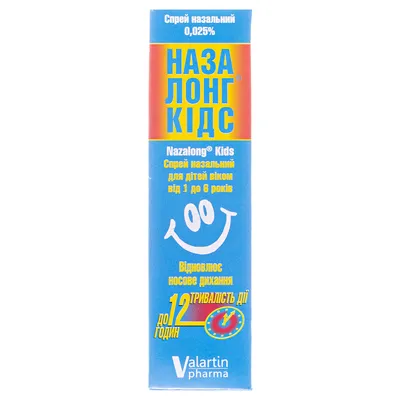
Table of Contents
INSTRUCTIONS FOR MEDICAL USE OF THE MEDICINAL PRODUCT NASELON® KIDS
Composition:
Active substance: oxymetazoline hydrochloride;
1 ml of 0.025% solution contains oxymetazoline hydrochloride 0.25 mg;
Excipients: benzalkonium chloride, disodium edetate, glycerol, citric acid monohydrate, sodium citrate, purified water.
Pharmaceutical form. Nasal spray.
Main physicochemical properties: the preparation is sprayed as an aerosol jet consisting of liquid particles dispersed in air.
Pharmacotherapeutic group.
Decongestants and other agents for local use in nasal cavity disorders. Sympathomimetics.
ATC code R01A A05.
Pharmacological properties.
Pharmacodynamics.
Nazalong® Kids belongs to the group of local vasoconstrictor agents. Oxymetazoline exerts sympathomimetic and vasoconstrictive effects, reducing edema of the nasal mucosa. It constricts blood vessels at the site of application, decreases swelling of the nasal and upper respiratory tract mucosa, and reduces nasal discharge. It restores nasal breathing. Relief of nasal mucosal swelling promotes restoration of ventilation to the paranasal sinuses and the middle ear cavity, thus preventing the development of bacterial complications.
Oxymetazoline exerts antiviral, anti-inflammatory, immunomodulatory, and antioxidant effects. Due to this combined mechanism of action, clinical studies have demonstrated faster and more effective relief of acute rhinitis symptoms (nasal congestion, rhinorrhea, sneezing, and general malaise).
When applied locally in therapeutic concentrations, it does not irritate the nasal mucosa and does not cause hyperemia.
The elimination half-life is approximately 35 hours after administration. About 2.1% of the drug is excreted via the kidneys, and approximately 1.1% via feces.
Pharmacokinetics.
Duration of action – up to 12 hours.
Following intranasal administration, the absorbed amount may sometimes be sufficient to initiate systemic effects, for example, in the central nervous and cardiovascular systems.
Additional pharmacokinetic data from human studies are lacking.
Preclinical safety data.
In toxicity studies in dogs, repeated nasal administration of oxymetazoline revealed no risks to human safety. Results of the in vitro bacterial mutagenicity test were negative. Currently, there are no data on the carcinogenic potential of this medicinal product. No teratogenic effects were observed in rats and rabbits. Doses above the therapeutic level were embryolethal or led to delayed fetal growth. In rats, suppression of maternal milk production was observed. There were no signs of impaired fertility.
Clinical characteristics.
Indications.
- Acute rhinitis.
- Allergic rhinitis.
- Episodes of non-infectious vasomotor rhinitis.
- To restore drainage and nasal breathing in diseases of the nasal paranasal sinuses, eustachitis associated with rhinitis.
- To eliminate swelling prior to diagnostic procedures in the nasal passages.
Contraindications.
- Hypersensitivity to oxymetazoline or to any other component of the drug.
- Atrophic rhinitis.
- Do not use after transsphenoidal hypophysectomy or other surgical procedures exposing the meninges.
- During treatment with monoamine oxidase inhibitors (MAOIs) and within 2 weeks after discontinuation of MAOIs, and when using other drugs that promote an increase in blood pressure.
- Increased intraocular pressure, especially in angle-closure glaucoma.
- Severe forms of cardiovascular diseases (e.g., ischemic heart disease) and arterial hypertension.
- Pheochromocytoma.
- Metabolic disorders (e.g., hyperthyroidism, diabetes mellitus).
- Prostate hyperplasia.
- Porphyria.
Nasalong® Kids 0.025% is contraindicated in infants and children under 1 year of age.
Interaction with other medicinal products and other types of interactions.
Concomitant use of oxymetazoline with MAO inhibitors of the tranylcypromine type, tricyclic antidepressants, and hypertensive agents may lead to increased blood pressure. Therefore, these medicinal products should not be used concurrently.
Special precautions for use
Prolonged use and overdosing of the medicinal product should be avoided.
In particular, the effect of nasal decongestants may decrease with prolonged use or overdosing (tachyphylaxis). This may lead to using the drug at higher doses or more frequent administration, which could result in the need for continuous use. If prolonged use or overdosing occurs, treatment with this medicinal product should be discontinued immediately.
Improper use of rhinological drugs may lead to the following phenomena:
- Reactive hyperemia of the nasal mucosa (rebound effect);
- Chronic swelling of the nasal mucosa (medicamentosa rhinitis);
- Atrophy of the nasal mucosa.
Use in chronic rhinitis, as well as at higher doses than recommended, should be carried out only under medical supervision.
Benzalkonium chloride contained in the medicinal product may cause swelling of the nasal mucosa, especially with prolonged use. If such a reaction is suspected (chronically blocked nose), another medicinal product for intranasal administration that does not contain preservatives should be used.
Use during pregnancy or breastfeeding.
Pregnancy.
Data from a limited number of women exposed during the first trimester of pregnancy do not indicate the development of adverse reactions affecting the course of pregnancy or the health of the fetus/newborn. Other epidemiological data are currently unavailable. Animal studies have shown reproductive dose-dependent toxicity when doses exceeding therapeutic levels were administered. The drug should be used during pregnancy only with caution, after consultation with a physician and careful assessment of the benefit-risk ratio for the mother and fetus. The recommended dosage should not be exceeded during pregnancy, as overdosing may impair fetal blood supply.
Breastfeeding.
Data regarding the passage of oxymetazoline into breast milk are unknown. The medicinal product should be used during breastfeeding only after consultation with a physician and careful assessment of the benefit-risk balance. The recommended dosage should not be exceeded during breastfeeding, as overdosing may reduce the amount of breast milk in women.
Ability to affect reaction speed when driving or operating machinery.
When therapeutic doses of the drug are used, it does not affect reaction speed when driving or operating machinery. However, a general effect on the cardiovascular and nervous systems cannot be completely ruled out.
Method of Administration and Dosage
Nazalong® Kids, nasal spray, is intended for nasal use.
Children aged 1 to 6 years — 1 spray of Nazalong® Kids 0.025% in each nostril 2–3 times daily. The single dose should not be used more than 3 times daily or for longer than 7 days. Doses higher than recommended should not be used.
The spray mechanism activates when pressing the dosing device. Before the first use, remove the protective cap and prime the pump by repeatedly depressing it until a consistent spray is achieved. When using Nazalong® Kids, do not tilt the head backward or invert the bottle. Insert the tip of the nozzle into each nostril and administer one spray. During administration, inhale gently through the nose. After use, clean the nozzle and replace the protective cap.
Children.
Nazalong® Kids 0.025% is indicated for children aged 1 to 6 years.
Overdose.
Prolonged use or overdose of nasal decongestants may lead to diminished effectiveness (tachyphylaxis). This may result in increased dosage or more frequent administration, potentially leading to dependence on the drug. If prolonged use or overdose occurs, treatment with this medication should be discontinued immediately.
Overdose may occur following nasal or accidental oral administration. The clinical picture of intoxication with imidazole derivatives may be unclear, as periods of stimulation may alternate with periods of depression of the central nervous, cardiovascular, and respiratory systems.
Stimulation of the central nervous system may manifest as anxiety, agitation, hallucinations, and seizures.
Depression of the central nervous system may present as hypothermia, lethargy, drowsiness, and potentially coma.
Other possible symptoms include miosis, mydriasis, elevated body temperature, sweating, pallor, cyanosis, tachycardia, bradycardia, cardiac arrhythmia, cardiac arrest, arterial hypertension, shock-like hypotension, nausea, vomiting, respiratory insufficiency, apnea, and psychiatric disturbances.
In particular, in children, overdose may predominantly cause effects on the central nervous system: seizures and coma, bradycardia, apnea, as well as arterial hypertension that may progress to arterial hypotension.
Intensive supportive therapy is required in cases of severe overdose. Immediate administration of activated charcoal (adsorbent), sodium sulfate (laxative), or gastric lavage (in case of ingestion of a large amount of the drug) is recommended, as oxymetazoline may be rapidly absorbed.
Vasopressor agents are contraindicated. Non-selective α-blockers may be used as an antidote. If necessary, measures to reduce body temperature, anticonvulsant therapy, and lung ventilation should be implemented.
Side effects.
From the nervous system. Restlessness, insomnia, fatigue (drowsiness, sedation), headache, hallucinations (especially in children).
From the cardiovascular system. Palpitations (awareness of heartbeat), tachycardia, arterial hypertension, arrhythmias, chest pain.
From the respiratory system. Nasal discomfort (e.g., burning sensation) or dryness of nasal mucosa, sneezing; after the effect of NazalLong® Kids wears off – sensation of severe nasal congestion, epistaxis; apnea in infants and newborns.
From the musculoskeletal system. Convulsions (especially in children).
From the immune system. Uncommon hypersensitivity reactions (angioedema, rash, pruritus).
General disorders and administration site reactions.
Very rare: increased fatigue (drowsiness), weakness.
Frequency unknown: tachyphylaxis (with prolonged use or overdose).
Reporting suspected adverse reactions
Reporting suspected adverse reactions after medicine authorization is very important. It allows continuous monitoring of the benefit/risk balance of the medicine. Healthcare professionals are encouraged to report suspected adverse reactions via the national reporting system.
Shelf life.
2 years.
Storage conditions.
Store in the original packaging at a temperature not exceeding 25 °C.
Keep out of reach of children.
Packaging.
10 ml in a bottle. 1 bottle per carton.
Prescription status.
Over-the-counter.
Manufacturer.
Micropharm LLC.
Manufacturer's address and location of operations.
Ukraine, 61013, Kharkiv Oblast, Kharkiv, Shevchenka Street, 20.
Marketing Authorization Holder.
Valartin Pharma LLC.
Address of the Marketing Authorization Holder.
Ukraine, 08135, Kyiv Oblast, Kyiv-Sviatoshyn District, village Chayky, Hrushevskoho Street, 60.