Sodium chloride solution isotonic 0.9 % b. braun
Ukraine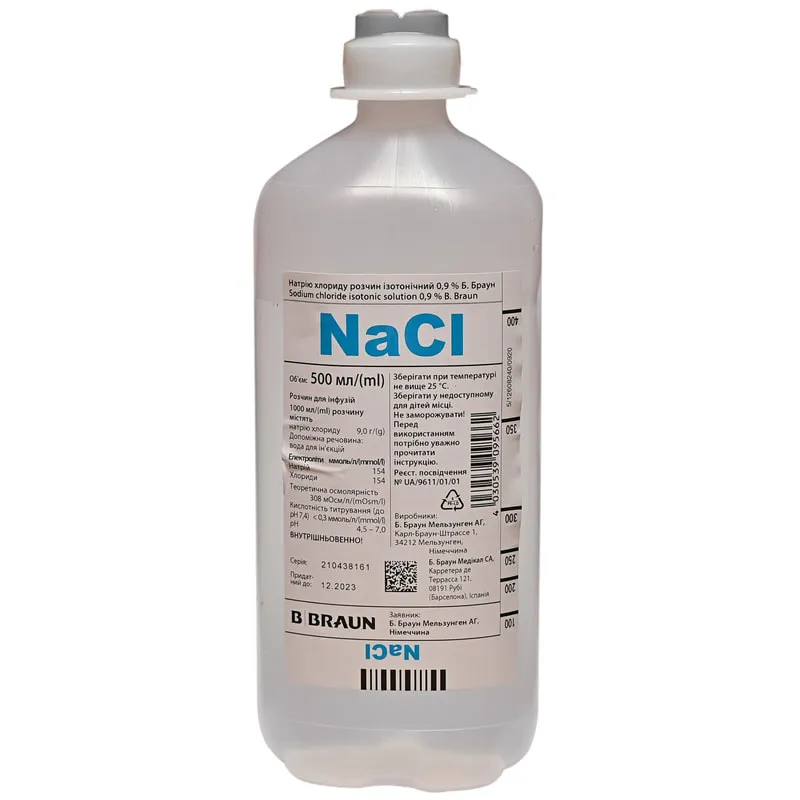
Table of Contents
INSTRUCTIONS FOR MEDICAL USE OF THE MEDICINAL PRODUCT SODIUM CHLORIDE ISOTONIC SOLUTION 0.9% B. BRAUN
Composition:
Active substance: sodium chloride;
1000 ml of solution contain 9.0 g of sodium chloride;
Electrolytes: sodium – 154 mmol/l; chloride – 154 mmol/l;
Excipient: water for injections.
Pharmaceutical form. Infusion solution.
Main physicochemical properties: clear, colorless solution, practically free from particles.
Theoretical osmolarity: 308 mOsm/l; acidity (titration to pH 7.4): < 0.3 mmol/l; pH: 4.5 – 7.0.
Pharmacotherapeutic group. Plasma substitutes and perfusion solutions. Electrolyte solutions. ATC code B05XA03.
Pharmacological properties.
Pharmacodynamics.
Mechanism of action
Sodium is the main cation in the extracellular space, which together with various anions regulates the volume of this space. Sodium is involved in the principal bioelectrical processes in the human body.
Chloride is the main osmotically active anion in the extracellular space.
An increase in chloride level in blood serum leads to enhanced renal excretion of bicarbonate. Thus, administration of chloride produces an acidifying effect.
Pharmacodynamic effect
The content of sodium and fluid metabolism in the human body are closely interrelated. Any deviation of serum sodium concentration from the physiological level simultaneously affects the body's fluid balance.
An increase in sodium content in the body also reduces the amount of free water, regardless of serum osmolality.
The osmolarity of 0.9% sodium chloride solution corresponds to plasma osmolarity. Administration of this solution primarily replenishes the interstitial space, which constitutes ⅔ of the total extracellular space. Only ⅓ of the infused solution remains in the vascular compartment. Thus, the hemodynamic effect of the solution is short-lived.
Pharmacokinetics.
Absorption
Since the solution is administered by intravenous infusion, its bioavailability is 100%.
Distribution
Total body sodium content is approximately 80 mmol/kg (5,600 mmol), of which 300 mmol belong to intracellular fluid at a concentration of 2 mmol/L, while 2,500 mmol are contained in bone tissue. Approximately 2 mol belong to extracellular fluid, with a concentration of approximately 135–145 mmol/L (3.1–3.3 g/L).
Total chloride content in the adult human body is approximately 33 mmol/kg body weight. Serum chloride concentration is maintained at a level of 98–108 mmol/L.
Metabolism
Although sodium and chloride are absorbed, distributed, and eliminated by the body, metabolism, in the strict sense of the term, does not occur.
The main regulators of sodium and water balance are the kidneys. Together with hormonal control mechanisms (renin-angiotensin-aldosterone system, antidiuretic hormone) and the hypothetical natriuretic hormone, the kidneys are primarily responsible for maintaining a constant extracellular volume and regulating its fluid composition.
In the tubular system, chloride is exchanged for bicarbonate; thus, chloride participates in the regulation of acid-base balance.
Excretion
Sodium and chloride ions are excreted in sweat, urine, and via the gastrointestinal tract.
Clinical characteristics.
Indications.
For fluid and electrolyte replenishment in hypochloremic alkalosis.
Sodium deficiency.
Chloride ion loss.
For short-term intravascular fluid volume replacement.
Hypotonic dehydration or isotonic dehydration.
Use as a solvent for compatible concentrated electrolytes and medicinal products.
Use externally for wound irrigation, moistening of dressings and tampons.
Contraindications.
“Sodium Chloride 0.9% Isotonic Solution B. Braun” is contraindicated in patients with the following conditions:
- hyperhydration;
- severe hypernatremia;
- severe hyperchloremia.
Interaction with other medicinal products and other forms of interactions.
Concomitant administration of sodium-retaining drugs (e.g., corticosteroids, nonsteroidal anti-inflammatory drugs) may lead to the development of edema.
When used concomitantly with lithium-containing preparations, renal clearance of both sodium and lithium may increase. Administration of “Sodium Chloride 0.9% Isotonic Solution B. Braun” may result in decreased lithium levels.
Special precautions for use
"Sodium Chloride 0.9% Isotonic Solution B. Braun" should be administered with caution in the following conditions:
- Hypokalemia;
- Hypernatremia;
- Hyperchloremia;
- Disorders requiring restriction of sodium intake, such as: decompensated heart failure with cardiac insufficiency, anasarca, pulmonary edema, hypertension, eclampsia, severe renal failure, liver cirrhosis.
Caution is advised when administering to patients receiving lithium medications (see section "Interaction with other medicinal products or other forms of interaction").
In shock states and blood loss, transfusion of blood, plasma, plasma substitutes, and simultaneous administration of 0.9% sodium chloride solution may be performed.
To prevent osmotic demyelination syndrome, the increase in serum sodium concentration should not exceed 9 mmol/L/day. In most cases, the recommended correction rate is 4 to 6 mmol/L/day, taking into account the patient's condition and concomitant risk factors.
Clinical monitoring should include assessment of serum ionogram, fluid balance, and acid-base status.
If rapid infusion is required, careful monitoring of cardiovascular and respiratory function should be performed.
Note. When this solution is used as a solvent, safety information regarding the dissolved medicinal product provided by the respective manufacturer should be considered.
Children
Sodium overload may occur in premature and full-term infants due to immature renal function. Therefore, repeated infusions of sodium chloride in premature and full-term infants should be administered only after determination of serum sodium levels.
Vials are intended for single use only. After administration, the vial and any unused contents should be discarded.
Do not use if the solution is not clear and colorless, or if the vial or its closure shows visible signs of damage.
Use during pregnancy or breastfeeding.
Pregnancy
Data on the use of "Sodium Chloride 0.9% Isotonic Solution B. Braun" during pregnancy are limited. These data do not confirm the presence of direct or indirect harmful effects of sodium chloride 9 mg/mL indicating reproductive toxicity.
Since the concentration of sodium and chloride corresponds to the physiological concentrations of these substances in the human body, harmful effects are not expected when the product is used according to its indications.
Therefore, "Sodium Chloride 0.9% Isotonic Solution B. Braun" can be used when clinically indicated.
However, precautionary measures should be taken in cases of eclampsia (see section "Special precautions for use").
Breastfeeding
Since the concentration of sodium and chloride corresponds to the physiological concentrations of these substances in the human body, harmful effects are not expected when the product is used according to its indications.
If necessary, "Sodium Chloride 0.9% Isotonic Solution B. Braun" can be used during breastfeeding.
Ability to influence the speed of reactions when driving vehicles or operating machinery.
"Sodium Chloride 0.9% Isotonic Solution B. Braun" has no effect or has a negligible effect on the ability to drive vehicles or operate machinery.
Method of Administration and Dosage
Dosage
Adults
The dose should be determined according to the actual need for replenishment of water and electrolyte levels.
Maximum daily dose
Up to 40 mL/kg body weight per day, corresponding to 6 mmol of sodium per 1 kg body weight.
Additional fluid losses (e.g., due to fever, diarrhea, vomiting, etc.) should be compensated according to the volume and composition of the lost fluid.
In the treatment of acute fluid deficiency, particularly severe or life-threatening hypovolemic shock, higher doses may be used, for example, via rapid infusion (under pressure).
In the treatment of sodium deficiency, the volume of sodium required to restore plasma sodium levels can be calculated using the following formula:
Sodium requirement [mmol] = (desired – actual serum Na concentration) × TBW
where TBW (total body water) is calculated as a fraction of body weight. This fraction is 0.6 in children, 0.6 and 0.5 in adult males and females, respectively, and 0.5 and 0.45 in elderly males and females, respectively.
Infusion rate
The infusion rate depends on the individual patient's condition (see section "Special precautions").
Elderly patients
In general, the same dosage as for other adult patients should be used in elderly individuals. However, special safety precautions should be taken when treating patients with conditions such as heart failure or renal failure, which are commonly associated with advanced age.
Solvent use
When using the medicinal product "Sodium Chloride 0.9% Isotonic Solution B. Braun" as a solvent, dosage and infusion rate are primarily determined based on the characteristics and dosing regimen of the drug being dissolved.
Wound irrigation
The volume of solution for wound irrigation or dressing moistening is determined according to clinical needs.
Route of administration
Intravenous administration or irrigation and moistening.
When performing rapid infusion using solution in polyethylene bottles, air must be completely removed from both the bottle and the infusion system before starting the infusion.
Children
The dose should be determined according to the individual need for water and electrolyte replenishment, as well as the patient's age, body weight, and clinical condition.
In cases of severe dehydration, a bolus administration of 20 mL/kg body weight is recommended during the first hour of treatment.
When administering this solution, the daily fluid intake should be taken into account.
Overdose
Symptoms
Overdose of the medicinal product "Sodium Chloride 0.9% Isotonic Solution B. Braun" may lead to hypernatremia, hyperchloremia, hyperhydration, acute volume overload, edema, serum hyperosmolality, and hyperchloremic acidosis.
Rapid increase in serum sodium levels in patients with chronic hyponatremia may result in osmotic demyelination syndrome (see section "Special precautions").
Early signs of overdose may include thirst, confusion, sweating, headache, weakness, drowsiness, and tachycardia. In cases of severe hypernatremia, hypertension or hypotension, respiratory distress, or coma may occur.
Treatment
Depending on the severity of the disturbances: immediate discontinuation of infusion, administration of diuretics with monitoring of serum electrolyte levels, and correction of electrolyte imbalances and acid-base disturbances.
In cases of severe overdose or in the presence of oliguria or anuria, dialysis may be required.
Adverse reactions.
When used according to the instructions, no adverse reactions have been reported.
Chloride acidosis may develop during massive infusions.
Reporting of suspected adverse reactions
It is important to report suspected adverse reactions after the medicinal product has been authorized. This enables ongoing monitoring of the benefit-risk balance of the medicinal product. Healthcare professionals are encouraged to report any suspected adverse reactions.
Shelf life.
3 years.
Storage conditions.
Store at a temperature not exceeding 25 °C.
Keep out of reach and sight of children.
Do not freeze.
Incompatibilities.
Potential incompatibilities should be considered when mixing with other medicinal products.
Packaging.
100 ml of solution in polyethylene bottles, pack of 20; 250 ml, 500 ml, or 1000 ml of solution in polyethylene bottles, pack of 10.
Prescription status.
Prescription only.
Manufacturers.
- B. Braun Melsungen AG / B. Braun Melsungen AG.
- B. Braun Medical SA / B. Braun Medical SA.
Manufacturers' addresses.
- Carl-Braun-Strasse 1, 34212 Melsungen, Germany / Carl-Braun-Strasse 1, 34212 Melsungen, Germany.
- Carretera de Terrassa 121, 08191 Rubi (Barcelona), Spain / Carretera de Terrassa 121, 08191 Rubi (Barcelona), Spain.