Sodium chloride
Ukraine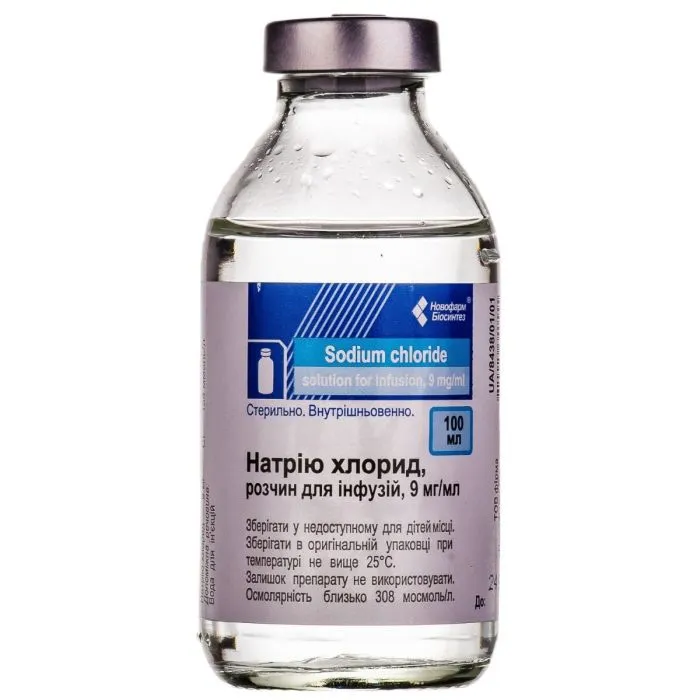
Table of Contents
INSTRUCTION FOR MEDICAL USE OF THE MEDICINAL PRODUCT Sodium Chloride (Natrii chloridi)
Composition:
Active substance: sodium chloride;
100 ml of solution contain 0.9 g of sodium chloride;
Ionic composition per 1 l of product: Na+ – 154 mmol, Cl¯ – 154 mmol;
Excipients: water for injections.
Pharmaceutical form. Infusion solution.
Main physicochemical characteristics: clear, colorless liquid. Ionic composition, mmol/l: sodium ion – 154; chloride ion – 154. Theoretical osmolarity approximately 308 mOsm/l.
Pharmacotherapeutic group. Plasma substitutes and perfusion solutions. Electrolyte solutions. ATC code B05XA03.
Pharmacological properties.
Pharmacodynamics.
0.9 % sodium chloride solution normalizes water and electrolyte balance and eliminates fluid deficiency in the human body, which develops in dehydration or due to accumulation of extracellular fluid in large burn areas and trauma, during abdominal surgeries, and in peritonitis.
0.9 % sodium chloride solution improves tissue perfusion, enhances the effectiveness of blood transfusion measures in massive blood loss and severe forms of shock.
It also exerts a detoxifying effect due to a transient increase in fluid volume, reduction of toxic substances concentration in blood, and stimulation of diuresis.
Pharmacokinetics.
Rapidly leaves the vascular system. The drug remains in the vascular bed for a short period, after which it transfers to the interstitial and intracellular compartments. After 1 hour, only approximately half of the infused solution remains in the blood vessels. Salts and fluid are very rapidly excreted by the kidneys, increasing diuresis.
Clinical characteristics.
Indications.
For the replenishment of fluid deficiency in the body and as part of intensive care measures; as a solvent for other compatible medicinal products. May be used locally for wound irrigation, nasal mucosa, as well as for catheters and transfusion systems.
Contraindications.
Hyperhydration, hyperchloremia, hypernatremia, chloride acidosis, conditions associated with the risk of pulmonary edema development.
The medicinal product should not be used for eye irrigation during ophthalmological procedures.
Interaction with other medicinal products and other types of interactions.
Concomitant administration of sodium-retaining drugs (e.g., corticosteroids, nonsteroidal anti-inflammatory drugs) may lead to edema formation.
When used concomitantly with lithium-containing drugs, renal clearance of both sodium and lithium may increase. Administration of this product may result in decreased lithium levels.
The product is compatible with most medicinal products; therefore, it is used to dissolve various medicinal agents—except for those drugs incompatible with sodium chloride as a solvent.
Note. When this solution is used as a solvent, information regarding the safety of the dissolved agent provided by the respective manufacturer should be taken into account.
Special precautions for use
During prolonged administration, especially in large volumes, monitor plasma and urine electrolyte levels as well as diuresis.
Concomitant administration with corticosteroids or corticotropin requires continuous monitoring of blood electrolyte levels.
In shock states and blood loss, transfusion of blood, plasma, and plasma substitutes may be performed simultaneously with the administration of 0.9% sodium chloride solution.
Use with caution in patients in the following cases:
- Hypokalemia;
- Disorders requiring restriction of sodium intake, for example: decompensated heart failure with cardiac insufficiency, anasarca, pulmonary edema, hypertension, eclampsia, severe renal failure, liver cirrhosis.
Also use with caution in patients taking lithium medications, because: low sodium levels in the body or increased sodium loss (e.g., low-salt diet or excessive sweating, etc.) may delay lithium excretion and increase the risk of its accumulation; conversely, administration of high doses of sodium enhances lithium excretion, which may reduce its efficacy. Monitoring of blood lithium levels is recommended (see section "Interaction with other medicinal products or other types of interactions").
To prevent osmotic demyelination syndrome, the increase in serum sodium levels should not exceed 9 mmol/L/day. In most cases, the recommended correction rate is 4 to 6 mmol/L/day, taking into account the patient's condition and concomitant risk factors.
Clinical monitoring should include assessment of serum ionogram, fluid balance, and acid-base status.
If rapid infusion is required, careful monitoring of cardiovascular and respiratory system function should be performed.
Infusion rate
The infusion rate depends on the individual patient's condition.
Older adults
Generally, the dosage for older adults should be the same as for other adult patients. However, special safety precautions should be taken when treating patients with conditions such as heart failure or renal failure, which are commonly associated with advanced age.
Solvent use
When the medicinal product is used as a solvent, the dosage and infusion rate are primarily determined based on the characteristics and dosing regimen of the dissolved medicinal product.
Wound irrigation
The volume of solution for wound irrigation or dressing moistening is determined according to clinical needs.
Children
In infants, sodium excess may occur due to immature renal function. Therefore, repeated sodium chloride infusions in infants (preterm and term) should be administered only after determining serum sodium levels.
The contents of the container/bottle are intended for single use only. After administration, any unused portion and packaging must be discarded.
Do not use the medicinal product if the solution is not clear and colorless or if the packaging shows visible signs of damage.
Use during pregnancy or breastfeeding
Pregnancy
Data on the use of Sodium Chloride 0.9% solution for infusion during pregnancy are limited. These data do not confirm the presence of direct or indirect harmful effects of sodium chloride 9 mg/mL indicating reproductive toxicity.
Since the concentration of sodium and chloride corresponds to the physiological concentration of these substances in the human body, harmful effects are not expected when the medicinal product is used according to indications. The product may be used when clinically indicated. However, precautionary measures should be taken in cases of eclampsia (see section "Special precautions for use").
Breastfeeding
Since the concentration of sodium and chloride corresponds to the physiological concentration of these substances in the human body, harmful effects are not expected when the medicinal product is used according to indications. The product may be used during breastfeeding if needed.
Ability to affect reaction speed when driving or operating machinery
Does not affect.
Administration and Dosage
Administer intravenously, rectally, and externally.
Administer intravenously by drip infusion at a rate of 4–10 mL/kg/hour, up to 3 L or more of solution per day, depending on the clinical condition and degree of fluid loss; administer orally; administer as enemas in doses of 75–100 mL; use for wound and mucous membrane irrigation.
Children.
In children with shock-level dehydration (without laboratory parameter assessment), administer 20–30 mL/kg. Subsequent dosing should be adjusted based on laboratory parameters. The total daily dose depends on the fluid and electrolyte balance, etc.
Overdose.
General adverse effects of excess sodium in the body include nausea, vomiting, diarrhea, abdominal cramps, thirst, decreased salivation and lacrimation, sweating, elevated body temperature, tachycardia, hypertension, renal failure, peripheral edema and pulmonary edema, respiratory arrest, headache, dizziness, anxiety, irritability, weakness, muscle twitching and rigidity, seizures, coma, and fatal outcomes.
Excessive administration of 0.9% sodium chloride may lead to hypernatremia (which may cause central nervous system (CNS) disturbances, including seizures, coma, cerebral edema, and death) and sodium overload (which may cause central and/or peripheral edema). The patient should receive specialized medical care.
Excess chloride in the body may lead to bicarbonate loss with acidifying effects.
When 0.9% sodium chloride is used as a solvent for other medicinal products, signs and symptoms of overdose will depend on the nature of the dissolved agents.
It may lead to chloride-induced acidosis, hypernatremia, hyperchloremia, increased potassium excretion, serum hyperosmolality, hyperhydration, and hypervolemia, which may result in cardiac failure. Rapid correction of serum sodium levels in patients with chronic hyponatremia may lead to the development of osmotic demyelination syndrome (see section "Special Warnings and Precautions for Use").
Early signs of overdose may include thirst, confusion, sweating, headache, weakness, drowsiness, and tachycardia. If such symptoms occur, administration of the drug should be discontinued immediately, the patient's condition assessed, and appropriate supportive measures initiated.
Treatment
Depending on the severity of the patient's condition: immediate discontinuation of infusion, administration of diuretics with monitoring of serum electrolyte levels, and correction of electrolyte and acid-base imbalances.
In cases of severe overdose or in the presence of oliguria or anuria, dialysis may be required.
Adverse Reactions
The following adverse reactions have been reported during the post-marketing period. The frequency of adverse reactions cannot be estimated from the available data.
Nervous system disorders: tremor.
Vascular disorders: hypotension.
Skin and subcutaneous tissue disorders: urticaria, rash, pruritus.
General disorders and administration site conditions: redness at the injection site; venous irritation and burning sensation, local pain or reaction, urticaria at the injection site; infection at the infusion site; venous thrombosis and phlebitis at the site of administration, extravasation, and hypervolemia; pyrexia; chills.
The following adverse reactions have not been reported with the use of this medicinal product, but there is a potential risk of their occurrence:
- Hypernatremia (e.g., when administered to patients with nephrogenic diabetes insipidus or in cases of evacuation of large volumes of gastric contents via a nasogastric tube);
- Hyperchloremic metabolic acidosis;
- Hyponatremia, which may be symptomatic. Hyponatremia may occur due to impaired excretion of excess water (e.g., in syndrome of inappropriate antidiuretic hormone secretion or in the postoperative period).
General adverse effects of sodium overload are described in the section "Overdose".
Adding other medicinal products to 0.9% sodium chloride
When 0.9% sodium chloride is used as a solvent for other medicinal products, the likelihood of any additional adverse effect is determined by the characteristics of the medicinal product to which 0.9% sodium chloride is added.
In case of an adverse reaction, infusion must be discontinued, the patient's condition should be assessed, and appropriate supportive measures provided. The remaining solution should be retained for investigation, if necessary.
Reporting of suspected adverse reactions
Reporting of suspected adverse reactions after medicinal product authorization is of great importance. It allows ongoing monitoring of the benefit-risk balance of the medicinal product. Healthcare professionals should report any suspected adverse reactions in accordance with applicable legal requirements.
24-hour telephone: +38(067)-319-16-25
E-mail: [email protected]; [email protected]
Shelf life
2 years
Storage conditions
Store in a dry place at a temperature not exceeding 25 °C. Do not freeze.
Store in the original packaging. Keep out of the reach of children.
Incompatibilities
Not established.
Packaging
100 mL, 200 mL, 250 mL, 400 mL, 500 mL, 1000 mL, 3000 mL, or 5000 mL in containers; 100 mL, 200 mL, or 250 mL in vials.
Prescription status
Prescription only
Manufacturer
Subsidiary enterprise "Farmatreyd"
Manufacturer's address and location of operations
82111, Drohobych, Sambirska St., 85, Lviv Oblast, Ukraine
Marketing Authorization Holder
Subsidiary enterprise "Farmatreyd"
Address of the Marketing Authorization Holder
82111, Drohobych, Sambirska St., 85, Lviv Oblast, Ukraine