Sodium chloride
Ukraine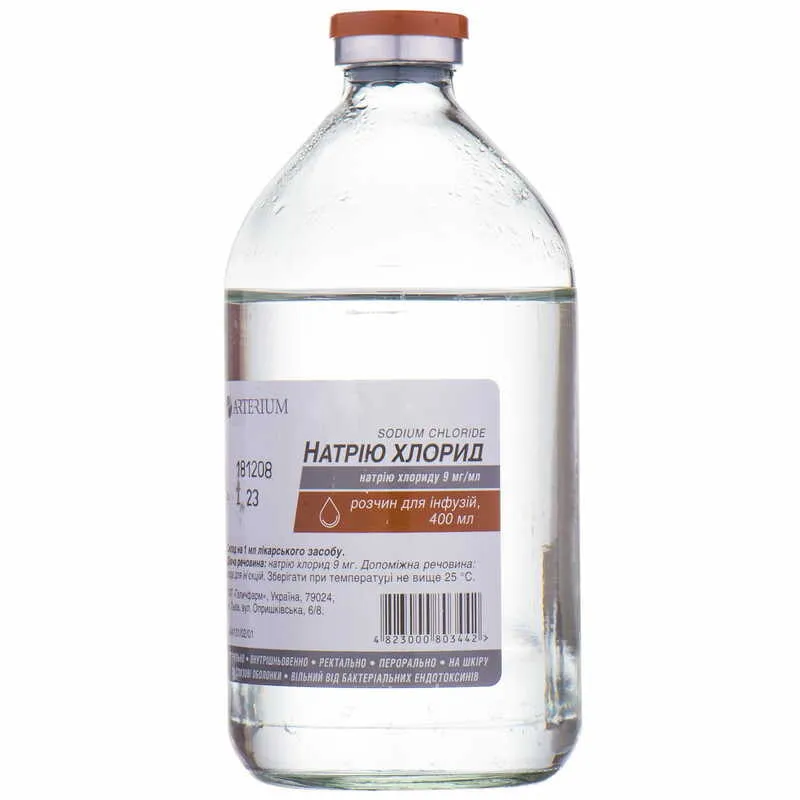
Table of Contents
INSTRUCTIONS for medical use of the medicinal product Sodium Chloride (SODIUM CHLORIDE)
Composition:
Active substance: sodium chloride;
1 ml of solution contains sodium chloride 9.0 mg;
Excipient: water for injections.
Pharmaceutical form. Infusion solution.
Main physico-chemical properties: clear, colorless liquid.
Ion content per 1 liter of the product: Na+ — 154 mmol, Cl¯ — 154 mmol.
Theoretical osmolarity — 308 mOsmol/L, pH 4.5–7.0.
Pharmacotherapeutic group. Plasma substitutes and perfusion solutions. Electrolyte solutions.
ATC code B05X A03.
Pharmacological properties.
Pharmacodynamics.
The pharmacodynamic properties of the solution are determined by the properties of sodium and chloride ions, which participate in maintaining the body's water-electrolyte balance. Ions such as sodium penetrate the cell membrane using various transport mechanisms, including the sodium pump (Na-K-ATPase). Sodium plays an important role in synaptic transmission of nerve impulses, electrophysiological processes in the heart, as well as in metabolic processes of the kidneys.
Most chloride ions are extracellular anions. Intracellular chlorides are present in significant concentrations in erythrocytes and in the gastric mucosa. Chloride reabsorption occurs after sodium reabsorption.
Pharmacokinetics.
Sodium is excreted primarily by the kidneys, although a significant portion undergoes reabsorption in the kidneys. A small amount of sodium is excreted in feces and through sweating.
Clinical characteristics.
Indications.
- For the treatment of isotonic extracellular dehydration.
- For the treatment of hyponatremia.
- For dilution of compatible medicinal products for parenteral administration.
Contraindications.
Hypersensitivity to the active substance or to any of the excipients.
Hypervolemia, hypernatremia, hyperchloremia.
When the medicinal product is used as a solvent, contraindications related to the medicinal products being dissolved must be taken into account.
Special precautions.
Before adding a medicinal product, check its solubility and stability in water within the pH range corresponding to the pH of 0.9% sodium chloride solution for infusion. The medicinal product may be administered prior to or during infusion at the infusion site.
Prior to administration, the solution should be inspected visually for discoloration and/or precipitation, presence of undissolved particles or crystal formation. The physician must review the package leaflet of the medicinal product being added to 0.9% sodium chloride solution.
Adding other medicinal products or using an incorrect administration method may cause fever due to the introduction of pyrogens. If an adverse reaction occurs, the infusion must be stopped immediately.
Do not reuse a glass vial whose contents have been partially used.
Unused portions of the medicinal product must be disposed of.
Interaction with other medicinal products and other forms of interaction.
The medicinal product should be used with caution in patients receiving lithium therapy. Renal clearance of sodium and lithium may increase during administration of 0.9% sodium chloride. Administration of 0.9% sodium chloride may lead to decreased lithium levels.
Corticosteroids/steroids and carbenoxolone are associated with sodium and water retention (with edema and hypertension) (see section "Special warnings and precautions for use").
Although sodium chloride is compatible with most solvents and medicinal products, compatibility should be verified by consulting the package leaflet of the medicinal product intended for co-administration with sodium chloride.
Special precautions for use.
Patients with severe renal impairment.
Sodium chloride 0.9% should be administered with particular caution to patients at risk of severe renal impairment. In such patients, administration of 0.9% sodium chloride may lead to sodium retention.
Risk of fluid and electrolyte overload, disturbances of water-electrolyte balance.
Depending on the volume and rate of infusion, intravenous administration of 0.9% sodium chloride may cause:
- fluid or electrolyte overload, leading to hyperhydration/hypervolemia and, for example, congestive phenomena, including central and peripheral edema;
- clinically significant disturbances of water-electrolyte balance and acid-base imbalance.
In general, the risk of hypervolemic states (water retention relative to sodium content) is inversely proportional to the electrolyte concentrations in the 0.9% sodium chloride solution and its impurities. Conversely, the risk of solute overload causing congestive states (retention of solutes relative to water) is directly proportional to the electrolyte concentrations in 0.9% sodium chloride and its impurities.
Special clinical monitoring is required at the beginning of any intravenous infusion.
Clinical assessment and periodic laboratory monitoring may be necessary to monitor changes in water-electrolyte balance and acid-base equilibrium during prolonged parenteral therapy or whenever the patient's condition or infusion rate requires such evaluation.
Patients at risk of sodium retention, fluid overload, and edema.
Sodium chloride 0.9% should be administered with particular caution or not administered at all to patients who have or are at risk of the following conditions:
- Metabolic acidosis, which may be exacerbated by prolonged use of the drug, especially in patients with impaired renal function.
- Iatrogenic hyperchloremic metabolic acidosis (e.g., during volume resuscitation with intravenous infusions).
- Conditions that may lead to sodium retention, fluid overload, and edema (central and peripheral):
- primary hyperaldosteronism;
- secondary hyperaldosteronism associated with hypertension, congestive heart failure, liver diseases (including liver cirrhosis), kidney diseases (including renal artery stenosis, nephrosclerosis), or preeclampsia.
Development of hypervolemic conditions such as congestive heart failure and pulmonary edema is possible, especially in patients with cardiovascular diseases.
Use with caution in patients taking medications such as corticosteroids, which increase the risk of sodium and fluid retention.
Reactions related to infusion administration.
Symptoms of unknown etiology, which may be hypersensitivity reactions associated with infusion of 0.9% sodium chloride, have been observed very rarely. These included arterial hypotension, pyrexia, tremor, chills, urticaria, rash, and pruritus. If signs or symptoms of such reactions occur, the infusion should be stopped immediately and appropriate therapeutic measures should be initiated according to clinical indications.
Special patient groups
The physician should have sufficient experience and knowledge for the safe use of the drug in special population groups, as they are particularly sensitive to rapid changes in serum sodium levels.
Rapid correction of hyponatremia and hypernatremia is potentially dangerous (risk of severe neurological complications).
Paediatric patients
Electrolyte concentrations in blood plasma must be carefully monitored, as the ability to regulate water-electrolyte balance may be reduced in paediatric patients. Repeated infusions of sodium chloride should be administered only after determination of serum sodium levels.
Geriatric patients
When selecting the type of infusion solution, volume/infusion rate for elderly patients, it should be considered that geriatric patients generally more frequently suffer from heart, kidney, liver diseases or other conditions, or are receiving concomitant therapy.
Use during pregnancy or breastfeeding.
Data on the use of 0.9% sodium chloride during pregnancy or breastfeeding are limited. Before administration of sodium chloride, the physician should evaluate potential risks and benefits in each individual case. Use with caution is recommended in patients with preeclampsia.
If adding a medicinal product, the mechanism of action of the drug and its appropriateness for use during pregnancy and lactation should be considered separately.
Ability to affect reaction speed when driving or operating machinery.
Studies on the effect of sodium chloride on the ability to drive or operate machinery have not been conducted.
Method of Administration and Dosage
The recommended dose can be calculated in mEq or mmol of sodium, mass of sodium ions, or mass of sodium chloride (1 g NaCl = 394 mg Na+, or 17.1 mEq, or 17.1 mmol Na+ and Cl¯).
The dose, rate, and duration of administration must be determined based on several factors, including age, body weight, clinical condition, concomitant therapy, and particularly the patient's hydration status and response to treatment, taking into account laboratory test results. Fluid balance and plasma electrolyte concentrations should be monitored during treatment.
Recommended Doses
Recommended doses for the treatment of isotonic extracellular dehydration and hyponatremia:
Adults: 500 mL to 3 L per day.
Children: 20 to 100 mL/kg body weight/day, depending on age and body weight.
The recommended dose when used as a solvent for compatible medicinal products is 50 to 250 mL per single dose of the medicinal product.
When 0.9% sodium chloride is used as a solvent for intravenous administration of compatible medicinal products, the dosage and infusion rate must also be determined according to the nature and dosing regimen of the compatible medicinal product.
Method of Administration
The solution is administered intravenously by infusion using a sterile, pyrogen-free infusion system, observing aseptic techniques. The infusion system must be filled with the solution to prevent air from entering the system.
Before administration, the solution should be visually inspected for the presence of particulate matter and discoloration. Do not use if the solution is cloudy, contains particulate matter, or if the packaging is damaged.
Additional medicinal products may be added before or during infusion via the infusion system.
Children
For children with isotonic extracellular dehydration and hyponatremia, administer 20 to 100 mL/kg body weight/day, depending on age and body weight.
Plasma electrolyte concentrations must be carefully monitored, as the ability to regulate water and electrolyte balance in pediatric patients may be reduced. Repeat infusions of sodium chloride should only be administered after serum sodium levels have been determined.
Overdose
General adverse effects of excess sodium in the body include nausea, vomiting, diarrhea, abdominal cramps, thirst, decreased salivation and lacrimation, sweating, elevated body temperature, tachycardia, hypertension, renal failure, peripheral edema, pulmonary edema, respiratory arrest, headache, dizziness, anxiety, irritability, weakness, muscle twitching and rigidity, seizures, coma, and fatal outcomes.
Excessive administration of 0.9% sodium chloride may lead to hypernatremia (which may cause central nervous system (CNS) disturbances, including seizures, coma, cerebral edema, and death) and sodium overload (which may cause central and/or peripheral edema). The patient should receive specialized medical care.
Excess chloride in the body may lead to bicarbonate loss with an acidifying effect.
When 0.9% sodium chloride is used as a solvent for other medicinal products, signs and symptoms of overdose will be related to the nature of the dissolved drugs. In case of overdose, treatment must be discontinued, the patient should be examined for relevant signs and symptoms associated with the administered drug, and appropriate supportive measures should be taken as necessary.
Adverse Reactions
The adverse reactions listed below have been reported during the post-marketing period. The frequency of adverse reactions cannot be estimated from the available data.
Neurological disorders: tremor.
Vascular disorders: hypotension.
Skin and subcutaneous tissue disorders: urticaria, rash, pruritus.
General disorders and administration site conditions: redness at the injection site; venous irritation and burning sensation, local pain or reaction, urticaria at the injection site; injection site infection; thrombophlebitis and phlebitis at the infusion site, extravasation, and hypervolemia; pyrexia; chills.
The following adverse reactions have not been reported with the use of this medicinal product, but there is a potential risk of their occurrence:
- hypernatremia (e.g., when administered to patients with nephrogenic diabetes insipidus or in cases of evacuation of large volumes of gastric contents via nasogastric tube);
- hyperchloremic metabolic acidosis;
- hyponatremia, which may be symptomatic. Hyponatremia may occur due to impaired excretion of excess water (e.g., in the syndrome of inappropriate antidiuretic hormone secretion or in the postoperative period).
General adverse effects of sodium overload are described in the section "Overdose".
Addition of other medicinal products to 0.9% sodium chloride
When 0.9% sodium chloride is used as a solvent for other medicinal products, the likelihood of any additional adverse effect is determined by the characteristics of the product to which 0.9% sodium chloride is added.
If an adverse reaction occurs, infusion should be discontinued, the patient's condition should be assessed, and appropriate supportive measures should be provided. The remaining solution should be retained for investigation, if necessary.
Reporting of adverse reactions
Reporting suspected adverse reactions after medicinal product authorization is important. It allows ongoing monitoring of the benefit-risk balance of the medicinal product. Medical and pharmaceutical professionals, as well as patients or their legal representatives, should report all suspected adverse reactions and lack of efficacy via the Automated Pharmacovigilance Information System at the following link: https://aisf.dec.gov.ua.
Shelf life. 3 years.
Storage conditions.
Keep out of reach and sight of children. Store at a temperature not exceeding 30°C. Store in the original packaging.
Incompatibilities.
As with any parenteral solution, compatibility of additives with the solution should be evaluated before addition. In the absence of compatibility studies, the solution must not be mixed with other medicinal products. Do not use with incompatible medicinal products.
Packaging.
100 ml, 250 ml or 500 ml in glass bottles.
Prescription status. Prescription only.
Manufacturer.
DIAKO BIOFARMAFUTICI S.R.L.
DIACO BIOFARMACEUTICI S.R.L.
Manufacturer's address and place of business.
VIA FLAVIA, 124, TRIESTE (TS), 34147, Italy