Sodium adenosinetriphosphate-darnitsa
Ukraine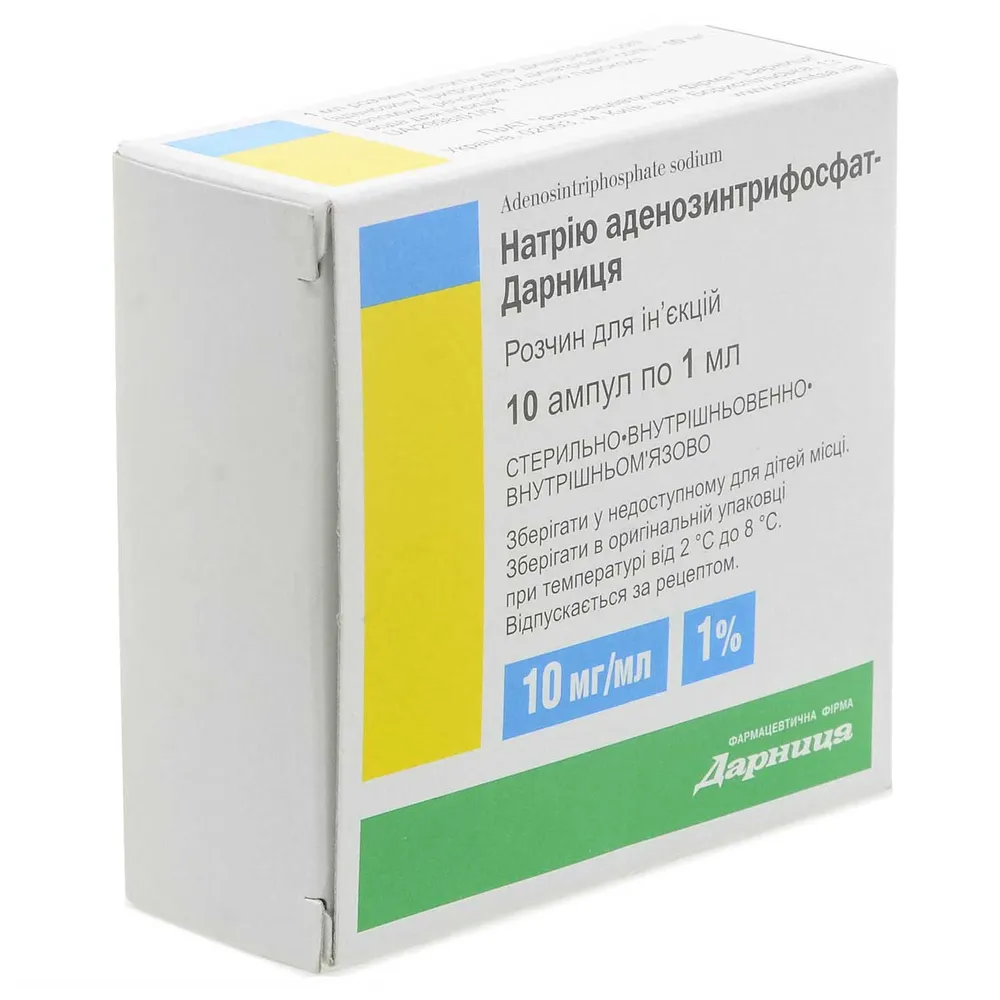
Table of Contents
INSTRUCTIONS FOR MEDICAL USE OF THE MEDICINAL PRODUCT SODIUM ADENOSINETRIPHOSPHATE-DARNITSA (SODIUM adenosintriphosphate-Darnitsa)
Composition:
Active substance: adenosine;
1 ml of solution contains ATP disodium salt (adenosine triphosphate disodium salt) 10 mg;
Excipients: sodium hydroxide, water for injections.
Pharmaceutical form. Injection solution.
Main physico-chemical properties: clear colorless or slightly yellowish liquid.
Pharmacotherapeutic group. Other cardiac preparations. Adenosine.
ATC code C01EB10.
Pharmacological properties.
Pharmacodynamics.
Adenosine triphosphate (ATP) is a natural macroergic compound. It is synthesized in almost all tissues of the body through oxidative phosphorylation and during carbohydrate breakdown. The highest production occurs in muscle tissue, where the energy stored in ATP molecules is used during muscle contraction. The energy released from ATP breakdown is utilized in synthetic processes, particularly in the synthesis of protein and urea.
In the nervous system, ATP molecules act as neurotransmitters, transmitting signals in purinergic synapses. At the same time, ATP accompanies acetylcholinergic and noradrenergic mediation.
After systemic administration, Sodium adenosine triphosphate-Darnytsia exerts metabolic, membrane-stabilizing, and antiarrhythmic effects, improving cerebral and coronary blood flow. The antiarrhythmic effect is associated with suppression of sinus node automaticity and impulse conduction through Purkinje fibers. It promotes relaxation of smooth muscles. It enhances myocardial antioxidant defense and increases myocardial contractile function.
It partially blocks calcium channels and facilitates transmembrane movement of potassium ions.
Pharmacokinetics.
Tracking the kinetics of parenterally administered ATP is not feasible due to the high intensity of various reactions involving endogenous ATP. Nevertheless, it is known that sodium adenosine triphosphate rapidly breaks down at the site of injection into adenosine diphosphoric acid and inorganic phosphate, releasing energy that is used by muscles to perform mechanical work and in biosynthetic processes (protein and urea synthesis), which are subsequently used for the synthesis of new ATP molecules.
The antiarrhythmic effect after intravenous administration occurs within 20–40 seconds.
Clinical characteristics.
Indications.
As part of combination therapy for muscular dystrophy and atrophy; for suppression of paroxysms of supraventricular tachycardia; in peripheral vascular spasms (intermittent claudication, Raynaud's disease, obliterating thromboangiitis).
Treatment of central, peripheral, and mixed forms of hereditary pigmentary retinal degeneration.
Contraindications.
Individual hypersensitivity to any component of the drug, acute myocardial infarction, arterial hypotension, severe forms of bradyarrhythmias, II−III degree atrioventricular block, decompensated stage of heart failure, cardiogenic shock and other types of shock, QT prolongation syndrome, hemorrhagic stroke; hyperkalemia, hypermagnesemia; inflammatory lung diseases, chronic obstructive pulmonary diseases (e.g., bronchial asthma); pregnancy or lactation period, childhood. Should not be administered simultaneously with cardiac glycosides in high doses.
Interaction with other medicinal products and other types of interactions.
Concomitant use with potassium-sparing diuretics, potassium supplements, and ACE inhibitors increases the risk of hyperkalemia; with magnesium-containing preparations – the risk of hypermagnesemia.
The drug may enhance the antianginal effect of beta-adrenoblockers and nitrates.
When used concomitantly with dipyridamole, the effect of dipyridamole, particularly its vasodilatory action, is enhanced.
A certain antagonism may occur when the drug is used together with purine derivatives (caffeine and theophylline).
Simultaneous administration with cardiac glycosides in high doses is contraindicated due to increased risk of adverse cardiovascular reactions.
Concomitant use with xanthinol nicotinate reduces the effect of sodium adenosine triphosphate.
Carbamazepine may potentiate the effects of adenosine and lead to the development of heart block.
Special precautions for use.
Intravenous administration of the medicinal product must be performed only under hospital conditions. Injections should be administered slowly, with monitoring of cardiac function, and blood pressure should be measured after administration.
Use with caution in patients with pronounced bradycardia (except in severe forms of bradyarrhythmias), sick sinus syndrome, first-degree atrioventricular block (AV block), or predisposition to arterial hypotension.
During prolonged use, serum potassium and magnesium levels should be monitored.
Prescribe with caution to patients prone to bronchospasm.
The medicinal product must not be administered in high doses simultaneously with cardiac glycosides.
Limit consumption of products containing caffeine (coffee, tea, cola-containing beverages).
Important information about excipients.
This medicinal product contains less than 1 mmol (23 mg)/dose of sodium, i.e., it is practically sodium-free.
Use during pregnancy or breastfeeding.
There is no data available on the use of Sodium Adenosine Triphosphate-Darnytsia during pregnancy or breastfeeding; therefore, the medicinal product should not be used in these patient groups.
Ability to influence reaction speed when driving or operating machinery.
During treatment, patients should refrain from driving or operating machinery requiring high concentration.
Dosage and Administration
Sodium adenosine triphosphate-Darnitsya should be administered intramuscularly or intravenously.
For the treatment of muscular dystrophies and disorders of peripheral circulation, administer 1 mL intramuscularly once daily for the first 2–3 days, then 1 mL twice daily or 2 mL once daily in subsequent days. The treatment course lasts 30–40 days. If necessary, the course may be repeated after 1–2 months.
For hereditary pigmentary retinal degeneration, administer 5 mL intramuscularly twice daily at 6–8 hour intervals, daily for 15 days. If necessary, the course may be repeated every 8–12 months.
For the termination of supraventricular tachyarrhythmias, administer 1–2 mL intravenously over 5–10 seconds (effect occurs within 20–40 seconds). If necessary, repeat administration with the same dose after 2–3 minutes.
Children
There is no experience with the use of Sodium Adenosine Triphosphate-Darnitsya in children; therefore, the drug is contraindicated in this age group.
Overdose
Symptoms: dizziness, arterial hypotension, transient loss of consciousness, arrhythmia, second- and third-degree atrioventricular block, asystole, bronchospasm, ventricular disturbances, sinus bradycardia and tachycardia. Allergic reactions may also occur.
Treatment: discontinue administration of the drug immediately and administer cardiotonic agents. Symptomatic therapy should be provided. Xanthines (euphyllin, theophylline) are competitive antagonists of adenosine.
Adverse reactions.
The following classification is used to assess the frequency of adverse reactions: very common (≥ 1/10), common (≥ 1/100 and < 1/10), uncommon (≥ 1/1000 and < 1/100), rare (≥ 1/10,000 and < 1/1000), very rare (≤ 1/10,000), including isolated cases, frequency not known.
Eye disorders:
Frequency not known: blurred vision.
Respiratory, thoracic and mediastinal disorders:
Very common: dyspnea;
Uncommon: hyperventilation;
Very rare: bronchospasm;
Frequency not known: apnea, respiratory failure.
Gastrointestinal disorders:
Common: nausea;
Uncommon: metallic taste in the mouth;
Frequency not known: increased gastrointestinal motility (with intravenous administration), vomiting.
Renal and urinary disorders:
Frequency not known: increased diuresis.
Nervous system disorders:
Common: headache, dizziness, paresthesia;
Uncommon: sensation of pressure in the head;
Frequency not known: phobias, transient loss of consciousness, seizures.
Psychiatric disorders:
Frequency not known: nervousness.
Cardiovascular disorders:
Very common: arterial hypotension, bradycardia, sinus pause, missed beats, atrial extrasystoles, atrioventricular conduction disturbances (AV block), ventricular excitability disorders such as ventricular extrasystoles, unstable ventricular tachycardia;
Uncommon: sinus tachycardia, palpitations, chest discomfort;
Very rare: atrial fibrillation, severe bradycardia unresponsive to atropine, ventricular excitability disturbances including ventricular fibrillation, torsade de pointes;
Frequency not known: asystole, which may lead to cardiac arrest and fatal outcome, especially in patients with ischemic heart disease, other heart diseases, coronary artery spasm which may lead to myocardial infarction.
Immune system disorders:
Frequency not known: hypersensitivity reactions, allergic dermatitis, urticaria, anaphylactic shock, angioedema (Quincke's edema).
Skin and subcutaneous tissue disorders:
Frequency not known: facial flushing, pruritus, skin rash.
Musculoskeletal and connective tissue disorders:
Frequency not known: pain in arms, back, and neck.
General disorders and administration site conditions:
Very common: sensation of pricking, skin hyperemia at the injection site;
Uncommon: increased sweating, hyperthermia, sensation of warmth, feeling of general discomfort.
Reporting of suspected adverse reactions.
Reporting of suspected adverse reactions after marketing authorization is an important procedure. It allows continued monitoring of the benefit-risk ratio of the medicinal product. Healthcare professionals are required to report any suspected adverse reactions through the national reporting system.
Shelf life. 2 years.
Storage conditions.
Store in the original packaging at a temperature of 2 °C to 8 °C. Keep out of the reach of children.
Incompatibilities.
The drug must not be administered simultaneously with carbamazepine, dipyridamole, xanthines, antiarrhythmics, or cardiac glycosides.
Packaging.
1 ml in an ampoule; 5 ampoules in a blister pack; 2 blister packs in a carton.
Prescription status. Prescription only.
Manufacturer. JSC "Pharmaceutical Company "Darnytsia".
Manufacturer's address and location of its business activity.
13, Boryspilska Street, Kyiv, 02093, Ukraine.