Nalbuphine
Ukraine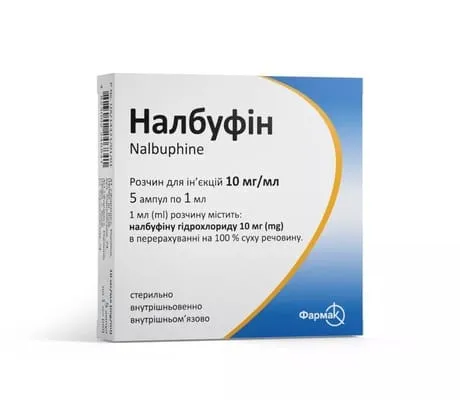
Table of Contents
INSTRUCTIONS FOR MEDICAL USE OF THE MEDICINAL PRODUCT NALBUPHINE
Composition:
active substance: nalbuphine;
1 ml of solution contains nalbuphine hydrochloride 10 mg;
excipients: sodium chloride, sodium citrate, anhydrous citric acid, sodium hydroxide, concentrated hydrochloric acid, water for injections.
Pharmaceutical form. Injection solution.
Main physicochemical properties: clear, colorless solution, free from visible particles.
Pharmacotherapeutic group. Agents acting on the nervous system. Analgesics. Opioids. Morphine derivatives. Nalbuphine. ATC code N02AF02.
Pharmacological properties.
Pharmacodynamics.
Nalbuphine is a semi-synthetic centrally-acting analgesic of the phenanthrene series with morphine agonist/antagonist properties. The analgesic effect of nalbuphine is equivalent to that of morphine.
Nalbuphine does not cause significant changes in cardiovascular parameters or gastrointestinal motility.
Nalbuphine has no spasmolytic effect on smooth muscle. In therapeutic doses, respiratory depression is moderate and does not increase beyond a dose of 0.3 mg/kg (ceiling effect).
Adults
Onset of action occurs within 2–3 minutes after intravenous administration and within less than 15 minutes after intramuscular or subcutaneous injection.
Duration of action ranges from 3 to 6 hours.
Children aged 1 year and older
Onset of action occurs within 2–3 minutes after intravenous administration and within 20–30 minutes after intramuscular or subcutaneous injection.
Duration of action is 3–4 hours.
Pharmacokinetics.
Adults
The elimination half-life from blood plasma is 2–3 hours.
Children aged 1 year and older
The elimination half-life from blood plasma is 1 hour.
Nalbuphine crosses the fetoplacental barrier, with a fetomaternal ratio of 0.76 (0.3–6). Pharmacokinetics in neonates whose mothers received treatment during labor has not been studied.
Plasma protein binding is approximately 35%.
Metabolized in the liver.
Excreted predominantly in urine and partially in feces, in unchanged, conjugated forms, and as metabolites.
Clinical characteristics.
Indications.
Severe pain and/or pain resistant to weaker analgesics.
Contraindications.
Hypersensitivity to nalbuphine.
Abdominal surgical conditions: nalbuphine may alter symptoms. This medicinal product should not be used before diagnosis is established.
Use (direct administration) in children under 18 months of age.
Combination with pure morphine-mimetic agonists (see section "Interaction with other medicinal products and other forms of interaction").
Breastfeeding (except during labor).
Interaction with other medicinal products and other forms of interaction.
Concomitant use is contraindicated
Pure morphine-mimetic agonists (alfentanil, codeine, dextropropoxyphene, dihydrocodeine, fentanyl, methadone, morphine, oxycodone, pethidine, sufentanil, tramadol): reduced analgesic effect due to competitive receptor blockade, with risk of withdrawal symptoms.
Concomitant use is not recommended
Alcohol: enhances the sedative effect of opioid analgesics. Due to impaired alertness, driving vehicles and operating machinery may be dangerous. Consumption of alcoholic beverages and use of medicinal products containing alcohol should be avoided.
Use with caution
Other opioid analgesics (antitussives and substitution therapy), barbiturates, benzodiazepines: increased risk of respiratory depression, which may be fatal in case of overdose.
Other central nervous system depressants, namely: other opioid analgesics, barbiturates, benzodiazepines, anxiolytics (excluding benzodiazepines), sedative antidepressants (amitriptyline, doxepin, mianserin, mirtazapine, trimipramine), sedative H1-antihistamines, hypnotics, neuroleptics, centrally-acting antihypertensive agents, thalidomide, baclofen: enhanced central nervous system depression. Due to impaired alertness, driving vehicles and operating machinery may be dangerous.
Special precautions for use
Special warnings
As with other morphine derivatives, prolonged use may lead to physical and psychological dependence and tolerance. The risk of abuse is low due to nalbuphine's significant antagonistic properties. Abrupt discontinuation after prolonged treatment may result in withdrawal syndrome.
Not recommended for outpatient use due to the risk of daytime drowsiness.
For information on use in obstetrics, see section "Use during pregnancy or breastfeeding".
During labor in women with cervical dilation of 4 cm or less, nalbuphine should be administered under strict medical supervision. In such cases, intravenous administration should be avoided.
Precautionary measures during use
This medicinal product contains less than 1 mmol (23 mg) of sodium per ampoule, i.e. it is practically sodium-free.
Nalbuphine causes very mild respiratory depression; however, its use poses a risk in patients with respiratory insufficiency.
Nalbuphine should be used with caution in patients with head injury and intracranial hypertension.
Due to hepatic metabolism and renal excretion of the drug, dose reduction is advisable in patients with impaired liver or kidney function.
In patients dependent on morphine or those recently treated with morphine, withdrawal syndrome may occur due to nalbuphine's antagonistic properties.
Use during pregnancy or breastfeeding
Pregnancy
Teratogenic effects
Animal studies have not revealed teratogenic effects. In the absence of teratogenic effects in animals, a malformative effect in humans is not expected. Current evidence indicates that substances causing developmental abnormalities in humans have demonstrated teratogenic properties in animals in properly conducted studies.
At present, there are insufficient clinical data to assess the potential malformative effects of nalbuphine when used during the first trimester of pregnancy.
As a precautionary measure, the use of nalbuphine during pregnancy is not recommended.
Fetotoxic effects
As with all opioid analgesics, prolonged use by the mother, especially towards the end of pregnancy, may cause withdrawal syndrome in the newborn, regardless of dose. Towards the end of pregnancy, high doses—even with short-term maternal treatment—may cause respiratory depression in the child.
Use in obstetrics
When nalbuphine is used during labor, respiratory depression—including delayed onset—has been observed in newborns. Therefore, the maximum dose should not exceed 20 mg intramuscularly, and monitoring of the newborn, particularly respiratory function, is recommended.
Nalbuphine should be avoided during high-risk pregnancies, especially in cases of preterm labor or twin delivery.
Breastfeeding period
Nalbuphine passes into breast milk; several cases of hypotonia and respiratory arrest in infants have been reported after maternal use of opioid derivatives in supratherapeutic doses.
Breastfeeding is contraindicated during prolonged treatment with this medicinal product. However, breastfeeding is not contraindicated following obstetric use of the drug.
Ability to influence reaction speed when driving or operating machinery
The use of this medicinal product is incompatible with driving vehicles or operating machinery (see section "Special precautions for use").
Method of administration and dosage.
Dosage
Dosage is determined according to the patient's body weight. Dosage errors should be avoided due to confusion between milligrams (mg) and milliliters (mL), which may lead to accidental overdose (see Table 1 (adult dosing) or Table 2 (pediatric dosing) below).
Adults
The recommended dose is 10–20 mg administered intravenously, intramuscularly, or subcutaneously. This dose may be repeated every 3–6 hours as needed. The daily dose should not exceed 160 mg.
Table 1
Dosing for adult patients
| Dose per administration |
Maximum single dose |
Maximum volume per administration |
Maximum daily dose |
Maximum daily volume |
| 0.1–0.3 mg/kg |
20 mg |
2 ml |
160 mg |
16 ml |
Children from 18 months of age
The recommended dose is 0.2 mg/kg administered intravenously, intramuscularly, or subcutaneously. Administration may be repeated every 4–6 hours up to a maximum total daily dose of 1.6 mg/kg. For pediatric use, intravenous or subcutaneous routes of administration are preferred.
Table 2
Dosing in children
| Dose per administration |
Maximum single dose |
Maximum volume per administration |
Maximum daily dose |
Maximum daily volume |
| 0.1–0.2 mg/kg |
0.2 mg/kg |
0.02 ml/kg |
1.6 mg/kg* |
0.16 ml/kg* |
* This dose is calculated based on the approved dosing interval. For medicinal products for which dose repetition is recommended every 4–6 hours, the maximum daily dose is 1.2 mg/kg and the maximum volume is 0.12 ml/kg.
Administration method
Injection solution. For intravenous, intramuscular or subcutaneous administration.
Children.
Administered to children according to the recommendations provided in the section "Dosage and administration".
Overdose.
In case of overdose, intravenous administration of naloxone (specific antidote) is indicated, along with, if necessary, other symptomatic therapy such as oxygen, plasma substitutes, vasopressors.
Adverse reactions.
The most common adverse effect is drowsiness.
Dizziness, nausea, vomiting, increased sweating, dry mouth, and headache may also occur.
Less frequently observed are mood disturbances, visual disturbances, flushing, sedative effect, and abdominal spasms.
In isolated cases, psychomimetic effects have been reported.
Respiratory depression in newborns following use in obstetrics may be prolonged or delayed (see section "Use during pregnancy or breastfeeding").
Reporting suspected adverse reactions
Reporting of suspected adverse reactions after drug authorization is important. It allows ongoing monitoring of the benefit-risk balance of the medicinal product. Healthcare and pharmaceutical professionals, as well as patients or their legal representatives, should report all suspected adverse reactions and lack of efficacy through the Automated Pharmacovigilance Information System at the following link: https://aisf.dec.gov.ua.
Shelf life. 2 years.
Storage conditions.
Store in the original packaging (to protect from light) at a temperature not exceeding 25 °C. Keep out of reach of children.
Incompatibilities.
Not applicable.
Packaging. 1 ml in a vial; 5 vials in a blister pack in a cardboard box.
Prescription status. Prescription only.
Manufacturer. STEGERIL-GENE LIFE SCIENCES (P) LTD / Steril-Gene Life Sciences (P) Ltd.
Manufacturer's address.
No. 45, Mangalam Main Road, Villianur Commune, Puducherry 605110, India / No. 45, Mangalam Main Road, Villianur Commune, Puducherry 605110, India.
Marketing authorization holder. JIVDHARA PHARMA PRIVATE LIMITED, India / JIVDHARA PHARMA PRIVATE LIMITED, India.
Address of the marketing authorization holder. 504, Block-B, Shiv Angan Complex, Sallaiya, Bhopal, Bhopal, Madhya Pradesh, 462026, India / 504, Block-B, Shiv Angan Complex, Sallaiya, Bhopal, Bhopal, Madhya Pradesh, 462026, India.