Naglazim®
Ukraine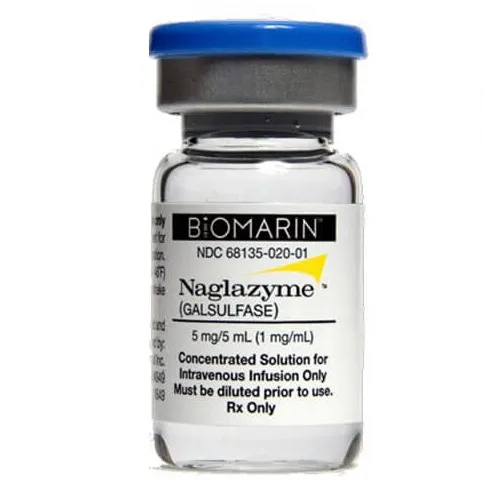
Table of Contents
INSTRUCTIONS for medical use of the medicinal product Naglazim® (Naglazyme®)
Composition:
Active substance: galsulfase;
1 ml of solution contains 1 mg of galsulfase;
1 vial contains 5 mg of galsulfase;
Excipients: sodium chloride; sodium dihydrogen phosphate monohydrate; sodium hydrogen phosphate heptahydrate; polysorbate 80; water for injections.
Pharmaceutical form. Concentrate for solution for infusion.
Main physicochemical properties: from clear to slightly opalescent liquid, colorless to pale yellow.
Pharmacotherapeutic group. Other agents affecting the digestive system and metabolic processes. Enzymes. ATC code A16AB08.
Pharmacological Properties
Pharmacodynamics
Deficiency of certain lysosomal enzymes required for the catabolism of glycosaminoglycans (GAGs) leads to impaired accumulation of mucopolysaccharides. Mucopolysaccharidosis type VI (MPS VI) is a heterogeneous, multisystemic disorder characterized by deficiency of N-acetylgalactosamine-4-sulfatase, a lysosomal hydrolase that catalyzes the hydrolysis of the sulfate group from the glycosaminoglycan dermatan sulfate. Reduced or absent activity of N-acetylgalactosamine-4-sulfatase results in the accumulation of dermatan sulfate in cells of various types and tissues.
The rationale for enzyme replacement therapy is to restore enzymatic activity to a level sufficient for hydrolysis of the accumulated substrate and to prevent further accumulation.
Purified galsulfase is a recombinant form of human N-acetylgalactosamine-4-sulfatase and is a glycoprotein with a molecular weight of approximately 56 kDa. After cleavage of the N-terminus, galsulfase consists of 495 amino acids. The molecule contains six N-linked oligosaccharide modification sites. Following intravenous administration, galsulfase is rapidly cleared from the circulation and taken up by cells, likely via mannose-6-phosphate receptors, and localized to lysosomes.
Three clinical studies of Naglazyme® focused on evaluating systemic manifestations of mucopolysaccharidosis type VI (MPS VI), such as endurance, joint mobility, joint pain and stiffness, upper airway obstruction, fine hand motor skills, and visual acuity.
The safety and efficacy of Naglazyme® were evaluated in a randomized, double-blind, placebo-controlled Phase 3 study involving 39 patients with mucopolysaccharidosis type VI (MPS VI), aged 5 to 29 years. Most patients had short stature, reduced endurance, and musculoskeletal symptoms. Patients included in the study were able to walk more than 5 meters but less than 250 meters in the 6-minute walk test at baseline, or less than 400 meters in 12 minutes.
Patients received either 1 mg/kg galsulfase or placebo weekly for a total of 24 weeks. The primary efficacy endpoint was the distance walked in 12 minutes at week 24 compared to baseline. Secondary efficacy endpoints included the number of stairs climbed in 3 minutes and urinary glycosaminoglycan (GAG) excretion in the treatment group compared to the placebo group at week 24. Subsequently, 38 patients were enrolled in an open-label extension study, in which they received 1 mg/kg galsulfase weekly.
After 24 weeks of treatment, patients receiving Naglazyme® showed an improvement in the 12-minute walk distance of 92 ± 40 meters compared to the placebo group (p = 0.025). In the treatment group, a 3-minute stair-climbing test showed improvement of 5.7 steps per minute compared to the placebo group. After 24 weeks of treatment, patients in the treatment group also showed a mean reduction in urinary glycosaminoglycan excretion of 238 ± 17.8 µg/mg creatinine (± standard error [SE]). In the Naglazyme® treatment group, GAG levels approached the normal age-related range.
In an additional randomized Phase 4 study with two dose levels, 4 patients with mucopolysaccharidosis type VI (MPS VI) aged up to 1 year received either 1 or 2 mg/kg/week for 53–153 weeks.
Despite the very small number of patients in this study, the following conclusions can be drawn.
Treatment with Naglazyme® demonstrated improvement or absence of worsening in facial dysmorphism. However, it does not prevent the progression of skeletal dysplasia and development of hernias, nor does it prevent progression of corneal clouding. Growth velocity remained normal during this limited observation period. Hearing improvement was observed in at least one ear in all four patients. Urinary glycosaminoglycan (GAG) levels decreased by more than 70%, consistent with findings in older patients.
Pharmacokinetics
The pharmacokinetics of galsulfase were evaluated in 13 patients with mucopolysaccharidosis type VI (MPS VI) who received 1 mg/kg galsulfase as a 4-hour infusion. After 24 weeks of treatment, the mean (± standard error [SE]) maximum plasma concentration (Cmax) was 2357 (± 1560) ng/mL, and the mean (± SE) area under the concentration-time curve (AUC0–T) was 5860 (± 4184) hour × ng/mL. The mean (± SE) volume of distribution (Vz) was 316 (± 752) mL/kg, and the mean (± SE) plasma clearance (CL) was 7.9 (± 14.7) mL/min/kg. The mean (± SE) elimination half-life (t1/2) was 22.8 (± 10.7) hours at week 24.
Pharmacokinetic parameters in patients enrolled in Phase 1 studies remained stable over a prolonged period (at least up to 194 weeks).
Galsulfase is a protein subject to metabolic degradation via peptide hydrolysis. Therefore, clinically significant effects of hepatic impairment on the pharmacokinetics of galsulfase are not expected. Renal excretion of galsulfase is considered negligible (see section "Dosage and administration").
Clinical characteristics.
Indications.
Naglazyme® is indicated for long-term enzyme replacement therapy in patients with a confirmed diagnosis of mucopolysaccharidosis VI (MPS VI; N-acetylgalactosamine-4-sulfatase deficiency; Maroteaux-Lamy syndrome) (see section "Pharmacodynamics").
Contraindications.
Severe or life-threatening hypersensitivity to the active substance or to any of the excipients that cannot be managed.
Interaction with other medicinal products and other forms of interaction.
Studies on drug interactions have not been conducted.
Special precautions for use.
Traceability
To improve the traceability of biological medicinal products, the name and batch number of the administered product should be clearly recorded in the patient's medical records.
Use in patients with respiratory tract disorders
Caution should be exercised when administering Naglazyme® to patients with respiratory tract disorders. The use of antihistamines and other sedative medicinal products should be limited or closely monitored. In appropriate clinical cases, the need for positive airway pressure during sleep or tracheostomy should be considered.
For patients with acute fever or respiratory illness, administration of Naglazyme® infusion may need to be postponed.
Use in patients with infusion reactions
Infusion reactions have been observed in patients receiving Naglazyme®. These are defined as any adverse reactions occurring during or on the day of infusion (see section "Adverse reactions").
Clinical trial data with Naglazyme® indicate that IgG antibodies to galsulfase are expected to develop in most patients within 4–8 weeks after initiation of treatment.
In clinical studies with Naglazyme®, infusion reactions were generally managed by interrupting or slowing the infusion rate and/or premedicating patients with antihistamines and/or antipyretics (e.g., paracetamol), allowing patients to continue treatment.
Due to limited experience with re-initiation of treatment after prolonged interruptions, caution is advised because of the theoretical risk of increased hypersensitivity reactions.
To minimize the potential for infusion reactions with Naglazyme®, patients should be premedicated with antihistamines with or without antipyretics approximately 30–60 minutes prior to the start of infusion.
In the case of a mild or moderate infusion reaction, consideration should be given to administering antihistamines and paracetamol and/or reducing the infusion rate to half the rate at which the reaction occurred.
In the case of a single severe infusion reaction, the infusion should be stopped until symptoms resolve, and administration of antihistamines and paracetamol should be considered. Infusion may be resumed at a reduced rate of 50–25% of the rate at which the reaction occurred.
In the case of recurrent moderate infusion reactions or re-administration after a single severe infusion reaction, premedication with antihistamines, paracetamol, and/or corticosteroids should be considered, along with reducing the infusion rate to 50–25% of the rate at which the previous reaction occurred.
As with intravenous administration of any protein medicinal product, severe allergic-type hypersensitivity reactions may occur. If such reactions occur, administration of Naglazyme® should be stopped immediately and appropriate medical treatment initiated. Current medical standards for emergency care should be followed. Patients who experience allergic reactions during Naglazyme® infusion require caution during subsequent infusions; appropriately trained personnel and equipment for emergency resuscitation (including adrenaline administration) must be available during infusions. Severe or potentially life-threatening hypersensitivity reactions are contraindications to re-administration if the hypersensitivity reaction is not manageable (see also section "Contraindications").
Spinal cord or cervical spinal cord compression
Spinal cord or cervical spinal cord compression (CSCC), leading to myelopathy, is a known and serious complication of Mucopolysaccharidosis type VI (MPS VI). During the post-marketing period, some patients receiving Naglazyme® developed or experienced worsening of CSCC, necessitating decompressive surgery. Patients should be monitored for symptoms of CSCC (including back pain, paralysis of limbs below the level of compression, urinary and fecal incontinence) and provided with appropriate clinical management.
Risk of acute cardiorespiratory failure
Caution should be exercised when administering Naglazyme® to patients who are susceptible to fluid overload, such as patients with body weight ≤20 kg, patients with acute respiratory illness, or patients with compromised cardiac and/or respiratory function, as congestive heart failure may occur. Appropriate medical support and monitoring should be provided during Naglazyme® infusion, and some patients may require prolonged observation based on individual patient needs (see section "Dosage and administration").
Immune-mediated reactions
Type III immune complex reactions, including membranous glomerulonephritis, have been observed with Naglazyme®. If an immune complex reaction occurs, administration of Naglazyme® should be discontinued and appropriate medical treatment initiated. The risks and benefits of re-administering Naglazyme® after an immune-mediated reaction should be carefully considered (see section "Dos游戏副本
Method of Administration and Dosage
As with other lysosomal genetic disorders, it is extremely important, especially in severe forms, to initiate treatment as early as possible, before the onset of irreversible clinical manifestations of the disease.
Treatment with Naglazyme® should be administered under the supervision of a physician experienced in managing patients with mucopolysaccharidosis type VI (MPS VI) or other inherited metabolic disorders. Naglazyme® should be administered in an appropriate clinical setting with resuscitation equipment available for emergency medical intervention.
Dosage
The recommended dose of galsulfase is 1 mg/kg body weight once weekly as an intravenous infusion over 4 hours.
Special Patient Groups
Elderly Patients
The safety and efficacy of Naglazyme® in patients over 65 years of age have not been established, and no recommendations for an alternative dosing regimen in these patients are available.
Patients with Renal or Hepatic Impairment
The safety and efficacy of Naglazyme® in patients with renal or hepatic impairment have not been established (see section "Pharmacokinetics"), and no recommendations for an alternative dosing regimen in these patients are available.
Instructions for Use
Method of Administration
The initial infusion rate should be adjusted so that approximately 2.5% of the total volume is infused during the first hour, and the remaining volume (approximately 97.5%) is infused over the following 3 hours.
Each vial of Naglazyme® is intended for single use only. The concentrate for infusion solution must be diluted in 0.9% sodium chloride solution (9 mg/mL) for infusion using an aseptic technique. It is recommended to administer the diluted Naglazyme® solution using an infusion system equipped with an in-line 0.2 μm filter.
Preparation of the Naglazyme® Infusion Solution (aseptic technique must be used)
Depending on the patient's body weight, determine the number of vials required for dilution and remove them from the refrigerator approximately 20 minutes in advance to allow the vials to reach room temperature.
Before dilution, inspect each vial for the presence of mechanical particles and discoloration of the solution. The solution should be clear to slightly opalescent, colorless to pale yellow, and free of visible particles.
From a 250 mL infusion bag, remove and discard a volume of 0.9% sodium chloride solution for infusion equal to the total volume of Naglazyme® to be added. Consider using 100 mL infusion bags for patients prone to fluid overload and with body weight less than 20 kg; in this case, the infusion rate (mL/min) should be reduced so that the total infusion duration is not less than 4 hours. When using 100 mL bags, the Naglazyme® volume may be added directly to the infusion bag.
Naglazyme® should be added slowly to 0.9% sodium chloride solution for infusion.
Before infusion, gently mix the solution.
Before administration, visually inspect the solution for mechanical particles. Only clear, colorless solutions free of visible particles should be used.
Diluted solutions: Chemical and physical stability has been confirmed for up to 4 days at room temperature (23–27 °C).
From a microbiological standpoint, Naglazyme® should be used immediately. If not used immediately, the user is responsible for storage conditions and duration; generally, the solution should be stored no longer than 24 hours at 2–8 °C, followed by up to 24 hours at room temperature (23–27 °C) during administration.
Any unused product or waste material must be disposed of in accordance with local requirements.
Children
The rationale for specific use of Naglazyme® in children is not available. Current data are presented in the section "Pharmacodynamics".
Overdose
Some patients who received an infusion rate exceeding the recommended rate were administered a total dose of Naglazyme® twice the recommended dose, without apparent adverse effects.
Adverse Reactions
Due to the small number of participants in clinical trials, safety data from all clinical studies with Naglazyme® were pooled and evaluated in a single integrated clinical safety data analysis.
All patients receiving Naglazyme® (59 out of 59) experienced at least one adverse reaction. The majority (42 out of 59; 71%) experienced at least one treatment-related adverse reaction. The most commonly reported treatment-related adverse reactions were fever, rash, pruritus, urticaria, chills, nausea, headache, abdominal pain, vomiting, and dyspnea. Serious adverse reactions included laryngeal edema, apnea, fever, urticaria, respiratory distress, angioedema, asthma, and anaphylactoid reactions.
Infusion-related reactions, defined as adverse reactions occurring during or on the same day of Naglazyme® infusion, were observed in 33 out of 59 patients (56%) treated with Naglazyme® across five clinical trials. Infusion-related reactions occurred from Week 1 through Week 146 of Naglazyme® therapy and were observed with multiple infusions, although not necessarily in consecutive weeks. The very common symptoms of these infusion-related reactions were fever, chills, rash, urticaria, and dyspnea. Common symptoms included pruritus, vomiting, abdominal pain, nausea, hypertension, headache, chest pain, erythema, cough, hypotension, angioedema, respiratory distress, tremor, conjunctivitis, malaise, bronchospasm, and arthralgia.
The adverse reactions listed below are classified by system organ class (MedDRA) and frequency of occurrence. Adverse reactions are categorized by frequency as follows: very common – reactions occurring at a frequency ≥ 1/10; common – reactions occurring at a frequency ≥ 1/100 to < 1/10. Due to the small patient population, adverse reactions occurring in a single patient were classified as common. Within each category, adverse reactions are listed in order of decreasing severity. The frequency of adverse reactions reported during the post-marketing period is classified as "unknown frequency" (frequency cannot be estimated based on available data).
Overall, one case of sleep apnea was observed across all clinical trials.
Immune system disorders: unknown frequency – anaphylaxis, shock.
Infections and infestations: very common – pharyngitis\textsuperscript{1}, gastroenteritis\textsuperscript{1}.
Nervous system disorders: very common – areflexia\textsuperscript{1}, headache; common – tremor; unknown frequency – paresthesia.
Eye disorders: very common – conjunctivitis\textsuperscript{1}, corneal clouding\textsuperscript{1}.
Cardiac disorders: unknown frequency – bradycardia, tachycardia, cyanosis.
Ear and labyrinth disorders: very common – ear pain\textsuperscript{1}, hearing impairment\textsuperscript{1}.
Vascular disorders: very common – hypertension\textsuperscript{1}; common – hypotension; unknown frequency – pallor.
Respiratory, thoracic and mediastinal disorders: very common – dyspnea\textsuperscript{1}, nasal congestion\textsuperscript{1}; common – apnea\textsuperscript{1}, cough, respiratory distress, asthma, bronchospasm; unknown frequency – laryngeal edema, hypoxia, tachypnea.
Gastrointestinal disorders: very common – abdominal pain\textsuperscript{1}, umbilical hernia\textsuperscript{1}, vomiting, nausea.
Skin and subcutaneous tissue disorders: very common – angioedema\textsuperscript{1}, rash\textsuperscript{1}, urticaria, pruritus; common – erythema.
General disorders and administration site conditions: very common – pain\textsuperscript{1}, chest pain\textsuperscript{1}, chills\textsuperscript{1}, malaise\textsuperscript{1}, fever.
Musculoskeletal and connective tissue disorders: very common – arthralgia.
Notes:
\textsuperscript{1} Reactions observed more frequently in the active group than in the placebo group in a placebo-controlled trial; frequency was determined in 39 patients from the Phase 3 blinded study.
Other reactions with known frequency were reported in 59 patients treated with Naglazyme® across all five clinical trials.
Reactions with unknown frequency were reported during the post-marketing period.
In four patients under 1 year of age, the overall safety profile of the higher dose (2 mg/kg/week) showed no clinically meaningful differences compared to the recommended dose of 1 mg/kg/week and was consistent with the safety profile of Naglazyme® in older children.
Immunogenicity
Of the 59 patients treated with Naglazyme® in clinical trials, 54 were tested for IgG antibodies. Of these, 53 out of 54 (98%) tested positive for IgG antibodies against galsulfase.
A comprehensive antibody analysis based on data from three clinical trials was performed in 48 patients.
Although recurrent infusion-related reactions were observed in a majority of patients with high total antibody titers, the titer of anti-galsulfase antibodies does not reliably predict the frequency or severity of such reactions. Furthermore, antibody development is not a predictive marker for reduced efficacy, although patients with limited response in terms of endurance or urinary glycosaminoglycan (GAG) parameters tend to have higher peak anti-galsulfase antibody titers compared to patients with good response.
Reporting of suspected adverse reactions
Reporting suspected adverse reactions after marketing authorization is of vital importance. It allows continued monitoring of the benefit-risk balance of the medicinal product. Healthcare professionals, pharmacists, and patients or their legal representatives are encouraged to report any suspected adverse reactions and lack of efficacy via the automated pharmacovigilance information system at: https://aisf.dec.gov.ua.
Shelf life. 3 years.
Storage conditions.
Store at 2 °C – 8 °C.
Do not freeze.
Keep out of the reach and sight of children.
Incompatibilities.
This medicinal product must not be mixed with other medicinal products except with 9 mg/mL (0.9%) sodium chloride solution for infusion.
Packaging.
5 mL in a vial stoppered with a rubber plug and sealed with an aluminum cap with a "flip-off" polypropylene disc. One vial per cardboard box.
Prescription status. Prescription only.
Manufacturer.
BioMarin International Limited
(final product quality control, labeling, secondary packaging, batch release responsible person).
Manufacturer’s address and place of business.
Shanbally, Ringaskiddy, Co. Cork, Ireland.
Marketing Authorization Holder. BioMarin International Limited.
Address of the Marketing Authorization Holder. Shanbally, Ringaskiddy, Co. Cork, Ireland.