Nabota
Ukraine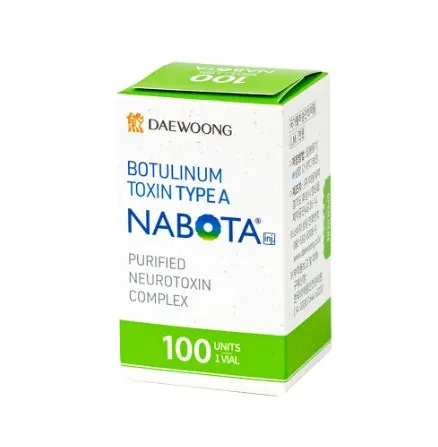
Table of Contents
INSTRUCTION FOR MEDICAL USE OF THE MEDICINAL PRODUCT NABOTA (Nabota®)
Composition:
Active substance: Clostridium botulinum toxin type A;
One vial contains 100 units of botulinum toxin type A;
Excipients: human albumin, sodium chloride.
Pharmaceutical form. Powder for solution for injection.
Main physicochemical properties: white to yellowish powder.
Pharmacotherapeutic group. Peripheral-acting muscle relaxants. Botulinum toxin. ATC code M03AX01.
Pharmacological properties.
Pharmacodynamics.
Mechanism of action.
Botulinum toxin type A blocks peripheral release of acetylcholine at presynaptic cholinergic nerve endings by cleaving SNAP-25, an essential component for vesicle docking and acetylcholine release from vesicles located in nerve terminals.
Following injection, the toxin initially binds rapidly to surface receptors on specific cells. This is followed by translocation of the toxin across the plasma membrane via receptor-mediated endocytosis. The toxin is then released into the cytosol, resulting in a gradual reduction in acetylcholine release. Clinical effects appear within 2–3 days, with maximum effect observed at 4 weeks after injection.
Recovery following intramuscular injection occurs over approximately 12 weeks, as nerve terminals regenerate and re-establish functional connections with the endplate.
Clinical study data.
Glabellar lines
A European/Canadian clinical trial included 540 patients with moderate to severe glabellar lines observed at maximum frown. Patients reported that their glabellar lines had a significant psychological impact on mood, anxiety/depressive symptoms.
According to investigator assessment, Nabota significantly reduced the severity of glabellar lines by at least 1 point on the grading scale at maximum frown over 139 days.
Table 1
Primary efficacy endpoint: proportion of patients achieving a score of 0 (none) or 1 (minimal) on the glabellar line severity scale at maximum contraction on Day 30, as assessed by the investigator, in the per-protocol population (PP population).
| Response to primary efficacy endpoint |
Placebo |
Comparator drug |
Nabota |
Absolute difference |
||
| Comparator drug vs Placebo |
Nabota vs Placebo |
Nabota vs comparator drug |
||||
| Number of participants |
2/48 |
202/244 |
205/235 |
|||
| % |
4.2% |
82.8% |
87.2% |
78.6% |
83.1% |
4.4% |
| Confidence interval in % |
(0.0, 9.8) |
(78.1, 87.5) |
(83.0, 91.5) |
(66.5, 85.5) |
(70.3, 89.4) |
(-1.9, 10.8) |
| p-value |
< 0.001 |
< 0.001 |
||||
Glabellar Line Scale (GLS): 0 – absent, 1 – mild, 2 – moderate, 3 – severe.
Two days after injection, 12.2% (6/49) of participants in the placebo group, 57.0% (139/244) of patients receiving the comparator drug, and 54.2% (130/240) of patients receiving Nabota were assessed by investigators as responders to treatment (wrinkles absent or mild in severity at maximum frown).
Table 2
Exploratory efficacy endpoint – Glabellar Line Scale score of 0 (absent) or 1 (mild) on Day 30, as assessed by the investigator at maximum muscle contraction, in the intent-to-treat (ITT) population who received Nabota.
| Glabella Wrinkle Severity Scale (GLS) at baseline under maximum contraction |
Nabota (N = 245) |
|
| GLS = 0 on Day 30 under maximum contraction |
GLS = 1 on Day 30 under maximum contraction |
|
| 2 (moderate) Number of participants % |
35/62 56.5% |
25/62 40.3% |
| 3 (severe) Number of participants % |
41/179 22.9% |
108/179 60.3% |
Glabella Wrinkle Scale (GLS): 0 – absent, 1 – mild, 2 – moderate, 3 – severe.
Dominant results are based on the number of participants with the specified severity grade at baseline under maximum contraction, who also had both baseline and Day 30 assessments on the Glabella Wrinkle Scale (GLS) under maximum muscle contraction as evaluated by the investigator.
Table 3
Exploratory efficacy endpoint – Glabella Wrinkle Scale score of 0 (absent) or 1 (mild) on Day 30 as assessed by the investigator under maximum muscle contraction for participants who received NaboTox product, by category at baseline under resting conditions in the ITT population
| Participant category at baseline at rest according to the Glabellar Line Severity (GLS) scale |
Nabota (N = 245) |
|
| GLS = 0 on day 30 at maximum contraction |
GLS = 1 on day 30 at maximum contraction |
|
| ≤ 1 (none or mild) Number of participants % |
61/103 59.2% |
40/103 38.8% |
| > 1 (moderate or severe) Number of participants % |
15/138 10.9% |
93/138 67.4% |
Glabella Wrinkle Scale (GLS): 0 – absent, 1 – mild, 2 – moderate, 3 – severe.
Dominant outcomes are based on the number of participants with the specified baseline severity grade at rest who also had both a baseline assessment at study entry and a Day 30 assessment on the Glabella Wrinkle Scale (GLS) during maximum contraction as evaluated by the investigator.
Nabota injections also reduced the severity of glabellar wrinkles at rest—an exploratory efficacy endpoint.
Table 4
Exploratory efficacy endpoint – Glabella Wrinkle Scale >/= 2 outcomes were better on Day 30 at rest as assessed by the investigator in the population of patients who completed the study per protocol (PP population)
| Response to exploratory efficacy endpoint |
Placebo |
Comparator drug |
Nabota |
Absolute difference |
||
| Comparator drug vs Placebo |
Nabota vs Placebo |
Nabota vs Comparator drug |
||||
| Number of participants |
0/27 |
36/149 |
32/133 |
|||
| % |
0 % |
24.2 % |
24.1 % |
24.2 % |
24.1 % |
|
| Confidence interval in % |
(0.0, 12.8) |
(17.5, 31.8) |
(17.1, 32.2) |
(11.4, 32.3) |
(11.3, 32.4) |
(-10.1, 9.9) |
| p-value |
0.003 |
0.003 |
0.984 |
|||
There are limited Phase 3 clinical data regarding the use of Nabota in patients over 65 years of age.
The duration of response in the Phase 3 study was 139 days based on a 1-point improvement in GLS.
Overall, 922 patients participated in two 1-year open-label, uncontrolled studies, and during these studies, patients received an average of 3 procedures.
The psychological impact of glabellar lines was confirmed at patient enrollment in the study. Although it is not possible to assess the beneficial effect on psychological status, a significant effect on emotional state has been demonstrated. Patients reported positive outcomes compared to placebo. This effect of Nabota on psychological status and patient-reported outcomes was comparable to that observed with the comparator product, i.e., an active control used in the main study.
Pharmacokinetics.
Nabota was not detected in peripheral blood after intramuscular injection at the recommended dose.
Studies on absorption, distribution, metabolism, and excretion of the active substance were not conducted due to the nature of this product.
Clinical characteristics.
Indications.
The medicinal product is indicated for temporary improvement in the appearance of moderate to severe glabellar lines visible at maximum frown (glabellar lines), when the marked appearance of these lines has a significant psychological impact in adults up to 65 years of age.
Contraindications.
Hypersensitivity to the active substance or to any of the excipients of the product. General disorders of muscular function (e.g. myasthenia gravis or Eaton-Lambert syndrome). Presence of infectious or inflammatory processes at the site of planned injection.
Interaction with other medicinal products and other forms of interaction.
Interaction studies have not been performed.
Theoretically, the effect of botulinum toxin may be potentiated by aminoglycoside antibiotics, spectinomycin, or other medicinal products interfering with neuromuscular transmission (e.g. neuromuscular blockers).
The effect of using different serological types of botulinum neurotoxin simultaneously or within several months of each other is unknown. Excessive neuromuscular weakness may be enhanced by administration of another botulinum toxin before the effect of the previously administered botulinum toxin has terminated.
Special precautions for use.
General
When treating glabellar lines, it is important to examine the patient's facial anatomy prior to administration of the medicinal product.
Injections into vulnerable anatomical structures such as nerves and blood vessels should be avoided.
Pain at the injection site, inflammation, paraesthesia, hypaesthesia, sensitivity, swelling, erythema, localized infection, bleeding and/or bruising may be associated with the injection. Needle-related pain and/or anxiety may lead to vasovagal reactions, including transient symptomatic hypotension and syncope.
Caution should be exercised if the target muscle shows excessive weakness or atrophy.
Care must be taken to ensure that the product is not injected into blood vessels in glabellar lines observed during maximum frowning (see section "Method of administration and dosage").
There is a risk of eyelid ptosis during treatment (see section "Method of administration and dosage").
Caution is advised if previous botulinum toxin injections have caused complications.
Coagulation disorders
Caution is required when administering NaboTa to patients with coagulation disorders, as injection may result in bruising.
Local and distant effects of the toxin
Very rarely, adverse reactions (see section "Adverse reactions") due to spread of toxin effects beyond the injection site have been reported.
Swallowing and breathing difficulties are serious and may lead to death. NaboTa injections are not recommended in patients with a history of dysphagia or aspiration.
Patients or their caregivers should be advised to seek immediate medical attention if difficulty swallowing, speech disturbances, or respiratory problems occur.
Injections in patients with pre-existing neuromuscular disorders
Patients with subclinical neuromuscular disorders may have an increased risk of clinically significant systemic effects, including severe dysphagia and respiratory impairment following therapeutic doses of botulinum toxin type A. In some of these cases, dysphagia has lasted several months and required placement of a feeding tube (see section "Contraindications").
Botulinum toxin type A should also be used with caution in patients with amyotrophic lateral sclerosis or peripheral neuromuscular disorders.
Hypersensitivity reactions
Anaphylactic reactions after botulinum toxin injections are very rare. Nevertheless, anti-anaphylactic treatment measures should be readily available.
Antibody formation
Antibodies to botulinum toxin type A may develop during treatment in patients receiving this medicinal product. Some of these antibodies neutralize the effect of the toxin, which may result in treatment failure with botulinum toxin type A.
The NaboTa medicinal product from a single vial should be used for only one patient during a single procedure.
Use during pregnancy or breastfeeding.
Pregnancy
There are insufficient data on the use of botulinum toxin type A in pregnant women. Animal studies have shown reproductive toxicity. NaboTa is not recommended for use in pregnant women, women planning pregnancy, or women of reproductive potential who are not using contraception.
Breastfeeding
There is no information on the presence of NaboTa in human breast milk. The use of NaboTa in breastfeeding women is not recommended.
Fertility
There are insufficient data on the effect of botulinum toxin type A on fertility. Animal studies have shown impaired fertility.
Ability to affect reaction speed when driving or operating machinery.
The medicinal product has no or moderate effect on the ability to drive or operate machinery. There is a potential risk of asthenia, muscle weakness, dizziness or visual disturbances, which may temporarily impair the ability to drive or operate machinery.
Method of Administration and Dosage
The product should only be administered by a physician with appropriate qualifications and experience in treating glabellar lines, and who uses appropriate equipment during treatment.
Doses.
The recommended dose per injection site into the muscle is 4 IU / 0.1 mL. Five injection sites (see figure): two injections into each corrugator supercilii muscle (lower medial and upper medial portions), and one injection into the procerus muscle, for a total dose of 20 IU. Units of botulinum toxin from different products are not interchangeable. Recommended doses of other botulinum toxin products may differ. In the absence of adverse reactions during initial treatment, an additional treatment course may be administered, maintaining a minimum interval of 3 months between initial and repeat administration. If treatment is ineffective (no noticeable improvement in glabellar lines upon maximum frowning) one month after the first treatment course, the following measures may be taken:
- Evaluate potential causes of inefficacy, such as improper injection technique, incorrect placement of injections into the muscle, or development of neutralizing antibodies against botulinum toxin.
- Reassess the appropriateness of treatment with botulinum toxin type A.
The efficacy and safety of repeat injections administered after 12 months have not been evaluated.
Geriatric Patients
There are limited clinical data on the use of the product in patients over 65 years of age. NaboTo is not recommended for use in patients over 65 years of age. No specific dose adjustment is required for use in elderly patients.
Children
There is no information on the use of the product in children.
Method of administration – intramuscular injection.
After reconstitution, the product from the vial should be used for only one patient during a single procedure.
Precautions to be taken before manipulation or administration of the product are described in the section "Special Warnings and Precautions for Use".
The product must be administered with caution to avoid intravascular injection when treating vertical lines between the eyebrows that appear with maximum frowning (also known as glabellar lines). Physical manipulations such as massaging the injection site should be avoided after administration.
Instructions for Administration into Glabellar Lines Observed with Maximum Frowning
The reconstituted solution (100 units / 2.5 mL) should be administered using a sterile 30-gauge (G) needle. To reduce the risk of complications such as eyelid ptosis, the following precautions should be taken:
- Two injections should be administered into each corrugator supercilii muscle (lower medial and upper medial portions), and one injection into the procerus muscle, for a total dose of 20 IU.
- Avoid injections near the muscle that elevates the upper eyelid, especially in patients with more pronounced brow depressor activity.
- Injections into the lateral corrugator muscle should be performed at least 1 cm above the bony orbital rim.
Figure. Recommended injection sites.
Reconstitution of the Solution
Reconstitution must be performed under aseptic conditions. NaboTo must be reconstituted with 0.9% sodium chloride injection solution. According to Table 1, the volume of 9 mg/mL (0.9%) sodium chloride injection solution should be drawn into a syringe to obtain a reconstituted solution at a concentration of 4 IU / 0.1 mL.
Table 1
| Amount of added solvent (sodium chloride 9 mg/ml (0.9%) solution for injection) in the 100-unit vial |
Resulting dose (units per 0.1 ml) |
| 2.5 ml |
4 IU |
The central part of the rubber cap should be disinfected with alcohol.
The solution is prepared by slowly injecting the solvent into the vial through the rubber stopper with a needle, gently rotating the vial to avoid formation of bubbles. The vial should be discarded if the vacuum does not draw the solvent into the vial. After reconstitution, the solution should be visually inspected before use. Only clear, colorless solution free of particles should be used.
The reconstituted solution (100 units / 2.5 mL) is administered using a sterile 30 G needle. Four units (4 U / 0.1 mL) are injected into each of 5 injection sites (see figure): two injections should be administered into each corrugator supercilii muscle (lower medial and upper medial portions), and one injection into the procerus muscle at a maximum dose of 20 U.
Safe disposal procedure for vials, syringes,
and used materials
Immediately after use and prior to disposal, any unused reconstituted Naboit solution remaining in the vial and/or syringe must be inactivated with 2 mL of diluted 0.5% or 1% sodium hypochlorite solution and then disposed of according to local requirements.
Used vials, syringes, and materials must not be emptied but should be discarded into appropriate containers and disposed of as medical biohazardous waste in accordance with local regulations.
Accident management recommendations
when handling botulinum toxin
In case of an accident during handling of the lyophilized or reconstituted product, appropriate measures described below should be initiated immediately.
- The toxin is highly sensitive to heat and certain chemicals.
- Any spill must be decontaminated: for the lyophilized product, use absorbent material moistened with sodium hypochlorite solution; for the reconstituted product, use dry absorbent material.
- Contaminated surfaces must be cleaned with absorbent material moistened with sodium hypochlorite solution, then dried.
- If the vial is broken, carefully collect glass fragments and wipe the vial as described above, avoiding skin cuts.
- If the product contacts the skin, wash it off immediately with sodium hypochlorite solution, then thoroughly rinse the skin with large amounts of water.
- If the product gets into the eyes, rinse thoroughly with large amounts of water or eye irrigation solution.
In case of injury (cut, puncture), perform the actions described above and seek appropriate medical attention. These instructions for use, handling, and disposal must be strictly followed.
Children
There is no information on the suitability of using this product in children.
Overdose
Symptoms of overdose
Symptoms of overdose do not appear immediately after injection. If the product is accidentally injected or ingested, the patient should be under medical observation for several days to detect progressive signs of generalized weakness or muscle paralysis. Hospitalization of patients exhibiting symptoms of botulinum toxin type A poisoning (generalized weakness, ptosis, diplopia, swallowing and speech difficulties, or respiratory muscle paresis) should be considered.
Excessively frequent or excessive injections may increase the risk of antibody formation. Antibody formation may lead to treatment failure.
Overdose with Naboit depends on the administered dose, injection site, and inherent characteristics of the medicinal product. There have been no reports of systemic toxicity following accidental injection of botulinum toxin type A.
Exceeding the recommended dose may cause localized or generalized, partial or complete neuromuscular paralysis. Cases of ingestion of botulinum toxin type A are unknown.
Treatment of overdose
In case of overdose, the patient should be under medical supervision for signs of excessive muscle weakness or muscle paralysis. Symptomatic treatment should be initiated as needed.
Adverse reactions.
Serious adverse reactions that may occur following treatment with the medicinal product NaboTox include eyelid ptosis, immune response, toxin spread, development or exacerbation of neuromuscular disorders, and hypersensitivity reactions. The most frequently reported adverse reactions during treatment were headache, observed in 9.0% of patients, and eyelid ptosis, observed in 1.0% of patients.
In Table 2, adverse reactions are listed by system organ class and frequency of occurrence: very common (> 1/10), common (> 1/100, ≤ 1/10), uncommon (> 1/1000, ≤ 1/100), rare (> 1/10 000, ≤ 1/1000), very rare (≤ 1/10 000).
| Organ system class |
Adverse reaction |
Frequency |
| Infections and infestations |
Upper respiratory tract infection |
Uncommon |
| Psychiatric disorders |
Depression |
Uncommon |
| Nervous system disorders |
Headache |
Common |
| Dizziness, migraine, muscle tone disorder, speech disorder |
Uncommon |
|
| Dysesthesia, head discomfort, hypoesthesia, paresthesia, malaise |
Uncommon |
|
| Eye disorders |
Blepharoptosis |
Common |
| Asthenopia, blepharospasm, brow ptosis, eyelid edema, eye swelling, blurred vision |
Uncommon |
|
| Diplopia, dry eye, disorders of eye movement |
Uncommon |
|
| Ear and labyrinth disorders |
Vertigo |
Uncommon |
| Vascular disorders |
Feeling of warmth |
Uncommon |
| Respiratory, thoracic and mediastinal disorders |
Nosebleed |
Uncommon |
| Gastrointestinal disorders |
Diarrhea |
Uncommon |
| Skin and subcutaneous tissue disorders |
Itching |
Uncommon |
| Dermal cyst, erythema, photosensitivity reaction, skin neoplasm, skin tightness |
Uncommon |
|
| Musculoskeletal and connective tissue disorders |
Muscle spasms, muscle pain, myalgia, neck pain |
Uncommon |
| General disorders and administration site conditions |
Injection site bruising, influenza-like illness, injection site pain, injection site swelling |
Common |
| Injection site: erythema, injection site paresthesia, injection site pruritus, pain, malaise |
Uncommon |
|
| Investigations |
Changes in intraocular pressure measurements |
Uncommon |
| Injury, poisoning and procedural complications |
Injury |
Uncommon |
| Post-procedural swelling, headache |
Uncommon |
Note. Adverse reactions that occurred rarely were reported in only 1 out of 1659 subjects receiving Nabota. Uncommon adverse reactions occurred in 2–7 subjects.
Description of selected adverse reactions
Adverse reactions related to the procedure
Adverse reactions related to the administration, reported after injection of Nabota, are uncommon and individual. The most common adverse reactions are bruising at the injection site, pain at the injection site, and swelling at the injection site. Rarely reported adverse reactions include erythema, paresthesia, pruritus, pain, and malaise.
Adverse reactions related to the active substance of the class of type A botulinum toxin
Muscle atrophy
Muscle atrophy is expected with repeated botulinum toxin treatment and is secondary to peripheral muscle paralysis in the muscle into which the injection was administered.
Toxin spread
Very rarely, adverse reactions related to the spread of toxin beyond the injection site (e.g., muscle weakness, difficulty breathing, dysphagia, or constipation) have been reported following the use of botulinum toxin (see section "Special precautions for use").
Hypersensitivity reactions
Anaphylactic reactions after botulinum toxin injections are very rare but possible. Therefore, epinephrine (adrenaline) or other anti-anaphylactic agents should be readily available.
Reporting of suspected adverse reactions
Reporting of suspected adverse reactions is important. It allows continuous monitoring of the benefit-risk balance of the medicinal product. Healthcare professionals should report any suspected adverse reactions via the national reporting system described in Appendix VI.
Shelf life. 3 years.
Storage conditions.
Store in the refrigerator in the original packaging, in a place inaccessible to children, at a temperature of 2 to 8 °C.
Chemical and physical stability of the reconstituted solution has been demonstrated for 72 hours at a temperature of 2–8 °C.
From a microbiological standpoint, the product should be used immediately.
If the product is not used immediately, the duration and conditions of storage are the responsibility of the user. Generally, stability is maintained for up to 24 hours at a temperature of 2 to 8 °C, provided that reconstitution/dilution was performed under controlled and validated aseptic conditions.
Incompatibilities.
Since compatibility studies have not been conducted, this medicinal product must not be mixed with other medicinal products.
Packaging.
1 vial per cardboard box.
Prescription status.
Prescription only.
Manufacturer.
Daewon Pharmaceutical Co., Ltd.
Manufacturer's address and location of the site of activity.
35-14 Jeyaekgundan 4-gil, Hyoanam-eup, Hwaseong-si, KR-18623, Republic of Korea.