Mutaflore
Ukraine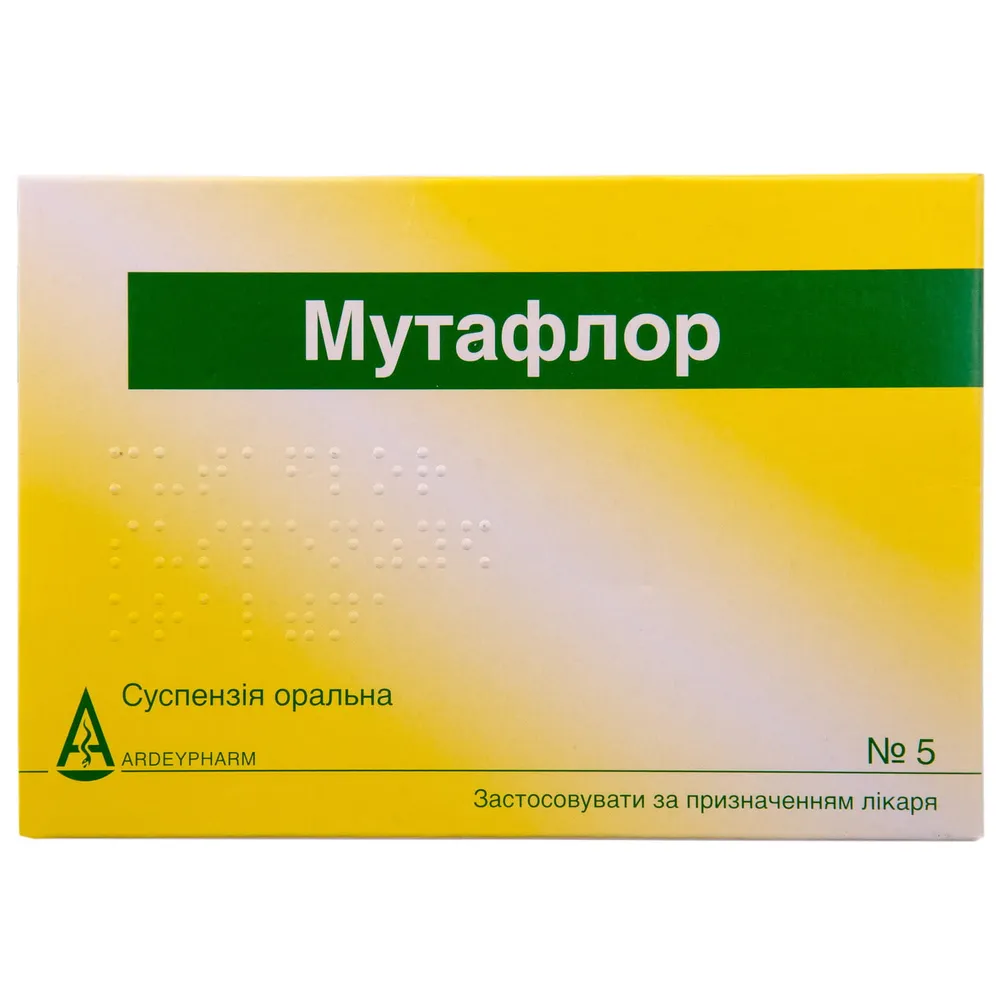
Table of Contents
INSTRUCTIONS FOR MEDICAL USE OF THE MEDICINAL PRODUCT MUTAFLOR (MUTAFLOR)
Composition:
Active substance (biomass): Escherichia coli strain NISSLE 1917;
1 ml of suspension contains bacterial culture of Escherichia coli strain NISSLE 1917 10^8 CFU;
Excipients: sodium chloride, potassium chloride, magnesium sulfate heptahydrate, calcium chloride, magnesium chloride hexahydrate, sodium hydroxide, 32% solution for adjusting pH to 7.0, purified water.
Note. The amount of biomass and saline solution depends on the number of CFU in the biomass.
Pharmaceutical form. Oral suspension.
Main physicochemical properties: slightly beige, milky-colored, watery liquid with a slightly salty taste and characteristic odor.
Pharmacotherapeutic group.
Antidiarrheal microbial agents. ATC code A07F A.
Pharmacological properties.
Pharmacodynamics.
The active ingredient is a strain of non-pathogenic bacteria belonging to Escherichia coli strain NISSLE 1917, in a live and reproductive form: E. coli strain NISSLE 1917. The effects of the drug Mutaflor (E. coli strain NISSLE 1917) have been established in in vitro and in vivo experiments, as well as in clinical studies. The following effects and mechanisms of action have been identified.
Antagonism against pathogenic and potentially pathogenic microorganisms and strengthening of the intestinal barrier:
- E. coli strain NISSLE 1917 produces antimicrobial substances responsible for antagonistic activity against pathogenic microorganisms.
- Through specialized adhesive organelles (fimbriae), the strain is able to adhere to the mucus layer covering the wall of the colon. The strain is highly motile due to flagella, which provides an advantage for colonizing the colon.
- E. coli strain NISSLE 1917 stimulates intestinal epithelial cells to synthesize inducible antimicrobial defensins (HBD-2, HBD-3).
- In animal experiments, E. coli strain NISSLE 1917 increases the concentration of calprotectin on the intestinal wall and thus prevents direct bacterial adhesion to intestinal mucosal epithelial cells.
E. coli strain NISSLE 1917 prevents entry of enteroinvasive pathogenic microorganisms into intestinal epithelial cells.
E. coli strain NISSLE 1917 has immunomodulatory properties:
In vitro and in vivo experiments have demonstrated that the immunomodulatory properties of E. coli strain NISSLE 1917 affect both the humoral and cellular immune systems of newborns. In vivo, these immunomodulatory effects are clearly observed only in germ-free experimental animals, newborns, or diseased animals or humans.
In healthy animals and humans, immunomodulatory effects can be observed only weakly.
- Effect on the specific immune system:
In preterm and full-term infants following intestinal colonization with bacteria
E. coli strain NISSLE 1917, an early increase in immunocompetence was observed, indicated by a significant rise in IgA and IgM levels in stool filtrates and serum. In contrast, serum IgG levels do not increase. Individual studies confirm an increase in IgA levels in saliva. It has been established that oral administration of
E. coli strain NISSLE 1917 also acts as a stimulator of cell-mediated immune response in preterm infants.
- Effect on the non-specific immune system:
In vitro and ex vivo studies revealed a significant increase in secretory and cytotoxic activity of macrophages. Furthermore, ex vivo studies demonstrated enhanced cytotoxic properties of macrophages directed against intracellular parasites, thus providing stronger protection against intracellular infectious agents.
In vivo, a prophylactic effect against systemic infections has been demonstrated.
In preterm newborns, oral administration of E. coli strain NISSLE 1917 was also associated with stimulation of non-specific innate immunity.
Prokinetic properties. E. coli strain NISSLE 1917 synthesizes short-chain fatty acids during its metabolism, which are essential for optimal energy balance of the colonic mucosa. These fatty acids stimulate intestinal motility and mucosal blood flow, and enhance absorption of sodium and chloride ions. Stimulation of motility, likely mediated by bacterially derived acetic acid, plays an important role in the treatment of chronic constipation.
Effect on metabolism. The strain contained in Mutaflor participates in numerous metabolic processes and is capable of catabolizing various carbohydrates, sugar alcohols, amino acids, and other substrates, consuming oxygen in the process. The anaerobic environment created in this way within the lumen of the colon is maintained for a prolonged period, which is extremely important for the stability of the intestinal ecosystem.
Pharmacokinetics.
Since the active substance (E. coli strain NISSLE 1917) is a commensal organism, it is capable of colonizing the intestine as a physiological bacterium. It is neither absorbed nor metabolized and is excreted from the intestine with feces.
Clinical characteristics.
Indications.
- For prevention of pathological colonization in the intestine of newborns (including premature infants);
- to enhance immunity in newborns (including premature infants);
- diarrhea in infants and preschool children, including those fed via feeding tube.
Contraindications.
Hypersensitivity to the ingredients of the drug.
Interaction with other medicinal products and other forms of interaction.
Antibiotics intended to act against gram-negative bacteria, as well as sulfonamides, may reduce the efficacy of the drug Mutaflor.
Special precautions for use
When treating severe forms of diarrhea with Mutaflor suspension, adequate intake of water and electrolytes must be ensured in order to prevent dehydration (exsiccosis).
This medicinal product contains 0.042–0.043 mmol (or 0.93–0.97 mg)/dose of sodium. Caution is advised when administering to patients on a sodium-controlled diet.
This medicinal product contains 0.033–0.034 mmol (or 1.25–1.31 mg)/dose of potassium. Caution is advised when administering to patients with impaired renal function or those on a potassium-controlled diet.
Use during pregnancy or breastfeeding
Escherichia coli strain Nissle 1917 is a commensal bacterium naturally present in the human intestine. It is not absorbed and has no influence on pregnancy or breastfeeding. Therefore, there are no restrictions regarding its use during these periods.
Ability to influence the speed of reactions while driving or operating machinery
Not observed.
Method of Administration and Dosage
Shake before use! The suspension can be administered directly into the mouth from the ampoule; in infants – before feeding, in preschool children – after meals.
The suspension can also be administered through a nasogastric tube.
For colonization prophylaxis: newborns (including premature infants) – 1 mL daily for at least 5 days.
For enhancing immunity in newborns: 1st week of life – 1 mL once daily;
2nd–3rd week – 1 mL three times weekly.
Diarrhea: infants and preschool children – 1 mL daily for 1–3 days.
In acute diarrhea – 1 mL daily for 5 days;
in prolonged diarrhea – 1 mL daily for up to 15 days.
Diarrhea during tube feeding: infants and preschool children – 1–5 mL once daily.
If treatment is effective, continue administration of the drug for several more days.
Children.
Mutaflor suspension can be used in infants and preschool children.
Overdose.
There is no data available on overdose.
Adverse Reactions
The assessment of the frequency of adverse reactions was based on the following criteria:
Very common (≥ 1/10)
Common (≥ 1/100 to <1/10)
Uncommon (≥1/1,000 to <1/100)
Rare (≥ 1/10,000 to <1/1,000)
Very rare (<1/10,000), including isolated cases.
The drug is well tolerated. Cases of undesirable effects may occur.
Gastrointestinal disorders: At the beginning of therapy, abdominal distension is commonly observed, which always indicates an excessive dose (resolves immediately after dose reduction). Very rarely, abdominal pain, diarrhea, nausea, or vomiting have been observed.
Skin disorders: Allergic reactions are possible, including urticaria, erythema, and skin desquamation.
Infections: Isolated cases of sepsis development have been reported in children with birth weight <1000 g born at a very premature gestational age.
Reporting of suspected adverse reactions
Reporting of suspected adverse reactions occurring after drug authorization is extremely important. It allows continuous monitoring of the benefit-risk balance of the medicinal product. Healthcare professionals are requested to report any suspected adverse reactions via the national reporting system.
Shelf life: 12 months.
Storage conditions
Store at 2–8 °C in places inaccessible to children.
Packaging
Polyethylene ampoules of 1 ml, with 5 ampoules placed in a sachet. Sachets containing 5 ampoules are placed in the outer packaging.
25 ampoules of 1 ml in a pack.
Prescription status
Prescription only.
Manufacturer
Ardeypharm GmbH.
Manufacturer's address and place of business
Loerfeldstrasse 20, 58313 Herdecke, Germany.