Mutaflore
Ukraine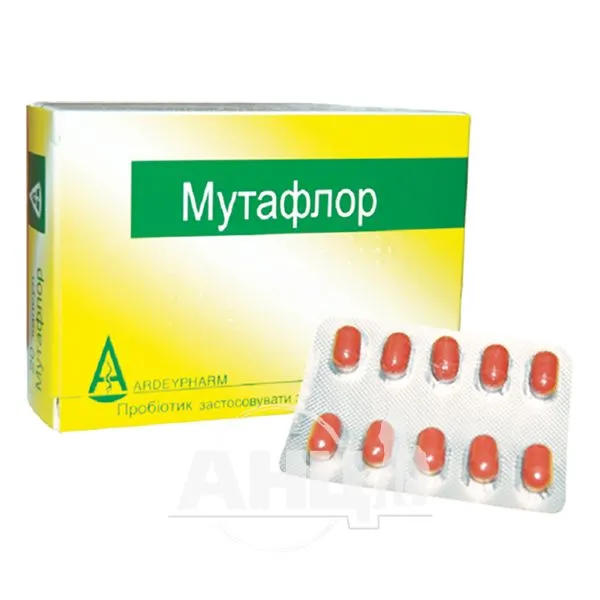
Table of Contents
INSTRUCTIONS FOR MEDICAL USE OF THE MEDICINAL PRODUCT Mutaflor (MUTAFLOR)
Composition:
Active substance: Escherichia coli strain NISSLE 1917;
composition per 1 unit of dosage form:
Escherichia coli strain NISSLE 1917 – 2.5 – 25x109 live bacterial cells (colony-forming units, CFU);
Excipients: maltodextrin, talc, copolymer (1:1) of methacrylic acid – methyl methacrylate, polyethylene glycol (4000), triethyl citrate, glycerol 85%, titanium dioxide (E 171), iron oxide red (E 172), gelatin, yellow wax, carnauba wax, shellac, purified water.
Dosage form. Gastric-resistant hard capsules.
Main physicochemical characteristics: colorless, transparent, cylindrical hard capsules with a red-brown gastroresistant coating. The capsule contents are a light beige powder with a characteristic odor. The capsule surface is smooth, without cracks.
Pharmacotherapeutic group.
Antidiarrheal, intestinal anti-inflammatory and antimicrobial medicinal products.
Intestinal anti-inflammatory medicinal products. ATC code A07E.
Pharmacological properties.
Pharmacodynamics.
The active ingredient is a non-pathogenic strain of human-origin bacteria belonging to the species Escherichia coli (E. coli), in a live and reproductive form: E. coli strain NISSLE 1917. Through specialized adhesive organelles (types F-1A, F-1C, and "curly" fimbriae), this strain is capable of adhering to the mucosa of the large intestine and forming microcolonies in the form of a biofilm. Due to the presence of flagella, the bacteria are motile, which provides them with an advantage in colonizing the large intestine. The effects of MUTALFLOR (E. coli strain NISSLE 1917) have been demonstrated in in vitro and in vivo experiments, as well as in clinical studies.
Antimicrobial properties (antagonism): E. coli strain NISSLE 1917 produces antimicrobial substances (microcins) and numerous iron-binding systems (siderophores), which are responsible, on one hand, for direct antagonism against pathogens, and on the other, for the strain's persistence, which exceeds the duration of the actual oral administration of the drug. In addition, the strain exerts an inhibitory effect on the invasion of enteroinvasive pathogens into the mucosa of the large intestine.
Stabilization of the intestinal mucosal barrier. In experiments on cell cultures of colonic epithelial cells, E. coli strain NISSLE 1917 demonstrated the ability to stabilize the epithelial barrier function and normalize increased intestinal mucosal permeability. This strengthening of barrier function results from stimulation of the synthesis of the tight junction protein (ZO-2) and the formation of strong intercellular contacts mediated by this protein.
Immunostimulatory properties:
Effect on humoral immune response
In newborn humans, after colonization of the intestine with E. coli strain NISSLE 1917, a significant increase in IgA and IgM levels was observed in stool filtrates and blood serum. In rare cases, an increase in salivary IgA levels has been described. In animals, oral administration of E. coli strain NISSLE 1917 to germ-free (microflora-free) newborn offspring stimulated the development of immunocompetent cells of the gut-associated lymphoid tissue (IgA- and IgG-producing lymphocytes, cells expressing major histocompatibility complex class II (MHC-II) proteins on their surface), without signs of inflammation (no granulocyte migration observed).
Effect on cellular immune response
In vitro experiments revealed immunomodulatory properties of E. coli strain NISSLE 1917. An increased secretory activity of mouse macrophages (interleukin-6 [IL-6], tumor necrosis factor, oxygen radicals) and human peripheral blood mononuclear cells (interleukin-10) was observed. However, the increase in tumor necrosis factor secretion was not confirmed in in vivo experiments in mice and other animals.
Moreover, ex vivo studies demonstrated enhanced cytotoxic properties of mouse macrophages against intracellular parasites, thus providing stronger protection against intracellular infectious agents.
Escherichia coli strain NISSLE 1917 also exerted a suppressive effect on the cell cycle and proliferation of human peripheral blood T-lymphocytes, but not on intestinal T-lymphocytes.
Thus, in inflammatory bowel diseases, this mechanism may prevent the migration of newly activated T-lymphocytes into the inflammatory site.
Effect on innate immunity
E. coli strain NISSLE 1917 stimulates the synthesis of antimicrobial peptides. In particular, it promotes defensin production by human colonic epithelial cells in vitro, and calprotectin production in vivo in the gut of germ-free newborn animal offspring after oral administration of the drug. In human newborns (preterm infants), oral administration of MUTALFLOR also positively influences both innate and adaptive immune responses.
Anti-inflammatory properties. MUTALFLOR exerts anti-inflammatory effects. Anti-inflammatory properties of E. coli strain NISSLE 1917 have been demonstrated in in vitro experiments with human epithelial cells, as well as in vivo.
Prokinetic properties. E. coli strain NISSLE 1917 synthesizes short-chain fatty acids during its metabolism, which are essential for the optimal energy balance of the colonic mucosa. These fatty acids stimulate colonic motility and mucosal blood flow, and enhance the absorption of sodium and chloride ions. The stimulation of motility, likely mediated by bacterially derived acetic acid, plays an important role in the treatment of chronic constipation.
Effect on metabolism. The strain contained in MUTALFLOR participates in numerous metabolic processes and is capable of catabolizing various carbohydrates, sugar alcohols, amino acids, and other substrates, consuming oxygen in the process. The anaerobic environment thus created in the lumen of the large intestine is maintained for a prolonged period, which is crucial for the stability of the intestinal ecosystem.
Pharmacokinetics.
Due to their capsule coating, MUTALFLOR capsules are resistant to gastric juice and do not dissolve until reaching the terminal ileum. Since the active ingredient (E. coli strain NISSLE 1917) is a commensal organism, it rapidly colonizes the large intestine without being absorbed or metabolized, and is excreted from the intestine with feces.
Clinical characteristics.
Indications.
Chronic constipation.
Non-specific ulcerative colitis in remission stage.
Contraindications.
Hypersensitivity to the ingredients of the drug.
Interaction with other medicinal products and other forms of interaction.
Antibiotics intended to affect gram-negative bacteria, as well as sulfonamides, may reduce the efficacy of the drug MUCIFLOR.
Special precautions for use.
None.
Use during pregnancy or breastfeeding.
Escherichia coli strain NISSLE 1917 is a commensal bacterium present in the human intestine. It is not absorbed, and has no effect on fertility, course of pregnancy, or breastfeeding. Therefore, there are no restrictions regarding its use.
Ability to influence reaction rate when driving or operating machinery.
Not observed.
Method of administration and dosing.
The entire daily dose should be taken during a meal, preferably with breakfast, and washed down with an adequate amount of liquid. Do not chew the capsules.
If abdominal bloating occurs or if an initial dose higher than the standard recommended dose is administered, the daily dose may be divided among all daily meals.
Adults and adolescents.
Standard dose: Days 1 to 4 of treatment – 1 capsule of MUTAFLOOR per day; thereafter – 2 capsules of MUTAFLOOR per day.
In case of prolonged constipation, the dose may be increased up to 4 capsules of MUTAFLOOR daily.
In ulcerative colitis. Experience with the use of the drug for up to 12 months in ulcerative colitis is based on results from controlled clinical studies. To prevent relapses of ulcerative colitis, MUTAFLOOR should be taken continuously.
In chronic constipation. MUTAFLOOR may be taken for up to 6 weeks. If the condition has been present for many years, MUTAFLOOR may be considered as a general tonic; therefore, treatment with this drug should be periodically repeated.
Children.
Can be used in children aged 15 years and older.
Overdose.
There is no data available on overdose.
Adverse Reactions
The drug is well tolerated. Adverse effects are classified by frequency of occurrence into the following categories: very common (≥ 1/10), common (≥ 1/100, < 1/10), uncommon (≥ 1/1,000, < 1/100), rare (≥ 1/10,000, < 1/1,000), very rare (<1/10,000), including isolated reports.
Gastrointestinal disorders: At the beginning of therapy, abdominal distension is common (≥1/100, <1/10). Very rare (<1/10,000) events include changes in stool consistency or frequency, abdominal pain, flatulence, diarrhea, sensation of stomach rumbling, nausea, or vomiting.
Skin and subcutaneous tissue disorders: Very rare (<1/10,000) generalized rash, erythema, skin peeling, and allergic reactions have been reported.
Central nervous system disorders: There have been isolated reports of headache.
Shelf life: 12 months.
Storage conditions:
Store at 2–8°C in places inaccessible to children.
Do not use after the expiry date stated on the packaging.
Packaging:
2 blisters of 10 capsules each in a cardboard box.
Blister: cup-shaped depressions made from PVC/PVDC sheets, sealed with heat-hardening aluminum foil.
Prescription status:
Prescription only.
Manufacturer:
Ardeypharm GmbH / Ardeypharm GmbH.
Manufacturer's address and place of business:
Loerfeldstrasse 20, 58313 Herdecke, Germany / Loerfeldstrasse 20, 58313 Herdecke, Germany.