Motorikum
Ukraine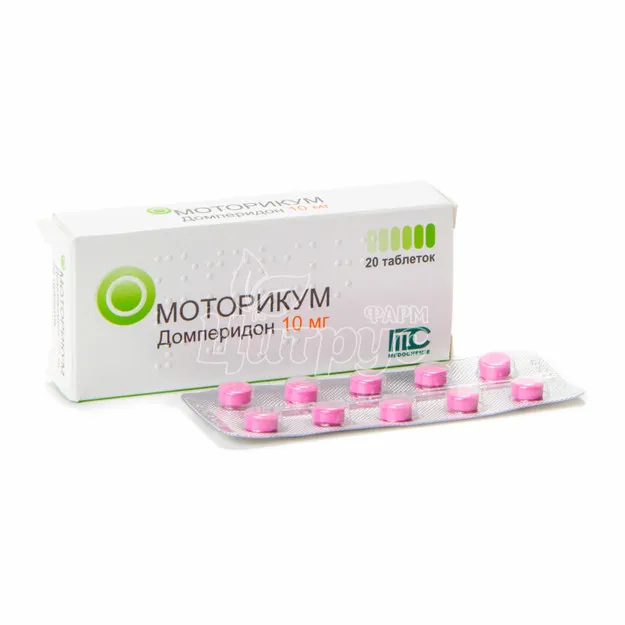
Table of Contents
INSTRUCTION FOR MEDICAL USE OF THE MEDICINAL PRODUCT MOTOZICUM (MOTORICUM)
Composition:
Active substance: domperidone;
1 tablet contains 10 mg of domperidone;
Excipients: maize starch*, microcrystalline cellulose, sodium starch glycolate (type A), sodium croscarmellose, colloidal anhydrous silicon dioxide, magnesium stearate, erythrosine (E 127).
*pregelatinized
Pharmaceutical form. Tablets.
Main physicochemical characteristics: pink, round, flat tablets with a dividing groove and the trademark "MS", approximately 7 mm in diameter.
Pharmacotherapeutic group. Prokinetic agents. ATC code A03F A03.
Pharmacological Properties.
Pharmacodynamics.
Domperidone is a dopamine antagonist with antiemetic properties. Domperidone penetrates the blood-brain barrier to a minimal extent. The use of domperidone is very rarely associated with extrapyramidal side effects, particularly in adults, but domperidone stimulates prolactin release from the pituitary gland. Its antiemetic effect is likely due to a combination of peripheral (gastrokinetic) action and antagonism at dopamine receptors in the chemoreceptor trigger zone located outside the blood-brain barrier in the posterior region (area postrema). Animal studies, as well as low brain concentrations detected, indicate that domperidone acts predominantly peripherally on dopamine receptors. Studies have shown that in humans, following oral administration, domperidone increases lower esophageal sphincter pressure, improves antroduodenal motility, and accelerates gastric emptying. Domperidone does not affect gastric secretion.
According to the international ICH-E14 guidelines, a thorough QT interval study was conducted in healthy subjects. This study was double-blind, placebo-controlled, and performed using both recommended and supratherapeutic doses (10 and 20 mg four times daily). When 20 mg of domperidone was administered four times daily, QT interval prolongation ranged from 3.4 to 5.9 ms throughout the observation period and did not exceed 10 ms. The QT prolongation observed in this study with domperidone at recommended doses is not clinically significant. This lack of clinical significance is supported by pharmacokinetic parameters and QTc data from two earlier studies involving 5-day administration of 20 mg and 40 mg of domperidone four times daily. ECGs were recorded before treatment, on day 5 approximately 1 hour (around tmax) after the morning dose, and 3 days after treatment. In both studies, no difference was observed in QTc between active treatment and placebo. Thus, it was concluded that administration of domperidone at doses of 80 and 160 mg daily had no clinically significant effect on QTc in healthy volunteers.
Pharmacokinetics.
Absorption. Domperidone is rapidly absorbed after oral administration on an empty stomach, with peak plasma concentrations reached approximately within 60 minutes. Cmax and AUC values of domperidone increased proportionally with dose over the range of 10 to 20 mg. A 2–3-fold accumulation of domperidone (AUC) was observed after repeated administration four times daily (every 5 hours) over 4 days. The low absolute bioavailability of oral domperidone (approximately 15%) is due to extensive first-pass metabolism in the intestinal wall and liver. Although domperidone bioavailability increases when taken after food in healthy subjects, patients with gastrointestinal symptoms should take domperidone 15–30 minutes before meals. Reduced gastric acidity decreases domperidone absorption. Oral bioavailability is reduced when domperidone is co-administered with cimetidine and sodium bicarbonate. When administered after food, peak absorption is slightly delayed and AUC is slightly increased.
Distribution. After oral administration, domperidone does not accumulate and does not induce its own metabolism; maximum plasma levels at 90 minutes (21 ng/mL) after two weeks of oral dosing at 30 mg daily were nearly the same as after the first dose (18 ng/mL). Domperidone is 91–93% bound to plasma proteins. Animal distribution studies using radiolabeled domperidone showed extensive tissue distribution but low brain concentrations. In animals, small amounts of the drug cross the placenta.
Metabolism. Domperidone is rapidly and extensively metabolized in the liver via hydroxylation and N-dealkylation. In vitro metabolism studies using diagnostic inhibitors showed that CYP3A4 is the primary cytochrome P450 isoenzyme involved in N-dealkylation of domperidone, while CYP3A4, CYP1A2, and CYP2E1 are involved in aromatic hydroxylation of domperidone.
Elimination. Excretion in urine and feces accounts for 31% and 66% of the oral dose, respectively. Excretion of unchanged drug is minimal (10% in feces and approximately 1% in urine). The elimination half-life in plasma after a single dose is 7–9 hours in healthy volunteers, but is prolonged in patients with severe renal impairment.
Special patient populations
Hepatic impairment. In patients with moderate hepatic impairment (7–9 points on the Pugh scale, Child-Pugh class B), AUC and Cmax of domperidone were 2.9 and 1.5 times higher, respectively, than in healthy volunteers. The free fraction increased by 25%, and the terminal elimination half-life was prolonged from 15 to 23 hours. In patients with mild hepatic impairment, exposure was slightly lower than in healthy volunteers based on Cmax and AUC, with no changes in protein binding or terminal elimination half-life. The use of Motilium in patients with severe hepatic impairment has not been studied. Motilium is contraindicated in patients with moderate to severe hepatic impairment (see section "Contraindications").
Renal impairment. In patients with severe renal impairment (serum creatinine clearance < 30 mL/min/1.73 m²), the elimination half-life of domperidone is prolonged from 7.4 to 20.8 hours, but plasma drug concentrations are lower than in patients with normal renal function. Since only a very small amount of the drug (approximately 1%) is excreted unchanged by the kidneys, dose adjustment is unlikely to be necessary after a single dose in patients with renal impairment. However, with repeated administration, the dosing frequency should be reduced to 1–2 times daily depending on the severity of impairment, and dose reduction may also be required.
Clinical characteristics.
Indications.
For relief of symptoms of nausea and vomiting.
Contraindications.
MOTORICUM is contraindicated:
- in patients with known hypersensitivity to the drug or to excipients;
- in patients with established prolactin-secreting pituitary tumor (prolactinoma);
- in patients with severe or moderate impairment of liver and/or kidney function (see section "Special precautions", "Pharmacological properties");
- in patients with known prolongation of cardiac conduction intervals, particularly QTc, in patients with significant electrolyte imbalances or underlying heart diseases such as congestive heart failure (see section "Special precautions");
- in patients with hepatic insufficiency;
- when stimulation of gastric motility may be dangerous, e.g. in gastrointestinal bleeding, mechanical obstruction or perforation;
- during concomitant use of ketoconazole, erythromycin or other potent inhibitors of CYP3A4;
- during concomitant use of medicinal products that prolong the QT interval (except apomorphine), such as fluconazole, erythromycin, itraconazole, oral ketoconazole, posaconazole, ritonavir, saquinavir, telaprevir, voriconazole, clarithromycin, amiodarone, telithromycin (see sections "Special precautions" and "Interaction with other medicinal products and other forms of interaction").
Interaction with other medicinal products and other types of interactions.
Anticholinergic drugs may neutralize the anti-dyspeptic effect of MOTORICUM. Due to pharmacodynamic and/or pharmacokinetic interactions, the risk of QT interval prolongation increases. Antacid and antisecretory drugs should not be taken simultaneously with MOTORICUM, as they reduce its bioavailability after oral administration (see section "Special precautions").
Domperidone is metabolized predominantly via CYP3A4. According to in vitro studies, concomitant use of drugs that significantly inhibit this enzyme may lead to increased plasma levels of domperidone. Clinically significant changes in QT interval have been observed when domperidone was used concomitantly with potent CYP3A4 inhibitors capable of prolonging the QT interval. Therefore, concomitant use of domperidone with certain drugs is contraindicated (see section "Contraindications").
Concomitant use with levodopa. Although dose adjustment of levodopa is not considered necessary, increased plasma concentrations of domperidone (up to 30–40%) have been observed when used concomitantly with levodompone.
Concomitant use of the following medicinal products with domperidone is contraindicated:
-
with all medicinal products that prolong the QT interval (risk of "torsade de pointes"): class IA antiarrhythmics (e.g., disopyramide, quinidine, hydroquinidine); class III antiarrhythmics (e.g., amiodarone, dofetilide, dronedarone, ibutilide, sotalol); some neuroleptics (e.g., haloperidol, pimozide, sertindole); some antidepressants (e.g., citalopram, escitalopram); some antibiotics (e.g., levofloxacin, moxifloxacin, erythromycin, spiramycin); some antifungal agents (e.g., fluconazole, pentamidine); some antimalarials (e.g., halofantrine, lumefantrine); some gastrointestinal drugs (e.g., cisapride, dolasetron, prucalopride); some antihistamines (e.g., mequitazine, mizolastine); some oncology drugs (e.g., toremifene, vandetanib, vincamine); some other drugs (e.g., bepridil, methadone, diphenylpyraline); apomorphine, except when benefit outweighs risks and strict adherence to recommended precautions for concomitant use (see apomorphine product information, section "Contraindications").
-
with potent inhibitors of CYP3A4: azole antifungals*, such as fluconazole*, itraconazole, ketoconazole*, posaconazole and voriconazole*; macrolide antibiotics, such as clarithromycin* and erythromycin*; protease inhibitors* (e.g., ritonavir, saquinavir, telaprevir); HIV protease inhibitors such as amprenavir, atazanavir, fosamprenavir, indinavir, nelfinavir, ritonavir and saquinavir; calcium channel blockers such as diltiazem and verapamil; amiodarone*; aprepitant; nefazodone; telithromycin*.
* Prolong QTc interval.
Concomitant use of the following substances requires caution. Domperidone should be used cautiously with drugs causing bradycardia and hypokalemia, as well as with macrolides that may cause QT interval prolongation: azithromycin and roxithromycin (clarithromycin is contraindicated as it is a potent CYP3A4 inhibitor). Domperidone should be used with caution concomitantly with potent CYP3A4 inhibitors that do not cause QT prolongation, such as indinavir, and patients should be closely monitored for adverse reactions. The above list is representative but not exhaustive.
MOTORICUM may be combined with: neuroleptics, whose action it enhances; dopaminergic agonists (bromocriptine, levodopa), the undesirable peripheral effects of which, such as digestive disturbances, nausea, vomiting, it suppresses without neutralizing their main properties.
In individual studies of pharmacokinetic/pharmacodynamic interaction in vivo, concomitant oral administration of ketoconazole or erythromycin to healthy volunteers confirmed that these drugs significantly inhibit presystemic metabolism of domperidone mediated by CYP3A4. When 10 mg domperidone was administered orally four times daily concomitantly with 200 mg ketoconazole orally twice daily, QTc interval was prolonged on average by 9.8 ms; individual values ranged from 1.2 to 17.5 ms. When 10 mg domperidone was administered four times daily concomitantly with 500 mg erythromycin orally three times daily, QTc interval was prolonged on average by 9.9 ms, with individual values ranging from 1.6 to 14.3 ms. Steady-state Cmax and AUC values of domperidone increased approximately threefold in each of these interaction studies. The impact of elevated plasma concentrations of domperidone on QTc prolongation is unknown. In monotherapy with domperidone (10 mg orally four times daily), QTc interval was prolonged on average by 1.6 ms (ketoconazole study) and 2.5 ms (erythromycin study), whereas administration of ketoconazole alone (200 mg twice daily) or erythromycin alone (500 mg three times daily) resulted in QTc prolongation of 3.8 ms and 4.9 ms, respectively, during the observation period. Theoretically, since MOTORICUM exerts a prokinetic effect on the stomach, it may affect the absorption of concomitantly administered oral drugs, particularly prolonged-release formulations or enteric-coated preparations. However, in patients already stabilized on digoxin or paracetamol, concomitant administration of domperidone did not affect blood levels of these drugs.
Special precautions for use.
MOTILIUM is not recommended in case of dehydration.
MOTILIUM should be used with caution in elderly patients and in patients with pre-existing heart disease, including history thereof.
Cardiovascular effects. Domperidone has been associated with QT interval prolongation on ECG. Very rare cases of QT interval prolongation and ventricular fibrillation/torsade de pointes have been reported in patients treated with domperidone. These reports included information on patients with other risk factors, electrolyte disturbances, and concomitant medications that may be contributing factors (see section "Adverse reactions"). According to ICH-E14 guidelines, a thorough QT study was conducted in healthy subjects. When domperidone was administered at recommended therapeutic doses (10 or 20 mg four times daily), QT prolongation was not considered clinically significant. Due to the increased risk of ventricular arrhythmia, MOTILIUM is contraindicated in patients with prolonged cardiac conduction intervals, particularly QTc, in patients with significant electrolyte imbalances (hypokalaemia, hyperkalaemia, hypomagnesaemia) or bradycardia, and in patients with underlying heart conditions such as congestive heart failure. Electrolyte imbalances (hypokalaemia, hyperkalaemia, hypomagnesaemia) and bradycardia are known to increase the proarrhythmic risk. If symptoms suggestive of cardiac arrhythmia occur, MOTILIUM should be discontinued immediately and the patient should seek immediate medical advice. Patients should promptly report any cardiac symptoms.
Warning. Domperidone should be used with caution in patients with mild hepatic and/or renal impairment.
Renal impairment. The elimination half-life of domperidone is prolonged in severe renal impairment. With long-term treatment, the dosing frequency of domperidone should be reduced to once or twice daily depending on the severity of impairment. Dose reduction may also be required.
Antacids or antisecretory agents should not be taken simultaneously with oral formulations of MOTILIUM, as they reduce the oral bioavailability of domperidone (see section "Interaction with other medicinal products and other forms of interaction"). When used concomitantly, MOTILIUM should be taken before meals, and antacids or antisecretory agents should be taken after meals.
Use with apomorphine. Concomitant use of domperidone is contraindicated with medicinal products that prolong the QT interval, including apomorphine, except when the benefit of concomitant use outweighs the risks, and only if strict adherence to the precautions described in the apomorphine product information is maintained.
Use with ketoconazole. In interaction studies with oral ketoconazole, QT interval prolongation was observed. Therefore, alternative treatment should be considered if antifungal therapy with ketoconazole is indicated (see section "Interaction with other medicinal products and other forms of interaction").
The following information should be considered regarding the risk of developing cardiovascular complications associated with medicinal products containing domperidone:
- Domperidone may be associated with an increased risk of serious ventricular arrhythmias or sudden cardiac death (see section "Adverse reactions").
- The risk of serious ventricular arrhythmias or sudden cardiac death is higher in patients aged 60 years and older, in patients receiving oral doses exceeding 30 mg per day, and in patients concurrently using medicinal products that prolong the QT interval or CYP3A4 inhibitors. Therefore, MOTILIUM should be used with caution in elderly patients. Patients aged 60 years and older should consult their physician before taking MOTILIUM.
- Domperidone should be prescribed to adults and children at the lowest effective dose.
The benefit-risk balance of domperidone remains favourable.
Use during pregnancy or breastfeeding.
Pregnancy. Data on post-marketing use of domperidone in pregnant women are limited. Therefore, MOTILIUM should be prescribed during pregnancy only when, in the opinion of the physician, the expected benefit to the mother outweighs the potential risk to the fetus.
Breastfeeding. The amount of domperidone that may pass into the infant via breast milk is extremely low. The maximum relative infant dose (%) is estimated at approximately 0.1% of the maternal dose, adjusted for body weight. It is unknown whether such a dose is harmful to the infant; therefore, mothers taking MOTILIUM should avoid breastfeeding. The decision to discontinue breastfeeding or to discontinue domperidone therapy should be based on an assessment of the benefits of breastfeeding for the child and the benefits of therapy for the mother. Caution should be exercised if risk factors for QTc interval prolongation are present in breastfed infants. After exposure due to passage of the drug into breast milk, adverse effects, including cardiovascular effects, cannot be excluded.
Ability to affect reaction speed when driving or operating machinery.
Dizziness and somnolence have been reported after administration of domperidone. Therefore, patients should be advised to refrain from driving, operating machinery, or engaging in other activities requiring mental alertness and coordination until they know how MOTILIUM affects them.
Method of Administration and Dosage.
To relieve symptoms of nausea and vomiting, Motilium should be used at the lowest effective dose for the shortest possible duration.
Adults and children aged 12 years and older with body weight of at least 35 kg: 1 tablet (10 mg) three times daily. Maximum daily dose – 3 tablets (30 mg per day).
It is recommended to take Motilium before meals. Absorption of the drug is slightly delayed when taken after food. Patients should take the medication according to the recommended dosing regimen. If a dose is missed, it should not be taken at an unscheduled time; instead, continue following the prescribed dosing schedule. Do not double the dose to compensate for a missed dose. Treatment duration should not exceed 1 week.
Renal impairment. The elimination half-life of domperidone is prolonged in patients with severe renal impairment. With prolonged use, the dosing frequency of domperidone should be reduced to once or twice daily, depending on the severity of renal dysfunction. Dose reduction may also be required. Patients with severe renal impairment should be monitored regularly (see section "Pharmacological properties").
Hepatic impairment. Motilium is contraindicated in patients with moderate or severe hepatic impairment (see section "Contraindications"). Dose adjustment is not required in patients with mild hepatic impairment (see section "Pharmacological properties").
Children.
This medication is indicated for treatment in children aged 12 years and older with body weight of at least 35 kg. Domperidone should be used in children at the lowest effective dose for the shortest possible duration.
Overdose.
Symptoms: Overdose has been reported primarily in infants and children. Symptoms may include agitation, altered consciousness, convulsions, disorientation, drowsiness, and extrapyramidal reactions.
Treatment. There is no specific antidote for domperidone. However, in cases of significant overdose, immediate symptomatic treatment is required. Gastric lavage within 1 hour of drug intake and administration of activated charcoal are recommended, along with close monitoring of the patient and supportive therapy. ECG monitoring should be performed due to the potential for QT interval prolongation. Anticholinergic drugs and anti-Parkinson agents may be effective in managing extrapyramidal reactions.
Side effects.
Frequency of adverse reactions: very common (≥ 1/10); common (≥ 1/100 to <1/10); uncommon (≥ 1/1000 to <1/100); rare (≥ 1/10000 to <1/1000); very rare (<1/10000). If the frequency cannot be determined from clinical trial data, it is listed as unknown. When dosage and treatment duration recommendations are followed, domperidone is generally well tolerated, and adverse events occur infrequently.
Immune system disorders: frequency unknown – allergic reactions, including anaphylaxis, anaphylactic shock, hypersensitivity.
Endocrine disorders: rare – increased prolactin levels.
Psychiatric disorders: uncommon – nervousness, irritability, agitation, decreased or absent libido; very rare – depression, anxiety.
Nervous system disorders: uncommon – headache, drowsiness, dizziness, extrapyramidal disorders; very rare – insomnia, thirst, lethargy, akathisia; frequency unknown – convulsions, restless legs syndrome (exacerbation of restless legs syndrome in patients with Parkinson’s disease).
Cardiovascular disorders: very rare – edema, palpitations, changes in heart rate and rhythm, serious ventricular arrhythmias; frequency unknown – QT interval prolongation, ventricular arrhythmias of the type "torsade de pointes", sudden cardiac death.
Gastrointestinal disorders: common – dry mouth; uncommon – diarrhea; rare – gastrointestinal disorders including abdominal pain, regurgitation, appetite changes, nausea, heartburn, constipation; very rare – transient intestinal spasms.
Skin and subcutaneous tissue disorders: uncommon – pruritus, rash, urticaria; frequency unknown – angioedema.
Reproductive system and breast disorders: rare – breast enlargement, galactorrhea, breast swelling, lactation disorders, irregular menstrual cycle; uncommon – breast pain, galactorrhea, breast tenderness; frequency unknown – amenorrhea, gynecomastia.
Musculoskeletal and connective tissue disorders: rare – leg pain.
Renal and urinary disorders: very rare – dysuria, frequent urination; frequency unknown – urinary retention.
General disorders: uncommon – asthenia.
Eye disorders: frequency unknown – oculogyric crises.
Other: conjunctivitis, stomatitis.
Laboratory test abnormalities: very rare – increased ALT, AST, and cholesterol levels; frequency unknown – liver function test abnormalities, increased blood prolactin levels.
In 45 studies where domperidone was used at higher doses, for longer durations, and for additional indications including diabetic gastroparesis, the frequency of adverse reactions (except dry mouth) was significantly higher. This was particularly evident in pharmacologically predictable cases related to elevated prolactin levels.
Since the pituitary gland lies outside the blood-brain barrier, domperidone may cause increased prolactin levels. In isolated cases, such hyperprolactinemia may lead to neuroendocrine adverse effects such as galactorrhea, gynecomastia, and amenorrhea. During the post-marketing period, no differences in safety profile between adults and children have been observed, except for extrapyramidal disorders and other central nervous system-related events such as convulsions and agitation, which were predominantly observed in children.
Reporting suspected adverse reactions. Reporting suspected adverse reactions after a medicinal product is authorized is important. It allows continued monitoring of the benefit-risk balance of the medicinal product. Healthcare professionals, pharmacists, and patients or their legal representatives should report all suspected adverse reactions and lack of efficacy through the Automated Pharmacovigilance Information System at the following link: https://aisf.dec.gov.ua/
Shelf life. 5 years.
Storage conditions. Store at temperatures not exceeding 25 °C in the original packaging, in a place inaccessible to children.
Packaging. 10 tablets in a blister pack, 2 blisters in a cardboard box.
Availability. Over-the-counter.
Manufacturer. Medocemie Limited / Medochemie Limited.
Manufacturer's address and location of operations.
Agios Athanassios Industrial Area, Michail Irakleous 2, Agios Athanassios, Limassol, 4101, Cyprus / Agios Athanassios Industrial Area, Michail Irakleous 2, Agios Athanassios, Limassol, 4101, Cyprus.