Mosid mt
Ukraine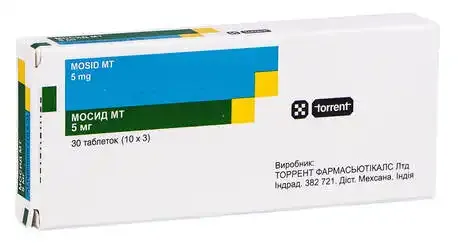
Table of Contents
INSTRUCTIONS FOR MEDICAL USE OF THE MEDICINAL PRODUCT MOSID MT
Composition:
Active substance: mosapride;
1 tablet contains mosapride citrate dihydrate equivalent to mosapride citrate 5 mg;
Excipients: mannitol (E 421), colloidal anhydrous silicon dioxide, orange special powder, peppermint powder, aspartame (E 951), talc, crospovidone, magnesium stearate, yellow iron oxide (E 172), red iron oxide (E 172).
Pharmaceutical form. Tablets.
Main physicochemical properties: round, flat tablets of pink-brown color with a fruity odor; presence of lighter and darker specks is allowed.
Pharmacotherapeutic group.
Peristaltic stimulants (prokinetics). ATC code A03F A.
Pharmacological Properties.
Pharmacodynamics.
Mosapride is an upper gastrointestinal prokinetic agent that acts selectively as an agonist at 5-HT4 receptors.
The pharmacological properties of mosapride can be summarized in three key characteristics: 1) mosapride is a selective agonist of 5-HT4 receptors; 2) it enhances motility of the upper gastrointestinal tract; 3) it does not exhibit dopamine D2 receptor antagonist properties.
It is known that the drug stimulates 5-HT4 receptors in the enteric neuronal plexuses, thereby increasing acetylcholine release, which leads to enhanced gastrointestinal peristalsis and gastric emptying. In addition, the main metabolite (M1) has high affinity for 5-HT3 receptors and has been confirmed as a potent 5-HT3 antagonist.
Due to its action as a 5-HT4 agonist and 5-HT3 antagonist, mosapride increases gastric emptying and enhances peristalsis in the stomach and duodenum, but does not stimulate motility in the lower gastrointestinal tract. Concurrently, it can be used as an antiemetic agent.
In a double-blind, comparative clinical study involving 435 patients, administration of mosapride 5 mg three times daily alleviated heartburn and vomiting associated with chronic gastritis.
Mosapride at a dose of 40 mg per day demonstrated efficacy in reducing gastric content reflux into the esophagus in patients suffering from gastroesophageal reflux disease.
Pharmacokinetics.
Absorption. After oral administration, mosapride is rapidly absorbed and reaches peak concentration within 0.8 hours. The maximum plasma concentration after a 5 mg dose administered on an empty stomach in healthy volunteers was 30.7 ng/mL. The elimination half-life (t½), determined in healthy volunteers, is 2 hours.
Distribution. Mosapride has a very high plasma protein binding capacity. Approximately 99% of the drug is bound to plasma proteins following oral administration.
Metabolism. Mosapride is primarily metabolized in the liver, where the 4-fluorobenzyl group is removed, followed by oxidation of the morpholine ring at position 5 and hydroxylation of the benzene ring at position 3. The main enzyme involved in metabolism is cytochrome P450 3A4. The primary metabolite of mosapride, des-4-fluorobenzyl compound, acts as a 5-HT3 receptor antagonist.
Excretion. 0.1% of mosapride is excreted unchanged, and 7% is excreted as the main metabolite in urine within 48 hours in healthy volunteers. Partial excretion also occurs via feces.
Clinical characteristics.
Indications.
Treatment of gastroesophageal reflux disease, as well as relief of gastrointestinal dyspeptic symptoms (heartburn, nausea) associated with gastroduodenal disorders.
Contraindications.
Hypersensitivity to the active substance or to any of the excipients of the medicinal product. Conditions where stimulation of gastrointestinal motility may be dangerous, such as gastrointestinal hemorrhage, mechanical obstruction, or perforation.
Interaction with other medicinal products and other forms of interaction.
The gastrokinetic effect of the drug is achieved via activation of cholinergic nerves. Therefore, when used concomitantly with anticholinergic agents (e.g., atropine sulfate, butylscopolamine bromide), the effect of the drug is reduced.
Since concomitant use of anticholinergic agents may diminish the effect of this drug, safety measures should be taken, such as administering the drugs with intervals.
The enhanced gastric emptying effect provided by mosapride is inhibited by atropine, but not by naloxone, methysergide, propranolol, ritanserin, pyrilamine, indomethacin, phenoxybenzamine, yohimbine, or bicuculline.
No interaction has been observed between mosapride and anti-ulcer medicinal products such as cimetidine, famotidine, and omeprazole.
Use with caution when administered concomitantly with non-steroidal anti-inflammatory drugs (NSAIDs) and histamine H2-receptor blockers. When used concomitantly with erythromycin, plasma concentrations of mosapride may increase. There is a risk of QT interval prolongation when used concomitantly with medicinal products that prolong the QT interval.
Special precautions for use
Mosid MT contains aspartame and therefore should not be used in patients with phenylketonuria.
This medicinal product should not be used for prolonged periods due to the risk of developing fulminant hepatitis, severe liver dysfunction, and jaundice. Patients should be closely monitored during treatment. If any symptoms occur, including malaise, anorexia, dark urine, or yellow discoloration of the conjunctiva, administration of the drug should be discontinued and medical advice should be sought immediately.
Use with caution in patients with a history of heart disease, including heart failure, conduction disorders, ventricular arrhythmias (including torsades de pointes), and myocardial ischemia (potential risk of arrhythmia); in patients receiving concomitant medications that prolong the QT interval (e.g., procainamide, quinidine, flecainide, sotalol, tricyclic antidepressants), which may potentially increase the risk of arrhythmias, including torsades de pointes; in patients with electrolyte imbalances, particularly hypokalemia, or those receiving concomitant medications that may rapidly induce hypokalemia (e.g., furosemide), which may potentially increase the risk of arrhythmias; and in patients with hepatic or renal impairment (pharmacokinetic data are lacking, but clearance of mosapride may potentially be reduced).
In elderly patients, in whom reduced renal and hepatic function are commonly observed, patient status should be carefully assessed. In the event of adverse reactions, appropriate measures should be taken, including dose reduction.
If no improvement is observed within 2 weeks of treatment, continued use is not recommended.
Use during pregnancy or breastfeeding
Data on the use of mosapride in pregnant women are limited; therefore, the drug should be administered during pregnancy only if the expected benefit to the mother outweighs the potential risk to the fetus.
Mosapride is excreted in breast milk; therefore, the use of this drug should be avoided in breastfeeding women.
Effect on the ability to drive or operate machinery
Mosid MT at therapeutic doses does not affect motor reaction speed. However, if adverse effects occur, patients should refrain from driving or operating complex machinery.
Dosage and Administration.
The usual dose of Mosid MT is 5 mg three times daily, taken before or after meals.
Mosid MT tablets dissolve rapidly in the mouth; if necessary, they can be taken with water.
Maximum daily dose – 40 mg.
The duration of treatment is determined individually by a physician.
Children.
The efficacy and safety of mosapride in children have not been established; therefore, the drug should not be used in this patient population.
Overdose.
There is no information regarding mosapride overdose; however, an increase in the manifestations of adverse reactions is possible. No specific antidotes are available. Gastric lavage, administration of activated charcoal, and symptomatic treatment are recommended.
Adverse Reactions
The overall incidence of adverse effects with oral administration of the drug does not exceed 7%. Possible adverse reactions include:
Gastrointestinal system: diarrhea, constipation, nausea, dry mouth, abdominal pain, vomiting, fulminant hepatitis, severe liver function abnormalities, and jaundice.
Nervous system: general weakness, headache, insomnia, dizziness, impaired consciousness.
Cardiovascular system: palpitations, tachycardia.
Skin: allergic reactions, including skin rash, urticaria.
Laboratory changes: eosinophilia, increased levels of triglycerides, aspartate aminotransferase, alanine aminotransferase, gamma-glutamyl transferase.
Since Mocid MT lacks dopamine D2 receptor antagonist properties, it does not affect the central nervous system and does not cause extrapyramidal disorders.
Shelf life: 3 years.
Storage conditions:
Store at a temperature not exceeding 25°C in the original packaging.
Keep out of reach of children.
Packaging:
10 tablets per strip, 3 strips per cardboard pack.
Prescription status: Prescription only.
Manufacturer:
TORRENT PHARMACEUTICALS LTD.
Manufacturer's address and place of business:
Indrad Plant, Vill. Indrad, Taluka Kadi, Dist. Mehsana, Gujarat 382721, India.