Morphine kalceks
Ukraine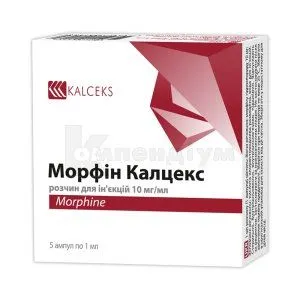
Table of Contents
INSTRUCTIONS FOR MEDICAL USE OF THE MEDICINAL PRODUCT MORPHINEKALCEKS (MORPHINEKALCEKS)
Composition:
Active substance: morphine;
1 ml of solution (1 ampoule) contains morphine hydrochloride 10 mg;
Excipients: diluted hydrochloric acid, water for injections.
Pharmaceutical form. Injection solution.
Main physicochemical properties: clear, colourless or slightly yellow liquid.
Pharmacotherapeutic group.
Analgesics. Opioids. Opium alkaloids. ATC code N02AA01.
Pharmacological Properties.
Pharmacodynamics.
Morphine is a natural alkaloid and a classic analgesic agent with potent central action. Its strong analgesic effect is associated with agonist activity at opioid receptors in the cerebral cortex, thalamus, reticular formation, limbic-hypothalamic system, periaqueductal gray matter, and gelatinous substance. The agonist effect of morphine hydrochloride is most pronounced at mu- and kappa- receptors. Its influence on sigma- and delta- receptors is less pronounced. By activating mu- receptors, morphine induces supraspinal analgesia, euphoria, and drug dependence. Stimulation of mu2 receptors causes miosis, respiratory depression, and slowed intestinal motility. Activation of kappa- receptors leads to spinal analgesia, miosis, and sedative effects.
By acting on the central nervous system (CNS), morphine significantly reduces acute and chronic pain, decreases psychomotor agitation, and induces general relaxation and euphoria. Morphine reduces tidal volume and respiratory rate and diminishes the respiratory center's sensitivity to carbon dioxide. Miosis results from morphine's excitatory effect on the oculomotor nerves due to activation of mu- and kappa- receptors. Markedly constricted pupils are a typical sign of morphine overdose.
Morphine activates smooth muscle receptors in the stomach and intestines, increasing their tone and reducing peristalsis. As a result, gastric emptying is prolonged. This also reduces secretion from the stomach, gallbladder, and pancreas. Slowed water passage leads to water reabsorption and increased stool viscosity. Due to its vasodilatory effect, morphine reduces venous return, making it beneficial in the treatment of heart failure and pulmonary edema.
Spasm of the gallbladder and increased tone of the sphincter of Oddi elevate bile pressure. Spasms of the urethral sphincter may cause urinary retention.
Prolonged use leads to tolerance, primarily affecting the depressant effects of morphine, rather than its miotic action or constipating effect.
Pharmacokinetics.
Absorption
After subcutaneous or intramuscular injection, morphine is rapidly absorbed into the bloodstream. Absorption is delayed in circulatory shock. Following subcutaneous administration, maximum effect is achieved within 50–90 minutes; after intramuscular administration, within 30–60 minutes. The duration of action is 4–5 hours.
Distribution
A large portion of the active substance forms conjugates in the liver and intestine. Morphine is distributed via the bloodstream primarily to the kidneys, liver, lungs, and spleen, and to a lesser extent to the brain and muscles. Morphine readily crosses the blood-brain and placental barriers, passes into breast milk (in amounts less than 1% of the administered dose), and into sweat. Approximately 35% of morphine binds to plasma proteins. The estimated volume of distribution at steady state is 3.3±0.9 L/kg.
Elimination
The elimination half-life of morphine is 2 hours; for its metabolites, it ranges from 2.4 to 6.7 hours. Less than 10% of morphine is excreted unchanged. The majority of morphine is excreted in conjugated form via urine; up to 10% is excreted in conjugated form via bile into feces. Approximately 90% of morphine is eliminated from the body within 24 hours, although traces in urine may persist for more than 48 hours.
Special patient groups
In elderly patients, morphine elimination occurs more rapidly, whereas in newborns it is slower. Impaired liver or kidney function may also affect morphine elimination.
Clinical characteristics.
Indications.
- Relief of severe, acute pain following severe injuries, bone fractures, burns, and surgery;
- alleviation of acute and chronic pain in myocardial infarction, as well as in acute pancreatitis;
- reduction of severe, chronic pain in malignant tumors and reduction of spastic pain caused by movement of kidney or gallbladder stones;
- as an antitussive agent in chest trauma and pulmonary hemorrhage, when coughing attacks become life-threatening, as well as in intractable cough in terminal-stage lung cancer;
- in dyspnea associated with left ventricular heart damage and pulmonary edema;
- for premedication before anesthesia.
Contraindications.
- Hypersensitivity to the active substance or to any of the components of the medicinal product;
- acute respiratory depression, bronchial asthma attacks;
- acute alcohol intoxication;
- delirium;
- paralytic ileus or abdominal pain of unknown origin ("acute abdomen");
- acute diarrhea caused by poisoning;
- increased intracranial pressure or head trauma, brain tumor;
- stroke;
- epileptic status;
- severe general exhaustion;
- fever;
- coronary heart disease;
- myxedema;
- adrenal insufficiency (Addison's disease);
- pheochromocytoma;
- severe liver or kidney disease;
- biliary colic;
- porphyria.
Morphine hydrochloride must not be administered during therapy with monoamine oxidase inhibitors (MAOIs), or within 2 weeks after discontinuation of such therapy.
Morphine hydrochloride must not be administered immediately after surgery on the biliary tract, or in diarrhea caused by toxins.
Interaction with other medicinal products and other forms of interaction.
The depressant effect of morphine hydrochloride may be enhanced by other CNS depressants (alcohol, barbiturates, neuroleptics, antidepressants, antihistamines, gabapentin or pregabalin), MAO inhibitors, physostigmine, neostigmine, and amphetamine. Such interactions cause CNS and respiratory depression, and enhance the hypotensive effect.
Concomitant use of opioids and sedative medicinal products, such as benzodiazepines or similar agents, due to additional CNS depressant effects, increases the risk of sedation, respiratory depression, coma, and fatal outcome. The dose and duration of concomitant use should be limited (see section "Special precautions for use").
Morphine hydrochloride may be administered no earlier than 2 weeks after discontinuation of MAO inhibitors (see section "Contraindications").
Tricyclic antidepressants, particularly desipramine, enhance and prolong the analgesic effect of morphine hydrochloride.
Concomitant use of opioid analgesics enhances the sedative effect.
Concomitant use with cisapride increases the plasma concentration of morphine hydrochloride.
Cimetidine and ritonavir increase the plasma concentration of morphine hydrochloride (risk of toxicity).
The effect of morphine hydrochloride is reduced by opioid mixed agonist-antagonists and partial agonists (pentazocine, butorphanol, buprenorphine). These agents may precipitate withdrawal symptoms in patients who have been receiving morphine hydrochloride for a prolonged period.
Concomitant use of morphine hydrochloride with metoclopramide or domperidone reduces the effect of morphine hydrochloride on the gastrointestinal tract.
In patients with acute coronary syndrome receiving morphine, delayed and reduced exposure to oral P2Y12 inhibitor antiplatelet therapy has been observed. This interaction may be related to decreased gastrointestinal motility and may apply to other opioids. The clinical significance is unknown, but data suggest a potential reduction in the effectiveness of P2Y12 inhibitors in patients who received morphine and a P2Y12 inhibitor concomitantly (see section "Special precautions for use"). For patients with acute coronary syndrome in whom discontinuation of morphine therapy is not feasible and rapid P2Y12 inhibition is considered important, the use of a parenteral P2Y12 inhibitor may be considered.
Morphine hydrochloride reduces the effect of diuretics by releasing antidiuretic hormone, and also reduces the effect of laxatives.
Opioids slow the absorption of mexiletine.
Morphine hydrochloride increases the toxicity of organophosphates.
Special precautions for use.
Caution should be exercised when prescribing morphine hydrochloride to patients with bronchial asthma, inflammatory or obstructive gastrointestinal disorders, myasthenia gravis, prostate enlargement, and pregnant women.
Lower doses of morphine hydrochloride should be used in elderly or debilitated patients, and in patients with impaired renal and/or hepatic function, hypotension, or a predisposition to seizures.
Morphine hydrochloride should also be used with caution in patients with arrhythmia, severe cor pulmonale, or urinary tract colic.
Rifampicin may reduce plasma levels of morphine. The analgesic effect of morphine should be monitored, and the morphine dose adjusted during and after rifampicin therapy.
Hyperalgesia may occur, in which further increases in morphine dose do not result in increased analgesic effect, especially when high doses of the drug are used. Dose reduction or switching to another opioid may be required.
Morphine, like other potent opioid receptor agonists, may lead to abuse and must therefore be used with particular caution in patients with a history of alcohol or drug dependence.
Opioid use disorders (abuse and dependence)
Tolerance and physical and/or psychological dependence may develop after repeated use of opioids such as Morphine Kalceks.
Repeated use of Morphine Kalceks may lead to opioid use disorders (OUD). Higher doses and longer duration of opioid treatment may increase the risk of developing OUD. Abuse or intentional misuse of Morphine Kalceks may result in overdose and/or death. The risk of OUD is increased in patients with a personal or family history (parents or siblings) of substance use disorders (including alcohol-related disorders), in current tobacco users, or in patients with other psychiatric disorders (e.g., major depression, anxiety, or personality disorders).
Before initiating and during treatment with Morphine Kalceks, the treatment goals and a plan for discontinuation should be discussed with the patient (see section "Dosage and administration"). Patients should also be informed before and during treatment about the risks and signs of OUD. Patients should be advised to contact their physician if such signs appear.
Patients should be monitored for signs of addictive behavior (e.g., early requests for additional doses). This includes checking for concomitant use of opioids and psychoactive medications (e.g., benzodiazepines). Patients exhibiting signs and symptoms of OUD should be considered for consultation with an addiction specialist.
Withdrawal syndrome (abstinence)
The risk of withdrawal syndrome increases with the duration of therapy and use of high doses. Symptoms may be minimized by dose adjustment, changing the dosage form, or gradual discontinuation of morphine. See section "Adverse reactions" for symptoms.
Sleep-related breathing disorders
Opioids may cause sleep-related breathing disorders, including central sleep apnea (CSA) and nocturnal hypoxemia. Opioid use increases the risk of CSA in a dose-dependent manner. In patients with CSA, consider reducing the total opioid dose.
Severe cutaneous adverse reactions (SCARs)
Cases of acute generalized exanthematous pustulosis (AGEP), which may be life-threatening or fatal, have been reported with morphine use. Most of these reactions occurred within the first 10 days of treatment. Patients should be informed about the signs and symptoms of AGEP and advised to seek medical help if such symptoms occur.
If signs or symptoms suggestive of these skin reactions appear, morphine should be discontinued and alternative treatment considered.
Hepatobiliary system disorders
Caution is advised when administering the drug to patients with biliary tract disorders (including biliary pancreatitis). Morphine may cause dysfunction and spasm of the sphincter of Oddi, thereby increasing intra-abdominal pressure and increasing the risk of biliary tract symptoms and pancreatitis.
Risk of concomitant use of sedatives such as benzodiazepines or similar drugs
Concomitant use of Morphine Kalceks and sedative drugs such as benzodiazepines or similar agents may cause sedation, respiratory depression, coma, and may lead to death. Because of these risks, opioids should be co-prescribed with such sedatives only for patients for whom alternative treatments are not feasible. If co-prescribing Morphine Kalceks with sedative drugs is necessary, the lowest effective dose should be used and the duration of treatment kept as short as possible.
Patients should be closely monitored for signs and symptoms of respiratory depression and sedation. Therefore, patients and caregivers should be informed about the potential for these symptoms (see section "Interaction with other medicinal products and other forms of interaction").
Antiplatelet therapy with oral P2Y12 inhibitors
During the first 24 hours of concomitant treatment with P2Y12 inhibitors and morphine, reduced efficacy of P2Y12 inhibitor therapy has been observed (see section "Interaction with other medicinal products and other forms of interaction").
Acute chest syndrome (ACS) in patients with sickle cell anemia (SCA)
Given the possible association between ACS and morphine use in patients with SCA during vaso-occlusive crises, careful monitoring for symptoms of ACS is required.
Adrenal insufficiency
Opioid analgesics may cause reversible adrenal insufficiency, which requires monitoring and glucocorticoid replacement therapy. Symptoms of adrenal insufficiency include, for example, nausea, vomiting, loss of appetite, fatigue, weakness, dizziness, and low blood pressure.
Reduction in sex hormone levels and increase in prolactin levels
Long-term use of opioid analgesics may be associated with decreased sex hormone levels and increased prolactin levels. Symptoms include reduced libido, impotence, or amenorrhea.
Children
Morphine hydrochloride is generally not used for cough treatment in children under 1 year of age.
Use during pregnancy or breastfeeding.
Pregnancy. Morphine hydrochloride crosses the placental barrier, and its use immediately before delivery may be hazardous to the newborn due to respiratory depression. Infants born to morphine-dependent mothers have lower birth weight and higher neonatal mortality. After delivery, newborns may exhibit withdrawal symptoms such as abnormal reflexes, increased muscle tone, seizures, diarrhea, and excessive sweating.
Newborns born to mothers who received opioid analgesics during pregnancy or delivery should be monitored for signs of neonatal withdrawal syndrome (abstinence). Treatment may include opioid and symptomatic therapy.
Morphine hydrochloride should not be used to reduce labor pain.
Breastfeeding period. The drug passes into breast milk (less than 1% of the administered dose) and therefore should not be administered to breastfeeding women. If treatment is necessary, breastfeeding should be discontinued.
Fertility. Animal studies have shown that morphine may reduce fertility.
Ability to affect reaction speed when driving or operating machinery.
Morphine hydrochloride may adversely affect attention and motor coordination. Therefore, driving vehicles or performing work involving risk and requiring skill and rapid reaction should be avoided during therapy. Alcohol use enhances the CNS effects of morphine hydrochloride.
Method of Administration and Dosage
Administered intravenously, intramuscularly, or subcutaneously.
Note: In cases of edema, administer only intramuscularly.
For slow intravenous administration, use ¼–½ of the corresponding intramuscular dose. For dilution, use 0.9% sodium chloride or 5% glucose solutions.
Adults
For acute pain: Subcutaneously or intramuscularly administer 10 mg morphine hydrochloride. If necessary, repeat the injection every 4–6 hours.
For postoperative pain relief: Subcutaneously or intramuscularly administer 10 mg morphine hydrochloride every 2–4 hours (as needed).
For chronic pain: Subcutaneously or intramuscularly administer 5–20 mg every 4 hours.
For myocardial infarction: Administer 10 mg morphine hydrochloride slowly (2 mg/min) intravenously; if necessary, further administer 5–10 mg.
For premedication: Subcutaneously or intramuscularly administer up to 10 mg morphine hydrochloride 60–90 minutes before surgery.
The maximum single dose of morphine hydrochloride for adults is 20 mg; the maximum daily dose is 50 mg.
Elderly and debilitated patients
For elderly and debilitated patients with myocardial infarction, administer ½ the standard dose.
Hepatic and/or renal impairment
In case of renal dysfunction (glomerular filtration rate <10 ml/min), the dose should be reduced to ½.
In hepatic dysfunction, the intervals between doses should be 1.5–2 times longer. Dose adjustment is not required during dialysis.
Treatment Goals and Discontinuation
Before initiating treatment with Morphine Kalceks**, the treatment strategy—including duration, treatment goals, and a discontinuation plan—should be discussed and agreed upon with the patient, in accordance with pain management protocols. During therapy, the physician should maintain regular contact with the patient to assess the need for continued treatment, consider discontinuation, and, if necessary, adjust the dosage. When the patient no longer requires therapy with** Morphine Kalceks**, tapering the dose gradually may be advisable to prevent withdrawal symptoms. In the absence of adequate pain control, consider the possibility of hyperalgesia, tolerance, or progression of the underlying disease (see section "Special Warnings and Precautions for Use").**
Duration of Treatment
Morphine Kalceks should not be used longer than necessary.
Children
Initial doses for children with acute pain:
- Under 1 month of age: 0.15 mg/kg body weight
- 1 to 12 months of age: up to 0.2 mg/kg body weight
- 1 to 12 years of age: up to 0.2 mg/kg body weight
Subsequent doses should be adjusted according to the patient's response.
For postoperative pain relief in children:
- Under 1 month of age: 0.15 mg/kg body weight
- 1 to 12 months of age: up to 0.2 mg/kg body weight
- 1 to 12 years of age: up to 0.2 mg/kg body weight
Doses should be adjusted according to the patient's response.
For premedication – intramuscularly 0.15 mg/kg body weight.
Overdose
Sensitivity to morphine hydrochloride is individual. Sensitivity is increased in children under 2 years of age (respiratory depression and excitation) and in elderly patients (respiratory depression). It may be reduced in patients who regularly use morphine or narcotics.
Symptoms
Symptoms of mild intoxication include euphoria, drowsiness, miosis, and slowed intestinal activity.
Severe poisoning is characterized by a marked decrease in respiratory rate, markedly constricted pupils, and coma. Respiratory depression leads to cyanosis, followed by tissue hypoxia, capillary damage, and shock.
Other symptoms of intoxication include decreased body temperature, muscle flaccidity, and airway obstruction due to tongue relaxation.
Aspiration pneumonia may occur. Respiratory failure may result in death.
In cases of intoxication symptoms, it is necessary to differentiate symptoms caused by histamine release, which are characterized by hypotension, tachycardia, and erythema.
Treatment
Treatment of hypotension, hypothermia, and respiratory depression is symptomatic. The most important measure is ensuring airway patency and adequate ventilation. For hypotension, administer isotonic sodium chloride solution or other plasma substitutes. If the response is inadequate, dopamine may be added at a dose of 5–15 mcg/kg/min.
The specific antidote for morphine is naloxone, which rapidly reduces intoxication symptoms. Administer intravenously at a dose of 0.4–2 mg; repeat the dose every 2–3 minutes until the patient awakens and respiration and cough reflex stabilize. In cases of morphine intoxication, methods of drug elimination (peritoneal dialysis, hemodialysis, hemoperfusion) are not used.
Adverse Reactions
Adverse reactions were observed in nearly 7% of patients when the recommended doses were used. The most commonly observed reactions are nausea and vomiting (mainly at the beginning of treatment) and constipation (3–4%).
Adverse reactions are listed below by system organ class and frequency of occurrence (MedDRA): very common (≥1/10), common (≥1/100 to <1/10), uncommon (≥1/1,000 to <1/100), rare (≥1/10,000 to <1/1,000), very rare (<1/10,000), and frequency not known (cannot be estimated from the available data).
Immune system disorders:
Rare – anaphylactic shock; frequency not known – anaphylactoid reactions.
Psychiatric disorders:
Common – drowsiness and confusion; frequency not known – hallucinations, dysphoria, anxiety, mood changes, decreased libido or potency, dependence.
Nervous system disorders:
Frequency not known – headache, dizziness, allodynia, hyperalgesia (see section "Special precautions"), hyperhidrosis.
Eye disorders:
Frequency not known – miosis, diplopia.
Cardiac disorders:
Frequency not known – bradycardia, tachycardia, atrial flutter.
Vascular disorders:
Uncommon – hypotension; frequency not known – facial flushing, postural hypotension.
Respiratory, thoracic and mediastinal disorders:
Frequency not known – respiratory depression, bronchoconstriction, central sleep apnea syndrome. High doses may cause pronounced respiratory depression. In patients with asthma, morphine hydrochloride may induce bronchospasm.
Gastrointestinal disorders:
Common – dry mouth, nausea, vomiting, constipation; frequency not known – pancreatitis.
Hepatobiliary disorders:
Frequency not known – biliary tract spasms, spasm of the sphincter of Oddi.
Skin and subcutaneous tissue disorders:
Frequency not known – pruritus, rash, urticaria, acute generalized exanthematous pustulosis (AGEP), contact dermatitis.
Musculoskeletal and connective tissue disorders:
Uncommon – muscle rigidity (especially with high doses); frequency not known – convulsions (especially in children).
Renal and urinary disorders:
Frequency not known – urinary retention, urinary tract spasm.
General disorders and administration site conditions:
Frequency not known – increased sweating, hypothermia; drug withdrawal syndrome (abstinence syndrome).
Drug dependence and withdrawal syndrome
The use of opioid analgesics may lead to physical and/or psychological dependence or tolerance. Repeated use of Morphine Kalceks may lead to drug dependence, even at therapeutic doses. The risk of developing drug dependence may vary depending on individual patient risk factors, dosage, and duration of opioid treatment (see section "Special precautions"). The abstinence syndrome may be caused by abrupt discontinuation of opioids or administration of opioid antagonists, and sometimes may occur between doses. For treatment information, see section "Special precautions". Physical withdrawal symptoms include body aches, tremor, restless legs syndrome, diarrhea, abdominal cramps, nausea, flu-like symptoms, tachycardia, and mydriasis. Psychological symptoms may include dysphoric mood, anxiety, and irritability. In cases of drug dependence, drug craving is often present.
Shelf life.
3 years.
Storage conditions.
Store at a temperature not exceeding 25 °C.
Store in the original packaging to protect from light.
Keep out of reach and sight of children.
Incompatibilities.
Morphine salts precipitate in alkaline solutions.
Morphine hydrochloride is incompatible with aminophylline, heparin, thiopental, peptobarbital, phenobarbital, and metaraminol; therefore, they should not be mixed in the same syringe (should not be used in combination).
Packaging.
1 ml in a vial made of colorless glass of hydrolytic class I, with a score line or dot and marking rings.
5 vials in a blister pack (cavity) made of polyvinyl chloride film.
1, 2, or 20 blister packs (cavities) in a cardboard carton with a tamper-evident closure in the form of a self-adhesive label on each opening part of the carton.
Prescription status.
Prescription only.
Manufacturer.
Manufacturer responsible for batch release:
JSC "Kalceks".
Manufacturer's address and location.
71E Krustpils Street, Riga, LV-1057, Latvia.
Marketing Authorization Holder.
JSC "Kalceks".
Address of the Marketing Authorization Holder.
71E Krustpils Street, Riga, LV-1057, Latvia.