Mometasone-zdorovya
Ukraine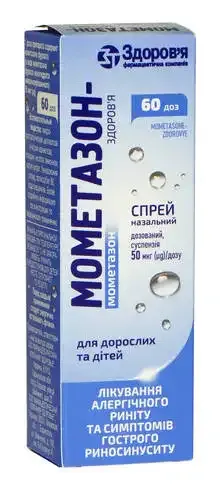
Table of Contents
INSTRUCTIONS FOR MEDICAL USE OF THE MEDICINAL PRODUCT MOMETASONE-ZDOROVYE (MOMETASONE-ZDOROVYE)
Composition:
Active substance: mometasone;
1 dose of the medicinal product contains mometasone furoate (as micronized mometasone furoate monohydrate) – 50 mcg;
Excipients: microcrystalline cellulose and sodium carmellose, glycerin, citric acid, sodium citrate, benzalkonium chloride, polysorbate 80, purified water.
Pharmaceutical form. Metered nasal spray, suspension.
Main physicochemical properties: opaque white or almost white suspension.
Pharmacotherapeutic group. Anti-inflammatory and other drugs for local use in nasal cavity disorders. Corticosteroids. ATC code R01AD09.
Pharmacological properties.
Pharmacodynamics.
Mechanism of action. Mometasone furoate is a glucocorticosteroid for topical use with local anti-inflammatory activity at doses that do not produce systemic effects.
The primary mechanism of the anti-inflammatory and antiallergic action of mometasone furoate is related to its ability to inhibit the release of mediators of allergic reactions. Mometasone furoate significantly reduces the release of leukotrienes from leukocytes of patients. In cell culture studies, mometasone furoate has demonstrated high efficacy in suppressing the synthesis/release of IL-1, IL-5, IL-6, and TNFα; it is also a potent inhibitor of leukotriene production. In addition, it is a potent inhibitor of Th2 cytokine production, including IL-4 and IL-5, from human CD4+ T-cells.
Pharmacodynamic effects. In challenge studies involving antigen application to the nasal mucosa, mometasone furoate demonstrated high anti-inflammatory activity both in the early and late phases of the allergic reaction. This was confirmed by a reduction (compared to placebo) in histamine levels and eosinophil activity, as well as a decrease (compared to baseline) in the number of eosinophils, neutrophils, and epithelial cell adhesion proteins.
A pronounced clinical effect within the first 12 hours of mometasone furoate spray use was achieved in 28% of patients with seasonal allergic rhinitis. On average (50%), symptom relief occurred within 35.9 hours.
Children. During a one-year placebo-controlled clinical study in which children (n = 49/group) received mometasone furoate at a dose of 100 mcg once daily, no suppression of growth velocity was observed.
Safety and efficacy data for the use of mometasone furoate in children aged 3 to 5 years are limited; therefore, the appropriate dose range cannot be established. In a study involving 48 children aged 3 to 5 years who received intranasal mometasone furoate at doses of 50, 100, or 200 mcg/day for 14 days, no significant differences compared to placebo were observed in the mean change in plasma cortisol levels in response to tetracosactrin stimulation testing.
Pharmacokinetics.
Absorption. The bioavailability of mometasone furoate following intranasal administration is < 1% in plasma (based on data obtained using a sensitive method with a lower limit of quantification of 0.25 pg/mL).
Distribution. Not applicable, as mometasone is poorly absorbed following intranasal administration.
Metabolism. The small amount that may be swallowed and absorbed undergoes extensive first-pass hepatic metabolism.
Elimination. Metabolites are excreted via bile and urine.
Clinical characteristics.
Indications.
- Treatment of symptoms of seasonal allergic or perennial rhinitis in adults and children aged 3 years and older.
- Treatment of nasal polyps in patients aged 18 years and older.
Contraindications. Hypersensitivity to the active substance or to any of the excipients of the medicinal product.
The medicinal product should not be used in the presence of untreated localized infections involving the nasal mucosa, such as herpes simplex.
Due to the ability of corticosteroids to suppress wound healing, intranasal corticosteroids should not be administered to patients who have recently undergone nasal surgery or have experienced nasal trauma until healing has occurred.
Interaction with other medicinal products and other forms of interaction. In a clinical study, no interaction was observed between mometasone furoate and loratadine.
Concomitant therapy with CYP3A inhibitors, particularly agents containing cobicistat, is expected to increase the risk of systemic adverse effects. Such combination should be avoided, except when the expected benefit outweighs the increased risk of systemic corticosteroid side effects. In such cases, patients should be monitored for systemic corticosteroid adverse effects.
Special precautions for use.
Immunosuppression. The medicinal product should be used with caution or not used at all in patients with active or latent respiratory tuberculosis, as well as in those with untreated fungal, bacterial, or systemic viral infections.
Patients receiving corticosteroids may potentially have suppressed immunity and should be warned about the increased risk of infection upon contact with certain infectious diseases (such as varicella or measles), and advised to consult a physician if such contact occurs.
Local effects. After 12 months of treatment with mometasone furoate in patients with perennial allergic rhinitis, no signs of nasal mucosal atrophy were observed; furthermore, mometasone furoate contributed to the normalization of the histological appearance of the nasal mucosa. As with any long-term therapy, patients using the medicinal product for several months or longer should be periodically examined for possible changes in the nasal mucosa. If a local fungal infection of the nose or throat develops, discontinuation of treatment with the medicinal product or initiation of appropriate therapy may be necessary. Persistent irritation of the nasal or pharyngeal mucosa may also be an indication for discontinuation of the medicinal product.
The use of mometasone furoate is not recommended in the event of nasal septum perforation (see section "Undesirable effects").
In clinical studies, the incidence of epistaxis was higher compared to placebo. Epistaxis was generally mild in severity and resolved spontaneously (see section "Undesirable effects").
The medicinal product contains benzalkonium chloride, which may cause irritation or local reactions.
Systemic effects of corticosteroids. Systemic effects of intranasal corticosteroids may occur, particularly when high doses are used for prolonged periods. These effects are much less common than with oral corticosteroids and may vary between individual patients and different corticosteroid products. Potential systemic effects may include Cushing's syndrome, Cushingoid features, adrenal suppression, growth retardation in children and adolescents, cataract, glaucoma, and, less frequently, a range of psychological or behavioral effects such as psychomotor hyperactivity, sleep disturbances, anxiety, depression, or aggression (particularly in children).
Cases of increased intraocular pressure have been reported following the use of intranasal corticosteroids (see section "Undesirable effects").
Visual disturbances may occur with both systemic and locally acting corticosteroids (including intranasal, inhaled, and intraocular administration). If symptoms such as blurred vision or other visual disturbances occur, patients should be referred to an ophthalmologist for evaluation of possible causes, which may include cataract, glaucoma, or rare conditions such as central serous chorioretinopathy, which has been reported after systemic and local corticosteroid use.
Patients who switch to intranasal spray treatment after prolonged systemic corticosteroid therapy require careful monitoring. Discontinuation of systemic corticosteroids in these patients may result in adrenal insufficiency for several months until recovery of the hypothalamic-pituitary-adrenal axis. If such patients exhibit signs and symptoms of adrenal insufficiency or withdrawal syndrome (e.g., joint and/or muscle pain, fatigue, depression), despite resolution of nasal symptoms, systemic corticosteroid therapy should be reinstated along with other treatment measures. During such transition, pre-existing allergic conditions such as allergic conjunctivitis or eczema, previously suppressed by systemic corticosteroid therapy, may also become apparent.
Use of doses higher than recommended may lead to clinically significant adrenal suppression. If evidence of doses exceeding the recommended levels is present, consideration should be given to the potential need for additional systemic corticosteroid coverage during periods of stress or elective surgery.
Nasal polyps. The safety and efficacy of mometasone furoate nasal spray for the treatment of unilateral polyps, polyps associated with cystic fibrosis, or polyps completely obstructing the nasal cavity have not been studied.
Unilateral polyps, particularly those associated with ulceration or bleeding, require further investigation.
Effect on growth in children. Regular monitoring of growth in children receiving long-term treatment with intranasal corticosteroids is recommended. If growth retardation is observed, therapy should be re-evaluated with the aim of reducing the dose of the intranasal corticosteroid, if possible, to the lowest dose that maintains effective symptom control. In addition, the patient should be referred for evaluation by a pediatrician.
Non-nasal symptoms. Although the medicinal product controls nasal symptoms in most patients, concomitant use of appropriate additional therapy may provide further relief of other symptoms, particularly ocular symptoms.
Use during pregnancy or breastfeeding.
Pregnancy. Data on the effects of mometasone furoate when used during pregnancy are limited or lacking. Animal studies have shown reproductive toxicity. As with other intranasal corticosteroids, the medicinal product should be used during pregnancy only if the expected benefit justifies the potential risk to the mother, fetus, or neonate. Neonates born to mothers who used corticosteroids during pregnancy should be carefully monitored for possible adrenal insufficiency.
Breastfeeding. It is unknown whether mometasone furoate passes into breast milk. As with other intranasal corticosteroids, a decision must be made whether to discontinue breastfeeding or to discontinue/abstain from treatment with mometasone furoate nasal spray, taking into account the benefits of breastfeeding for the child and the therapeutic benefit for the woman.
Fertility. Clinical data on the effect of mometasone furoate on fertility are lacking. Animal studies have shown reproductive toxicity, but no effect on fertility.
Ability to affect reaction speed when driving or operating machinery. Unknown.
Dosage and Administration
Before using a new bottle, approximately 10 actuations of the dosing device should be performed; this primes the device to deliver a consistent dose, with each actuation releasing approximately 100 mg of suspension containing 50 mcg of mometasone (1 dose). If the nasal spray has not been used for 14 days or longer, the device must be re-primed by 2 actuations prior to the next use, until a full spray is observed. Do not puncture the nozzle before initial use.
The bottle should be shaken vigorously before each administration.
If the nozzle becomes clogged, remove the plastic cap by pressing gently on the white ring, carefully detach the nozzle, wash it with warm running water, dry it thoroughly, and reattach it. Do not attempt to clear the nozzle with a needle or any other sharp object, as this may damage the pump.
Regular cleaning of the nozzle is very important.
Before each use, the nose should be thoroughly cleared of mucus.
Treatment of seasonal allergic or perennial rhinitis:For adults (including elderly patients) and children aged 12 years and older, the recommended prophylactic and therapeutic dose is 2 sprays (50 mcg each) in each nostril once daily (total daily dose – 200 mcg). After achieving the therapeutic effect, the dose should be reduced to 1 spray in each nostrir once daily (total daily dose – 100 mcg) for maintenance therapy. If symptoms are not adequately controlled with the recommended therapeutic dose, the daily dose may be increased to the maximum: 4 sprays in each nostril once daily (total daily dose – 400 mcg). The dose should be reduced once symptoms have improved.
For children aged 3–11 years, the recommended therapeutic dose is 1 spray (50 mcg) in each nostril once daily (total daily dose – 100 mcg).
The medicinal product has demonstrated a clinically significant onset of action within 12 hours after the first dose in some patients with seasonal allergic rhinitis. However, full benefit may not be achieved within the first 48 hours; therefore, patients should continue regular use to achieve the full therapeutic effect.
Treatment with mometasone furoate nasal spray may be initiated several days before the anticipated start of the pollen season in patients with a history of moderate to severe seasonal allergic rhinitis.
Nasal polyps: For adults (including elderly patients), the usual recommended initial dose is 2 sprays (50 mcg each) in each nostril once daily (total daily dose – 200 mcg). If symptom relief is not achieved after 5–6 weeks of treatment, the daily dose may be increased to 2 sprays in each nostril twice daily (total daily dose – 400 mcg). The dose should be reduced to the lowest effective dose that maintains symptom control. If symptoms are not adequately controlled after 5–6 weeks of treatment with the higher dose (twice daily), alternative treatment options should be considered.
The clinical studies on the efficacy and safety of mometasone furoate nasal spray in the treatment of nasal polyposis lasted up to 4 months.
Children.
Seasonal allergic or perennial rhinitis. The safety and efficacy of the medicinal product have not been established in children under 3 years of age.
Nasal polyps. The safety and efficacy of the medicinal product have not been established in children under 18 years of age.
Overdose.
Symptoms. Inhalation or oral ingestion of excessive doses of corticosteroids may lead to suppression of the hypothalamic-pituitary-adrenal (HPA) axis.
Treatment. Due to the low systemic bioavailability of the medicinal product (< 1%), it is unlikely that any intervention other than patient observation and subsequent administration at the recommended dose will be required in cases of overdose.
Adverse Reactions
Summary of safety profile. In clinical trials of allergic rhinitis, nasal bleeding was mainly self-limiting, mild, and occurred slightly more frequently than with placebo (5%), but at a comparable rate or less frequently than with other investigational intranasal corticosteroids used as active controls (up to 15%). The incidence of other adverse reactions was comparable to that observed with placebo. In patients with nasal polyps, the overall incidence of adverse reactions was similar to that observed in patients with allergic rhinitis.
Systemic effects of intranasal corticosteroids are more likely to occur with high-dose and long-term use.
Tabulated list of adverse reactions. Treatment-related adverse reactions (≥ 1%) reported in clinical trials in patients with allergic rhinitis or nasal polyps, as well as during the post-marketing period, regardless of indication, are listed in Table 1. Adverse reactions are listed by system organ class. Within each system organ class, adverse reactions are ranked by frequency. The frequency categories are defined as follows: very common (≥ 1/10); common (≥ 1/100, < 1/10); uncommon (≥ 1/1,000, < 1/100). The frequency of adverse reactions in the post-marketing period is considered "not known" (cannot be estimated from available data).
| Table 1: Treatment-related adverse reactions reported by system organ class and frequency |
|||
| Very common |
Common |
Unknown |
|
| Infections and infestations |
Pharyngitis, upper respiratory tract infections2 |
||
| Immune system disorders |
Hypersensitivity, including anaphylactic reactions, angioedema, bronchospasm, and dyspnea |
||
| Nervous system disorders |
Headache |
||
| Eye disorders |
Glaucoma, increased intraocular pressure, cataract, blurred vision (see also section "Special precautions") |
||
| Respiratory, thoracic and mediastinal disorders |
Nasal bleeding1 |
Nasal bleeding, nasal burning sensation, nasal irritation, nasal ulcers |
Nasal septum perforation |
| Gastrointestinal disorders |
Throat irritation1 |
Disturbances of taste and smell |
|
¹ Observed with twice daily use for the treatment of nasal polyps.
² Observed infrequently with twice daily use for the treatment of nasal polyps.
Children. In children, the frequency of reported adverse reactions during clinical studies, such as epistaxis (6%), headache (3%), nasal irritation (2%), and sneezing (2%), was comparable to that observed with placebo.
Shelf life. 2 years.
Storage conditions.
Store in the original packaging at a temperature not exceeding 25 °C.
Do not freeze.
Keep out of reach of children.
Packaging.
60 doses or 140 doses in a bottle with a spray pump and protective cap in a carton.
Prescription category. Prescription only.
Manufacturer.
LIMITED LIABILITY COMPANY "CORPORATION "ZDOROV'YA".
Manufacturer's address and location of business operations.
Ukraine, 61013, Kharkiv region, city of Kharkiv, Shevchenka Street, building 22.
(quality control, batch release)
Ukraine, 08301, Kyiv region, city of Boryspil, Shevchenka Street, building 100, letter B-II (building 4).
(all manufacturing stages, batch release)