Molsicor
Ukraine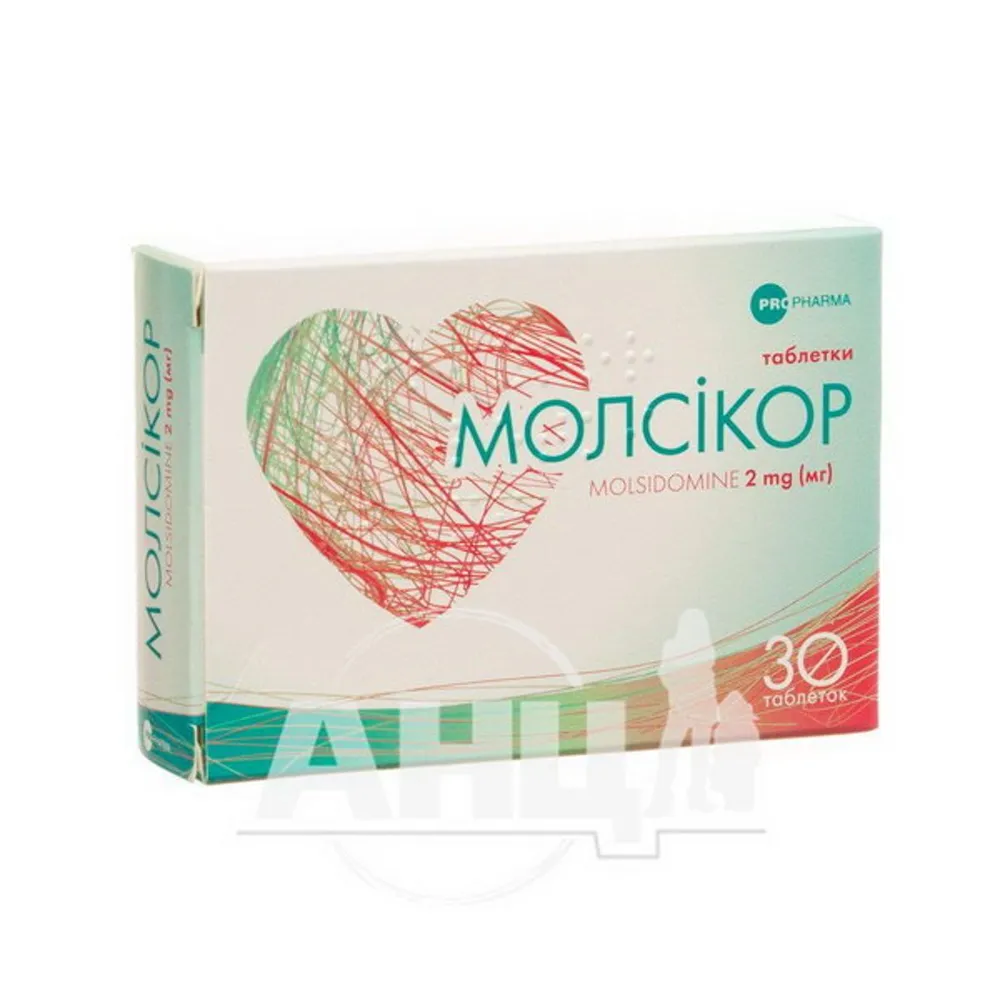
Table of Contents
INSTRUCTIONS FOR MEDICAL USE OF THE MEDICINAL PRODUCT MOLSICOR (MOLSICOR)
Composition:
Active substance: molsidomine;
1 tablet contains 2 mg of molsidomine;
Excipients: lactose monohydrate; sucrose; potato starch; orange-yellow S (E 110); povidone K-25; magnesium stearate.
Pharmaceutical form. Tablets.
Main physicochemical properties: tablets of uneven light-orange color, round, flat on both sides, beveled, with a dividing line on one side.
Pharmacotherapeutic group. Vasodilators used in the treatment of heart diseases. Molsidomine. ATC code C01D X12.
Pharmacological properties.
Pharmacodynamics.
Molsidomine is a derivative of sydnonimine. The active metabolite of molsidomine – linsidomine (SIN-1A) – is a compound that reduces the tone of smooth muscle in vessel walls and exerts an antianginal effect. Relaxation of smooth muscles promotes an increase in venous capacity and vascular volume, resulting in reduced venous return, thereby decreasing the filling pressure of both ventricles. This reduces cardiac workload and improves hemodynamic conditions in coronary circulation. Arterial vasodilation leads to a reduction in peripheral resistance, thus decreasing cardiac load, myocardial tension, and consequently, myocardial oxygen demand. In addition, molsidomine reduces coronary artery spasm and dilates their major branches. The anti-aggregatory effect of molsidomine has clinical significance in the treatment of ischemic heart disease. Unlike nitrates, molsidomine does not induce tachyphylaxis.
Pharmacokinetics.
After oral administration, molsidomine is approximately 90% absorbed in the gastrointestinal tract. The onset of action occurs about 20 minutes after administration. The duration of effect after a single dose is 4–6 hours. Maximum plasma concentration is reached approximately within 30–60 minutes. Bioavailability is about 65%, and plasma protein binding is 11%. Molsidomine is metabolized in the liver via enzymatic pathways to the active metabolite sydnonimine-1 (SIN-1), which is then transformed non-enzymatically to N-morpholino-N-aminoacetonitrile (SIN-1A), known as linsidomine.
It is unknown whether molsidomine and its metabolites are excreted in breast milk.
Molsidomine is primarily excreted in urine – 90–95% (2% unchanged) – and in feces – 3–4%. Total clearance is 40–80 L/h, and for SIN-1 – 170 L/h. The elimination half-life of the drug is 1.6 hours, but it increases in cases of severe hepatic insufficiency (in liver cirrhosis – approximately 13.1 hours). The elimination half-life of the metabolite linsidomine is 1–2 hours and increases to 7.5 hours in severe hepatic insufficiency. The drug does not accumulate in the body.
Clinical characteristics.
Indications.
Prevention and long-term treatment of angina pectoris when other drugs are contraindicated, not tolerated, or have proven insufficiently effective, as well as for elderly patients.
Due to its delayed onset of action, the medicinal product Molsicor is not suitable for the relief of acute angina attacks.
Contraindications.
− Hypersensitivity to any component of the drug.
− Glaucoma, especially closed-angle glaucoma.
− Acute stage of myocardial infarction, particularly with reduced arterial pressure.
− Acute heart failure, including cardiogenic shock, vascular collapse.
− Arterial hypotension.
− Concomitant use of molsidomine and phosphodiesterase-5 inhibitors, such as sildenafil, vardenafil, tadalafil (see section "Interaction with other medicinal products and other forms of interaction").
− Simultaneous administration of nitric oxide donors in any form and stimulators of soluble guanylate cyclase (e.g., riociguat) is contraindicated due to the risk of arterial hypotension (see section "Interaction with other medicinal products and other forms of interaction").
− Pregnancy and breastfeeding period.
Interaction with other medicinal products and other forms of interaction.
When molsidomine is used concomitantly with peripheral vasodilators, calcium antagonists, and antihypertensive agents, the hypotensive effect is potentiated.
Concomitant use of molsidomine and acetylsalicylic acid potentiates the antiplatelet effect.
Combined use of molsidomine and iloprost leads to significant inhibition of platelet aggregation; therefore, if such a combination is necessary, appropriate tests assessing blood parameters and platelet aggregation should be performed.
When using the medicinal product Molsicor, sildenafil should not be used due to the possibility of irreversible arterial hypotension with serious consequences.
Concomitant use of molsidomine and drugs for the treatment of erectile dysfunction containing phosphodiesterase-5 inhibitors as the active substance, such as sildenafil, vardenafil, or tadalafil, is contraindicated due to the possibility of unpredictable sudden reduction in arterial pressure, leading to syncope and even collapse. Therefore, before prescribing molsidomine, the physician must inform the patient about the impossibility of simultaneous use of these drugs. If molsidomine administration is necessary after treatment with sildenafil, it may be given only 24 hours after the last dose of sildenafil.
The reason for this interaction lies in the mechanism of action of drugs for the treatment of erectile dysfunction containing phosphodiesterase-5 inhibitors as the active substance and molsidomine. Drugs for the treatment of erectile dysfunction containing phosphodiesterase-5 inhibitors as the active substance inhibit phosphodiesterase type 5 (PDE5), which is responsible for the metabolic breakdown of cyclic guanosine monophosphate (cGMP). At the same time, molsidomine is transformed, resulting in activation of cGMP and dilation of blood vessels. Thus, increased concentration of cGMP due to concomitant intake of drugs for the treatment of erectile dysfunction containing phosphodiesterase-5 inhibitors and molsidomine leads to sudden reduction in arterial pressure.
The drug may be used concomitantly with beta-blockers and calcium antagonists.
Alcohol enhances the effect of the drug; therefore, alcohol consumption is prohibited during treatment with this drug.
Ergot alkaloids. A possible pharmacodynamic interaction exists between nitric oxide donors and ergot alkaloids, which may result in antagonistic effects of the drugs. Concomitant use of nitric oxide donors and ergot alkaloids should be avoided.
Concomitant use of molsidomine and stimulators of soluble guanylate cyclase (e.g., riociguat), which is a nitric oxide receptor, is contraindicated because the combination may lead to an increased risk of arterial hypotension.
Special precautions for use.
Warnings and special precautions for use
Molsidomine generally does not cause significant reduction in arterial pressure; however, caution should be exercised in patients with arterial hypotension, elderly patients with reduced circulating blood volume, and patients receiving treatment with other vasodilators. Careful monitoring is required, and dosage should be adjusted according to the patient's condition.
During therapy with Molsikor, it should be borne in mind that resting arterial pressure, particularly systolic pressure, may decrease. In this case, hypertensive baseline pressure responds significantly more strongly than normotensive or hypotensive pressure.
Use with caution in patients with hypertrophic obstructive cardiomyopathy, constrictive (restrictive) pericarditis, pericardial tamponade, reduced ventricular filling pressure, aortic stenosis or mitral sten0sis, acute myocardial infarction, and impaired left ventricular function (left ventricular insufficiency).
Particular attention during treatment with the drug is required in patients after hemorrhagic stroke, cerebral circulation disorders, and increased intracranial pressure; patients after recent myocardial infarction; and patients prone to hypotensive reactions.
With prolonged use of nitrates, molsidomine is recommended to be included in the treatment regimen to prevent the development of nitrate tolerance.
Patients with hepatic or renal insufficiency should receive lower doses, gradually increasing them until the desired therapeutic effect is achieved. In cases of pronounced liver dysfunction (increase in bromsulphthalein test by 20–50%), plasma concentration of molsidomine increases and elimination half-life is prolonged, requiring dose adjustment.
Generally, dose modification of molsidomine is not recommended in patients with renal impairment. However, since 90–95% of molsidomine metabolites are excreted via the kidneys, dose reduction or prolonged dosing intervals may be considered based on individual patient response to the drug.
As the drug contains lactose, it should not be used in patients with rare hereditary forms of galactose intolerance, Lapp lactase deficiency, or glucose-galactose malabsorption syndrome.
If intolerance to certain sugars is established, consult a physician before taking this medicinal product.
Due to the presence of the colorant sunset yellow FCF (E 110) in the formulation, allergic reactions may occur.
Use during pregnancy or breastfeeding.
Teratogenic effects of the drug were not observed in animal studies. However, due to lack of convincing safety data, use of Molsikor in pregnant women is contraindicated.
Molsidomine passes into breast milk. The use of the drug during breastfeeding is contraindicated.
Ability to influence reaction speed when driving or operating machinery.
Due to the drug's adverse effects (dizziness) and possible negative impact on attention and concentration, Molsikor should be prescribed with caution to individuals who drive vehicles or operate machinery, and only after careful assessment of potential risks.
Dosage and Administration.
The dosage of the drug is individually determined for each patient depending on the severity and phase of disease activity, as well as the patient's response to treatment.
The drug can be taken independently of food intake, at regular intervals, with sufficient amount of liquid.
The usual dose is 1 tablet twice daily (equivalent to 4 mg of molsidomine per day). In some cases, a dose of 1/2 tablet twice daily (equivalent to 2 mg of molsidomine per day) may be sufficient. If necessary, the dose may be increased to 1–2 tablets three times daily (equivalent to 6–12 mg of molsidomine per day), up to a maximum daily dose of 2 tablets four times daily (equivalent to 16 mg of molsidomine per day).
Special patient groups. A lower initial dose may be appropriate for certain patients, such as those with hepatic or renal impairment, patients with congestive heart failure, or patients receiving other vasodilators (see section "Special Warnings and Precautions for Use").
The duration of treatment depends on the severity and course of the disease and is determined by the physician.
Children.
Do not administer this drug to children.
Overdose.
Symptoms of overdose include severe headache, arterial hypotension, tachycardia, bradycardia, weakness, drowsiness, dizziness accompanied by nausea and vomiting, and in severe cases, collapse and shock.
Treatment: forced diuresis. If a dose significantly exceeding the usual single dose has been ingested and less than one hour has passed, gastric lavage should be performed. Symptomatic treatment should be administered if necessary. There are no data on the effectiveness of dialysis in overdose.
Adverse reactions.
The frequency of adverse reactions is classified as follows: very common (≥ 1/10), common (≥1/100, < 1/10), uncommon (≥ 1/1000, < 1/100), rare (≥ 1/10,000, < 1/1000), very rare (<1/10,000), and frequency not known.
Clinical trial data
Immune system disorders
Rare: hypersensitivity reactions (e.g., skin allergic reactions, including skin rash, bronchospasm, asthma).
Central nervous system disorders
Common: headache, occurring at the beginning of treatment and usually resolving with continued therapy.
Rare: dizziness.
Frequency not known: rapid fatigue, general weakness, slowed psychomotor and motor reactions (in most cases – at the beginning of treatment).
Cardiovascular system disorders
Common: arterial hypotension. Treatment with Molsicor may lead to a reduction in arterial blood pressure, rarely resulting in collapse or shock. In such cases, dose reduction or discontinuation of the medicinal product may be required.
Uncommon: reflex tachycardia, orthostatic dysregulation.
Frequency not known: collapse.
Gastrointestinal disorders
Rare: nausea.
Frequency not known: loss of appetite, anorexia, vomiting, diarrhea.
Skin and subcutaneous tissue disorders
Frequency not known: facial skin redness, urticaria.
Post-marketing surveillance data
During post-marketing surveillance of medicinal products containing molsidomine, the following adverse reactions have been observed:
Blood and lymphatic system disorders
Frequency not known: thrombocytopenia.
Immune system disorders
Very rare: anaphylactic shock.
Reporting of adverse reactions after marketing authorization of the medicinal product is of great importance. It enables continuous monitoring of the benefit-risk balance of the medicinal product. Healthcare professionals, pharmacists, patients, and their legal representatives are encouraged to report all suspected adverse reactions and lack of efficacy via the Automated Pharmacovigilance Information System at the following link: https://aisf.dec.gov.ua.
Shelf life.
3 years.
Storage conditions. Store in the original packaging at a temperature not exceeding 25 °C, protected from light and kept out of the reach of children.
Packaging.
30 tablets in a blister; 1 blister in a cardboard box.
Prescription status. Prescription only.
Manufacturer.
Pharmaceutical Plant "POLPHARMA" S.A.
Manufacturer's address and place of business.
2 Metalowca Street, 39-460 Nowa Deba, Poland.
Marketing Authorization Holder.
PROPHARMA International Trading Limited, Malta.