Mizostol
Ukraine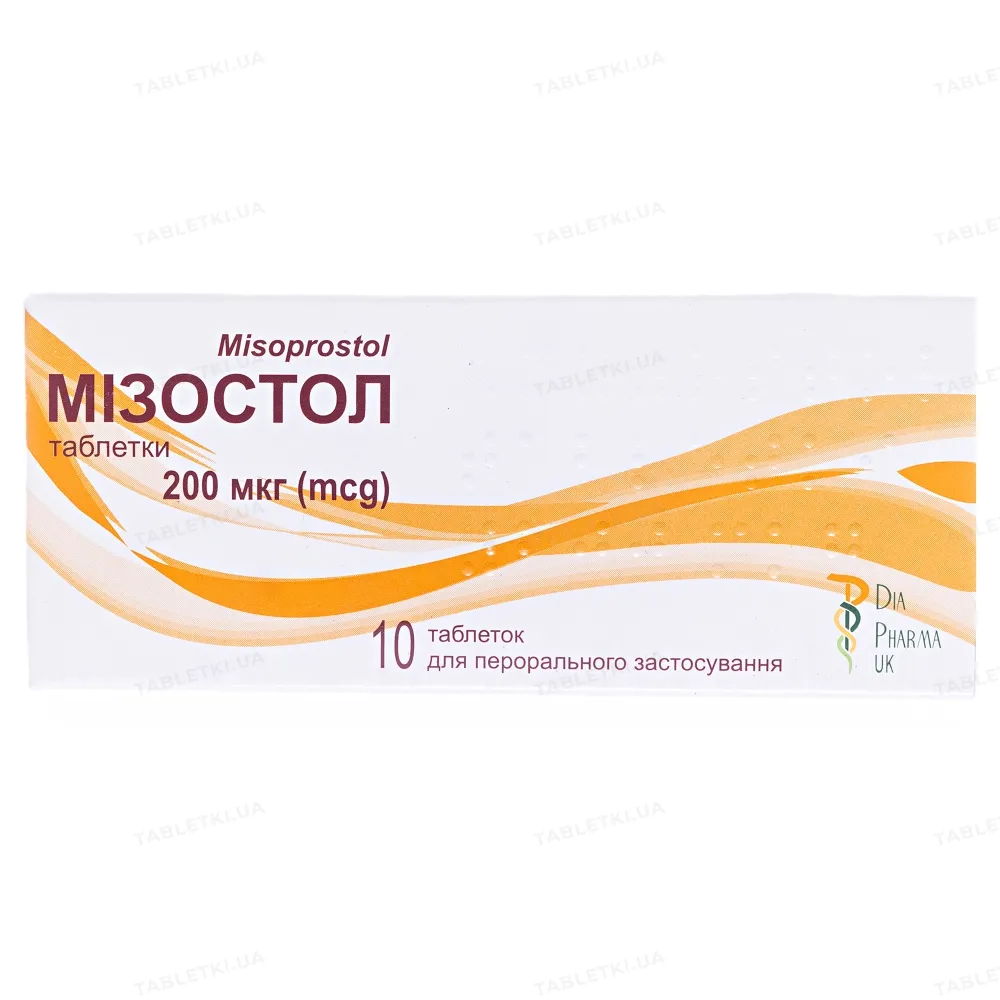
Table of Contents
INSTRUCTION for medical use of the medicinal product Misostol (Misostol)
Composition:
Active substance: misoprostol;
1 tablet contains 200 mcg of misoprostol;
Excipients: microcrystalline cellulose, sodium starch glycolate (type A), hypromellose, hydrogenated castor oil.
Pharmaceutical form. Tablets.
Main physico-chemical properties: uncoated tablets, white to almost white, round, biconvex, smooth on both sides.
Pharmacotherapeutic group. Prostaglandins. Misoprostol. ATC code A02BB01.
Pharmacological Properties.
Pharmacodynamics.
Misoprostol is a synthetic prostaglandin E1 analogue that promotes healing of peptic ulcer and provides symptomatic relief.
Misoprostol protects the mucosa of the gastrointestinal tract (GIT) by inhibiting basal, stimulated, and nocturnal acid secretion, reducing the volume of gastric juice secretion, decreasing the proteolytic activity of gastric fluid, and increasing bicarbonate and mucus secretion.
Pharmacokinetics.
After oral administration, misoprostol is rapidly absorbed.
It is metabolized in the walls of the gastrointestinal tract and in the liver to the pharmacologically active de-esterified metabolite—misoprostolic acid. The time to reach maximum metabolite concentration is 30 minutes. The half-life of misoprostolic acid is 20–40 minutes. It does not accumulate.
Increasing the dose of misoprostol to 400 mcg twice daily does not lead to an increase in plasma concentrations of misoprostolic acid.
Clinical characteristics.
Indications.
For the treatment of gastric and duodenal ulcers, including those caused by the use of nonsteroidal anti-inflammatory drugs (NSAIDs) in patients with arthritis who are at risk but continue NSAID therapy.
For the prevention of NSAID-induced ulcers.
Contraindications.
Hypersensitivity to the active substance or to any of the excipients of the medicinal product.
Known allergies to prostaglandins.
Pregnancy, potential for pregnancy, or planned pregnancy – misoprostol increases uterine tone and contractions, which may result in termination of pregnancy and partial or complete abortion (see sections "Special precautions", "Use during pregnancy or lactation", "Adverse reactions"). The use of misoprostol during pregnancy has been associated with fetal abnormalities.
Interaction with other medicinal products and other forms of interaction.
Concomitant use of NSAIDs and misoprostol may in some cases lead to increased transaminase levels and peripheral edema.
Misoprostol is primarily metabolized via fatty acid oxidative systems and does not exhibit any adverse effect on the microsomal mixed-function oxidase enzyme system (P450). No clinically significant pharmacokinetic interactions have been observed with antipyrine or diazepam. With repeated administration of misoprostol, a slight increase in propranolol concentration has been observed (mean increase in AUC of approximately 20%, Cmax by 30%).
Studies on drug interactions between misoprostol and several NSAIDs have shown no clinically significant effect on the kinetics of ibuprofen, diclofenac, piroxicam, aspirin, naproxen, or indomethacin.
During treatment with misoprostol, magnesium-containing antacids should be avoided, as they may exacerbate misoprostol-induced diarrhea.
Special precautions for use.
When prescribing the medicinal product to women of childbearing potential, pregnancy should first be excluded and appropriate contraceptive methods should be used. If pregnancy is confirmed, the drug should be discontinued immediately (see sections "Contraindications", "Use during pregnancy or breastfeeding", "Side effects").
Misoprostol may be used in women of childbearing potential only if the patient:
- uses effective contraceptive methods;
- is informed about the risks of using misoprostol during pregnancy (see section "Contraindications").
Gastrointestinal bleeding, ulcers, and perforation have been observed in patients undergoing NSAID therapy who received misoprostol. In cases of ulcers, even in the absence of gastrointestinal symptoms, therapy should be continued with caution, and if appropriate, endoscopy and biopsy should be performed prior to treatment to exclude the presence of malignant lesions in the upper gastrointestinal tract.
The medicinal product contains hydrogenated castor oil, which may cause gastrointestinal disturbances and diarrhea. Therefore, the drug should be used with particular caution in patients with inflammatory bowel diseases. To minimize the risk of diarrhea, misoprostol should be taken with food and magnesium-containing antacids should be avoided (see section "Interaction with other medicinal products and other forms of interaction").
Misoprostol should be used cautiously in patients with significant dehydration. The condition of such patients should be closely monitored.
Experience with the use of misoprostol at doses effective for promoting healing of gastric and duodenal ulcers indicates that the drug does not cause hypotension. However, Misoprostol should be used with caution in patients with conditions in which hypotension may lead to serious complications, such as cerebrovascular disorders, coronary artery disease, or severe peripheral vascular diseases, including hypertension.
There is no evidence that misoprostol has a negative effect on glucose metabolism in patients with diabetes mellitus.
Use during pregnancy or breastfeeding.
Pregnancy
Misoprostol is contraindicated in pregnant women, as it causes uterine contractions and may lead to termination of pregnancy, partial or complete abortion, fetal death, or congenital malformations. The risk associated with using misoprostol in the first trimester is significantly increased risk of two congenital defects: Möbius sequence (e.g., paralysis of cranial nerves VI and VII) and limb deformities. Other defects, including arthrogryposis, have also been observed.
Factors increasing the risk of uterine rupture include: advancing gestational age, previous uterine surgery, including cesarean section, and multiple pregnancies.
Breastfeeding
Misoprostol is rapidly metabolized to misoprostol acid, which is biologically active and excreted into breast milk. Misoprostol should not be used during breastfeeding because excreted misoprostol acid may cause diarrhea in the infant.
Ability to affect reaction speed when driving or operating machinery.
Studies on the effect of misoprostol on the ability to drive or operate machinery have not been conducted. However, since misoprostol may cause side effects such as dizziness, headache, and fatigue, patients are advised to refrain from driving or operating machinery until they are certain that such reactions do not occur.
Dosage and Administration.
Mizoprostol is taken orally.
Treatment of gastric and duodenal ulcers and peptic ulcer associated with NSAID use: the daily dose is 800 mcg, divided into 2–4 doses taken with breakfast and/or each main meal and at bedtime.
The duration of treatment should be at least 4 weeks, even if symptomatic relief occurs earlier. In most patients, ulcer healing occurs within 4 weeks, but treatment may continue up to 8 weeks if necessary. In case of ulcer recurrence, repeated courses of therapy may be prescribed.
Prevention of peptic ulcer associated with NSAID use: 200 mcg 2–4 times daily. Dosage and duration of treatment should be individually determined based on the patient's clinical condition.
Renal impairment
Dose adjustment is not required.
Hepatic impairment
Misoprostol is metabolized by fatty acid oxidation systems present in organs throughout the body. Therefore, its metabolism and plasma levels are unlikely to be significantly affected in patients with impaired liver function.
Elderly patients
Dose adjustment is not required.
Children
There is no experience with the use of this medicinal product in children.
Overdose.
Toxicity of misoprostol in humans has not been demonstrated. Clinical signs that may indicate overdose include drowsiness, tremor, seizures, abdominal pain, fever, tachycardia, hypotension, or bradycardia.
Treatment is symptomatic.
There have been reports of misoprostol administration at doses of 1200 mcg daily for three months without significant adverse effects.
Adverse Reactions
Adverse reactions are categorized according to frequency as follows: very common (≥ 1/10), common (≥ 1/100, < 1/10), uncommon (≥ 1/1000, < 1/100), rare (≥ 1/10000, < 1/1000), very rare (< 1/10000), frequency not known.
Immune system disorders
Frequency not known: anaphylactic reaction.
Nervous system disorders
Common: headache, dizziness, fainting.
Gastrointestinal disorders
Very common: diarrhea*.
Common: abdominal pain*, constipation, flatulence, dyspepsia, nausea, vomiting.
Skin and subcutaneous tissue disorders
Rare: allergic reactions, rash.
Effects on pregnancy, postpartum and perinatal periods
Amniotic fluid embolism, abnormal uterine contractions, fetal death, fetal distress syndrome, incomplete abortion, premature delivery, retained placenta, uterine hyperstimulation and rupture, uterine perforation, genital tract infection.
Reproductive system and breast disorders
Uncommon: vaginal bleeding (including postmenopausal bleeding), intermenstrual bleeding, menstrual cycle disturbance, uterine cramps, prolonged menstrual bleeding, on average lasting 9 days (up to 45 days).
Rare: menorrhagia, dysmenorrhea.
Frequency not known: uterine bleeding.
Congenital and genetic disorders
Frequency not known: congenital defects.
General disorders and administration site conditions
Very common: shivering, fever, including body temperature above 40 °C.
Common: chills.
Uncommon: fatigue.
Generally, shivering and fever occur 60–90 minutes after taking misoprostol and are transient and short-lived.
Women should be advised to seek medical reassessment if they experience prolonged heavy bleeding or fever.
* Diarrhea and abdominal pain are dose-related and usually occur at the beginning of therapy; they are self-limiting. Rare cases of severe diarrhea leading to significant dehydration have been reported. Diarrhea can be minimized by taking single doses not exceeding 200 mcg with food and by avoiding concomitant use of antacids containing magnesium.
Shelf life.
2 years.
Storage conditions.
Store in the original packaging at a temperature not exceeding 25 °C.
Keep out of the reach of children.
Packaging.
1 tablet or 10 tablets in a blister, 10 blisters (1×10) or 1 blister (10×1) in a cardboard box.
Prescription status.
Prescription only.
Manufacturer.
ACME FORMULATIONS PVT. LTD.
aCME FORMULATIONS PVT. LTD
Manufacturer's address.
Ropar Road, Nalagarh, District Solan, Himachal Pradesh, 174101, India
Ropar Road, Nalagarh, District Solan, Himachal Pradesh, In 174101, India
Marketing Authorization Holder.
M. BIOTECH LimiteD
M. BIOTECH LimiteD
Address of Marketing Authorization Holder.
Gladstone House, 77-79 High Street, Egham TW20 9HY, Surrey, United Kingdom
Gladstone House, 77-79 High Street, Egham TW20 9HY, Surrey, United Kingdom