Myopridine®
Ukraine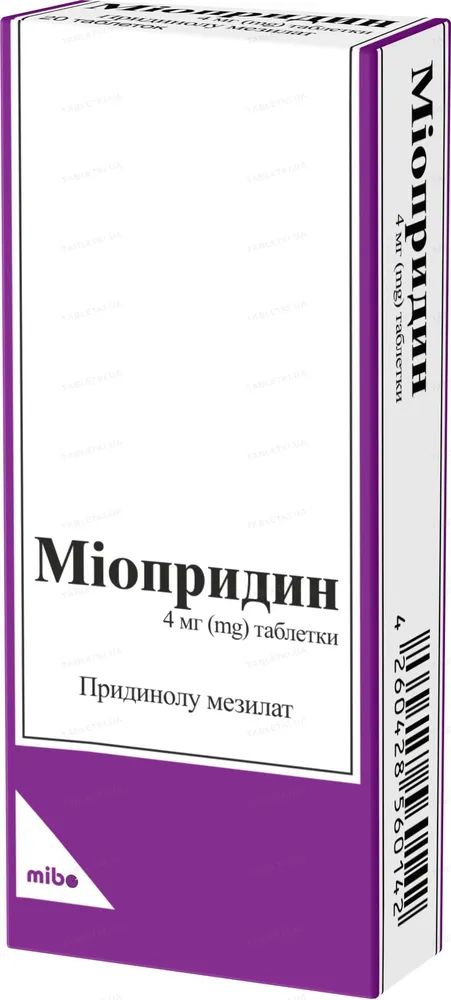
Table of Contents
INSTRUCTION FOR MEDICAL USE OF THE MEDICINAL PRODUCT MIOPRIDIN® (MYOPRIDIN)
Composition:
Active substance: pridinol mesylate;
1 tablet contains 4 mg of pridinol mesylate (equivalent to 3.02 mg of pridinol);
Excipients: povidone K 30, lactose monohydrate, talc, colloidal anhydrous silicon dioxide, microcrystalline cellulose, hydrogenated castor oil, magnesium stearate (from plant source).
Pharmaceutical form. Tablets.
Main physicochemical properties: flat, white tablets on both sides, with a score line on one side. The tablet can be divided into equal doses.
Pharmacotherapeutic group.
Medicinal products for the treatment of disorders of the musculoskeletal system. Muscle relaxants, centrally acting agents. Other centrally acting agents.
ATC code M03B X03.
Pharmacological Properties.
Pharmacodynamics.
The active ingredient of the medicinal product Mioprydin® is pridinol, in the form of pridinol mesylate, which is a derivative of piperidine-polymer alcohol with the chemical formula: 1,1-diphenyl-1-ol-3-piperidin-propane-methanesulfonate.
Its pharmacological action is manifested through an atropine-like effect on smooth and striated muscles. This effect is used in the treatment of tension states of both central and peripheral skeletal muscles.
The earlier myotonic treatment is initiated, the more effectively pridinol relieves muscle tension. In cases of prolonged muscle spasms, during which additional anatomical changes in muscle fibers, ligaments, and joint capsules have occurred, pridinol may achieve only partial efficacy.
Pharmacokinetics.
Pharmacokinetic studies of pridinol mesylate conducted in humans have shown that after oral administration, maximum blood concentration is reached approximately within 1 hour, and uniform distribution throughout the body occurs. The active substance—pridinol—is eliminated predominantly within 24 hours. Pridinol is excreted by the kidneys, partly in unchanged form and partly as glucuronide and sulfoc conjugates.
Clinical characteristics.
Indications.
Central and peripheral muscle spasms, lumbar pain, torticollis, general muscle pain in adults.
Contraindications.
Hypersensitivity to the active substances or to any of the excipients of the medicinal product.
Glaucoma.
Prostate hyperplasia.
Conditions associated with urinary retention.
Obstructions in the gastrointestinal tract.
Cardiac arrhythmias.
First trimester of pregnancy.
Interaction with other medicinal products and other forms of interaction.
Myopridine® enhances the effect of anticholinergic agents, such as atropine (see section "Adverse reactions").
Special precautions for use
This medicinal product should be used with caution in patients with renal and/or hepatic impairment, as higher blood levels and/or prolonged exposure to the active substance may be expected.
Myopridine® contains lactose. One tablet of Myopridine® contains 143.5 mg of lactose (as monohydrate). Myopridine® should not be administered to patients with rare hereditary disorders of galactose intolerance, lactase deficiency, or glucose-galactose malabsorption.
Use during pregnancy or breastfeeding
Pregnancy
The drug is contraindicated during the first trimester of pregnancy.
During the later stages of pregnancy, the drug should be administered only after careful medical evaluation, under medical supervision, and solely if clearly necessary.
Breastfeeding period
There are no data on whether pridinol passes into human breast milk. The use of this medicinal product should be avoided during breastfeeding.
Fertility
There are no data on the effect of pridinol on human fertility.
Ability to affect reaction speed when driving or operating machinery
Due to the possible cholinoblocking effect on vision (see section "Adverse reactions"), particular caution is recommended when driving or operating machinery.
Method of Administration and Dosage.
Dosage
The recommended dose is 1.5 – 3 mg of pridinol three times daily (½ – 1 tablet).
For nocturnal leg cramps, take 3 – 6 mg of pridinol (1 – 2 tablets) before bedtime.
The duration of treatment is determined by the physician.
Tablets should be taken independently of food intake; however, the effect occurs faster if the drug is taken before meals.
For certain patients (suspected circulatory disorders, angioneurotic lability), it may be advisable to take the tablets after food intake, as there may be an increased risk of developing hypotensive circulatory reactions. The drug should be administered with particular caution on the first day of treatment.
Method of Administration
For oral use.
Tablets should be swallowed whole with sufficient liquid (e.g., one glass of water).
Children.
There are no data regarding the use of this drug in children.
Overdose.
In case of overdose or accidental poisoning, typical cholinoblocker overdose symptoms occur.
Depending on the severity of symptoms, physostigmine salicylate should be administered slowly intravenously.
Adverse reactions
The following classification was used to determine the frequency of adverse reactions:
Very common (≥1/10)
Common (≥1/100, <1/10)
Uncommon (≥1/1,000, <1/100)
Rare (≥1/10,000, <1/1,000)
Very rare (<1/10,000)
Frequency not known (frequency cannot be determined from available data).
The assessment of the frequency of adverse reactions was based on results from a prospective, uncontrolled clinical trial involving 1369 patients. For adverse reactions reported through spontaneous reporting systems, the frequency cannot be estimated due to lack of a reliable denominator; therefore, these are categorized as "Frequency not known" (see table below).
When the specified doses are used, adverse reactions occur rarely or uncommonly and generally resolve after dose reduction or discontinuation of the drug.
When used concomitantly with other anticholinergic agents, the following adverse reactions may occur: dry mouth, sensation of thirst, transient visual disturbances (mydriasis, accommodation disorders, photophobia, slight increase in intraocular pressure), skin redness and dryness, bradycardia followed by tachycardia, urinary retention, constipation, and very rarely, vomiting, dizziness, and unsteadiness when walking.
| System organ class |
Uncommon |
Rare |
Frequency unknown |
| Immune system disorders |
hypersensitivity reaction (e.g., itching, skin redness, swelling, or shortness of breath) |
||
| Psychiatric disorders |
restlessness |
feeling of fear, depression |
hallucinations |
| Nervous system disorders |
dizziness, headache, speech disorder |
attention, coordination, taste disturbances |
hand tremor, paresthesia |
| Eye disorders |
accommodation disorders, visual disturbances |
acute attack of angle-closure glaucoma in closed-angle glaucoma |
|
| Cardiac disorders |
tachycardia |
cardiac arrhythmia, bradycardia |
|
| Vascular disorders |
circulatory reaction, hypotension |
||
| Gastrointestinal disorders |
nausea, abdominal pain, dry mouth |
diarrhea, vomiting |
|
| Musculoskeletal and connective tissue disorders |
muscle weakness |
||
| Renal and urinary disorders |
urination disorder, acute urinary retention in BPH |
||
| General disorders and administration site reactions |
fatigue, asthenia |
increased body temperature |
Reporting of suspected adverse reactions
Reporting of adverse reactions after marketing authorization of a medicinal product is of great importance. It enables continuous monitoring of the benefit-risk balance of the medicinal product. Medical and pharmaceutical personnel, as well as patients or their legal representatives, should report all suspected adverse reactions and lack of efficacy through the Automated Information System for Pharmacovigilance at the following link: https://aisf.dec.gov.ua.
Shelf life. 5 years.
Storage conditions.
Store at a temperature not exceeding 25 °C. Keep out of reach and sight of children.
Packaging.
10 tablets in a blister; 2 or 5 blisters per carton.
Prescription status. Prescription only.
Manufacturer. mibe GmbH & Co. KG Arzneimittel.
Manufacturer's address and place of business.
Muenchenstrasse 15, Breuna, Saxony-Anhalt, 06796, Germany.