Minirin
Ukraine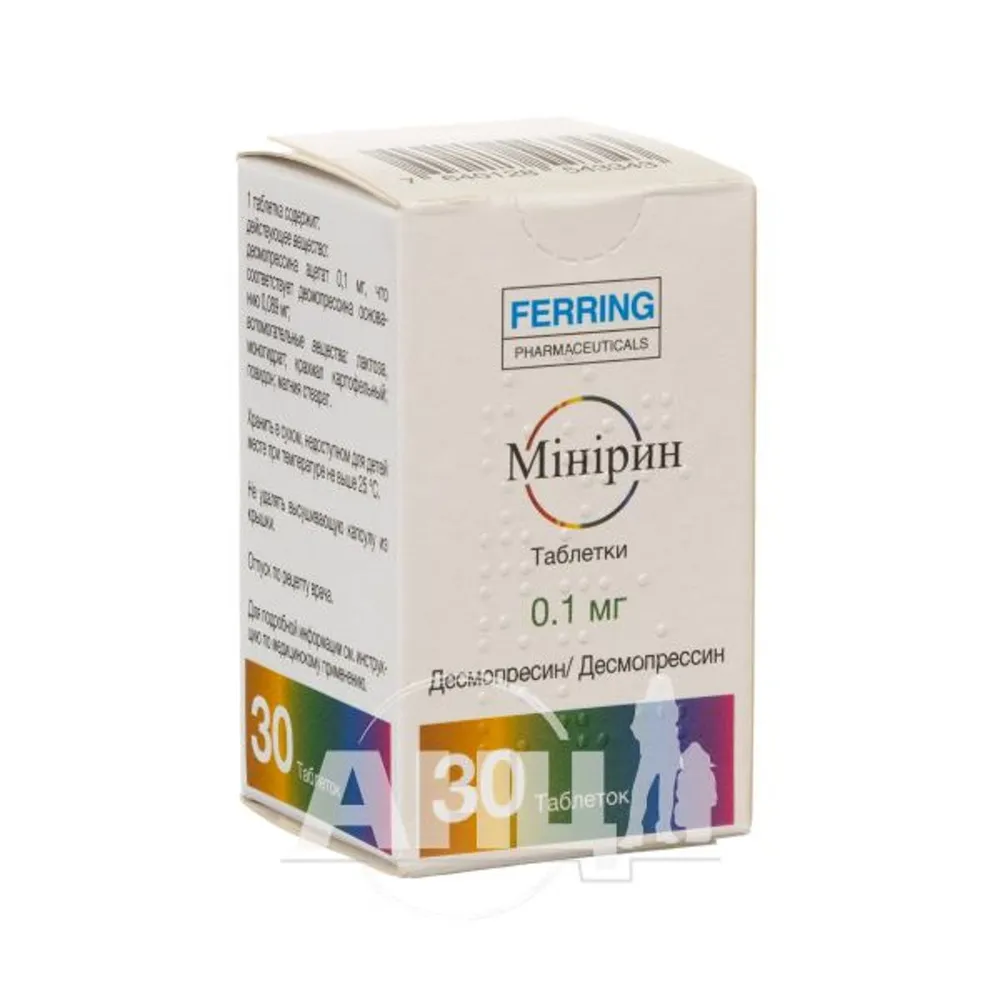
Table of Contents
INSTRUCTIONS FOR MEDICAL USE OF THE MEDICINAL PRODUCT MINIRIN (MINIRIN®)
Composition:
Active substance: desmopressin;
1 tablet contains desmopressin acetate 0.1 mg, corresponding to desmopressin base 0.089 mg or desmopressin acetate 0.2 mg, corresponding to desmopressin base 0.178 mg;
Excipients: lactose monohydrate; potato starch; povidone; magnesium stearate.
Pharmaceutical form. Tablets.
Main physicochemical properties:
white oval biconvex tablets with a notch on one side and embossing "0.1" on the other;
white round biconvex tablets with a notch on one side and embossing "0.2" on the other.
Pharmacotherapeutic group. Hormone preparations for systemic use, excluding sex hormones and insulin. Posterior pituitary hormones. ATC code H01BA02.
Pharmacological properties.
Pharmacodynamics.
The drug contains desmopressin – a structural analogue of the natural pituitary hormone arginine vasopressin. The difference between them lies in the deamination of cysteine and the substitution of L-arginine with D-arginine. This results in a significant prolongation of the duration of action and complete absence of pressor effect at clinically used doses. The EC50 (half-maximal effective concentration) of desmopressin causing an antidiuretic effect is 1.6 pg/mL. After oral administration, the effect lasts from 6 to 14 hours.
Pharmacokinetics.
The absolute bioavailability of Minirin tablets is 0.16% with a 95% confidence interval of 0.17%. Maximum plasma concentration is reached within 2 hours. Concomitant food intake reduces the rate and extent of absorption by 40%.
Distribution.
Desmopressin distribution is best described by a two-compartment model, with a volume of distribution during the elimination phase of 0.3–0.5 L/kg.
Metabolism.
The metabolism of desmopressin in vivo has not been studied. In vitro studies of microsomal metabolism in human liver cells revealed no significant amounts of desmopressin metabolized by the cytochrome P450 system.
Therefore, hepatic metabolism of desmopressin in vivo is unlikely.
The effect of desmopressin on plasma concentrations of other drugs is likely to be minimal due to the absence of influence on the cytochrome P450 system.
Excretion.
Total clearance of desmopressin is 7.6 L/h. The terminal half-life of desmopressin is 2.8 hours. In healthy volunteers, the fraction of unchanged drug excreted ranged from 52% (44%–60%).
Linearity/non-linearity.
There are no data regarding non-linearity of any pharmacokinetic parameter of desmopressin.
Clinical characteristics.
Indications.
- Central diabetes insipidus;
- Primary nocturnal enuresis in children over 5 years of age with normal renal concentrating function;
- Symptomatic treatment of nocturia associated with nocturnal polyuria in adults.
Contraindications.
- Essential or psychogenic polydipsia (urine output exceeding 40 ml/kg/24 hours);
- Heart failure or other conditions requiring diuretic therapy;
- Moderate to severe renal impairment (creatinine clearance below 50 ml/min);
- Hyponatremia;
- Syndrome of inappropriate secretion of antidiuretic hormone (SIADH);
- Hypersensitivity to desmopressin or to any of the excipients;
- Alcohol abuse;
- Severe classic von Willebrand-Jürgens syndrome (type IIb), in patients with 5% factor VIII activity and factor VIII antibodies.
Interaction with other medicinal products and other forms of interaction.
Concomitant use of drugs capable of inducing the syndrome of inappropriate antidiuretic hormone secretion, such as tricyclic antidepressants, selective serotonin reuptake inhibitors, chlorpromazine, and carbamazepine, as well as certain antidiabetic sulfonylureas, particularly chlorpropamide, may enhance the antidiuretic effect of the drug and increase the risk of fluid retention and hyponatremia.
Concomitant use with nonsteroidal anti-inflammatory drugs (NSAIDs) may cause fluid retention/hyponatremia.
When used concomitantly with oxytocin, increased antidiuretic effect and reduced uterine perfusion should be considered. Clofibrate and indometacin may potentiate the antidiuretic effect of desmopressin, whereas glibenclamide and lithium salts may reduce it.
Concomitant use with loperamide may increase plasma desmopressin levels by threefold and increase the risk of adverse effects (fluid retention and hyponatremia). Although such studies have not been conducted, there is a possibility that other medicinal products reducing intestinal smooth muscle tone and motility may produce a similar effect.
Interaction of desmopressin with drugs affecting hepatic metabolism is unlikely, as in vitro studies of microsomal metabolism in human liver cells did not reveal significant metabolism of desmopressin. However, formal in vivo interaction studies have not been conducted.
Concomitant food intake reduces the rate and extent of absorption of Minirin tablets by 40%. No clinically significant effects on pharmacodynamic properties (urine production or osmolality) have been observed.
Food intake may reduce the intensity and duration of the antidiuretic effect when low doses of Minirin tablets are administered.
Special precautions for use.
When taking Minirin tablets for the treatment of nocturnal enuresis, fluid intake should be restricted as a precautionary measure starting 1 hour before administration and continuing for up to 8 hours after taking Minirin, limiting fluid intake only to the amount needed to quench thirst. Treatment without concomitant restriction of fluid intake may lead to fluid retention and/or hyponatremia, with symptoms such as headache, nausea, vomiting, weight gain, and in severe cases – cerebral edema, seizures, and coma. The safety of long-term use of the drug for the treatment of nocturnal enuresis has not been established.
Cases of cerebral edema and seizures have been repeatedly reported in healthy children and young adults receiving desmopressin for the treatment of nocturnal enuresis. This risk is considered particularly high during the first week of treatment.
Elderly patients (>65 years of age) and patients with serum sodium levels at the lower limit of normal have an increased risk of developing hyponatremia.
The duration of drug action increases with higher doses, thus increasing the risk of hyponatremia as well. Dose escalation should therefore be performed cautiously and with careful titration.
Desmopressin should be used with particular caution in patients with cystic fibrosis, ischemic heart disease, hypertension, thrombosis-prone conditions, chronic kidney disease, pre-eclampsia, increased intracranial pressure, or water-electrolyte imbalance.
In patients with hypertension or chronic kidney disease, symptoms listed in the section "Side effects" may be exacerbated. Minirin should be used cautiously in very young or elderly patients, or in patients with risk factors that may lead to increased intracranial pressure, in order to avoid fluid retention.
If fluid intake is not simultaneously restricted, desmopressin treatment may result in fluid retention and hyponatremia.
Patients, or their parents (in the case of treating children), should be informed that excessive fluid intake must be avoided, and that desmopressin should be discontinued in cases of vomiting, diarrhea, systemic infections, or fever until normal fluid balance is restored.
To reduce the risk of hyponatremia or water intoxication, restricting fluid intake is especially important:
- when using medicinal products known to induce the syndrome of inappropriate antidiuretic hormone secretion (SIADH) (tricyclic antidepressants, selective serotonin reuptake inhibitors, chlorpromazine, chlorpropamide, and carbamazepine);
- during concomitant treatment with NSAIDs.
Monitoring body weight is important during treatment.
In patients aged 65 years and older, serum sodium levels should be measured before starting treatment and again 3 days after initiation of treatment or after any dose increase. Treatment should be discontinued if headache and/or nausea occur.
Organic causes of polyuria, increased frequency of urination, or nocturia—such as benign prostatic hyperplasia (BPH), urinary tract infections, bladder stones or tumors, bladder sphincter disorders, polydipsia, or inadequately controlled diabetes mellitus—should be ruled out or appropriately treated. Any adrenal or thyroid insufficiency should be treated prior to initiating desmopressin therapy.
Minirin tablets should not be used in patients with rare hereditary problems of galactose intolerance, lactase deficiency, or glucose-galactose malabsorption.
Use during pregnancy or breastfeeding.
Fertility.
Fertility studies have not been conducted.
Pregnancy.
The medicinal product should be used with caution in pregnant women, and monitoring of blood pressure is recommended.
Available data from a limited number of pregnant women (n=53) with diabetes insipidus and pregnant women (n=54) with von Willebrand's disease indicate that desmopressin has no negative effect on pregnancy or on fetal or neonatal health. To date, there are no relevant epidemiological data available. Animal studies do not indicate any direct or indirect harmful effects on pregnancy, embryonic/fetal development, parturition, or postnatal development.
Minirin should be prescribed to pregnant women only after careful assessment of the benefits and risks of treatment.
Breastfeeding period.
Analysis of breast milk from mothers who received high doses of desmopressin (300 mcg intranasally) indicates that the amount of desmopressin transferred to the infant is substantially lower than the dose required to affect diuresis.
Ability to influence reaction speed when driving vehicles or operating machinery.
The drug has no effect or only a minor effect on the ability to drive a car or operate machinery. This should be taken into account by drivers and professionals whose work requires high levels of alertness. The potential risk of dizziness or somnolence during treatment should be considered.
Method of Administration and Dosage
The dosage of desmopressin tablets should be individually adjusted. Desmopressin should always be taken at the same time relative to food intake, as food reduces its absorption.
If no adequate clinical response is observed after 4 weeks of treatment and dose adjustment, continued use of the medication is not recommended.
In case of symptoms of fluid retention and/or hyponatremia (headache, edema, nausea/vomiting, weight gain, and in severe cases – seizures), treatment must be discontinued immediately until the patient has fully recovered. When resuming therapy, patients should more strictly limit fluid intake.
The recommended doses for children are the same as for adults.
Central diabetes insipidus.
Dosage is individual; however, clinical experience has shown that the total daily dose usually ranges from 0.2 to 1.2 mg. The appropriate initial dose in adults and children is 0.1 mg three times daily. This dosage regimen should be adjusted according to the patient's response. For most patients, the maintenance dose is 0.1 mg to 0.2 mg three times daily.
Primary nocturnal enuresis.
The recommended initial dose is 0.2 mg at bedtime. If this dose is insufficiently effective, it may be increased to 0.4 mg. Fluid intake must be restricted during treatment.
The treatment course lasts 3 months. The need for continuing therapy should be evaluated after a one-week treatment break from Minirin.
Nocturia.
To diagnose nocturnal polyuria, data on urine volume and frequency of urination in patients with nocturia should be collected no later than 2 days before starting therapy. Nocturnal polyuria is defined as urine output exceeding bladder capacity or exceeding \⅓ of the total daily diuresis.
The recommended initial dose is 0.1 mg at night. If this dose is insufficiently effective after 1 week, the dose should be increased to 0.2 mg, and further increased weekly up to 0.4 mg. Fluid intake must be restricted during treatment.
Treatment is not recommended for patients aged 65 years and older. If treatment is prescribed, serum sodium levels must be monitored before starting therapy and 3 days after initiation of treatment or dose increase, as well as at any time as directed by the physician.
Children.
To be used in children aged 5 years and older with normal renal concentrating function for the treatment of primary nocturnal enuresis.
Overdose.
In cases of acute overdose of Minirin, adverse effects may be intensified.
Overdose leads to prolonged duration of action with an increased risk of fluid retention and hyponatremia. Although treatment of hyponatremia depends on the individual patient, the following general recommendations should be considered:
- In asymptomatic hyponatremia, treatment with the drug should be discontinued and fluid intake restricted;
- In symptomatic hyponatremia, administration of isotonic or hypertonic sodium chloride solution by infusion may be additionally prescribed. In case of cerebral edema, the patient must be immediately transferred to an intensive care unit. Seizures in children also require intensive care measures.
Side effects
The most serious adverse reaction associated with the use of desmopressin is hyponatremia, which may cause headache, abdominal pain, nausea, vomiting, weight gain, dizziness, confusion, malaise, memory impairment, vertigo, loss of consciousness, and in severe cases, seizures and coma.
In most adults treated for nocturia who developed hyponatremia, decreased serum sodium levels were observed after 3 days of treatment. In adults, the risk of hyponatremia increases with higher doses of desmopressin and is more pronounced in women.
In adults, the most common adverse reaction during treatment was headache (12%). Other common adverse reactions included hyponatremia (6%), dizziness (3%), arterial hypertension (2%), and gastrointestinal disorders (nausea (4%), vomiting (1%), abdominal pain (3%), diarrhea (2%), and constipation (1%)). Less common were effects on sleep/consciousness level, namely insomnia (0.96%), somnolence (0.4%), asthenia (0.06%). Anaphylactic reactions were not observed in clinical trials, although there have been isolated reports.
In children, the most common adverse reaction during treatment was headache (1%). Psychiatric disorders were infrequent (irritability (0.1%), aggression (0.1%), anxiety (0.05%), mood swings (0.05%), nightmares (0.05%)), which resolved after discontinuation of treatment, as well as gastrointestinal disorders (abdominal pain (0.65%), nausea (0.35%), vomiting (0.2%), diarrhea (0.15%)). Anaphylactic reactions were not observed during clinical trials, although isolated cases have been reported.
Adults
Below are the adverse reactions reported during clinical trials of orally administered desmopressin in adults for the treatment of nocturia (N=1557), combined with post-marketing data in adults for all indications (including central diabetes insipidus). The frequency of reactions reported during the post-marketing period is listed as "Frequency not known".
Adverse reactions are categorized by frequency as follows: very common (>10%), common (1–10%), uncommon (0.1–1%), rare (0.1–0.01%), frequency not known.
Immune system disorders:
Frequency not known – anaphylactic reactions.
Metabolism and nutrition disorders:
Common – hyponatremia*; frequency not known – dehydration**, hypernatremia*.
Psychiatric disorders:
Uncommon – insomnia; rare – confusion*.
Nervous system disorders:
Very common – headache*; common – dizziness*; uncommon – somnolence, paraesthesia; frequency not known – seizures*, asthenia*, coma*.
Eye disorders:
Uncommon – visual disturbances.
Ear and labyrinth disorders:
Uncommon – vertigo*.
Cardiac disorders:
Uncommon – palpitations.
Vascular disorders:
Common – arterial hypertension; uncommon – orthostatic hypotension.
Respiratory system disorders:
Uncommon – dyspnea.
Gastrointestinal disorders:
Common – nausea*, abdominal pain*, diarrhea, constipation, vomiting*; uncommon – dyspepsia, (TVR1) flatulence, abdominal distension.
Skin and subcutaneous tissue disorders:
Uncommon – sweating, pruritus, rash, urticaria; rare – allergic dermatitis.
Musculoskeletal and connective tissue disorders:
Uncommon – muscle cramps, myalgia.
Renal and urinary disorders:
Common – (TVR1) bladder symptoms and urethral symptoms.
General disorders and administration site conditions:
Common – (TVR1) edema, fatigue; uncommon – discomfort*, chest pain, influenza-like illness.
Investigations:
Uncommon – weight increase*, increased liver enzymes, hypokalemia.
*Hyponatremia may cause headache, abdominal pain, nausea, vomiting, weight gain, dizziness, confusion, malaise, memory impairment, vertigo, loss of consciousness, seizures, and coma.
** Only in diabetes insipidus.
1 Term of high level.
Children and adolescents
Below are the adverse reactions reported during clinical trials of orally administered desmopressin in children and adolescents for the treatment of primary nocturnal enuresis (N=1923). The frequency of reactions reported during the post-marketing period is listed as "Frequency not known".
Adverse reactions are categorized by frequency as follows: very common (>10%), common (1–10%), uncommon (0.1–1%), rare (0.1–0.01%), frequency not known.
Immune system disorders:
Frequency not known – anaphylactic reactions.
Metabolism and nutrition disorders:
Frequency not known – hyponatremia****.
Psychiatric disorders:
Uncommon – mood lability**, aggression***; rare – (TVR1) anxiety symptoms, nightmares*, mood changes*; frequency not known – abnormal behavior, emotional disorders, depression, hallucinations, insomnia.
Nervous system disorders:
Common – headache; rare – somnolence; frequency not known – attention disorders, psychomotor hyperactivity, seizures*.
Vascular disorders:
Rare – arterial hypertension.
Respiratory system disorders:
Frequency not known – epistaxis.
Gastrointestinal disorders:
Uncommon – abdominal pain, nausea, vomiting, diarrhea.
Skin and subcutaneous tissue disorders:
Frequency not known – rash, allergic dermatitis, sweating, urticaria.
Renal and urinary disorders:
Uncommon – (TVR1) bladder symptoms and urethral symptoms.
General disorders and administration site conditions:
Uncommon – peripheral edema, fatigue; rare – increased irritability.
*Hyponatremia may cause headache, abdominal pain, nausea, vomiting, weight gain, dizziness, confusion, malaise, memory impairment, vertigo, loss of consciousness, seizures, and coma.
** Observed equally frequently in children and adolescents (<18 years) in post-marketing studies.
*** Observed exclusively in children and adolescents (<18 years) in post-marketing studies.
**** Initially observed in children (<12 years) in post-marketing studies.
Shelf life. 3 years.
Storage conditions.
Store in a dry place, out of reach of children, at a temperature not exceeding 25°C.
Packaging.
30 tablets in a bottle; 1 bottle in a cardboard box.
Prescription status.
Prescription only.
Manufacturer.
Ferring GmbH, Germany / Ferring GmbH, Germany.
Manufacturer's address and place of business.
Wittland 11, 24109 Kiel, Germany / Wittland 11, 24109 Kiel, Germany.