Milucant
Ukraine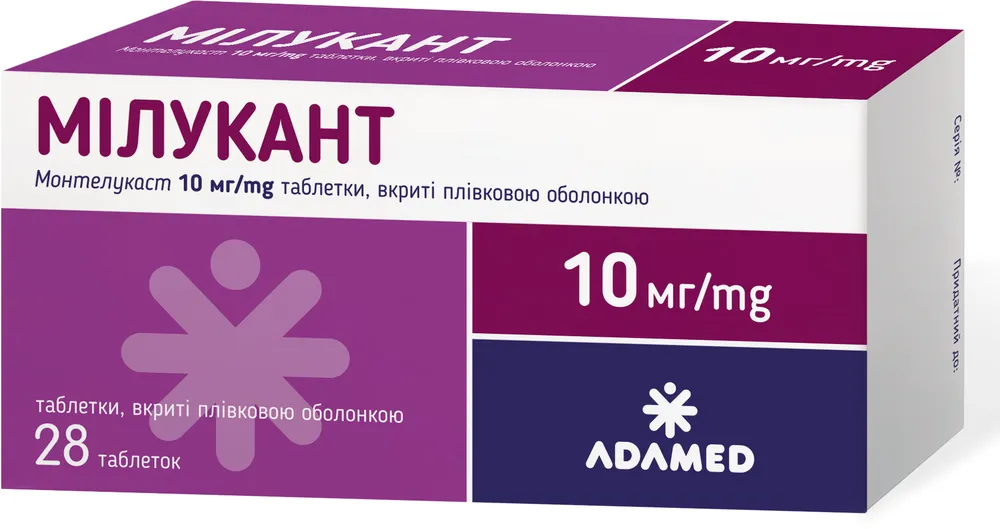
Table of Contents
INSTRUCTIONS FOR MEDICAL USE OF THE MEDICINAL PRODUCT MİLUKANTE (MILUKANTE)
Composition:
Active substance: montelukast sodium;
1 tablet contains 4.16 mg of montelukast sodium, equivalent to 4 mg of montelukast;
Excipients: microcrystalline cellulose, mannitol (E 421), crospovidone, iron oxide red (E 172), hydroxypropyl cellulose, disodium edetate, cherry flavor, aspartame (E 951), talc, magnesium stearate.
Pharmaceutical form. Chewable tablets.
Main physicochemical characteristics: light pink, oval, biconvex tablets.
Pharmacotherapeutic group. Antiasthmatic agents. Selective oral leukotriene receptor antagonists. ATC code R03DC03.
Pharmacological Properties.
Pharmacodynamics.
Cysteinyl leukotrienes (LTC4, LTD4, LTE4) are potent inflammatory eicosanoids released from various cells, including mast cells and eosinophils. These key pro-asthmatic mediators bind to cysteinyl leukotriene receptors (CysLT) present in human airways and are responsible for bronchoconstriction, mucus secretion, vascular permeability, and increased eosinophil recruitment. CysLTs are implicated in the pathophysiology of asthma and allergic rhinitis. In allergic rhinitis, cysteinyl leukotrienes are released into nasal secretions following allergen exposure during both early and late phases of the reaction and are associated with symptoms of allergic rhinitis. Intranasal challenge with CysLTs has been shown to increase nasal airway resistance and symptoms of nasal obstruction.
Montelukast is an orally active compound that binds with high affinity and selectivity to CysLT1 receptors. Montelukast produces significant blockade of cysteinyl leukotriene receptors in the airways, as demonstrated by its ability to inhibit LTD4-induced bronchoconstriction in patients with bronchial asthma.
Montelukast inhibits bronchoconstriction induced by inhaled LTD4 even at doses as low as 5 mg. Bronchodilation is observed within 2 hours after oral administration. The bronchodilatory effect of β-agonists is additive to the effect produced by montelukast. Treatment with montelukast inhibits both early and late phases of antigen-induced bronchoconstriction. Montelukast treatment significantly reduces the number of eosinophils in the airways (measured in sputum). Montelukast also reduces eosinophil counts in peripheral blood of adults and children aged 2 to 14 years and improves clinical asthma control.
In a study involving children aged 2 to 5 years, montelukast 4 mg improved daytime symptoms (including cough, wheezing, shortness of breath, and activity limitation) and nighttime symptoms, reduced the need for rescue use of β-agonists, and decreased the requirement for emergency use of systemic corticosteroids during asthma exacerbations. Patients receiving montelukast had a greater number of asthma-symptom-free days.
In a study involving children aged 2 to 5 years with mild asthma and episodic exacerbations, montelukast 4 mg reduced the annual rate of asthma exacerbation episodes.
In a study involving children aged 6 months to 5 years with intermittent (but not persistent) asthma, no significant difference was observed between patients receiving montelukast 4 mg and those receiving placebo regarding the number of asthma episodes progressing to an asthma attack (defined as an asthma episode requiring unplanned visit to a physician, emergency department, or hospitalization; or treatment with oral, intravenous, or intramuscular corticosteroids).
Pharmacokinetics.
Absorption.
Montelukast is rapidly and almost completely absorbed after oral administration. Following administration of 4 mg chewable tablets on an empty stomach to children aged 2 to 5 years, Cmax is achieved within 2 hours after dosing. Cmax values are 66% higher, and Cmin values are lower, compared to adults receiving 10 mg tablets.
Distribution.
Over 99% of montelukast is bound to plasma proteins. The mean volume of distribution at steady state is 8–11 L. Studies with radiolabeled montelukast have shown minimal distribution across the blood-brain barrier. Additionally, concentrations of radiolabeled material in all other tissues 24 hours after administration were minimal.
Biotransformation.
Montelukast is almost entirely metabolized. In studies of therapeutic doses, plasma concentrations of montelukast metabolites at steady state in adults and children were undetectable. In vitro studies using human liver microsomes have shown that cytochrome P450 enzymes 3A4, 2A6, and 2C9 are involved in the metabolism of montelukast. Based on further in vitro testing using human liver microsomes, therapeutic plasma concentrations of montelukast do not inhibit cytochrome P450 enzymes 3A4, 2C9, 1A2, 2A6, 2C19, or 2D6. The contribution of metabolites to the therapeutic effect of montelukast is minimal.
Elimination.
The plasma clearance of montelukast averages 45 mL/min in healthy adult subjects.
Approximately 86% of an orally administered radiolabeled dose of montelukast is excreted in feces within 5 days, with less than 0.2% excreted in urine. Considering bioavailability and elimination characteristics, it can be concluded that montelukast and its metabolites are almost entirely eliminated via bile.
Pharmacokinetics in Specific Patient Populations.
Dose adjustment is not required for elderly patients or patients with mild to moderate hepatic impairment. Since montelukast and its metabolites are almost completely eliminated via bile, dose adjustment is not necessary for patients with renal impairment. There are no data regarding the pharmacokinetics of montelukast in patients with severe hepatic impairment.
Pharmacokinetic studies in adults and children have shown that the concentration profiles of 4 mg chewable tablets in children aged 2–5 years and 5 mg chewable tablets in children aged 6–14 years are similar to the concentration profile of 10 mg film-coated tablets administered to individuals aged 15 years and older.
When montelukast was administered at high doses (20–60 times the therapeutic dose), a decrease in plasma theophylline concentrations was observed. This effect was not observed at therapeutic doses (10 mg once daily).
Clinical characteristics.
Indications.
For children aged 2 to 5 years:
- As add-on therapy for asthma in patients aged 2 to 5 years with mild to moderate persistent asthma not adequately controlled by inhaled corticosteroids, and in those with inadequate clinical control of asthma using short-acting β-adrenergic agonists as needed.
- As an alternative treatment option instead of low-dose inhaled corticosteroids in patients aged 2 to 5 years with mild persistent asthma who have not experienced severe asthma attacks requiring oral corticosteroids in the recent past, and who are unable to use inhaled corticosteroids (see section "Dosage and administration").
- Prevention of asthma in patients aged 2 years and older in whom exercise-induced bronchospasm is the predominant component of asthma.
- Relief of symptoms of seasonal and perennial allergic rhinitis.
Contraindications.
Hypersensitivity to the active substance or to any of the excipients.
Children under 2 years of age.
Interaction with other medicinal products and other forms of interactions.
Montelukast may be used concomitantly with other medications for the prevention and chronic treatment of asthma. In drug interaction studies, the recommended clinical dose of montelukast did not have a clinically significant effect on the pharmacokinetics of the following agents: theophylline, prednisolone, oral contraceptives (ethinylestradiol/norethindrone 35/1), terfenadine, digoxin, and warfarin.
The area under the concentration-time curve (AUC) for montelukast decreased by approximately 40% in individuals who concurrently took phenobarbital. Montelukast is metabolized by CYP 3A4, 2C8, and 2C9; therefore, caution should be exercised, especially in children, when prescribing it concomitantly with inducers of CYP 3A4, 2C8, and 2C9 such as phenytoin, phenobarbital, and rifampicin.
In vitro studies have shown that montelukast is a potent inhibitor of CYP 2C8. However, clinical drug interaction data between montelukast and rosiglitazone (a marker substrate representing drugs primarily metabolized by CYP 2C8) demonstrated that montelukast does not inhibit CYP 2C8 in vivo. Therefore, montelukast is not expected to significantly alter the metabolism of drugs metabolized by this enzyme (e.g., paclitaxel, rosiglitazone, and repaglinide).
In vitro studies indicate that montelukast is a substrate of CYP 2C8, and to a lesser extent of CYP 2C9 and 3A4. In a clinical drug interaction study involving montelukast and gemfibrozil (an inhibitor of both CYP 2C8 and 2C9), gemfibrozil increased systemic exposure to montelukast by 4.4-fold. Dose adjustment of montelukast is generally not required when coadministered with gemfibrozil or other potent inhibitors of CYP 2C8; however, in such cases, physicians should consider the potential for increased adverse reactions.
Based on in vitro studies, clinically significant drug interactions are not anticipated with weaker inhibitors of CYP 2C8 (e.g., trimethoprim). Concomitant administration of montelukast with itraconazole, a potent inhibitor of CYP 3A4, did not result in a significant increase in systemic exposure to montelukast.
Special precautions for use.
Patients should be warned that MiluKant should not be used for the treatment of acute asthma attacks and that they must keep their usual rescue medications readily available for such episodes. In the event of an acute attack, short-acting inhaled β-agonists should be used. Patients should consult their physician as soon as possible if they require more frequent use of short-acting β-agonists than usual.
Montelukast should not be used to abruptly replace inhaled or oral corticosteroid therapy. There are no data to suggest that oral corticosteroid dosage can be reduced when montelukast is co-administered.
Psychoneuropsychiatric events have been reported in adults, adolescents, and children taking montelukast (see section "Adverse reactions"). Patients and physicians should be alert to such psychoneuropsychiatric events. Patients and/or their caregivers should be instructed to report any such events to their physician. Physicians should carefully evaluate the risks and benefits of continuing MiluKant therapy if such events occur.
In rare cases, patients receiving anti-asthma medications, including montelukast, may develop systemic eosinophilia, sometimes accompanied by clinical signs of vasculitis—so-called Churg-Strauss syndrome, a condition treated with systemic corticosteroid therapy. These cases typically occur in association with reduction or withdrawal of oral corticosteroid therapy. A possible association between leukotriene receptor antagonists and the development of Churg-Strauss syndrome cannot be excluded. Therefore, physicians should be alerted to the possibility of eosinophilia, vasculitic rash, worsening pulmonary symptoms, cardiac complications, and/or neuropathy in patients. Patients who develop the aforementioned symptoms should undergo re-evaluation, and their treatment regimen should be reassessed.
Treatment with montelukast does not eliminate the need to avoid aspirin and other nonsteroidal anti-inflammatory drugs in patients with aspirin-sensitive asthma.
MiluKant 4 mg chewable tablets contain aspartame, a source of phenylalanine. This may be harmful for patients with phenylketonuria. Patients with phenylketonuria should be advised that one 4 mg chewable tablet contains phenylalanine equivalent to 0.674 mg per dose.
Neuropsychiatric events such as behavioral changes, depression, and suicidal ideation have been reported in patients of all age groups receiving montelukast (see section "Adverse reactions"). Symptoms may be severe and persist unless treatment is discontinued. Therefore, if neuropsychiatric symptoms occur, montelukast should be discontinued.
Patients and/or their caregivers should be cautious regarding neuropsychiatric events and should inform their physician if such behavioral changes occur.
Use during pregnancy or breastfeeding.
Pregnancy.
Studies in animals have not shown any harmful effects of montelukast on pregnancy or embryonic/fetal development.
Limited data from available pregnancy registries do not support a causal relationship between montelukast and congenital malformations (such as limb defects), which have been rarely reported in post-marketing surveillance worldwide. Most of these women were also taking other asthma medications. A causal relationship between these cases and montelukast use has not been established.
Data from published and retrospective cohort studies on montelukast use in pregnant women, assessing major congenital malformations in offspring, have not shown an increased risk associated with the drug. However, these studies have methodological limitations, including small sample sizes, retrospective data collection in some cases, and non-comparable control groups.
When prescribing MiluKant to pregnant women, the benefit-risk balance should be carefully considered.
Breastfeeding.
Animal studies in rats have shown that montelukast is excreted into breast milk.
There are no data on the excretion of MiluKant into human breast milk. Therefore, the benefit-risk balance should be considered when prescribing MiluKant during breastfeeding.
Fertility.
In animal studies, montelukast did not affect fertility or reproductive function at systemic exposures exceeding clinical systemic exposure by more than 24 times.
Ability to affect reaction speed when driving or operating machinery.
MiluKant generally does not affect the ability to drive or operate machinery. However, somnolence and dizziness have been reported very rarely in patients taking the drug. Therefore, patients should exercise caution when driving or operating machinery while taking this medication.
Method of Administration and Dosage.
The medication should be administered to children under adult supervision. The tablets should be chewed before swallowing.
For patients with asthma and allergic rhinitis (seasonal and perennial), 1 chewable tablet (4 mg) should be taken once daily. To alleviate symptoms of allergic rhinitis, the time of administration should be individually adjusted.
For asthma treatment, the dose for children aged 2 to 5 years is 1 chewable tablet (4 mg) daily, taken in the evening. Milukant should be taken 1 hour before or 2 hours after a meal. Dose adjustment is not required for this age group. The medication Milukant in the form of chewable tablets (4 mg) is not recommended for children under 2 years of age.
General recommendations for drug use.
The therapeutic effect of Milukant on asthma control becomes apparent within 24 hours. Patients should be advised to continue taking Milukant even when asthma is under control, as well as during asthma exacerbation periods.
Dosage adjustment is not required for patients with renal insufficiency or mild to moderate hepatic insufficiency. There are no data regarding dosage adjustment in patients with severe hepatic insufficiency. The dosage for male and female patients is identical.
Milukant as an alternative treatment to low-dose inhaled corticosteroids in mild persistent asthma.
Montelukast is not recommended as monotherapy for patients with moderate persistent asthma. The use of montelukast as an alternative to low-dose inhaled corticosteroids in children with mild persistent asthma may be considered only for those who have not recently experienced severe asthma attacks requiring oral corticosteroids, or for those who cannot use inhaled corticosteroids. Mild persistent asthma is defined as asthma with symptoms occurring more than once a week but less than once a day, nocturnal symptoms more than twice a month but less than once a week, and normal lung function between episodes. If satisfactory asthma control is not achieved (typically within 1 month), the need for additional or alternative anti-inflammatory therapy should be evaluated based on a stepwise asthma treatment approach. Regular assessment of asthma control in patients is necessary.
Prevention of asthma in patients aged 2 to 5 years whose primary asthma component is exercise-induced bronchospasm.
Milukant is recommended for patients aged 2 to 5 years for the prevention of exercise-induced bronchospasm, which may be the primary manifestation of persistent asthma requiring inhaled corticosteroid therapy.
The patient's condition should be evaluated 2–4 weeks after initiating montelukast treatment. If satisfactory treatment outcomes are not achieved, a decision regarding additional or alternative therapy should be made.
Treatment with Milukant compared to other treatment methods.
When Milukant treatment is used as add-on therapy to inhaled corticosteroids, Milukant must not be abruptly substituted for inhaled corticosteroids.
Children. Milukant 4 mg chewable tablets are intended for use in children aged 2 to 5 years.
Overdose.
There is no specific information regarding the treatment of montelukast overdose. In chronic asthma studies, montelukast was administered at doses up to 200 mg/day to adult patients for 22 weeks, and in short-term studies, up to 900 mg/day for approximately 1 week, without clinically significant adverse reactions.
During post-marketing use and clinical trials, reports of acute overdose have been received, including cases of adult and pediatric intake exceeding 1000 mg (approximately 61 mg/kg in a 42-month-old child). In most overdose cases, no adverse events were observed. The most commonly reported adverse effects were consistent with the drug's safety profile and included: abdominal pain, drowsiness, thirst, headache, vomiting, and psychomotor hyperactivity. Treatment is symptomatic. It is unknown whether montelukast is eliminated by peritoneal dialysis or hemodialysis.
Adverse reactions.
Milucant is generally well tolerated. Long-term treatment in various age groups in clinical studies has demonstrated a consistent safety profile.
Infections and infestations: upper respiratory tract infections.
Blood and lymphatic system disorders: tendency to increased bleeding, thrombocytopenia.
Immune system disorders: hypersensitivity reactions, including anaphylaxis, hepatic eosinophilic infiltration.
Psychiatric disorders: attention disturbances, memory impairment, sleep disorders, including nightmares, insomnia, somnambulism, irritability, anger, impatience, anxiety, agitation, including aggressive behavior or hostility, depression, tremor, very rare hallucinations, disorientation, suicidal thoughts and behavior (suicide attempt), dysphemia, obsessive-compulsive disorders.
Nervous system disorders: dizziness and lethargy, somnolence, paraesthesia/hypoaesthesia, seizures, headache.
Cardiac disorders: palpitations.
Respiratory, thoracic and mediastinal disorders: epistaxis, Churg–Strauss syndrome (CSS) (see section "Special precautions for use"), pulmonary eosinophilia.
Gastrointestinal disorders: diarrhea, dry mouth, dyspepsia, nausea, vomiting, abdominal pain.
Hepatobiliary disorders: increased serum transaminase levels (alanine aminotransferase and aspartate aminotransferase), hepatitis, including cholestatic, hepatocellular and mixed type, liver damage.
Renal and urinary disorders: enuresis in children.
Skin and subcutaneous tissue disorders: angioneurotic edema, bruising, urticaria, pruritus, rash, nodular erythema, multiform erythema.
Musculoskeletal and connective tissue disorders: arthralgia, myalgia, including muscle cramps.
General disorders and administration site conditions: fever, asthenia/fatigue, discomfort, edema, thirst.
Shelf life.
2 years.
Storage conditions.
Store in the original packaging, in a place inaccessible to children.
Packaging.
7 tablets per blister. 4 or 12 blisters per cardboard box.
Prescription category. Prescription only.
Manufacturer.
Adamed Pharma S.A., Poland
Manufacturer's address and place of business.
5 Józefa Piłsudskiego Street, 95-200 Pabianice, Poland.