Milistan syrup for cough
Ukraine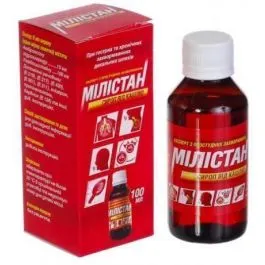
Table of Contents
INSTRUCTIONS FOR MEDICAL USE OF THE MEDICINAL PRODUCT MİLİSTAN COUGH SYRUP (MILISTANANTICOUGHSYRUP)
Composition:
Active substances: ambroxol hydrochloride, carbocisteine.
5 ml of syrup contain ambroxol hydrochloride 15 mg, carbocisteine 100 mg;
Excipients: sodium methylhydroxybenzoate (E 219); sodium propylhydroxybenzoate (E 217); glucose solution 70%; sorbitol (E 420); glycerol; aspartame (E 951); propylene glycol; disodium edetate; citric acid monohydrate; sodium benzoate (E 211); sodium hydroxide; Ponceau 4R (E 124) colour; strawberry flavor; purified water.
Pharmaceutical form. Syrup.
Main physico-chemical properties: clear syrup-like pink liquid with strawberry taste.
Pharmacotherapeutic group. ATC code. Medicinal products used in cough and colds. Mucolytic agents.
ATC code R05C B10.
Pharmacological Properties.
Pharmacodynamics.
The drug is a balanced combination of two active ingredients – ambroxol and carbocisteine.
Ambroxol is an active metabolite of bromhexine, but more effective. It normalizes the pathologically altered secretion of glandular cells of the bronchial mucosa, promotes liquefaction of viscous bronchial secretions, and facilitates their expectoration by increasing mucociliary clearance, altering the ratio of serous and mucous components of sputum. Ambroxol stimulates Clara cells and activates hydrolytic enzymes, which also contributes to a reduction in sputum viscosity. Ambroxol has secretomotor properties – it stimulates the ciliated epithelium of the bronchi, restores the drainage function of small bronchi and bronchioles. The drug stimulates the production of endogenous surfactant, does not cause excessive secretion, and reduces spasmodic bronchial hyperreactivity. Cough and sputum volume are significantly reduced.
Carbocisteine exerts a mucolytic and expectorant effect by activating sialyltransferase – an enzyme of goblet cells in the bronchial mucosa. It normalizes the quantitative ratio of acidic and neutral sialomucins, thereby reducing the viscosity of bronchial secretions. It facilitates sputum expectoration by enhancing mucociliary clearance and possesses antioxidant and pneumoprotective properties, due to the ability of sulfhydryl groups to bind free radicals.
Pharmacokinetics.
After oral administration, ambroxol is almost completely absorbed in the gastrointestinal tract and penetrates well into lung tissue. Absolute bioavailability after oral administration is 70–80%. Maximum plasma concentration is reached approximately 2 hours after ingestion. The elimination half-life is 7–12 hours. It is excreted primarily via urine (up to 90%). It crosses the blood-brain barrier, enters breast milk, and does not accumulate.
Maximum plasma and respiratory mucosa concentrations of carbocisteine are achieved within 1–3 hours and are maintained in the mucosa for up to 8 hours. It is excreted almost completely as inactive metabolites (inorganic sulfates, diacetylcysteine) in the urine. Only a small amount is excreted unchanged in feces. It may cross the placental barrier and accumulate in amniotic fluid.
Clinical characteristics.
Indications.
Acute and chronic respiratory tract diseases associated with the production of difficult-to-expectorate secretions, chronic bronchitis with obstructive syndrome, pneumonia, bronchial asthma with severe sputum retention, bronchiectasis, respiratory distress syndrome, treatment of complications following lung surgery, care for tracheostomy, before and after bronchoscopy. Inflammatory diseases of the middle ear and paranasal sinuses.
Contraindications.
Known hypersensitivity to ambroxol hydrochloride, carbocysteine, or any other component of the medicinal product, especially to methylparahydroxybenzoate or propylparahydroxybenzoate. In rare hereditary conditions involving incompatibility with excipients of the medicinal product (see section "Special precautions for use"), the use of the medicinal product is contraindicated.
Peptic ulcer of the stomach and duodenum during the exacerbation period. First trimester of pregnancy due to insufficient data on teratogenic and embryotoxic effects.
Interaction with other medicinal products and other types of interactions.
Enhances the efficacy of glucocorticoid and antibacterial therapy in the treatment of inflammatory diseases of the upper and lower respiratory tract. However, concomitant use with tetracycline antibiotics (except doxycycline) is not recommended; the interval between their administration should be at least 2 hours.
Simultaneous use of ambroxol and cough suppressants may lead to excessive mucus accumulation due to suppression of the cough reflex. Therefore, such a combination should be used only after careful evaluation by a physician of the benefit-risk ratio.
During carbocysteine treatment, antitussive agents and agents that suppress bronchial secretion should not be used.
Special precautions for use
Productive cough is a fundamental protective mechanism of the bronchopulmonary system and as such should not be suppressed. It is irrational to combine medicinal products that modify bronchial secretion with agents that suppress cough and/or substances that reduce secretion (anticholinergic group, e.g. atropine).
The use of mucolytic agents may lead to impaired bronchial clearance in infants. In children during the first year of life, the ability to clear bronchial secretions is limited due to age-related anatomical and physiological characteristics. Therefore, mucolytic agents should not be administered to infants.
Treatment should be reassessed if there is no therapeutic effect or if symptoms worsen.
Serious skin reactions have been reported, including erythema multiforme, Stevens-Johnson syndrome (SJS), toxic epidermal necrolysis (TEN), and acute generalized exanthematous pustulosis (AGEP), associated with the use of ambroxol hydrochloride. These are mostly attributable to the severity of the underlying disease and/or concomitant use of other medications. Therefore, if new skin or mucosal lesions occur, immediate medical attention should be sought and treatment with ambroxol hydrochloride should be discontinued. In the initial stages of Stevens-Johnson syndrome or Lyell’s syndrome (toxic epidermal necrolysis), patients may present with non-specific, flu-like symptoms such as fever, malaise, rhinitis, cough, and sore throat. These non-specific, flu-like symptoms may lead to inappropriate symptomatic treatment with cough and cold remedies.
Ambroxol should be used with caution in patients with impaired bronchial motility and increased mucus secretion (e.g. in rare conditions such as primary ciliary dyskinesia), as ambroxol may increase mucus secretion.
Patients with impaired renal function or severe hepatic insufficiency should take this medicinal product only after consultation with a physician. When ambroxol is used, as with any active substance metabolized in the liver and subsequently excreted by the kidneys, metabolites formed in the liver may accumulate in patients with severe renal impairment.
Close medical supervision is required in the presence of purulent sputum and high fever.
The product should be used with caution in patients with a history of gastric or duodenal ulcer.
The product contains sorbitol; therefore, patients with rare hereditary fructose intolerance should not take this product.
The product contains aspartame; therefore, it should not be used in patients with phenylketonuria.
The product contains glucose; therefore, patients with rare hereditary glucose intolerance or glucose-galactose malabsorption should avoid taking this product. Use with caution in patients with diabetes mellitus.
The medicinal product contains Ponceau 4R, methylparahydroxybenzoate, and propylparahydroxybenzoate, which may cause delayed allergic reactions.
Use during pregnancy or breastfeeding
Contraindicated during the first trimester of pregnancy. During the second and third trimesters of pregnancy, the product should be used only after careful assessment of the benefit-risk ratio for mother and fetus, as determined by the physician. Use during breastfeeding is not recommended.
Preclinical studies do not indicate a direct or indirect harmful effect on fertility.
Effect on ability to drive and use machines
No studies on the effect on the ability to drive or operate machinery have been conducted. If dizziness occurs, patients should refrain from driving or operating machinery.
Dosage and Administration.
Children aged 7–12 years: 5 ml (1 measuring spoon) 2–3 times daily.
Children aged 2–6 years: 2.5 ml (1/2 measuring spoon) 2–3 times daily.
Duration of treatment should not exceed 5 days.
Children.
The medication may be administered to children aged 2 years and older. Children's treatment should be carried out under medical supervision.
Overdose.
Symptoms: stomach pain, nausea, vomiting, diarrhea.
Treatment: symptomatic and supportive care.
Side effects.
The following classification was used to assess the frequency of adverse events:
| very common |
>10 %; |
| common |
>1 % and <10 %; |
| uncommon |
>0.1 % and <1 %; |
| rare |
>0.01 % and <0.1 %; |
| very rare |
<0.01 %; |
| frequency not known |
cannot be estimated based on available data. |
Immune system side effects:
Rare – hypersensitivity reactions;
Frequency unknown – anaphylactic reactions, including anaphylactic shock, angioneurotic edema, and pruritus.
Skin and subcutaneous tissue side effects:
Rare – skin rashes (maculopapular, macular, papular, confluent plaques), urticaria, pruritus, erythema, dermatitis;
Frequency unknown – serious skin adverse reactions (including erythema multiforme, Stevens-Johnson syndrome/toxic epidermal necrolysis, and acute generalized exanthematous pustulosis).
Gastrointestinal side effects:
Common – nausea, decreased oral sensation;
Uncommon – vomiting, diarrhea, dyspepsia, stomach pain, abdominal pain;
Very rare – hypersalivation;
Frequency unknown – dry mouth, heartburn, constipation, dry throat, gastrointestinal bleeding.
Respiratory, thoracic and mediastinal side effects:
Frequency unknown – decreased pharyngeal sensation, rhinorrhea, dyspnea (as a symptom of hypersensitivity reaction), dryness of respiratory tract.
Urinary system side effects: dysuria.
Neurological disorders:
Frequency unknown – dizziness, headache, dysgeusia (taste disturbance), restlessness.
Cardiac disorders:
Frequency unknown – palpitations.
General disorders:
Uncommon – fever, mucosal reactions;
Frequency unknown – general weakness.
Due to the presence of Ponceau 4R, methylhydroxybenzoate, and propylhydroxybenzoate in the formulation, allergic reactions, possibly delayed in time, may occur. In case of adverse effects, it is recommended to reduce the dose or discontinue the medication.
Shelf life.
3 years.
Storage conditions.
Store at a temperature not exceeding 25 °C, in the original packaging, in a place inaccessible to children.
Packaging.
100 ml of syrup in a bottle. One bottle together with a 5 ml measuring spoon, packed in a cardboard box.
Availability.
Over-the-counter.
Manufacturer.
Gracure Pharmaceuticals LTD / Gracure Pharmaceuticals LTD.
Manufacturer's address.
E-1105, Industrial Area, Phase III, Bhiwadi, Alwar District, Rajasthan, 301019, India /
E-1105, Industrial Area, Phase III, Bhiwadi, Alwar District, Rajasthan, 301019, India.
Marketing authorization holder.
Mili Healthcare Limited / Mili Healthcare Limited.
Address of marketing authorization holder.
Second Floor Office Suite, 4 Chartfield House, Castle Street, Taunton, Somerset, England, TA1 4AS, Great Britain /
Second Floor Office Suite, 4 Chartfield House, Castle Street, Taunton, Somerset, England, TA1 4AS, Great Britain.