Milistan hot cough tea
Ukraine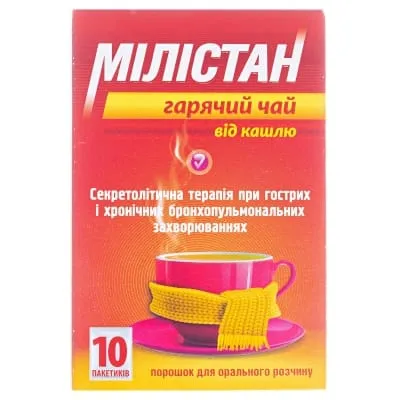
Table of Contents
INSTRUCTIONS FOR MEDICAL USE OF THE MEDICINAL PRODUCT MİLİSTAN HOT TEA ANTICOUGH
Composition:
Active substances: ambroxol hydrochloride, ascorbic acid;
1 sachet (6 g) contains ambroxol hydrochloride 30 mg, ascorbic acid 200 mg;
Excipients: sucrose, anhydrous citric acid, tartaric acid, sodium citrate, quinoline yellow dye (E 104), lemon essence, aspartame (E 951).
Pharmaceutical form. Oral soluble granules.
Main physicochemical characteristics: granular free-flowing powder, a mixture of white, pale yellow and/or yellow granules of different sizes, with lemon flavour and lemon odour when dissolved.
Pharmacotherapeutic group. Preparations used in cough and colds. Mucolytics. ATC code R05C B10.
Pharmacological properties.
Pharmacodynamics.
Ambroxol is an active metabolite of bromhexine that normalizes pathologically altered secretion of glandular cells of the bronchial mucosa, promotes liquefaction of viscous bronchial secretions and facilitates their expectoration by enhancing mucociliary clearance, and alters the ratio between serous and mucous components of sputum. Ambroxol stimulates Clara cells and activates hydrolyzing enzymes, which also contributes to reduction in sputum viscosity. The drug possesses secretomotor properties: it stimulates ciliary epithelium of the bronchi, restores drainage function of small bronchi and bronchioles. The preparation stimulates the production of endogenous surfactant, does not cause excessive secretion, and reduces spasmodic hyperreactivity of the bronchi. Cough and sputum volume are significantly reduced.
Vitamin C is a water-soluble vitamin. It acts as an antioxidant and a mild immunostimulant.
Pharmacokinetics.
After oral administration, ambroxol is almost completely absorbed in the gastrointestinal tract and penetrates well into lung tissues. Absolute bioavailability after oral administration is 70–80%. Maximum plasma concentration is reached approximately 2 hours after oral administration. The elimination half-life is 7–12 hours. It is excreted mainly via urine.
Ascorbic acid is rapidly absorbed from the gastrointestinal tract. Bioavailability is approximately 70%. It is metabolized predominantly in the liver and excreted by the kidneys.
Clinical characteristics.
Indications.
Mucolytic therapy in acute and chronic bronchopulmonary diseases associated with impaired bronchial secretion and weakened mucus transport.
Contraindications.
Hypersensitivity to ambroxol hydrochloride, ascorbic acid, or to other components of the medicinal product; thrombosis, predisposition to thrombosis, thrombophlebitis, diabetes mellitus, severe renal disease, urolithiasis (when administered at doses exceeding 1 g per day). Fructose intolerance. Phenylketonuria.
Interaction with other medicinal products and other types of interactions.
Concomitant use of ambroxol and antitussive agents may lead to excessive mucus accumulation due to suppression of the cough reflex. Therefore, such combination should only be used after careful evaluation by a physician of the expected benefit versus possible risk.
When administered concomitantly, ambroxol increases the concentrations of antibiotics (amoxicillin, cefuroxime, erythromycin) in bronchopulmonary secretions and sputum.
Ambroxol enhances the efficacy of glucocorticoid and antibacterial therapy in the treatment of inflammatory diseases of the upper and lower respiratory tract. However, concomitant use with tetracycline antibiotics (except doxycycline) is not recommended; the interval between their administration should be at least 2 hours.
Concomitant use of the drug with theophylline enhances the effect of the latter.
Oral ascorbic acid reduces the toxicity of sulfonamide drugs, enhances the absorption of penicillin and tetracycline, promotes iron absorption, reduces the effectiveness of heparin and indirect anticoagulants, increases the risk of crystalluria during salicylate therapy, and increases the risk of glaucoma during glucocorticosteroid therapy. Absorption of ascorbic acid is reduced when used concomitantly with oral contraceptives, fruit or vegetable juices, and alkaline drinks.
High doses reduce the effectiveness of tricyclic antidepressants, decrease renal tubular reabsorption of amphetamine, increase renal excretion of mexiletine, and enhance the overall clearance of ethanol. Ascorbic acid increases the total clearance of ethanol. Antidepressants, antiparkinsonian and antipsychotic agents, phenothiazine derivatives, increase the risk of urinary retention, dry mouth, and constipation.
Ascorbic acid should be administered only 2 hours after deferoxamine injection, as their concomitant use increases iron toxicity, especially in the myocardium, potentially leading to circulatory decompensation. Prolonged use of high doses during disulfiram treatment inhibits the disulfiram–alcohol reaction.
Quinolone derivatives, calcium chloride, salicylates, and corticosteroids reduce the body's stores of ascorbic acid when used long-term.
Vitamin C promotes intestinal absorption of aluminum, which should be considered during concomitant treatment with aluminum-containing antacids. When used in high doses, ascorbic acid affects vitamin B12 resorption. Vitamin C increases oxalate excretion in urine, thereby increasing the risk of urinary oxalate stone formation.
Acetylsalicylic acid (aspirin) may reduce the absorption of ascorbic acid.
Special precautions for use.
Arterial pressure should be monitored in patients with arterial hypertension. The drug should be used with caution and under medical supervision in patients with peptic ulcer disease of the stomach or duodenum.
There have been reports of severe skin reactions, such as erythema multiforme, Stevens-Johnson syndrome (SJS)/toxic epidermal necrolysis (TEN/Lyell's syndrome), and acute generalized exanthematous pustulosis (AGEP), associated with the use of ambroxol hydrochloride. These reactions were mostly attributable to the severity of the underlying disease in patients and/or concomitant use of other medications. In the early stages of Stevens-Johnson syndrome or Lyell's syndrome, patients may experience nonspecific, flu-like symptoms such as fever, malaise, rhinitis, cough, and sore throat. In such cases, symptomatic treatment with cough and cold remedies may be mistakenly initiated. Therefore, if new skin lesions or mucosal involvement occur, medical help should be sought immediately and treatment with ambroxol hydrochloride should be discontinued.
The drug should be used with caution in patients with impaired bronchial motility and increased mucus secretion (e.g., in rare conditions such as primary ciliary dyskinesia), as ambroxol may enhance mucus secretion.
Patients with renal impairment or severe hepatic insufficiency should use "Milistan Hot Cough Tea" only after consultation with a physician. When ambroxol, like any active substance metabolized in the liver and subsequently excreted by the kidneys, is administered, metabolites formed in the liver may accumulate in patients with severe renal insufficiency.
Renal function, arterial blood pressure, and pancreatic function should be monitored during prolonged use or when high doses are administered. The drug should be used with caution in patients with a history of kidney disease.
In patients with urolithiasis, the daily dose of ascorbic acid should not exceed 1 g.
High doses of the drug should not be prescribed to patients with increased blood coagulation.
Since ascorbic acid enhances iron absorption, its use in high doses may be hazardous in patients with hemochromatosis, thalassemia, polycythemia, leukemia, or sideroblastic anemia. Patients with high iron levels in the body should use the drug in minimal doses.
Concomitant use of the medicinal product with alkaline drinks reduces the absorption of ascorbic acid; therefore, it should not be taken with alkaline mineral water.
Absorption of ascorbic acid may be impaired in intestinal dyskinesia, enteritis, and achylia.
Use with caution in patients with glucose-6-phosphate dehydrogenase deficiency.
As a reducing agent, ascorbic acid may interfere with various laboratory test results, for example, blood glucose, bilirubin, transaminase activity, and lactate dehydrogenase levels.
Ascorbic acid should be used with caution in patients with progressive malignant disease, as its use may complicate the course of the disease.
The drug may be harmful to teeth.
Do not use in patients with fructose intolerance, glucose-galactose malabsorption, or sucrose-isomaltase deficiency.
If you have been diagnosed with carbohydrate intolerance, consult your doctor before taking this medicinal product.
The medicinal product contains 330 mg/dose of sodium citrate. Caution is advised when administering to patients on a sodium-restricted diet.
Aspartame (E 951) is a phenylalanine derivative and poses a risk to patients with phenylketonuria.
Use during pregnancy or breastfeeding.
Pregnancy. Ambroxol hydrochloride crosses the placental barrier. Animal studies have not revealed any direct or indirect adverse effects on pregnancy, embryonal/fetal development, parturition, or postnatal development.
Based on clinical experience with ambroxol after the 28th week of pregnancy, no harmful effects on the fetus have been observed.
However, general precautions regarding medication use during pregnancy should be observed. Particularly in the first trimester, ambroxol is not recommended.
Vitamin C deficiency in the diet of pregnant women may be dangerous for the fetus; however, high-dose vitamin C supplementation may also adversely affect fetal development. Therefore, ascorbic acid should be administered only when the expected benefit to the mother outweighs the potential risk to the fetus.
Breastfeeding. Ambroxol hydrochloride passes into breast milk.
Ascorbic acid passes into breast milk; therefore, vitamin C should be taken during breastfeeding only under medical supervision.
Thus, the drug is not recommended during breastfeeding.
Fertility. Preclinical studies do not indicate a direct or indirect adverse effect on fertility.
Effect on the ability to drive vehicles or operate machinery.
There are no data regarding the effect of the medicinal product on the ability to drive vehicles or operate machinery. Studies on such effects have not been conducted.
Method of administration and dosage.
The medicinal product should be used by dissolving the contents of 1 sachet in a glass of boiled hot water (not boiling water) and taken while hot.
Adults and children aged 12 years and older: 1 sachet 3 times daily.
"Milistan Hot Cough Tea" should not be used for longer than 4–5 days without consulting a physician.
Children.
Do not use in children under 12 years of age.
Overdose.
There are currently no reports of overdose cases in humans. Ambroxol is well tolerated after parenteral administration at doses up to 15 mg/kg/day and after oral administration up to 25 mg/kg/day. Severe symptoms of intoxication have not been observed following ambroxol overdose. Possible symptoms include stomach pain, nausea, vomiting, diarrhea, and short-term restlessness.
According to preclinical studies of ambroxol, significant overdose may lead to hypersalivation, vomiting reflex, and decreased arterial pressure.
In case of ascorbic acid overdose, symptoms such as nausea, vomiting, bloating and abdominal pain, itching, skin rashes, and increased excitability may occur. With prolonged use at high doses, the following may develop: suppression of the pancreatic islet apparatus function (hyperglycemia, glucosuria), impaired glycogen synthesis; sodium and fluid retention, disturbances in zinc metabolism, damage to the renal glomerular apparatus, formation of urate and/or oxalate kidney stones in the kidneys and urinary tract, renal failure, crystalluria, thrombocytosis, myocardial dystrophy, hyperprothrombinemia, erythrocytopenia, neutrophilic leukocytosis. Copper metabolism disturbances in patients with glucose-6-phosphate dehydrogenase deficiency may lead to erythrocyte hemolysis and hemolytic anemia.
Emergency measures such as inducing vomiting and gastric lavage are generally not indicated and should only be applied in cases of acute intoxication. Treatment is symptomatic and supportive.
Adverse Reactions
Immune system, skin and subcutaneous tissue disorders: Skin rash, urticaria, eczema; angioneurotic edema, pruritus, anaphylactic reactions (including anaphylactic shock), other hypersensitivity reactions; severe skin reactions: Stevens-Johnson syndrome and toxic epidermal necrolysis (Lyell's syndrome), and acute generalized exanthematous pustulosis.
Cardiovascular disorders: Arterial hypertension, myocardial dystrophy.
Nervous system disorders: Headache, sensation of heat, increased excitability, sleep disturbances, dysgeusia (taste disturbance), fatigue.
Gastrointestinal disorders: Irritation of the gastrointestinal mucosa, heartburn, nausea, decreased oral sensitivity; vomiting, diarrhea, dyspepsia, abdominal pain, dry mouth; constipation, hypersalivation; dry throat.
Respiratory, thoracic and mediastinal disorders: Decreased pharyngeal sensitivity; rhinorrhea; dyspnea (as a symptom of hypersensitivity reaction).
Renal and urinary disorders: Glomerular kidney damage, crystalluria, formation of urate, cystine and/or oxalate calculi in kidneys and urinary tract, renal failure, dysuria.
Endocrine disorders: With prolonged use in high doses – damage to the pancreatic islet apparatus (hyperglycemia, glucosuria), impaired glycogen synthesis up to the development of diabetes mellitus.
Blood and lymphatic system disorders: Thrombocytosis, erythrocytopenia, thrombosis, neutrophilic leukocytosis, hyperprothrombinemia; in patients with glucose-6-phosphate dehydrogenase deficiency of red blood cells may cause hemolysis of erythrocytes, hemolytic anemia.
Metabolism and nutrition disorders: Disturbances in zinc and copper metabolism.
General disorders: Fever, mucosal reactions.
Other: Tachycardia, dizziness.
Reporting of suspected adverse reactions
Reporting of suspected adverse reactions after marketing authorization is an important procedure. It allows continuous monitoring of the benefit-risk balance of the medicinal product. Healthcare professionals are requested to report all suspected adverse reactions via the pharmacovigilance system.
Shelf life. 2 years.
Storage conditions.
Store at temperatures not exceeding 25 °C in the original packaging and in a place inaccessible to children.
Packaging.
6 g per sachet. 10 sachets per cardboard box.
Supply category. Over-the-counter (without prescription).
Manufacturer.
IXL Laboratories Pvt. Ltd. / XL Laboratories Pvt. Ltd.
Manufacturer's address.
E-1223, Phase-I, Extn. (Ghatal), RIICO Industrial Area, Bhiwadi, Dist. Alwar (Raj.), India / E-1223, Phase-I, Extn. (Ghatal), RIICO Industrial Area, Bhiwadi, Dist. Alwar (Raj.), India.
Marketing authorization holder.
Mili Healthcare Limited / Mili Healthcare Limited.
Address of the marketing authorization holder.
Second Floor Office Suite, 4 Chartfield House, Castle Street, Taunton, Somerset, England, TA1 4AS, Great Britain / Second Floor Office Suite, 4 Chartfield House, Castle Street, Taunton, Somerset, England, TA1 4AS, Great Britain.