Mesoderm
Ukraine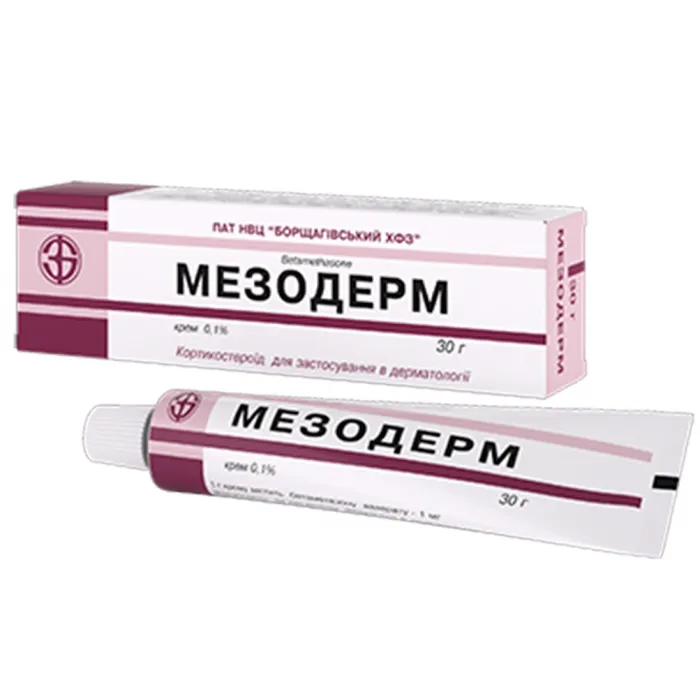
Table of Contents
INSTRUCTIONS FOR MEDICAL USE OF THE MEDICINAL PRODUCT MEZODERM
Composition:
Active substance: betamethasone;
1 g of the preparation contains betamethasone (as betamethasone valerate, recalculated to 100 % dry substance) − 1 mg;
Excipients: methylparahydroxybenzoate (E 218), propylene glycol, soft white paraffin, mineral oil, cetostearyl alcohol, macrogol cetostearyl ether, disodium edetate, sodium hydrogen phosphate dodecahydrate, potassium dihydrogen phosphate, purified water.
Pharmaceutical form. Cream.
Main physicochemical properties: white homogeneous cream, odorless.
Pharmacotherapeutic group. Dermatologicals. Corticosteroids for dermatological use. Betamethasone. ATC Code D07AC01.
Pharmacological Properties.
Pharmacodynamics.
Betamethasone is a synthetic glucocorticosteroid exhibiting anti-inflammatory, antiallergic, and antipruritic effects. When applied locally, it causes vasoconstriction, relieves itching, reduces the release of inflammatory mediators, inhibits hyaluronidase activity, and decreases vascular wall permeability. The cream base provides emollient and moisturizing effects.
Pharmacokinetics.
Betamethasone, as a fluorinated corticosteroid, is very poorly absorbed into systemic circulation through the skin. With local application, the intensity of absorption depends on the condition of the epidermal barrier (inflammation and skin diseases increase absorption).
Clinical characteristics.
Indications.
Treatment of dermatoses sensitive to potent glucocorticosteroid therapy, such as psoriasis; initial treatment of severe atopic eczema.
Contraindications.
Mesoderm, cream, is contraindicated in patients with allergic reactions to any component of the medicinal product.
Mesoderm, cream, is contraindicated in the following cases:
- viral infections, including post-vaccination reactions and varicella;
- viral skin infections (e.g., herpes simplex, herpes zoster, varicella);
- acne;
- rosacea-like (perioral) dermatitis;
- bacterial dermatoses, including tuberculosis and syphilis of the skin;
- fungal diseases;
- erosive skin lesions, burns, frostbite;
- acneiform eruptions;
- ophthalmological diseases (Mesoderm, cream, is not intended for ophthalmic use).
Application of Mesoderm cream under occlusive dressings (plaster, etc.) is not recommended.
Particular caution should be observed when applying the medicinal product to areas near the face. Avoid contact of the preparation with eyes or mucous membranes. Prolonged treatment and/or application over large areas of skin should be avoided, as systemic absorption of the active substance may occur.
The cream should not be used during the first trimester of pregnancy (see section "Use during pregnancy or breastfeeding").
Interaction with other medicinal products and other types of interactions.
Due to the presence of soft white paraffin and mineral oil, the use of Mesoderm cream in the anogenital area may damage the structure of latex condoms and reduce their safety during treatment.
Special precautions for use
Mesoderm is not intended for ophthalmic use. Particular care should be taken to avoid application of the product to the eyelids, as this may lead to the development of glaucoma.
Application of the medicinal product to eroded, weeping areas or to skin fissures and ulcers should be avoided.
Systemic absorption of topical corticosteroids generally increases with higher corticosteroid doses, longer duration of treatment, and larger treated body surface area.
High-potency corticosteroids applied over large skin areas should be used with careful monitoring, as they may suppress the hypothalamic-pituitary-adrenal (HPA) axis. If suppression occurs, the medicinal product should be discontinued, the frequency of application reduced, or the patient switched to a less potent corticosteroid. HPA axis function usually recovers after discontinuation of the product.
In some cases, withdrawal symptoms may occur, requiring administration of systemic corticosteroids. Abrupt discontinuation of treatment may lead to symptom flare-ups (especially in patients with psoriasis).
Prolonged use of betamethasone in patients with generalized psoriasis (except for treatment of isolated plaques) or generalized eczema, as well as prolonged use in skin folds, is not recommended due to the potential for increased systemic absorption. Use of occlusive dressings, particularly those made of plastic material, may enhance this effect.
Corticosteroid-containing products should be used with caution in patients with impaired immune system function or those who have received immunosuppressive therapy.
If skin irritation or signs of hypersensitivity occur during treatment with Mesoderm, therapy should be discontinued and appropriate alternative treatment initiated. In the presence of infection, antifungal or antibacterial agents should be prescribed. If the desired effect is not rapidly achieved, corticosteroid use should be discontinued until signs of infection have resolved.
Any adverse effects associated with systemic use of glucocorticoids, including adrenal cortex suppression, may also occur with topical application.
Use of both systemic and topical corticosteroids (including intranasal, inhaled, and intraocular administration) may lead to visual disturbances. If symptoms such as blurred vision or other visual changes occur, the patient should undergo ophthalmologic evaluation to determine possible causes, which may include cataract, glaucoma, or rare conditions such as central serous chorioretinopathy, which has been reported after use of systemic and topical corticosteroids.
Mesoderm cream contains methyl parahydroxybenzoate, cetostearyl alcohol, and propylene glycol. Methyl parahydroxybenzoate may cause allergic reactions (possibly delayed). Cetostearyl alcohol and propylene glycol may cause local skin reactions (e.g., contact dermatitis).
Use during pregnancy or breastfeeding
Pregnancy
As the safety of topical corticosteroids in pregnant women has not been established, Mesoderm cream should not be used during the first trimester of pregnancy.
These products may be prescribed only during later stages of pregnancy if the expected benefit to the mother outweighs the potential risk to the fetus.
During pregnancy, products of this class should not be applied over large areas, in large amounts, for prolonged periods, or under occlusive dressings.
Breastfeeding
It is not known whether corticosteroids, after topical application and systemic absorption, can pass into breast milk. When deciding whether to discontinue breastfeeding or to discontinue the medicinal product, the importance of the therapy for the mother should be considered. Contact between the infant and the skin area treated with the cream should be avoided.
Effect on ability to drive or operate machinery
The medicinal product usually does not affect the patient's reaction speed when driving or operating machinery.
Method of Administration and Dosage
Apply the cream topically. The dosage is determined individually by a physician, as it depends on the size of the affected area.
The cream should be applied as a thin layer to the affected area once to three times daily, gently rubbed into the skin, sufficient to cover all affected skin areas. When the condition improves, the frequency of application may be reduced to once daily.
Prolonged use of Mesoderm cream (more than 3 months) or application over large areas (more than 20% of body surface) should be avoided. This also applies to treatment covering more than 10% of body surface for longer than 1 week.
After improvement of clinical symptoms, switching to a weaker corticosteroid is often recommended.
Intermittent therapy may be beneficial, involving alternating weekly use of Mesoderm cream and a topical preparation without active ingredient.
Careful monitoring for signs and symptoms of systemic drug effects is recommended.
The method of administration should be adapted according to skin type and disease stage.
Mesoderm cream is the preferred dosage form for oily skin, increased sebaceous gland activity, weeping lesions, and acute disease stages.
Patients with fungal dermatoses require specific treatment.
The duration of treatment is determined by the physician based on the nature and severity of the disease. Typically, treatment lasts 1–2 weeks, but not longer than 3 weeks.
Do not use under occlusive dressings.
Children
Experience with the use of this medicinal product in children is limited; therefore, its use in this age group is not recommended.
Children have a higher surface-area-to-body-mass ratio than adults, resulting in more intensive absorption of the drug. Children are more susceptible to hypothalamic-pituitary-adrenal (HPA) axis suppression and the development of exogenous corticosteroid effects.
Overdose
Excessive and prolonged use of the drug over large skin areas may lead to systemic corticosteroid effects, including suppression of pituitary-adrenal function, development of secondary adrenal insufficiency, and acute symptoms of hypercortisolism, such as Cushing's syndrome. Acute symptoms of hypercortisolism are usually reversible.
Treatment is symptomatic. Electrolyte balance should be corrected if necessary. In cases of chronic toxic effects, gradual withdrawal of the corticosteroid is recommended.
Adverse Reactions
Adverse reactions are listed by system organ class and frequency: very common (≥ 1/10); common (≥ 1/100 to < 1/10); uncommon (≥ 1/1000 to < 1/100); rare (≥ 1/10,000 to < 1/1000); very rare (< 1/10,000); frequency not known (cannot be estimated from available data).
Local adverse reactions associated with topical corticosteroids, especially when used under occlusive dressings:
Infections and infestations: frequency not known – folliculitis, secondary infection.
Eye disorders: frequency not known – blurred vision (see also section "Special precautions").
Hypersensitivity reactions are possible in patients with individual intolerance to any component of the drug.
General disorders and administration site conditions: frequency not known – dryness of the skin at the application site, irritation at the application site, skin pricking sensation, skin induration, sensation of warmth, lamellar desquamation, focal desquamation, erythema.
Skin and subcutaneous tissue disorders: frequency not known – burning, itching, hypertrichosis, acneiform dermatitis, hypopigmentation of the skin, rosacea-like (perioral) dermatitis; allergic contact dermatitis; under occlusive dressing: skin maceration, skin atrophy, striae, miliaria; telangiectasia, hypersensitivity reactions.
Any adverse effects observed with systemic use of glucocorticoids, including adrenal cortex suppression, may also occur with topical application.
With prolonged use over large skin areas or when used under occlusive dressings, systemic adverse effects typical of glucocorticosteroids may develop. Skin maceration, striae, and miliaria may also occur.
Reporting of suspected adverse reactions
It is important to report suspected adverse reactions after marketing authorization. This allows continued monitoring of the benefit-risk balance of the medicinal product. Healthcare professionals are required to report all suspected adverse reactions.
Shelf life. 5 years.
Storage conditions.
In the original packaging at a temperature not exceeding 25 °C. Do not freeze. Keep out of reach of children.
Packaging.
30 g in a tube in a carton.
Prescription status.
Prescription only.
Manufacturer.
Public Joint-Stock Company "Scientific and Production Center "Borysyivsky Chemical and Pharmaceutical Plant".
Manufacturer's address and site of operations.
17 Myru Street, Kyiv, 03134, Ukraine.