Mesaton
Ukraine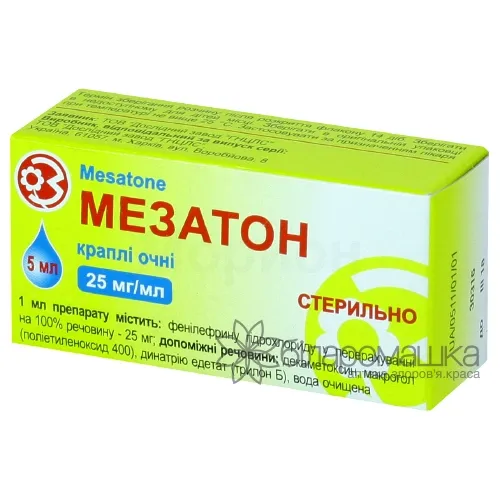
Table of Contents
INSTRUCTIONS for medical use of the medicinal product MЕZATON
Composition:
Active substance: phenylephrine;
1 ml of solution contains phenylephrine hydrochloride, calculated as 100 % substance – 25 mg;
Excipients: decamethoxin, macrogol (polyethylene glycol 400), disodium edetate (trometamol B), purified water.
Pharmaceutical form. Eye drops.
Main physico-chemical properties: clear colourless or slightly yellowish liquid.
Pharmacotherapeutic group. Medicinal products used in ophthalmology. Mydriatics and cycloplegics. ATC code S01F B01.
Pharmacological properties.
Pharmacodynamics. The drug has a pronounced stimulating effect on postsynaptic α-adrenergic receptors, while its effect on cardiac β-adrenergic receptors is almost negligible. The agent exerts a vasoconstrictor action similar to that of norepinephrine; however, it has virtually no chronotropic or inotropic effect on the heart. The vasopressor effect of the drug is less pronounced than that of norepinephrine, but significantly more prolonged. When used in usual doses, it does not produce a significant stimulatory effect on the central nervous system. After instillation, phenylephrine contracts the iris dilator muscle, thereby causing pupil dilation, as well as constricting the smooth muscles of conjunctival arterioles. There is no effect on the ciliary muscle, so mydriasis occurs without cycloplegia.
Pharmacokinetics. Phenylephrine readily penetrates ocular tissues; pupil dilation occurs within 10–60 minutes after a single instillation. Mydriasis persists for 4–6 hours. Due to significant contraction of the iris dilator muscle, pigment particles from the pigment layer of the iris may appear in the anterior chamber fluid 30–45 minutes after instillation. This phenomenon should be differentiated from signs of anterior uveitis or the presence of formed blood elements in the anterior chamber fluid.
Clinical characteristics.
Indications.
- Iridocyclitis, anterior uveitis (for treatment and prevention of posterior synechiae formation and reduction of exudation from the iris).
- Diagnostic dilation of the pupil during ophthalmoscopy and other diagnostic procedures necessary to assess the condition of the posterior segment of the eye.
- Provocative testing in patients with narrow anterior chamber angle and suspected angle-closure glaucoma.
- Differential diagnosis of types of ocular injection.
- Pupil dilation during laser interventions on the fundus and vitreoretinal surgery.
- "Red eye" syndrome (reduction of hyperemia and irritation of ocular tissues).
- Complex therapy of accommodative spasm in school-age children.
- Treatment and prevention of asthenopia.
Contraindications.
- Hypersensitivity to any component of the medicinal product.
- Narrow-angle or angle-closure glaucoma.
- Severe cardiovascular disorders (heart disease, arterial hypertension, aneurysm, tachycardia), especially in elderly patients.
- Insulin-dependent diabetes mellitus.
- Thyrotoxicosis.
- Hyperthyroidism.
- Concomitant use with monoamine oxidase inhibitors (MAOIs) and within 2 weeks after discontinuation of MAOI therapy.
- Additional pupil dilation during surgical procedures in patients with compromised integrity of the eyeball or impaired tear secretion.
- Concomitant use with tricyclic antidepressants and antihypertensive agents (including β-blockers).
- Congenital glucose-6-phosphate dehydrogenase deficiency.
- Hepatic porphyria.
Contraindicated in:
- Neonates with low birth weight;
- Neonates and infants with cardio- or cerebrovascular disorders;
- Elderly patients with severe arteriosclerotic, cardiovascular, or cerebrovascular diseases.
Interaction with other medicinal products and other forms of interaction. The mydriatic effect of phenylephrine is enhanced by local application of atropine, and reduced by local application of other ophthalmic preparations containing miotics. The drug may inhibit the ability of miotics to reduce intraocular pressure.
The mydriatic effect of phenylephrine is enhanced by local application of atropine.
Antihypertensive medicinal products (including β-adrenergic blockers) are contraindicated for concomitant use with phenylephrine for topical application, as a reversal of effect of many antihypertensive agents may occur, potentially leading to fatal outcomes; arterial hypertension is possible.
MAO inhibitors. Concomitant use of phenylephrine during treatment with MAO inhibitors and within 2 weeks after discontinuation of MAOI therapy is contraindicated. Concurrent use within 21 days after cessation of MAOI therapy should be performed with caution due to the risk of systemic adrenergic effects.
Tricyclic antidepressants are contraindicated for concomitant use with phenylephrine. The vasoconstrictor effect of adrenergic agents may be potentiated by tricyclic antidepressants (risk of cardiac arrhythmia, including within several days after discontinuation of their use), propranolol, reserpine, guanethidine, methyldopa, and muscarinic cholinergic blockers.
Inhalation anesthesia. The drug may potentiate cardiovascular depression during inhalation anesthesia. Due to increased risk of ventricular fibrillation, the drug should be used with caution during general anesthesia with anesthetics such as halothane (fluothane), which increase myocardial sensitivity to sympathomimetics.
Cardiac glycosides or quinidine. Increased risk of arrhythmia.
Special precautions for use.
Phenylephrine hydrochloride is a medication with adrenergic action, used in ophthalmology primarily to achieve mydriatic effect. The drug has minimal effect on the ciliary muscle of the eye, so significant impact on accommodation is not observed. However, pupil dilation may reduce depth of focus and cause impaired vision.
Systemic effects can be minimized by applying digital pressure to the inner corner of the eye for one minute after instillation (this blocks the passage of drops through the nasolacrimal duct to the nasal and pharyngeal mucosa). This is especially recommended for infants, children, and elderly patients.
Since the pupil-dilating effect may last 1–3 hours, patients may experience photophobia. Therefore, eyes should be protected from bright sunlight, including the use of sunglasses, until vision fully recovers. Activities requiring visual concentration (such as reading or watching television) should be avoided until residual effects of mydriasis have resolved.
Increased absorption and enhanced systemic adverse effects may occur in the presence of conjunctival hyperemia or corneal epithelial damage.
To prevent glaucoma exacerbation, the anterior chamber angle should be evaluated before administering the medication. To prevent discomfort during phenylephrine use, anesthetic drops may be instilled a few minutes prior to application.
Elderly patients. Reactive miosis may occur. Reactive miosis has been observed in elderly patients one day after phenylephrine solution application, and repeated administration led to reduced pupil dilation. Use with caution in patients with cerebral atherosclerosis, cardiovascular disorders, chronic bronchial asthma, arterial hypertension, or insulin-controlled diabetes.
Due to the pronounced effect of the drug on pupil dilation, temporary appearance of floating pigment spots in the intraocular fluid may occur in elderly patients within 30–45 minutes after instillation of phenylephrine solution.
Pediatric population. The lowest effective dose should always be used. Parents should be informed about the need to prevent the medication from entering the child's mouth or contacting the cheeks, and about the importance of washing their own hands as well as the child's hands and face after administration. In general, children, especially low-birth-weight infants and premature newborns, are at increased risk of developing systemic adverse reactions, including transient elevation of blood pressure, which increases the risk of intraventricular hemorrhage. Infants should be monitored after instillation, and appropriate resuscitation measures should be available if needed.
Use during pregnancy or breastfeeding. Not studied. Use may be considered if the expected benefit to the mother outweighs the potential risk to the fetus or infant. Breastfeeding should be discontinued during treatment with this medication.
Ability to affect reaction speed when driving or operating machinery. Patients should wait until visual acuity has fully recovered before driving or operating machinery.
Method of Administration and Dosage.
For ophthalmoscopy, administer a single instillation of the 2.5% solution. Generally, instillation of 1 drop of the 2.5% solution into the conjunctival sac is sufficient to achieve mydriasis. Maximum mydriasis is reached within 15–30 minutes and remains adequate for 1–3 hours. If prolonged maintenance of mydriasis is required, repeat instillation may be performed after 1 hour.
Single instillation of the 2.5% solution is used for diagnostic procedures:
- as a provocative test in patients with a narrow anterior chamber angle and suspected angle-closure glaucoma. If the difference in intraocular pressure before and after pupil dilation is 3 to 5 mm Hg, the provocative test is considered positive;
- for differential diagnosis of ocular hyperemia: if within 5 minutes after instillation there is a narrowing of the blood vessels of the eyeball, the hyperemia is classified as superficial; if ocular redness persists, the patient should be carefully examined for iridocyclitis or scleritis, as this indicates vasodilation in deeper ocular tissues;
- in iridocyclitis and anterior uveitis, to treat and prevent the development of posterior synechiae, and to reduce exudation into the anterior chamber of the eye. For this purpose, instill 1 drop of the drug into the conjunctival sac of the affected eye(s) 2–3 times daily.
Complex therapy of accommodative spasm and asthenopia in school-age children. In mild myopia, administer 1 drop of the 2.5% solution before bedtime on days of high visual strain; in moderate myopia — 1 drop of the 2.5% solution 3 times a week before bedtime, and in cases of emmetropia (absence of myopia) — daily regardless of visual load.
In hyperopic patients who show a tendency to spasm, apply the 2.5% solution in combination with 1 drop of 1% cyclopentolate before bedtime during periods of intense visual strain, and during regular periods — 3 times a week.
Use in elderly patients. Dose adjustment is not required in elderly patients. Repeated instillations may produce a less pronounced mydriatic effect.
When administering instillations, it is necessary to follow sanitary and hygienic rules: wash hands with soap and avoid touching the dropper tip with fingers.
Children. In pediatric practice, the medicinal product can be used for diagnostic procedures (ophthalmoscopy, retinography) from the first days of life. Use in premature infants should be cautious and only after a physician has evaluated the risk-benefit ratio: no more than 1 drop in each eye.
Overdose. Even with topical application, systemic effects of phenylephrine may occur. Most commonly, these include significant increase in blood pressure and reflex bradycardia.
Treatment: administration of α-adrenoblockers. In case of reflex bradycardia, atropine should be administered (in children — at a dose of 0.01–0.02 mg/kg body weight).
Adverse reactions.
Immune system: hypersensitivity, allergic conjunctivitis.
Eye disorders: eye pain, burning sensation (at the beginning of administration), reactive hyperemia, blurred vision, irritation, allergic reactions, discomfort, lacrimation, increased intraocular pressure in patients with narrow-angle or closed-angle glaucoma, reactive miosis (on the following day after administration; repeated instillations may produce less pronounced mydriasis than the previous day; this effect is more commonly observed in elderly patients). Periocular pallor may occur in premature newborns.
Cardiovascular system: tachycardia, cardiac arrhythmias, including ventricular arrhythmias, arterial hypertension, reflex bradycardia, coronary artery occlusion, pulmonary artery embolism, myocardial infarction.
Central nervous system: headache, excitement, dizziness, tremor, paresthesia, insomnia.
Other: facial skin pallor, weakness, dyspnea, dyspeptic symptoms.
Reporting of suspected adverse reactions. After marketing authorization, reporting of suspected adverse reactions is an important procedure. It allows continuous monitoring of the benefit-risk balance of the medicinal product. Healthcare professionals should report any suspected adverse reactions via the national pharmacovigilance system.
Shelf life. 2 years. The solution may be used for up to 14 days after opening the bottle.
Storage conditions. Store in the original packaging at a temperature not exceeding 25 °C. Keep out of reach of children.
Packaging. 5 ml in a bottle with a dropper cap, in a carton.
Prescription status. Prescription only.
Manufacturer.
Limited Liability Company "Research Plant "GNCLS".
Limited Liability Company "FARMEKS GROUP".
Manufacturer's address and place of business.
8 Vorobiova Street, Kharkiv, Kharkiv Region, Ukraine.
(Limited Liability Company "Research Plant "GNCLS")
100 Shevchenka Street, Boryspil, Kyiv Region, 08301, Ukraine.
(Limited Liability Company "FARMEKS GROUP")