Mezanext
Ukraine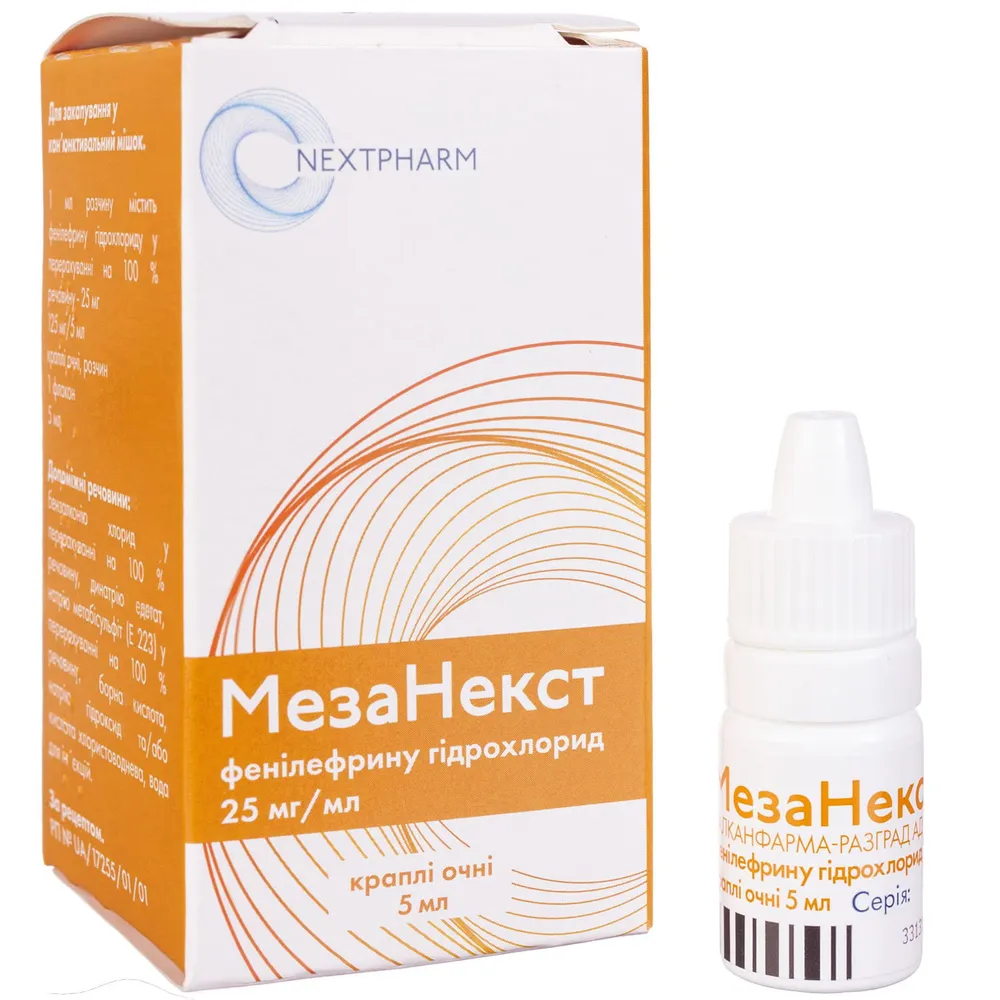
Table of Contents
INSTRUCTIONS FOR MEDICAL USE OF THE MEDICINAL PRODUCT MezaNext (MezaNext)
Composition:
Active substance: phenylephrine hydrochloride;
1 ml of solution contains phenylephrine hydrochloride, recalculated to 100 % substance – 25 mg;
Excipients: benzalkonium chloride, recalculated to 100 % substance, disodium edetate, sodium metabisulfite (E 223), recalculated to 100 % substance, boric acid, sodium hydroxide and/or hydrochloric acid, water for injections.
Pharmaceutical form. Eye drops, solution.
Main physicochemical properties: clear liquid.
Pharmacotherapeutic group. Agents acting on sensory organs. Agents used in ophthalmology. Mydriatics and cycloplegics. Sympathomimetics, excluding antiglaucoma agents. Phenylephrine.
ATC code S01F B01.
Pharmacological properties.
Pharmacodynamics.
Mechanism of action
Phenylephrine is a direct-acting sympathomimetic that stimulates α-adrenergic receptors.
Pharmacodynamic effects
When applied to the eye, it causes mydriasis, usually without cycloplegic effect. The time to reach maximum mydriasis typically ranges from 15 to 60 minutes.
The maximum duration of induced mydriasis is 60–90 minutes. Complete recovery occurs within 3–7 hours after administration.
Timolol antagonizes the mydriatic effect.
Pharmacokinetics.
Under physiological pH conditions, phenylephrine is a weak base. The extent of penetration through ocular tissues and structures depends on the condition of the cornea. A healthy cornea acts as a physical barrier to phenylephrine penetration, an effect supplemented by some metabolic activity of this ocular structure.
When corneal epithelial integrity is compromised, the extent of phenylephrine absorption may increase.
Data indicate that after topical ocular administration of phenylephrine (10% solution), maximum plasma concentration is reached on average within 10 minutes after instillation and is approximately 10.2 ± 7.9 ng/mL.
Clinical characteristics.
Indications.
The drug MezaNext is indicated for pupil dilation during diagnostic and/or therapeutic procedures; in uveitis - to break posterior synechiae or to prevent their formation; during surgical interventions; for refraction examination without cycloplegia; during fundus examinations and other diagnostic procedures.
Contraindications.
- Hypersensitivity to any component of the drug.
- Significant cardiovascular disorders (heart disease, arterial hypertension, aneurysm, tachycardia), especially in elderly patients.
- Thyrotoxicosis.
- Insulin-dependent diabetes mellitus.
- Hyperthyroidism.
- Concomitant use of monoamine oxidase inhibitors (MAOIs) and within 2 weeks after discontinuation of MAOI therapy.
- Concomitant use with tricyclic antidepressants and antihypertensive agents (including β-blockers).
- Congenital glucose-6-phosphate dehydrogenase deficiency.
- Hepatic porphyria.
- Closed-angle glaucoma (except in cases of prior iridectomy) and patients with narrow anterior chamber angles who are predisposed to glaucoma development when using mydriatics.
- Use in premature infants and newborns with low body weight.
- Use in newborns and infants with cardio- or cerebrovascular disorders.
- Use in elderly patients with severe atherosclerotic, cardiovascular, or cerebrovascular diseases.
- Additional pupil dilation during surgery in patients with compromised integrity of the eyeball or impaired tear secretion.
Interaction with other medicinal products and other forms of interactions.
Antihypertensive agents (including β-adrenergic blockers)
Topical application of phenylephrine may reverse the effects of antihypertensive agents, which in some cases may lead to fatal outcomes, and may cause arterial hypertension; therefore, concomitant use of phenylephrine for topical application with antihypertensive agents is contraindicated. Systemic adverse effects are more frequently observed in patients taking β-adrenergic blockers such as propranolol.
MAO inhibitors
The use of phenylephrine is contraindicated during therapy with MAO inhibitors and within 2 weeks after discontinuation of MAOI treatment. Concomitant use of phenylephrine within 21 days after stopping MAOIs should be performed with caution due to the possible development of systemic adrenergic effects.
Tricyclic antidepressants
Concomitant use with phenylephrine is contraindicated.
The vasoconstrictor effect of adrenergic agents (with risk of cardiac arrhythmia, including several days after discontinuation of treatment) may be enhanced in patients taking tricyclic antidepressants, propranolol, reserpine, guanethidine, methyldopa, and muscarinic receptor blockers.
Inhalational anesthesia
Increased risk of ventricular fibrillation. Phenylephrine should be used with caution during general anesthesia with anesthetics such as halothane (fluothane), which increase myocardial sensitivity to sympathomimetics and may potentiate cardiovascular depression during inhalational anesthesia.
Cardiac glycosides or quinidine
Increased risk of arrhythmia.
Atropine
The mydriatic effect of phenylephrine is enhanced when atropine is applied topically, whereas it is reduced when other miotic agents are applied topically. Concomitant use may enhance adrenergic effects and may even cause tachycardia in some patients, particularly in children.
Special precautions for use.
The drug MesаNext is intended for topical ocular use only. The solution must not be administered subconjunctivally or directly into the anterior chamber of the eye.
The drug should be prescribed with caution to patients with diabetes mellitus, cerebral atherosclerosis, chronic asthma, as well as to children and elderly individuals.
In some elderly patients, reflex miosis has been observed after instillation of phenylephrine, and additional instillation led to weaker mydriasis than initially achieved. This effect may be clinically significant in elderly patients undergoing pupil dilation prior to cataract extraction or retinal detachment surgery.
After instillation of phenylephrine, especially at high doses, transient appearance of pigment particles in the anterior chamber may occur in elderly patients. This is explained by the strong effect of the drug on the iris dilator muscle and may mimic anterior chamber uveitis or microscopic hyphema.
Since the mydriatic effect may last 1–3 hours, patients may experience photophobia. Therefore, the eye(s) should be protected from bright sunlight, including by wearing sunglasses, until vision fully returns to normal. Visual strain (reading, watching television) should be avoided until residual mydriasis resolves.
In elderly patients with cardiovascular diseases, blood pressure should be monitored. The drug should be used with caution in children with heart defects.
To prevent discomfort during application of MesаNext, instillation of local anesthetic eye drops a few minutes prior to administration may be considered.
To reduce the risk of acute angle-closure glaucoma, a prior assessment of the anterior chamber angle is required before using the drug.
Conjunctival hyperemia and corneal epithelial defects increase the absorption of phenylephrine during local application and may enhance systemic adverse effects.
Exceeding the recommended dose, as well as using phenylephrine after surgery in patients with ocular trauma or eye diseases, reduced tear secretion, or during anesthesia, may increase its absorption and cause systemic pressor responses.
Corneal clouding may occur when phenylephrine is used at higher concentrations (10%) in patients with corneal epithelial defects.
The drug contains benzalkonium chloride as an excipient, which may cause eye irritation. Contact with soft contact lenses should be avoided. Contact lenses must be removed before using the drug and should not be reinserted until at least 15 minutes after instillation. Benzalkonium chloride is known to discolor contact lenses.
This medicinal product contains sodium metabisulfite, which may rarely cause hypersensitivity reactions and bronchospasm.
Pediatric use.
The minimum effective dose should always be used. Parents should be informed that the drug must not enter the child’s mouth or come into contact with the cheeks, and that hands of both the caregiver and the child should be washed after administration. In general, children, especially neonates with low birth weight and preterm infants, are at increased risk of systemic adverse reactions, including transient elevation of blood pressure, which may increase the risk of intraventricular hemorrhage. Infants should be monitored after instillation, and appropriate resuscitation measures should be available if needed.
Use during pregnancy or breastfeeding.
Pregnancy
The safety of phenylephrine use during pregnancy in humans has not been established; therefore, the drug should be used during pregnancy only if the expected benefit to the mother outweighs the potential risk to the fetus.
Breastfeeding period
The safety of phenylephrine during breastfeeding has not been established; therefore, the drug should be used during this period only if the expected benefit to the mother outweighs the potential risk to the infant. Breastfeeding should be discontinued during treatment with this drug.
Ability to affect reaction speed when driving or operating machinery.
As with any ophthalmic medication, transient blurred vision or other visual disturbances may occur after administration of MesаNext, which may impair the ability to drive or operate machinery.
Patients should be advised that if blurred vision occurs after using MesаNext, they should wait until vision clears before driving or operating complex machinery.
Dosage and Administration
Dosage
Adults
Vasoconstriction and Mydriasis
Instill 1 drop of the solution into the affected eye(s).
If necessary, the dose may be repeated only once, no sooner than one hour after the first instillation.
To avoid local irritative effects and further tear dilution, it is recommended to use a topical anesthetic a few minutes prior to instillation of MesаNext.
The use of MesаNext is particularly suitable when it is necessary to relieve conjunctival vascular congestion and achieve rapid and potent mydriasis without cycloplegia.
Uveitis and Posterior Synechiae
Use to prevent or treat synechiae formation. Synechiae can be prevented by strong pupil dilation with phenylephrine, atropine, or other cycloplegic agents.
Instill 1 drop of the solution into the affected eye(s) 1–2 times daily. The maximum dose should not exceed 3 drops per day. If necessary, treatment may be repeated the following day.
If this treatment yields positive results, warm compresses and atropine may be included in the treatment regimen.
Glaucoma
In patients with open-angle glaucoma, MesаNext can be used concomitantly with miotic agents, as phenylephrine enhances their hypotensive effect and reduces their adverse effects on visual acuity by expanding the narrowed visual field.
Instill 1 drop of the solution into the affected eye(s).
Surgical Procedures
The drug may be used when strong, short-term mydriasis is required. Instill 1 drop into the affected eye(s) 30–60 minutes prior to surgery.
Refraction
Phenylephrine enhances the mydriatic effect of homatropine, cyclopentolate, tropicamide, and atropine.
Instill 1 drop of the solution into the affected eye(s).
Ophthalmoscopy
Adequate mydriasis lasting 1–3 hours is achieved within 15–30 minutes after instillation of 1 drop of the solution.
Provocative Test for Angle-Closure Glaucoma
MesаNext can be used to diagnose chronic glaucoma. Intraocular pressure and gonioscopy must be measured before and after phenylephrine-induced pupil dilation.
A significant increase in intraocular pressure in combination with a narrow anterior chamber angle, as determined by gonioscopy, suggests the presence of glaucoma. It should be noted that a negative test result does not exclude the condition.
Retinoscopy
Use when pupil dilation without cycloplegia is required.
In any of the procedures described above, eyes with more intense iris pigmentation may require higher doses of phenylephrine.
Blanching Test
Instill 2 drops of the solution into the hyperemic eye. Perilimbal hyperemia may be observed within 5 minutes after instillation. Blanching is typical of conjunctival vessels, while superficial hyperemia is more characteristic of conjunctivitis rather than iridocyclitis.
Elderly Patients (65 years and older)
No dose adjustment is required for this patient group. In most cases, repeated instillations may result in less pronounced mydriasis. Usually, one drop of phenylephrine should be administered 5 minutes after the selected cycloplegic agent.
Administration
The drops should be instilled into the conjunctival sac. To minimize systemic absorption through the nasal mucosa and enhance local effect, especially in infants, children, and elderly patients, the nasolacrimal duct should be compressed with a finger for 2–3 minutes or the eyes should be kept closed for 3 minutes after instillation.
When instilling drops into the affected eye(s), the tip of the dropper must not touch the eyelids, skin around the eyes, or any other surface to avoid contamination.
Children
In pediatric practice, the drug may be used from the first days of life for diagnostic procedures (e.g., ophthalmoscopy, retinography). Use in premature infants is possible with caution, following physician assessment of the benefit-risk ratio, with no more than 1 drop per eye.
Overdose
Even with topical administration, systemic effects of phenylephrine from MesаNext may occur. Severe toxic reactions associated with phenylephrine overdose develop rapidly and are usually short-lived. These typically manifest as sympathetic stimulation—palpitations, tachycardia followed by bradycardia, arterial hypertension, pulmonary edema, or cardiac arrest.
Treatment should be symptomatic. Rapid intravenous administration of fast-acting α-adrenergic blockers such as phentolamine (2–5 mg IV) is recommended. In case of reflex bradycardia, atropine should be administered (in children: 0.01–0.02 mg/kg body weight).
Side effects
The following standard was used to classify adverse effects according to frequency: very common (≥ 1/10), common (≥ 1/100 to < 1/10), uncommon (≥ 1/1000 to < 1/100), rare (≥ 1/10000 to < 1/1000), very rare (< 1/10000), unknown (frequency cannot be estimated from available data).
The following adverse reactions have been reported with the use of phenylephrine 25 mg/mL ophthalmic drops. Frequency cannot be estimated from available data. Adverse reactions are listed in order of decreasing severity.
Eye disorders:
Unknown – eye pain, irritation, transient blurred vision and other visual disturbances, photophobia, increased conjunctival sensitivity, allergic reactions, ocular hyperemia.
Cases of allergic blepharoconjunctivitis have been reported. The reaction usually begins 3–4 hours after instillation of the product and may last approximately 12 hours, with gradual regression within 72 hours.
Cardiac and vascular disorders:
Unknown – palpitations, tachycardia, extrasystoles, cardiac arrhythmia, and arterial hypertension.
Serious cardiac events have been observed with use of 10% phenylephrine ophthalmic drops, including coronary artery spasm, ventricular arrhythmias, tachycardia, and myocardial infarction.
These adverse reactions, which may sometimes be fatal, typically occur in patients with cardiovascular disease and in elderly patients.
Sudden increase in blood pressure has been reported in premature neonates with low body weight, as well as in children and adults with idiopathic or orthostatic hypotension.
Immune system disorders:
Unknown – hypersensitivity.
Nervous system disorders:
Unknown – headache, restlessness, dizziness, tremor, paresthesia, insomnia.
Skin and subcutaneous tissue disorders:
Unknown – contact dermatitis.
Respiratory, thoracic and mediastinal disorders:
Unknown – pulmonary edema, dyspnea.
Pediatric population:
Unknown (frequency cannot be estimated from available data): periorbital pallor in premature patients.
Reporting suspected adverse reactions
Reporting of suspected adverse reactions after medicinal product authorization is important. It allows continued monitoring of the benefit-risk balance of the medicinal product. Medical and pharmaceutical professionals, as well as patients or their legal representatives, should report all suspected adverse reactions and lack of efficacy through the Automated Pharmacovigilance Information System at the following link: https://aisf.dec.gov.ua.
Shelf life. 2 years.
After first opening, store for up to 28 days at a temperature not exceeding 25 °C, protected from light.
Storage conditions. Store in the original packaging, protected from light, at a temperature not exceeding 25 °C. Do not freeze!
Keep out of reach of children.
Packaging.
5 mL in a white plastic dropper bottle closed with a screw cap with a tamper-evident ring; 1 dropper bottle per cardboard box.
Prescription status. Prescription only.
Manufacturer.
BALKANFARMA-RAZGRADE AD.
Manufacturer's address and place of business.
Bul. Aprilsko Vastanie 68, Razgrad 7200, Bulgaria