Meverin
Ukraine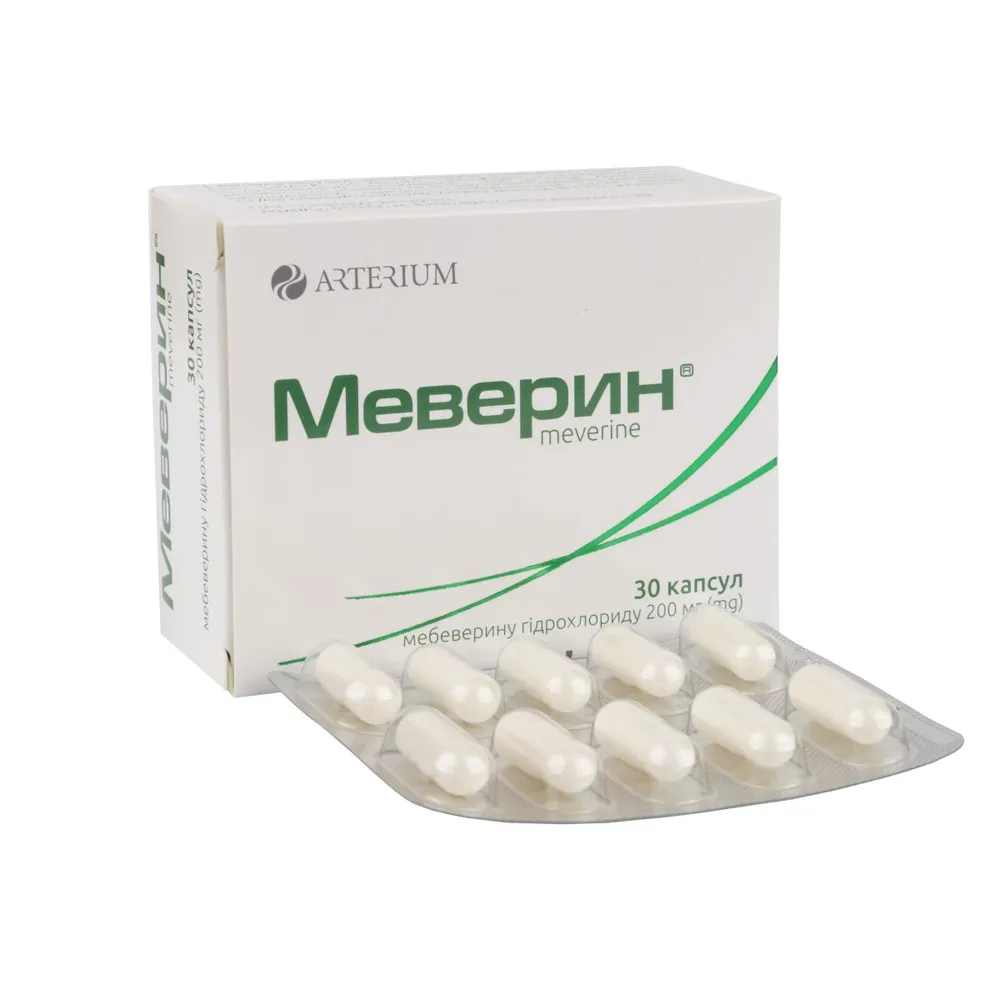
Table of Contents
INSTRUCTIONS FOR MEDICAL USE OF THE MEDICINAL PRODUCT MEVERINE® (MEVERINE)
Composition:
Active ingredient: mebeverine;
1 capsule contains mebeverine hydrochloride, pellets containing the active substance, calculated as mebeverine hydrochloride – 200 mg;
Excipients included in the pellets: sucrose, corn starch, povidone, ethylcellulose, talc, shellac;
Capsule shell: titanium dioxide (E 171), gelatin.
Pharmaceutical form. Capsules.
Main physicochemical properties: hard gelatin capsules size №1, white in color. The capsule contents are white or almost white granules (pellets), or white with a creamy tint, spherical in shape.
Pharmacotherapeutic group. Agents used in functional gastrointestinal disorders. Synthetic anticholinergic agents, esterified tertiary amines. ATC code A03A A04.
Pharmacological Properties
Pharmacodynamics
Mechanism of action and pharmacodynamic effects
Meberin**®** is a myotropic spasmolytic agent with selective action on smooth muscles of the gastrointestinal tract. In therapeutic doses, the drug blocks sodium channels in smooth muscle cell membranes, prevents sodium ions from entering the cell, and thereby prevents spasm of smooth muscles of internal organs. It relieves spasm without affecting normal intestinal peristalsis. Unlike cholinolytic agents, Meberin**®** does not act on M-cholinoreceptors and does not produce the typical side effects associated with spasmolytics having M-cholinoblocking action (such as dry mouth, visual disturbances, urinary retention), which allows its use in patients with benign prostatic hyperplasia or glaucoma. Administration of Meberin**®** is not accompanied by the development of reflex intestinal hypotonia.
Children
Mebeverine is also effective in relieving symptoms of irritable bowel syndrome in children.
The capsule dosage regimen is based on the safety and tolerability of mebeverine.
Pharmacokinetics
Absorption
Mebeverine is rapidly and completely absorbed after oral administration in tablet form. Due to the prolonged release of the drug from the capsule, it can be administered twice daily.
Distribution
With repeated administration of Meberin**®**, no significant accumulation occurs.
Biotransformation
Mebeverine hydrochloride is mainly metabolized by esterases, which in the first stage of metabolism cleave the ester bonds, forming veratric acid and mebeverine alcohol.
Elimination
Mebeverine is not excreted unchanged; it is completely metabolized, and metabolites are almost entirely eliminated. Veratric acid is excreted in urine. Mebeverine alcohol is also excreted by the kidneys in the form of the corresponding carboxylic or demethylcarboxylic acid.
Children
Pharmacokinetic studies have not been conducted in children.
Clinical characteristics.
Indications.
Adults and children aged 10 years and older:
- symptomatic treatment of pain, spasms, intestinal disorders, and sensation of discomfort in the intestine associated with irritable bowel syndrome;
- treatment of secondary gastrointestinal spasms caused by organic diseases.
Contraindications.
Hypersensitivity to the active substance or to any of the excipients.
Interaction with other medicinal products and other forms of interaction.
Studies on interaction with alcohol have been conducted. In vitro and in vivo studies in animals demonstrated absence of any interaction between mebeverine and ethanol.
Special precautions for use.
Due to the content of sucrose, the use of the drug is not recommended in patients with rare hereditary fructose intolerance, glucose-galactose malabsorption, or sucrase-isomaltase deficiency.
The drug should not be used in patients with porphyria.
Since the drug does not exhibit typical anticholinergic adverse effects, it can be used in patients with benign prostatic hyperplasia and glaucoma.
The drug should be used with caution in patients with severe hepatic or renal impairment and in those with cardiac conduction blocks.
Use during pregnancy or breastfeeding.
There are only very limited data on the use of mebeverine in pregnant women. Reproductive toxicity studies in animals are insufficient. Meberin® is not recommended during pregnancy.
It is unknown whether mebeverine or its metabolites are excreted in human breast milk. Excretion of mebeverine into animal breast milk has not been studied. Meberin® should not be used during breastfeeding.
There are no clinical data on the effect on male or female fertility; however, animal studies do not indicate harmful effects of mebeverine.
Ability to influence reaction speed when driving or operating machinery.
Studies on the influence on the ability to drive a vehicle or operate machinery have not been conducted. However, the pharmacodynamic and pharmacokinetic profile, as well as post-marketing experience, do not indicate any harmful effect on the ability to drive or operate machinery.
Method of Administration and Dosage
For oral use.
Swallow the capsules with sufficient amount of water (not less than 100 ml). Do not chew the capsules.
For adults and children aged 10 years and older, the recommended dose is 1 capsule twice daily (in the morning and evening).
Duration of treatment is not limited. If one or more doses are missed, the patient should take the next dose as prescribed. Do not take the missed dose(s) additionally to the regular dose.
There are no data indicating specific risks in elderly individuals or in patients with impaired renal and/or hepatic function. Dose adjustment is not required for the aforementioned patient groups.
Children.
Mebaverine hydrochloride should not be used in children under 3 years of age due to lack of clinical data in this age group. Meverin® capsules should also not be used in children aged 3 to 10 years due to the high content of the active substance.
Overdose.
In case of overdose, theoretically, central nervous system excitation may occur. In reported cases of mebeverine overdose, symptoms were either absent or mild and rapidly resolved. Symptoms observed were of neurological or cardiovascular origin. No specific antidote is known. Symptomatic treatment is recommended. Gastric lavage is recommended only in cases of intoxication with multiple drugs diagnosed within 1 hour after drug intake. Measures to reduce absorption are not necessary.
Side effects.
The following adverse reactions have been reported spontaneously during post-marketing use. The frequency cannot be precisely determined based on available data.
Allergic reactions, primarily affecting the skin, have been observed.
Skin and subcutaneous tissue disorders:
Urticaria, angioneurotic edema, facial swelling, and rash.
Immune system disorders:
Hypersensitivity (anaphylactic reactions).
Shelf life. 3 years.
Storage conditions.
Store in the original packaging at a temperature not exceeding 25°C.
Keep out of reach of children.
Packaging. 200 mg capsules, 10 in a blister pack, 3 blisters per carton.
Prescription status. Prescription only.
Manufacturer. JSC "Kyivmedpreparat".
Manufacturer's address and location of business activity.
139 Saksahanskoho Street, Kyiv, 01032, Ukraine.