Metronidazole-zdorovya
Ukraine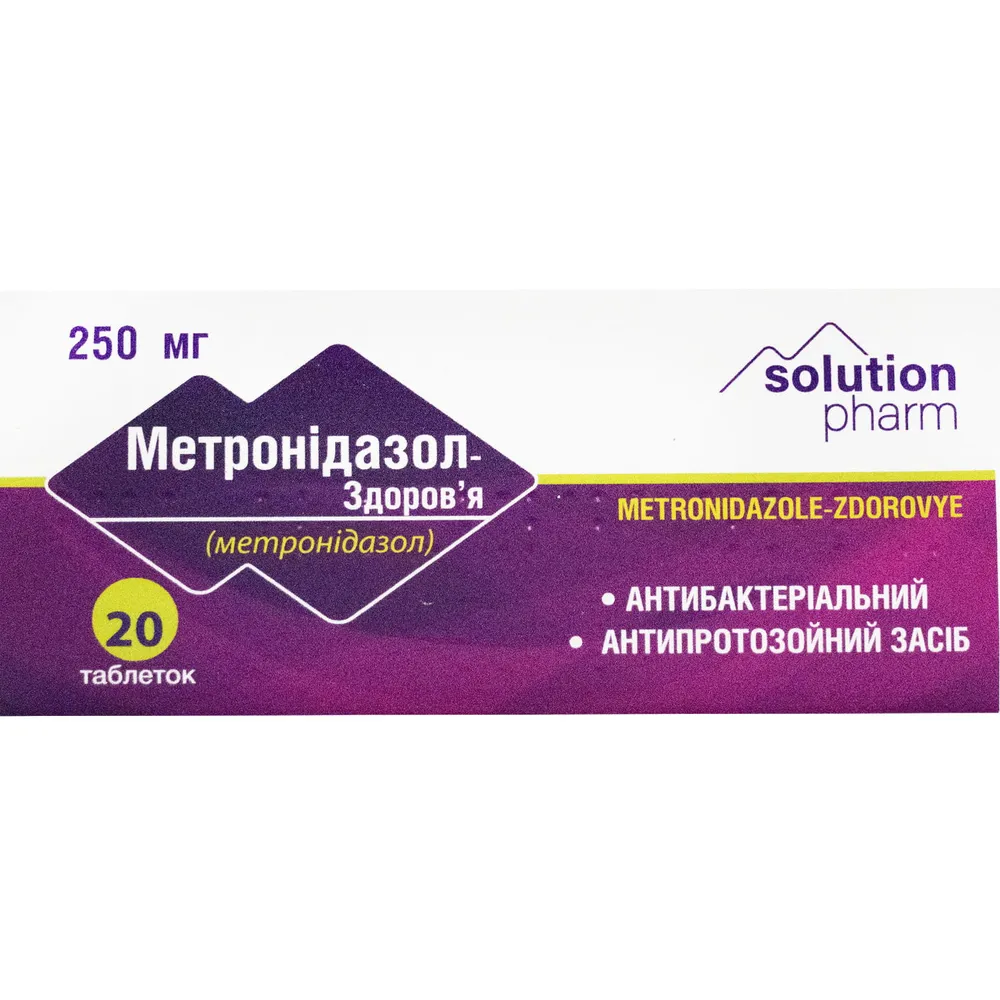
Table of Contents
INSTRUCTIONS FOR MEDICAL USE OF THE MEDICINAL PRODUCT METRONIDAZOLE-ZDOROV'YA
Composition:
Active substance: 1 tablet contains 250 mg of metronidazole;
Excipients: pregelatinized starch, hypromellose, sodium croscarmellose, microcrystalline cellulose, stearic acid.
Pharmaceutical form. Tablets.
Main physicochemical properties: white or off-white to yellowish-greenish tinted tablets, flat cylindrical shape, with a score line and bevel.
Pharmacotherapeutic group. Antibacterial agents for systemic use. Antiprotozoal agents. Imidazole derivatives. ATC code J01X D01.
Agents for the treatment of amoebiasis and other protozoal diseases. Antiprotozoal agents.
ATC code P01A B01.
Pharmacological properties.
Pharmacodynamics. Metronidazole belongs to the nitro-5-imidazoles and has a broad spectrum of activity. The serum concentration thresholds of the drug that allow differentiation of susceptible strains (S) from strains with moderate susceptibility, and strains with moderate susceptibility from resistant strains (R), are as follows: S < 4 mg/L and R > 4 mg/L.
The prevalence of acquired resistance among certain microbial species may vary depending on geographical location and time. Therefore, it is useful to have information on local resistance patterns, especially when treating severe infections. These data serve only as general guidelines indicating the likelihood that a particular bacterial strain is susceptible to this antibiotic.
Organisms susceptible to the drug include: Peptostreptococcus spp., Clostridium spp., Bacteroides spp., Fusobacterium spp., Porphyromonas, Bilophila, Helicobacter pylori, Prevotella spp., Veilonella. Metronidazole inhibits the growth of protozoa—Trichomonas vaginalis, Giardia intestinalis (Lamblia intestinalis), Entamoeba histolytica. Organisms with variable susceptibility: Bifidobacterium spp., Eubacterium spp. Resistant microbial strains: Propionibacterium, Actinomyces, Mobiluncus.
Pharmacokinetics.
Absorption. After oral administration, metronidazole is rapidly and almost completely absorbed (at least 80% within one hour). The Cmax in serum achieved after oral administration is similar to that achieved after intravenous infusion of equivalent doses.
The oral bioavailability is 100% and is not significantly reduced by concomitant food intake.
Distribution. Approximately one hour after a single 500 mg dose, the mean Cmax in plasma is 10 µg/mL. After 3 hours, the mean plasma concentration is 13.5 µg/mL.
T½ is 8–10 hours; plasma protein binding is minimal—no more than 20%. The volume of distribution is high (approximately 40 L, i.e., 0.65 L/kg).
Distribution is rapid and extensive, achieving concentrations close to plasma levels in the lungs, kidneys, liver, skin, bile, cerebrospinal fluid, saliva, seminal fluid, and vaginal secretions.
Metronidazole crosses the placental barrier and is excreted in breast milk.
Biotransformation. Metronidazole is metabolized in the liver via oxidation. Two metabolites are formed:
- The main hydroxy metabolite, which exhibits approximately 30% of the antibacterial activity of metronidazole against anaerobic bacteria; its T½ is approximately 11 hours;
- The acidic metabolite, present in smaller amounts, which provides approximately 5% of metronidazole's antibacterial activity.
Elimination. High concentrations are found in the liver and bile; low concentrations in the colon; negligible fecal elimination. The drug is excreted via the kidneys by 35–65% (as unchanged metronidazole and oxidized metabolites).
Clinical characteristics.
Indications. Infections caused by microorganisms sensitive to the drug: amoebiasis; urogenital trichomoniasis; nonspecific vaginitis; giardiasis; surgical infections caused by anaerobic microorganisms sensitive to metronidazole; replacement of intravenous treatment of infections caused by anaerobic microorganisms sensitive to metronidazole.
Contraindications. Hypersensitivity to metronidazole or to imidazole group drugs, or to other components of the drug; pediatric use under 6 years of age due to the pharmaceutical form.
Interaction with other medicinal products and other types of interactions.
Antabuse-like reaction. There are many medicinal products that trigger an antabuse-like reaction to alcohol, and their concomitant use with alcohol is not recommended.
Combinations not recommended.
Alcohol (as a beverage or excipient). Antabuse effect (flushing, erythema, vomiting, tachycardia). Consumption of alcoholic beverages and medicinal products containing alcohol should be avoided.
Disulfiram. Risk of developing acute psychotic episodes or confusion, which are reversible after discontinuation of the drug.
Busulfan. When high-dose busulfan is administered: doubling of busulfan concentrations in patients receiving metronidazole.
Combinations requiring precautions during use.
Enzyme-inducing anticonvulsants. Decreased plasma concentrations of metronidazole due to enhanced hepatic metabolism induced by enzyme inducers. Clinical monitoring is indicated and dosage adjustment of metronidazole may be necessary during and after treatment with the inducer.
Rifampicin. Decreased plasma concentrations of metronidazole due to enhanced hepatic metabolism by rifampicin. Clinical monitoring is indicated and dosage adjustment of metronidazole may be necessary during and after treatment with rifampicin.
Lithium. Increased blood lithium levels, which may reach toxic levels, with signs of lithium overdose. Careful monitoring of blood lithium levels is required; dosage adjustment may be necessary.
Combinations requiring special attention.
Fluorouracil (and, by extrapolation, tegafur and capecitabine). Increased fluorouracil toxicity due to reduced clearance.
Special issues regarding INR (International Normalized Ratio). In patients receiving antibacterial therapy, numerous cases of enhanced activity of oral anticoagulants have been reported. Risk factors include severity of infection or inflammation, patient's age, and general health status. Under these circumstances, it is difficult to determine to what extent the imbalance in INR is influenced by the infection itself or by its treatment. However, certain antibiotic classes are more frequently associated with this effect, particularly fluoroquinolones, macrolides, tetracyclines, co-trimoxazole, and some cephalosporins.
Special precautions for use.
Hypersensitivity/reactions affecting the skin and its appendages. Allergic reactions, including anaphylactic shock, which may be life-threatening, can occur. In such cases, metronidazole therapy must be discontinued and appropriate treatment initiated.
If generalized erythema and pustular eruptions accompanied by fever develop at the beginning of treatment, acute generalized exanthematous pustulosis (AGEP) should be suspected. In such cases, treatment with the drug must be discontinued, and further use of metronidazole, either alone or in combination with other drugs, is contraindicated.
Effects on the nervous system. The drug should be discontinued if patients develop ataxia, dizziness, or confusion.
In patients with severe, chronic, or active diseases of the peripheral or central nervous system, the risk of neurological status exacerbation should be considered.
During prolonged treatment, patients should be monitored for signs indicating possible adverse effects such as central or peripheral neuropathy (paresthesia, ataxia, dizziness, seizures).
If aseptic meningitis occurs in patients during metronidazole therapy, re-administration of the drug is not recommended, or the decision to re-administer should be based on a benefit-risk assessment in patients with serious infections.
Psychiatric effects. Psychotic reactions may occur immediately after starting treatment with this drug and may be associated with behavior placing patients at risk, especially in those with a history of psychiatric disorders. If such reactions occur, metronidazole should be discontinued, the physician should be informed, and appropriate therapeutic measures should be initiated immediately.
Hematological effects. In patients with a history of hematological disorders or those receiving high doses and/or prolonged treatment, regular blood tests, particularly leukocyte counts, should be performed.
For patients with leukopenia, the decision on continuing treatment depends on the severity of the infection.
Hepatotoxicity in patients with Cockayne syndrome. Cases of severe hepatotoxicity/acute liver failure, including fatal cases with rapid progression, have been reported in patients with Cockayne syndrome receiving systemic metronidazole-containing medicinal products. Therefore, metronidazole should not be used in these patients except when the benefit outweighs the risk and no alternative therapy is available. Liver function tests should be performed immediately before starting therapy, during treatment, and after its completion until liver function parameters return to normal or baseline values. If liver function parameters significantly increase during treatment, the drug should be discontinued. Patients with Cockayne syndrome should be advised to discontinue metronidazole immediately and inform their physician if any symptoms suggestive of potential liver injury occur (see section "Adverse reactions").
Pediatric patients. The use of tablets is contraindicated in children under 6 years of age due to the risk of choking. Other dosage forms of metronidazole-based drugs are available for younger children.
Interaction with other medicinal products. Concomitant use of metronidazole and alcohol is not recommended. Concomitant use of metronidazole and busulfan is not recommended. Concomitant use of metronidazole and disulfiram is not recommended.
Effect on laboratory test results. Metronidazole may immobilize treponemes, thereby leading to false-positive results in the Nelson test.
Use during pregnancy or breastfeeding.
Pregnancy. Teratogenic effects were not observed in animals. Since teratogenic effects are not observed in animals, malformations in humans are not expected. According to available data, substances causing developmental abnormalities in humans also exhibit teratogenic effects in animals. From a clinical standpoint, no fetotoxic effects on pregnancy have been reported.
However, more data are needed to confirm the absence of risk. Therefore, metronidazole should be prescribed during pregnancy only if clearly necessary, when the benefit of using the drug outweighs the potential risk.
Breastfeeding. Metronidazole passes into breast milk. The drug should not be used during breastfeeding.
Ability to influence reaction speed when driving or operating machinery. Individuals who drive vehicles or operate machinery should be aware of the possible occurrence of confusion, dizziness, hallucinations, seizures, or visual disturbances during treatment with this drug and should refrain from driving vehicles or operating machinery during therapy.
Dosage and Administration
For amoebiasis: Administer the drug continuously for 7 days.
Adults: 1.5 g per day, i.e., 500 mg (2 tablets) three times daily.
Children aged 6 years and older: 30–40 mg/kg body weight per day in three divided doses.
In cases of hepatic abscess due to amoebiasis, drainage or aspiration of pus should be performed concurrently with metronidazole therapy.
For giardiasis: Treat for 5 days. Adults should receive 750 mg–1 g of the drug per day. Children aged 6–10 years: 375 mg/day; children aged 10–15 years: 500 mg/day. To achieve the prescribed dosage, use metronidazole in appropriate strengths or other pharmaceutical forms.
For trichomoniasis in women (urethritis and vaginitis caused by trichomonads): Administer the drug for a 10-day treatment course, combining 250 mg (1 tablet) twice daily with one vaginal suppository (500 mg) daily. The sexual partner must be treated simultaneously, regardless of the presence or absence of clinical signs of trichomoniasis, even if laboratory test results are negative.
For trichomoniasis in men (urethritis caused by trichomonads): Administer the drug for a 10-day treatment course: 250 mg (1 tablet) twice daily.
In exceptional cases, it may be necessary to increase the daily dose to 750 mg or 1 g.
For non-specific vaginitis: Administer 500 mg (2 tablets) of the drug twice daily for 7 days. The sexual partner should be treated simultaneously.
For the treatment of anaerobic infections (first-line therapy or substitute treatment): Administer 1–1.5 g (4–6 tablets) of the drug per day to adults; for children aged 6 years and older: 20–30 mg/kg body weight per day in two divided doses.
Children: The 250 mg tablet formulation may be administered to children aged 6 years and older.
Overdose: Single ingestions of up to 12 g have been observed in suicide attempts and accidental overdoses.
Symptoms included vomiting, ataxia, and mild disorientation. There is no specific antidote. In cases of significant overdose, symptomatic therapy should be administered.
Adverse reactions.
Gastrointestinal disorders: mild gastrointestinal disturbances (epigastric pain, nausea, vomiting, diarrhea); glossitis with dryness of the mouth, stomatitis, taste disturbances, anorexia; pancreatitis, which is reversible after discontinuation of the drug.
Skin and subcutaneous tissue disorders: flushing, pruritus, skin rash, sometimes accompanied by fever; urticaria, angioneurotic edema, anaphylactic shock; very rare cases of acute generalized exanthematous pustulosis.
Nervous system disorders: headache, peripheral sensory neuropathy, convulsions, dizziness, confusion; cases of encephalopathy and subacute cerebellar syndrome (ataxia, dysarthria, gait disturbances, nystagmus, tremor), which may resolve after discontinuation of the drug; aseptic meningitis.
Eye disorders: transient visual disturbances such as diplopia, myopia, blurred vision, decreased visual acuity, color vision changes; optic neuropathy/optic neuritis.
Psychiatric disorders: hallucinations; psychotic reactions with paranoia and/or delirium, which in some cases may be associated with suicidal thoughts or suicide attempts; depressed mood.
Blood and lymphatic system disorders: neutropenia, agranulocytosis, thrombocytopenia.
Hepatobiliary disorders: reversible abnormalities in liver function tests, cholestatic or mixed hepatitis (sometimes accompanied by jaundice). During systemic administration of metronidazole in patients with Cockayne syndrome, cases of severe irreversible hepatotoxicity/acute liver failure, including fatal cases with rapid progression, have been reported (see section "Special precautions").
Other: reddish-brown discoloration of urine due to water-soluble pigments formed during the metabolism of metronidazole.
Shelf life. 5 years.
Storage conditions. Store in the original packaging at a temperature not exceeding 25 °C. Keep out of reach of children.
Packaging. 250 mg tablets: № 20 (20x1), № 20 (10x2) in blisters in a box.
Prescription status. Prescription only.
Manufacturer. LIMITED LIABILITY COMPANY "CORPORATION "ZDOROV'YA".
Limited Liability Company "FARMEKS GROUP".
Manufacturer's address and location of business activity. Ukraine, 61013, Kharkiv region, city of Kharkiv, Shevchenko Street, 22.
(LIMITED LIABILITY COMPANY "CORPORATION "ZDOROV'YA")
Ukraine, 08301, Kyiv region, city of Boryspil, Shevchenko Street, 100.
(Limited Liability Company "FARMEKS GROUP")