Metronidazole
Ukraine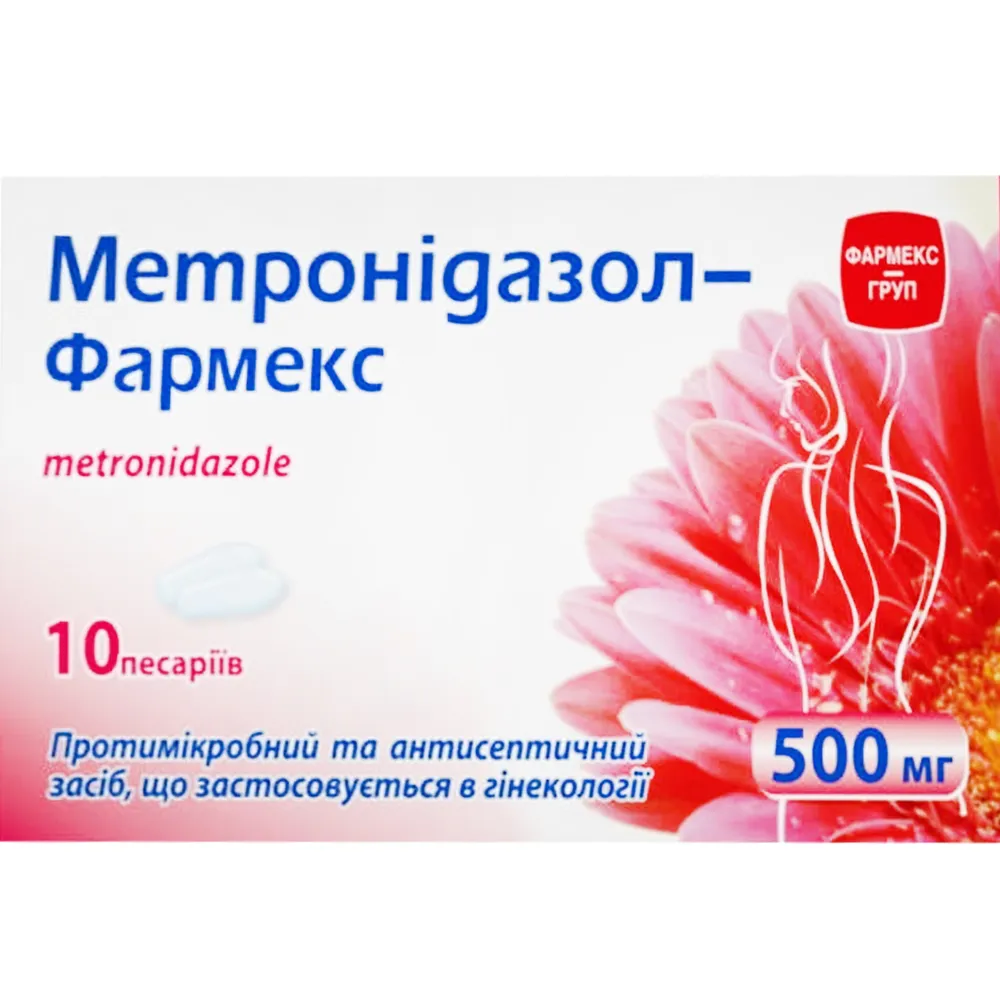
Table of Contents
INSTRUCTIONS
for medical use of the medicinal product METRONIDAZOLE (METRONIDAZOLE)
Composition:
Active substance: metronidazole;
1 suppository contains 500 mg of metronidazole;
Excipient: hard fat.
Pharmaceutical form. Suppositories.
Main physicochemical properties: cylindrical-conical shaped suppositories, white or white with a yellowish tint. Presence of an air-filled porous core and a funnel-shaped depression in the cross-section is permissible.
Pharmacotherapeutic group. Antimicrobial and antiseptic agents used in gynecology. ATC code G01AF01.
Pharmacological properties
Pharmacodynamics.
Metronidazole belongs to nitro-5-imidazoles and has a broad spectrum of activity. The breakpoint concentrations that allow distinguishing susceptible strains (S) from moderately susceptible strains, and moderately susceptible strains from resistant strains (R), are S < 4 mg/L and R > 4 mg/L.
Organisms sensitive to the drug: Peptostreptococcus spp., Clostridium spp., Bacteroides spp., Fusobacterium spp., Porphyromonas, Bilophila, Helicobacter pylori, Prevotella spp., Veilonella. Metronidazole inhibits the growth of protozoa – Trichomonas vaginalis, Giardia intestinalis (Lamblia intestinalis), Entamoeba histolytica. Organisms with variable sensitivity to the drug: Bifidobacterium spp., Eubacterium spp. Insensitive microbial strains: Propionibacterium, Actinomyces, Mobiluncus.
Pharmacokinetics.
After vaginal administration, systemic absorption is minimal.
The plasma elimination half-life is 8–10 hours.
Plasma protein binding is negligible (less than 20%).
Rapid and pronounced diffusion into lungs, kidneys, liver, bile, cerebrospinal fluid, skin, saliva, and vaginal secretions. Crosses the placental barrier and is excreted in breast milk.
Metabolism occurs mainly in the liver: two non-conjugated oxidized active metabolites are formed (5–30% of the parent compound's activity).
Excretion is primarily renal: 35–65% of the administered dose is excreted in urine as metronidazole and its oxidized metabolites.
Clinical characteristics.
Indications.
Local treatment of trichomonal and nonspecific vaginitis.
Contraindications.
Hypersensitivity to metronidazole or to any other component of the drug. Hypersensitivity to imidazole derivatives.
It is not recommended to administer in combination with disulfiram or alcohol (see section "Interaction with other medicinal products and other types of interactions").
Interaction with other medicinal products and other types of interactions.
Disulfiram: cases of acute transient encephalopathy (acute confusional state, disorientation) have been reported in patients receiving metronidazole and disulfiram concurrently.
Alcohol: alcoholic beverages and medicinal products containing alcohol should not be consumed during treatment and for at least one additional day after its completion due to the possible occurrence of a disulfiram-like (antabuse) reaction (flushing, erythema, vomiting, tachycardia).
Oral anticoagulant therapy (warfarin-like): enhanced effects of oral anticoagulants and increased risk of hemorrhagic complications due to slowed metabolism in the liver. Prothrombin levels and INR (International Normalized Ratio) should be monitored more frequently. Dose adjustment of the oral anticoagulant is recommended during metronidazole therapy and for 8 days after discontinuation.
Lithium: plasma lithium levels may increase when metronidazole is administered. Plasma concentrations of lithium, creatinine, and electrolytes should be monitored in patients receiving lithium and metronidazole concurrently.
Cyclosporine: there is a risk of increased serum levels of cyclosporine. If concomitant use is necessary, serum levels of cyclosporine and creatinine should be closely monitored.
Phenytoin or phenobarbital: reduce plasma levels of metronidazole.
5-fluorouracil: reduced clearance of 5-fluorouracil leads to increased 5-fluorouracil toxicity.
Busulfan: metronidazole may increase busulfan plasma levels, which could result in significant busulfan toxicity.
Changes in International Normalized Ratio (INR). Numerous cases of increased activity of oral anticoagulants have been reported in patients receiving antibacterial therapy. Factors predisposing to this complication include presence of infection or marked inflammation, patient age, and general health status. Under these circumstances, it is difficult to determine to what extent the disturbance in INR balance is due to the infection itself or its treatment. However, certain classes of antibiotics play a greater role, particularly: fluoroquinolones, macrolides, tetracyclines, co-trimoxazole, and some cephalosporins.
Laboratory test results. Metronidazole may immobilize treponemes, leading to a false-positive Nelson test.
Special precautions for use.
Metronidazole does not have a direct effect on aerobic or facultative anaerobic bacteria.
Metronidazole should not be prescribed for longer than 10 days or more frequently than 2 or 3 times per year.
Alcohol consumption should be avoided during metronidazole treatment (disulfiram-like reaction (see section "Interaction with other medicinal products and other forms of interaction")).
There is a possibility of persistence of gonococcal infection after elimination of trichomonas infection.
In patients undergoing hemodialysis, metronidazole and its metabolites are eliminated during 8 hours of hemodialysis; therefore, metronidazole should be administered immediately after hemodialysis.
Dosage adjustment is not required in patients with renal impairment undergoing peritoneal dialysis.
The drug should be discontinued if a patient develops ataxia, dizziness, or confusion.
In patients with severe, chronic, or progressive diseases of the peripheral or central nervous system, the risk of neurological status exacerbation should be taken into account.
In patients with a history of hematological disorders or those receiving the drug in high doses and/or for prolonged periods, regular blood tests, especially leukocyte count, should be performed.
Metronidazole should be used with caution in patients with hepatic encephalopathy. In patients with hepatic encephalopathy, the daily dose should be reduced by one third and may be administered once daily.
In patients with leukopenia, the decision to continue treatment will depend on the severity of the infectious disease.
In case of prolonged treatment, patients should be monitored for the development of adverse reactions such as central or peripheral neuropathy (paresthesia, ataxia, dizziness, seizures).
Patients should be informed that metronidazole may darken the urine (due to active metabolite).
Use of suppositories may increase the risk of latex condom or diaphragm rupture when used with them.
Use during pregnancy or breastfeeding.
Pregnancy. Clinical data have not demonstrated any specific teratogenic or fetotoxic effects associated with metronidazole. However, the absence of such risk can only be confirmed by epidemiological studies. Therefore, metronidazole should be prescribed during pregnancy only if clearly necessary.
Breastfeeding. Metronidazole is excreted in breast milk. Therefore, use of this medicinal product should be avoided during breastfeeding.
Ability to affect reaction speed when driving or operating machinery.
If dizziness, hallucinations, seizures, or temporary visual disturbances occur during treatment, patients should refrain from driving or operating machinery.
Method of Administration and Dosage
The drug may be used for treatment of adult patients only.
Trichomonas vaginitis. Administer 1 suppository once daily for 10 days. Insert the suppository deeply into the vagina. In trichomonas vaginitis, treatment should be combined with oral administration of metronidazole.
Nonspecific vaginitis. Insert 1 suppository deeply into the vagina once daily for 7 days. If necessary, oral metronidazole may be prescribed. Simultaneous treatment of the patient's sexual partner is absolutely essential, even in the absence of infection symptoms in the partner.
The maximum duration of treatment with Metronidazole should not exceed 10 days, and the number of treatment courses should not exceed 2–3 per year.
Children.
The drug is contraindicated for use in children.
Overdose.
Possible symptoms include leukopenia, neuropathy, ataxia, vomiting, and mild disorientation. As a specific antidote for metronidazole is not known, symptomatic therapy is recommended.
Adverse Reactions.
Gastrointestinal side effects:
− epigastric pain, nausea, vomiting, diarrhea;
− inflammation of the oral mucosa, glossitis with dry mouth, stomatitis, taste disturbances (metallic taste), anorexia, coated tongue;
− very rare cases of pancreatitis, which are reversible.
Skin and appendages:
− flushing with hyperemia, pruritus, rashes, possibly accompanied by chills;
− urticaria, angioneurotic edema, rarely – anaphylactic shock;
− isolated cases of pustular rash and erythema multiforme.
Nervous system side effects:
− peripheral sensory neuropathy;
− headache, seizures, dizziness, ataxia, somnolence;
− very rare cases of encephalopathy (e.g., confusion, fever, photophobia, torticollis, hallucinations, paralysis, visual and motor disturbances) and subacute cerebellar syndrome (e.g., ataxia, dysarthria, gait disturbances, nystagmus, tremor), which may resolve after discontinuation of the drug;
− aseptic meningitis.
Psychiatric side effects:
− psychiatric disorders, including confusion, hallucinations, depressed mood.
Eye disorders:
− transient visual disturbances such as diplopia, myopia, blurred vision, decreased visual acuity, color vision changes;
− optic neuropathy/neuritis.
Hematological side effects:
− in isolated cases – agranulocytosis, neutropenia, thrombocytopenia, pancytopenia, and leukopenia.
Hepatobiliary disorders:
− in isolated cases – elevated liver enzymes (AST, ALT, alkaline phosphatase), cholestatic or mixed hepatitis, hepatocellular injury (hepatocyte damage), sometimes with jaundice;
− cases of liver failure requiring liver transplantation have been reported in patients treated with metronidazole and other antibiotics.
Musculoskeletal and connective tissue disorders:
− very rarely – myalgia, arthralgia.
Other adverse reactions:
− increased body temperature.
During treatment, urine may turn reddish-brown due to the presence of water-soluble pigments, which are metabolites of metronidazole.
Shelf life. 3 years.
Storage conditions. Store at a temperature not exceeding 25 ºC. Keep out of reach of children.
Packaging. 5 tablets per strip, 2 strips per cardboard box.
Prescription status. Prescription only.
Manufacturer.
“Farmaprim” S.R.L., Republic of Moldova / «Farmaprim» S.R.L., Republica Moldova.
Manufacturer’s address and location of business operations.
MD-4829, Str. Crinilor 5, Sat Porumbeni, Raionul Criuleni, Republica Moldova.
Marketing Authorization Holder.
GREEN BUSINESS SOLUTIONS SA, Switzerland.
Address of the Marketing Authorization Holder.
Rue Mercerie 12, c/o Drys Fiduciaire SA, 1003 Lausanne, Switzerland.