Mercazolil-zdorovya
Ukraine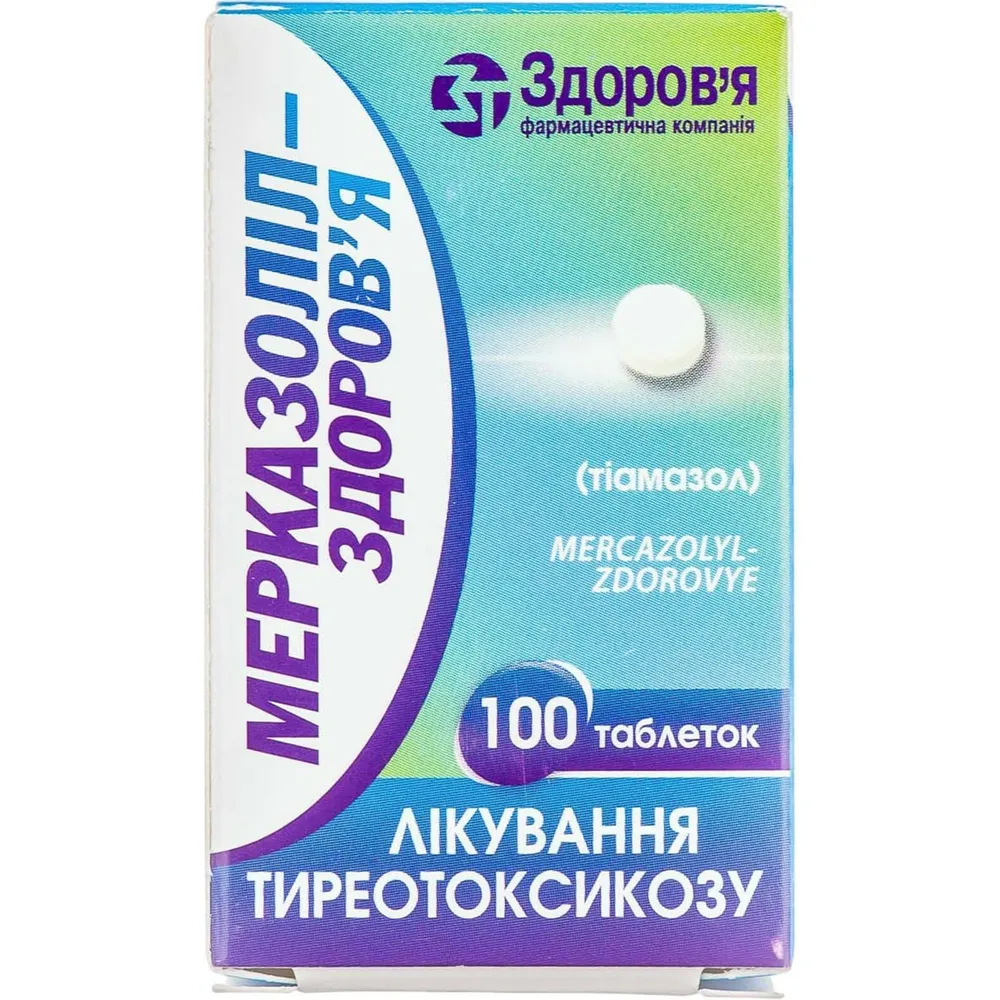
Table of Contents
INSTRUCTION FOR MEDICAL USE OF THE MEDICINAL PRODUCT MERCAZOLYL-ZDOROVYE (MERCAZOLYL-ZDOROVYE)
Composition:
Active substance: thiamazole;
1 tablet contains 5 mg of thiamazole;
Excipients: potato starch, calcium stearate, refined sugar, talc.
Medicinal form. Tablets.
Main physicochemical properties: tablets of white or white with a yellowish tint, with a flat surface and bevel.
Pharmacotherapeutic group. Antithyroid agents. ATC code H03B B02.
Pharmacological properties.
Pharmacodynamics.
Antithyroid agent. The thyrostatic effect is due to inhibition of the enzyme peroxidase activity, which participates in iodination of thyroid hormones in the thyroid gland, thereby disrupting the synthesis of thyroxine and triiodothyronine. This property allows symptomatic treatment of thyrotoxicosis regardless of its etiology. Thiamazole does not affect the secretion of previously synthesized thyroid hormones, which explains the prolonged latent period before normalization of thyroxine and triiodothyronine concentrations in blood serum, after which the clinical picture of the disease improves. It does not affect thyrotoxicosis that has developed due to hormone release following destruction of thyroid cells (after radioactive iodine treatment or in thyroiditis).
Pharmacokinetics.
After oral administration, thiamazole is rapidly and completely absorbed from the gastrointestinal tract. Cmax in plasma is reached within 40–80 minutes. It is practically not bound to plasma proteins. Thiamazole accumulates in the thyroid gland and is very slowly metabolized, resulting in a plateau of concentration on the kinetic curve, which remains for 24 hours after a single dose. The kinetics of metabolism do not depend on thyroid function. The half-life (T½) is 3 hours; in patients with hepatic insufficiency, it is prolonged. It is excreted in urine and bile, and to a minor extent in feces. In urine, it is excreted as metabolites (70% within 24 hours) and unchanged substance.
Clinical characteristics.
Indications.
Treatment of thyrotoxicosis.
- Conservative treatment of thyrotoxicosis, especially with absent or small goiter.
- Preparation for surgical treatment in all forms of thyrotoxicosis.
- Preparation for radioactive iodine therapy in thyrotoxicosis.
- Therapy during the latent period of action of radioactive iodine.
- Prevention of thyrotoxicosis when administering iodine-containing drugs in the presence of latent thyrotoxicosis, autonomous adenomas, or history of thyrotoxicosis.
Contraindications.
- Hypersensitivity to any component of the drug or other thionamide derivatives;
- Moderate to severe blood dyscrasias (granulocytopenia);
- Cholestasis prior to initiation of treatment not caused by thyrotoxicosis;
- Bone marrow damage following previous therapy with thiamazole or carbimazole;
- Acute pancreatitis following thiamazole or carbimazole use in medical history.
Concomitant therapy with thiamazole and thyroid hormones during pregnancy is contraindicated (see section "Use during pregnancy or breastfeeding").
Interaction with other medicinal products and other types of interactions.
Iodine deficiency increases thyroid gland sensitivity to thiamazole, whereas iodine excess reduces it. Other direct interactions with medicinal products are unknown. It should be considered that metabolism and elimination of other drugs may be increased in hyperthyroidism. These parameters normalize upon restoration of thyroid function. Dosage adjustments of concomitant drugs may be necessary.
Furthermore, correction of hyperthyroidism may normalize increased anticoagulant activity in patients with hyperthyroidism.
Drug interaction studies involving children have not been conducted.
Special precautions for use.
The medicinal product is not recommended for patients with a history of moderate hypersensitivity reactions (allergic rashes, pruritus).
The medicinal product should be used with caution in patients with very large goiter and tracheal compression: for as short a duration as possible and under close medical supervision due to the risk of goiter enlargement.
Myelotoxicity.
Agranulocytosis has been reported in 0.3–0.6% of cases. Particular attention should be paid to symptoms of agranulocytosis (stomatitis, pharyngitis, high body temperature) prior to initiating treatment. Symptoms typically occur at the beginning of treatment, but may also appear several months later or during a repeated course of therapy. Blood parameters should be monitored before and after initiation of therapy, especially in patients with moderate granulocytopenia. If any of the above symptoms develop, particularly during the first weeks of treatment, immediate medical consultation is required to perform a blood test. If agranulocytosis is confirmed, further treatment with the drug must be discontinued.
When used at recommended doses, adverse reactions due to bone marrow toxicity occur rarely. Such reactions have been frequently reported with very high doses of thiamazole (approximately 120 mg daily). Such doses are prescribed only under special indications (severe disease forms, thyrotoxic crisis). If signs of bone marrow toxicity occur during thiamazole treatment, the drug should be discontinued immediately, and if necessary, therapy should be switched to an antithyroid agent from another drug class.
Acute pancreatitis.
Cases of acute pancreatitis have been reported in patients receiving thiamazole or carbimazole. If acute pancreatitis develops, thiamazole must be discontinued immediately. Thiamazole should not be prescribed to patients who previously developed acute pancreatitis after taking thiamazole or carbimazole. Re-administration of these drugs may trigger a recurrence of acute pancreatitis, with a shorter time to onset of symptoms.
Women of reproductive age and pregnant women.
Women of reproductive age are advised to use effective contraception during thiamazole therapy. Thiamazole should be prescribed to pregnant women only after careful benefit-risk assessment and at the lowest effective doses, without additional administration of thyroid hormones. If used during pregnancy, careful monitoring of the mother, fetus, and newborn is required (see section "Use during pregnancy or breastfeeding").
Control of hyperthyroidism.
Excess of the drug in the body after administration of very high doses may lead to the development of subclinical/clinical hypothyroidism or goiter enlargement due to increased secretion of thyroid-stimulating hormone (TSH). Therefore, the drug dose should be reduced immediately after restoration of normal thyroid function, and levothyroxine may be prescribed if necessary. Complete discontinuation of the drug and replacement with levothyroxine alone is not recommended.
Goiter enlargement during thiamazole therapy, despite suppression of TSH secretion, occurs as a result of the underlying disease itself and cannot be prevented by additional levothyroxine administration.
Maintaining normal TSH secretion levels is important to minimize the risk of development or worsening of endocrine ophthalmopathy. However, this condition often does not depend on the course of thyroid disease. Such complications are not a reason to change the treatment regimen and are not considered adverse reactions when treatment is correctly administered.
Rarely, after completing a course of antithyroid therapy without surgical intervention, cases of late-onset hypothyroidism have been observed. This is not an adverse drug reaction but rather a consequence of inflammatory and destructive processes in the thyroid parenchyma caused by the underlying disease.
Due to reduced pathologically increased energy expenditure in hyperthyroidism, body weight may increase during thiamazole treatment. Improvement in clinical symptoms indicates normalization of energy metabolism.
The medicinal product contains refined sugar. If a patient has known sugar intolerance, medical advice should be sought before taking this product.
Use during pregnancy or breastfeeding.
Women of reproductive age.
Women of reproductive age should use effective contraceptive methods during treatment.
Pregnancy.
Adequate treatment of hyperthyroidism in pregnant women is necessary to prevent serious complications for both mother and fetus. Thiamazole crosses the placental barrier.
Clinical data and individual case reports indicate congenital abnormalities following high-dose thiamazole use during the first trimester of pregnancy. Specifically, congenital skin aplasia (defects healed spontaneously within several weeks), craniofacial developmental defects (choanal atresia, facial dysmorphism), omphalocele, esophageal atresia, omphalomesenteric duct anomaly, and ventricular septal defect have been reported.
Thiamazole may be prescribed during pregnancy only after careful benefit-risk assessment and at the lowest effective dose, without additional thyroid hormone administration. If thiamazole is used during pregnancy, close medical monitoring of the mother, fetus, and newborn is required.
Breastfeeding.
Thiamazole passes into breast milk, where its concentration reaches levels comparable to maternal serum concentrations, thereby posing a risk of hypothyroidism in the infant.
During breastfeeding, the drug should be administered at the lowest effective doses not exceeding 10 mg daily, without additional thyroid hormone administration.
Thyroid function in newborns should be monitored regularly.
Ability to affect reaction speed when driving or operating machinery.
The drug does not affect the ability to drive or operate machinery.
Dosage and Administration
Thiamazole is the active metabolite of carbimazole; however, 1 mg of thiamazole is not equivalent to 1 mg of carbimazole. This must be taken into account when initiating treatment with thiamazole or switching from carbimazole to thiamazole. The following dosage recommendations should be followed.
The daily dose may be administered once daily or divided into several doses throughout the day. At the beginning of treatment, doses should be taken at regular intervals during the day. The maintenance dose should be taken as a single dose, during or after breakfast.
Tablets should be swallowed whole, without chewing, with sufficient liquid.
If a dose is missed, the next dose should not be increased.
General Dosage Recommendations
Adults.
Depending on the severity of the disease and iodine intake, the recommended dose for adults is 10–40 mg per day. In many cases, suppression of thyroid hormone production is achieved with a daily dose of 20–30 mg. In mild cases of the disease, a lower dose should be prescribed; in severe cases, an initial dose of 40 mg per day is required.
Dosage adjustments should be individualized, taking into account the metabolic activity related to thyroid hormone production levels.
For maintenance therapy, the following dosing is recommended:
- Maintenance dose of 5–20 mg per day in combination with levothyroxine to prevent hypothyroidism;
- In monotherapy: 2.5–10 mg per day.
In cases of iodine-induced thyrotoxicosis, higher doses of the drug may be used.
Conservative Treatment of Thyrotoxicosis
The goal of therapy is to achieve a euthyroid state and sustained remission after a limited treatment duration. According to study data, remission can be achieved in up to 50% of patients within one year after therapy. It has been established that the time to achieve remission varies significantly depending on initial parameters. Probable influencing factors include the type of hyperthyroidism (immunogenic or non-immunogenic), duration of treatment, thiamazole dosage, and source of iodine: dietary or iatrogenic.
The duration of treatment with the drug ranges from 6 months to 2 years (on average, 1 year). The possibility of prolonging remission depends on the duration of therapy. In cases where remission cannot be achieved and other therapeutic interventions are not feasible, the drug may be used for long-term therapy at the lowest effective doses, either alone or in combination with a low dose of levothyroxine.
Patients with tracheal compression or very large goiters should receive the drug only for a short period. Prolonged therapy may lead to goiter growth.
Preparation for Surgical Treatment in All Forms of Thyrotoxicosis
Short-term preparatory therapy (for 3–4 weeks; in some cases, the drug may be used longer) helps restore the euthyroid state, thereby reducing risks associated with surgery.
Surgery should be performed immediately after achieving the euthyroid state. If surgery is not performed, levothyroxine should be administered. Thiamazole therapy may be discontinued one day before surgery.
During the last 10 days before surgery, the surgeon may additionally prescribe high-dose iodine preparations to firm up thyroid tissue (Plummer’s iodine therapy).
Preparation for Radioactive Iodine Therapy
The drug should be used to achieve a euthyroid state prior to initiating radioactive iodine therapy. Previous treatment with the drug is especially necessary for patients with severe thyrotoxicosis, as isolated cases of thyrotoxic crisis have been observed after radioactive iodine treatment without prior thiamazole therapy.
It should be noted that thiourea derivatives may reduce the sensitivity of thyroid tissue to radiation therapy. When planning radioactive iodine therapy for autonomous adenomas, prior treatment with the drug is necessary to prevent activation of parathyroid tissue.
Therapy During the Latent Period of Radioactive Iodine Action
The duration and dose of the drug should be individually adjusted based on disease severity and the expected onset of radioactive iodine action (approximately 4–6 months).
Prophylactic Treatment in Patients at Risk of Developing Hyperthyroidism When Iodine-Containing Drugs Are Prescribed for Diagnostic Purposes
The usual recommended dose is 10–20 mg of thiamazole per day and/or 1 g of perchlorate daily for 10 days (e.g., when administering a renal-excreted radiopaque agent). The duration of prophylactic treatment should be determined based on the period during which iodine-containing drugs remain in the body.
Special Patient Groups
Patients with Hepatic Impairment
In patients with impaired liver function, the elimination rate of thiamazole is reduced. Therefore, the drug should be used at the lowest effective doses, and patient monitoring is necessary during treatment.
Patients with Renal Impairment
Patients with renal insufficiency require individual dose adjustment and close monitoring, as there is insufficient data on the pharmacokinetic properties of the drug in this patient group.
Geriatric Patients
Individual dose adjustment and continuous monitoring are recommended for elderly patients, as there are no data on drug accumulation in this population. The drug should be used at the lowest effective doses.
Children
Children and Adolescents (3–17 years)
The initial dose for treating children and adolescents (3–17 years) is calculated based on body weight.
Treatment is generally initiated at 0.5 mg/kg per day, divided into two or three equal doses.
The maintenance dose may be reduced depending on the individual patient's response to therapy and administered once daily. To prevent hypothyroidism, additional levothyroxine may be required. The total daily dose should not exceed 40 mg of thiamazole.
Children under 2 years of age
The safety and efficacy of thiamazole in children under 2 years of age have not been studied.
The use of thiamazole in children under 2 years of age is not recommended.
Overdose
Overdose may lead to hypothyroidism with corresponding symptoms of slowed metabolism and, due to hormone deficiency, to activation of the adenohypophysis with subsequent goiter growth.
This can be avoided by reducing the dose of the drug until the euthyroid state is achieved. If necessary, levothyroxine may be additionally prescribed. The adverse effects of accidental ingestion of high doses of thiamazole are unknown.
Adverse Reactions
Undesirable effects are classified by frequency of occurrence into the following categories: very common (> 1/10), common (> 1/100, < 1/10), uncommon (> 1/1000, < 1/100), rare (> 1/10000, < 1/1000), very rare (< 1/10000), frequency not known (cannot be estimated from available data).
Blood and lymphatic system disorders: uncommon: agranulocytosis (occurs in approximately 0.3–0.6% of cases, may manifest several weeks or months after initiation of treatment, requiring discontinuation of the drug; in most cases, this condition resolves spontaneously after stopping the medication); very rare: thrombocytopenia, pancytopenia, generalized lymphadenopathy.
Endocrine system disorders: very rare: insulin autoimmune syndrome with a sharp decrease in blood glucose concentration.
Nervous system disorders: rare: taste disturbances (dysgeusia, ageusia), which resolve after discontinuation of the drug (sometimes taste sensation returns several weeks after completion of treatment); very rare: neuritis, polyneuropathy.
Gastrointestinal disorders: very rare: acute inflammation of the salivary glands; frequency not known: acute pancreatitis.
Hepatobiliary disorders: very rare: cholestatic jaundice or toxic hepatitis. Symptoms usually resolve after discontinuation of the drug. Clinically subtle signs of biliary stasis during treatment should be differentiated from dysfunctions caused by hyperthyroidism, such as elevated levels of γ-glutamyltransferase and alkaline phosphatase, or increased levels of the specific bone isoenzyme of alkaline phosphatase.
Skin and subcutaneous tissue disorders: very common: allergic skin reactions of varying severity (itching, rash, urticaria), usually of moderate severity, which resolve during continued therapy; very rare: severe forms of allergic skin reactions, including generalized dermatitis, alopecia, drug-induced lupus erythematosus.
Musculoskeletal and connective tissue disorders: common: arthralgia, developing gradually and may occur even several months after initiation of therapy.
General disorders: rare: drug-induced fever.
Children. The frequency, type, and severity of adverse reactions in children are expected to be similar to those observed in adult patients.
Very rare cases of serious hypersensitivity skin reactions, such as generalized dermatitis including Stevens–Johnson syndrome, have been reported in both adult and pediatric patients.
Shelf life. 5 years.
Storage conditions. Store in the original packaging at a temperature not exceeding 25 °C.
Keep out of reach of children.
Packaging. Tablets № 50, № 100 in a container within a carton; № 50 (10×5), № 100 (10×10) in blisters.
Prescription status. Prescription only.
Manufacturer. LIMITED LIABILITY COMPANY "CORPORATION "ZDOROV'YA".
Manufacturer's address and place of business.
22, Shevchenka Street, Kharkiv, Kharkiv Oblast, 61013, Ukraine.