Meratin combi
Ukraine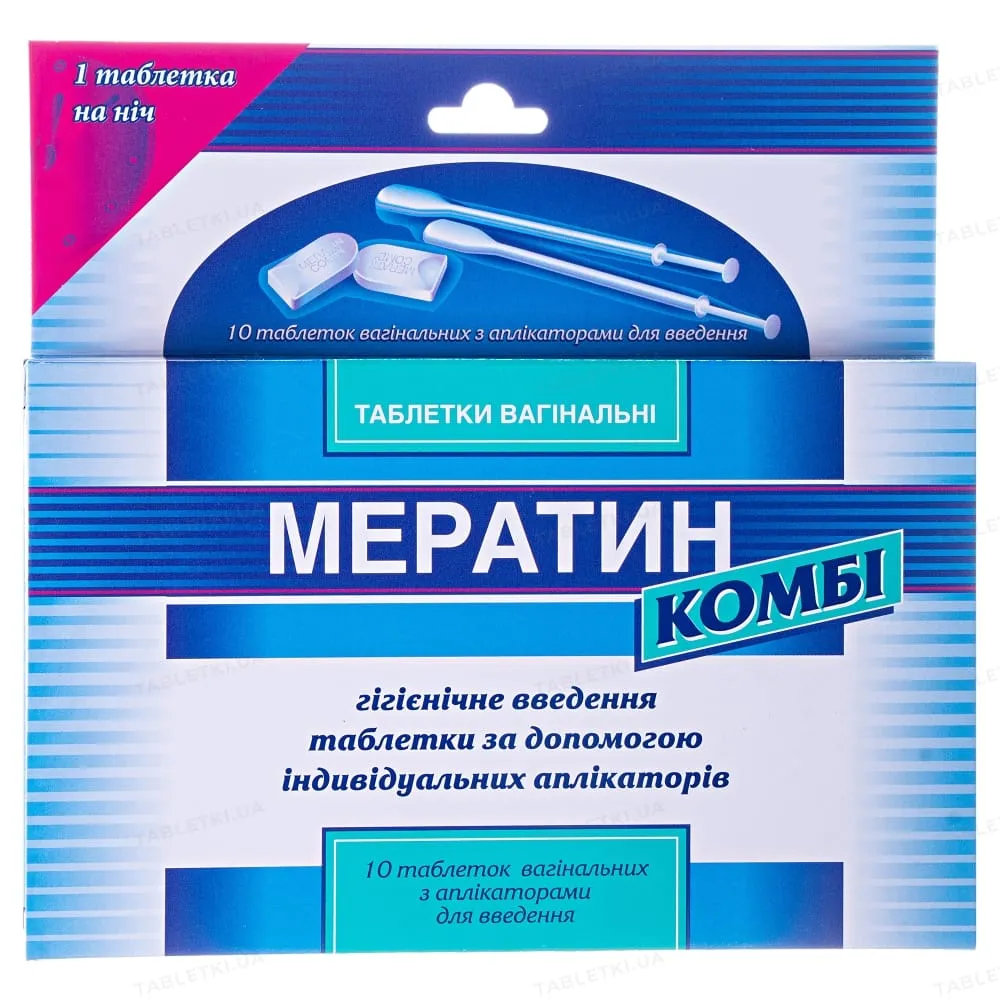
Table of Contents
INSTRUCTION FOR MEDICAL USE OF THE MEDICINAL PRODUCT MERAТIN COMBI (MERATINCOMBI)
Composition:
Active substances: ornidazole, neomycin sulfate, nystatin, prednisolone;
1 tablet contains: ornidazole 500 mg, neomycin sulfate 100 mg (68,000 IU), nystatin 100,000 IU, prednisolone 3 mg;
Excipients: maize starch, microcrystalline cellulose, propyl gallate, sodium methylparaben (E 219), sodium propylparaben (E 217), colloidal anhydrous silicon dioxide, talc, magnesium stearate, sodium starch glycolate (type A), sodium carmellose.
Pharmaceutical form. Vaginal tablets.
Main physicochemical properties: cream-colored, cartridge-shaped, biconvex, uncoated tablets with the imprint “MERATIN COMBI” on one side. Minor dark specks and marbling are permissible.
Pharmacotherapeutic group.
Antimicrobial and antiseptic agents used in gynecology. Imidazole derivatives and corticosteroids. ATC code G01AF.
Pharmacological properties.
Pharmacodynamics.
Ornidazole. The mechanism of action of ornidazole is associated with disruption of DNA structure in susceptible microorganisms. The drug easily penetrates the microbial cell and, by binding to DNA, interferes with the replication process. Ornidazole is active against Trichomonas vaginalis, Entamoeba histolytica, Giardia lamblia (Giardia intestinalis), as well as certain anaerobic bacteria such as Bacteroides and Clostridium spp., Fusobacterium spp., and anaerobic cocci.
Neomycin is an antibiotic belonging to the aminoglycoside group. Aminoglycosides exhibit high activity against both gram-negative and gram-positive bacteria.
Nystatin is an antifungal agent belonging to the polyene group. Nystatin acts on fungal membranes by binding to one of their components—ergosterol. This disrupts the structure of the fungal cell, leading to its death. This component of the drug exhibits selective toxicity against fungi because human cells and bacterial cells contain cholesterol instead of ergosterol.
Prednisolone is a synthetic corticosteroid used to reduce inflammatory manifestations. Prednisolone inhibits the secretion and release of inflammatory mediators. It suppresses proliferative processes in inflammatory diseases and reduces the likelihood of scar formation.
Pharmacokinetics.
When applied locally, the concentration of the drug in vaginal tissues is significantly higher than that achieved with oral or intravenous administration.
Clinical characteristics.
Indications.
Meratin Combi is indicated:
- for the treatment of gynecological disorders such as bacterial vaginosis and vaginitis, trichomonal vaginitis, fungal vaginitis caused by Candida albicans; vaginitis caused by mixed infections (trichomonads, anaerobic flora including Gardnerella and yeast-like fungi);
- for prophylactic purposes prior to surgical treatment of gynecological disorders, for vaginal sanitation before childbirth or abortion, before and after insertion of intrauterine contraceptives, before and after diathermocoagulation of cervical erosions, and before intrauterine examinations.
Contraindications.
Hypersensitivity to any component of the drug or to other derivatives of imidazole. Systemic and local infectious diseases until specific therapy has been initiated.
Interaction with other medicinal products and other forms of interaction.
Interactions related to prednisolone
Undesirable combinations:
- with acetylsalicylic acid: increased risk of bleeding when used concomitantly with anti-inflammatory doses of acetylsalicylic acid (≥ 1 g per dose or ≥ 3 g daily).
Combinations requiring caution:
- with anticonvulsants and enzyme-inducing agents: decreased plasma concentration and efficacy of corticosteroids due to enhanced hepatic metabolism. The consequences of this interaction are particularly severe (or significant) in patients with Addison's disease receiving hydrocortisone and in organ transplant recipients. Clinical and laboratory monitoring is required, along with dose adjustment of corticosteroids during and after treatment with enzyme-inducing agents;
- with isoniazid: reduced plasma concentration of isoniazid due to enhanced hepatic metabolism, and reduced hepatic metabolism of glucocorticosteroids;
- with rifampicin: reduced plasma concentration and efficacy of corticosteroids due to enhanced hepatic metabolism following interaction with rifampicin. The consequences of this interaction are particularly severe (or significant) in patients with Addison's disease receiving hydrocortisone and in organ transplant recipients. Clinical and laboratory monitoring is required, along with dose adjustment of corticosteroids during and after treatment with rifampicin;
- with other hypokalemic agents: increased risk of hypokalemia. Serum potassium levels should be monitored and corrected if necessary;
- with cardiac glycosides: hypokalemia exacerbates the toxic effects of cardiac glycosides. Before initiating treatment, assess for hypokalemia, determine serum potassium levels, and perform electrocardiography;
- with medicinal products that may cause polymorphic ventricular tachycardia of the "torsades de pointes" type: increased risk of ventricular arrhythmias, including polymorphic ventricular tachycardia of the "torsades de pointes" type. Before initiating treatment, assess for hypokalemia, determine serum potassium levels, and perform electrocardiography;
- with cyclosporine: enhanced effects of prednisolone, including Cushing-like symptoms, and reduced carbohydrate tolerance (decreased prednisolone clearance);
- with acetylsalicylic acid: increased risk of bleeding with antipyretic or analgesic doses of ≥ 500 mg per dose or < 3 g daily;
- with nonsteroidal anti-inflammatory drugs (NSAIDs): increased risk of peptic ulceration and gastrointestinal bleeding;
- with fluoroquinolones: increased risk of tendinitis or tendon rupture (rare), particularly in patients receiving long-term corticosteroid therapy.
Special precautions for use.
The medicinal product should be used with caution under constant medical supervision by specialists in patients who are simultaneously using systemic corticosteroids, and in patients with osteoporosis, arterial hypertension, heart failure, severe emotional disorders (including in medical history), tuberculosis, diabetes mellitus, glaucoma, corticosteroid-induced myopathy, hepatic insufficiency, epilepsy, peptic ulcer, hypothyroidism, or recent myocardial infarction.
The drug should be used with caution in patients with severe pseudoparalytic myasthenia gravis, ulcerative colitis, diverticulitis, and recent intestinal anastomoses.
Despite local application, systemic absorption of the drug is possible, especially during vaginal inflammation.
Adverse reactions can be minimized by using the drug for the shortest necessary treatment duration and under continuous medical supervision.
Meratin Combi may damage latex contraceptives and reduce the effectiveness of locally applied contraceptives; therefore, sexual intercourse should be avoided and local contraceptives (diaphragms, latex condoms, spermicides) should not be used during treatment with this drug.
Patients should use individual personal hygiene items (sponges, towels, etc.), wear underwear made of natural cotton, and use sanitary pads instead of tampons.
Appropriate treatment of the sexual partner should be carried out simultaneously to prevent reinfection.
Sodium methylparaben (E 219) and sodium propylparaben (E 217) contained in the drug may cause allergic reactions (possibly delayed).
Use during pregnancy or breastfeeding.
Contraindicated in the first trimester of pregnancy. Use during the second and third trimesters of pregnancy is possible if the expected benefit to the mother outweighs the potential risk to the fetus, as systemic concentrations of the drug components are minimal due to low absorption. The drug may be used during breastfeeding. However, if the drug is used as part of combination therapy with oral ornidazole, breastfeeding should be discontinued.
Ability to influence reaction rate while driving or operating machinery.
Has no effect.
Method of Administration and Dosage.
Insert 1 tablet deeply into the vagina at night. After insertion, the patient should remain lying down for at least 15 minutes. The average duration of treatment is 10 days.
Administration Instructions:
- Place the vaginal tablet into the applicator.
- Immerse the applicator with the tablet in warm (30–40 °C) boiled water or physiological saline (for individuals prone to allergic reactions) for 15–30 seconds.
- Carefully insert the applicator with the tablet as deeply as possible into the vagina (preferably while lying on the back).
- Leave the tablet in the vagina by expelling it from the applicator; remove the applicator.
Practical Tip.
For hygienic administration of the tablet, use an individual applicator for each application.
Treatment should be accompanied by adherence to personal hygiene: wear cotton underwear, avoid douching, use sanitary pads instead of tampons during treatment, and use separate personal hygiene items (sponge, towel, etc.).
Treatment should not be interrupted during menstruation.
Children.
Meratin Combi is not used in children.
Overdose.
Due to the local action of the medicinal product, overdose has not been observed. Possible intensification of adverse reactions may occur.
Treatment is symptomatic.
Side effects.
Immune system: hypersensitivity.
Skin and subcutaneous tissue: allergic dermatitis, rash, pruritus, urticaria.
Reproductive system: application site reactions such as stinging or irritation, erosions, vaginal edema, burning sensation in the vagina, vulvovaginal erythema, vulvovaginal pain, vulvovaginal pruritus. In case of systemic corticosteroid effects, delayed wound and fissure healing, mucosal atrophy may occur.
If adverse reactions occur, discontinue use of the drug and consult a physician.
Shelf life.
2 years.
Storage conditions.
Store at temperatures not exceeding 25 °C in the original packaging and in a place inaccessible to children.
Packaging.
10 tablets in a blister pack. One blister pack together with 10 applicators in a cardboard box.
Prescription category. Prescription only.
Manufacturer.
Mepro Pharmaceuticals Private Limited /
Mepro Pharmaceuticals Private Limited.
Manufacturer's address.
Unit II, Q-Road, Phase IV, GIDC, Wadhwan, Surendranagar, Gujarat, 363 035, India /
Unit II, Q-Road, Phase IV, GIDC, Wadhwan, Surendranagar, Gujarat, 363 035, India.
Marketing authorization holder.
Mili Healthcare Limited / Mili Healthcare Limited.
Address of the marketing authorization holder.
Second Floor Office Suite, 4 Chartfield House, Castle Street, Taunton, Somerset, England, TA1 4AS, Great Britain /
Second Floor Office Suite, 4 Chartfield House, Castle Street, Taunton, Somerset, England, TA1 4AS, Great Britain.