Merelis® intensive
Ukraine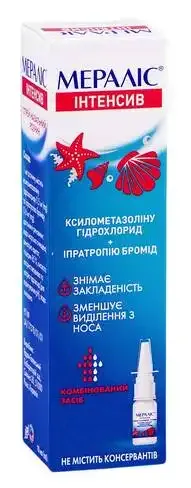
Table of Contents
INSTRUCTIONS FOR MEDICAL USE OF THE MEDICINAL PRODUCT MERALIS® INTENSIVE (MERALYS® INTENSIVE)
Composition:
Active substances: ipratropium bromide; xylometazoline hydrochloride;
1 ml contains 0.6 mg of ipratropium bromide and 0.5 mg of xylometazoline hydrochloride;
Excipients: purified seawater, disodium edetate, glycerol 85%, hydrochloric acid and sodium hydroxide (for pH adjustment), purified water.
Pharmaceutical form. Nasal spray, solution.
Main physicochemical characteristics: clear, colorless solution.
Pharmacotherapeutic group. Agents used in nasal cavity disorders. Decongestants and other agents for local use in nasal disorders. Sympathomimetics in combination with other agents (except corticosteroids). Xylometazoline. ATC code R01AB06.
Pharmacological properties.
Pharmacodynamics.
Xylometazoline hydrochloride is a sympathomimetic agent acting on α-adrenergic receptors. Xylometazoline exerts a vasoconstrictive effect, specifically causing constriction of blood vessels in the nasal mucosa, thereby reducing swelling and hyperemia of the nasopharyngeal mucosa. It relieves nasal breathing in rhinitis. The effect occurs within 5–10 minutes and lasts for 6–8 hours.
Ipratropium bromide is a quaternary ammonium compound with an anticholinergic effect. When administered intranasally, it reduces nasal secretions by competitively inhibiting cholinergic receptors located on nasal epithelium. The effect is usually achieved within 15 minutes and lasts on average 6 hours.
Pharmacokinetics.
After a single spray administration of 140 mcg xylometazoline and 84 mcg ipratropium bromide into each nostril in 24 healthy volunteers, the mean peak plasma concentrations of 0.085 ng/mL and 0.13 ng/mL were reached within 1 hour and 2 hours after administration for ipratropium bromide and xylometazoline, respectively. The active ingredients are present in blood plasma in negligible amounts. However, based on available data, accumulation of ipratropium bromide, and especially xylometazoline, may be expected following administration of the drug product three times daily.
Clinical characteristics.
Indications.
Symptomatic treatment of nasal congestion and rhinorrhea associated with respiratory tract diseases.
Contraindications.
Hypersensitivity to any component of the medicinal product.
Increased sensitivity to atropine or similar agents, such as hyoscine (scopolamine); history of surgical interventions on the meninges, e.g. transsphenoidal hypophysectomy or other transnasal surgeries; acute coronary conditions, coronary asthma, hyperthyroidism; angle-closure glaucoma, dry or atrophic rhinitis, pediatric population (under 18 years of age).
Interaction with other medicinal products and other forms of interaction.
Monoamine oxidase inhibitors (MAO inhibitors). Concomitant use of Meralis® Intensive with MAO inhibitors is not recommended, as well as within 2 weeks after discontinuation of MAO inhibitors, due to the possible significant increase in blood pressure. Sympathomimetic agents cause release of catecholamines, leading to intense norepinephrine release, which in turn produces vasoconstrictive effects resulting in elevated arterial pressure.
In case of severe increase in blood pressure, treatment with Meralis® Intensive should be discontinued and symptomatic therapy initiated.
Tricyclic and tetracyclic antidepressants. Concomitant use of Meralis® Intensive with tricyclic and tetracyclic antidepressants is not recommended, as well as within 2 weeks after discontinuation of these agents, due to the possible enhancement of the sympathomimetic effect of xylometazoline.
Beta-2 agonists. Concomitant use with ipratropium increases the risk of acute glaucoma in patients with a history of angle-closure glaucoma.
There have been isolated reports of ocular complications (i.e. mydriasis, increased intraocular pressure, narrow-angle glaucoma, and eye pain) following accidental exposure of ipratropium bromide aerosol to the eyes during administration of this drug as monotherapy or in combination with a beta-2-adrenergic agonist.
Concomitant use of other anticholinergic agents may lead to an enhanced anticholinergic effect.
The above interactions were studied when each active ingredient of Meralis® Intensive was used separately, not in combination.
Formal drug interaction studies with other medicinal products have not been conducted.
Special precautions for use.
The medicinal product Meralis® Intensive should be used with caution in patients predisposed to develop angle-closure glaucoma, with prostate hyperplasia and bladder neck obstruction.
Spraying the product into or around the eyes must be avoided. In case of contact with eyes, the following reactions may occur: temporary blurred vision, irritation, pain, redness of the eyes. An acute attack of angle-closure glaucoma may develop. Patients should be advised to rinse their eyes immediately with cold water if the product gets into the eyes. Medical advice should be sought if eye pain or blurred vision occurs.
The product should be used with caution in patients prone to nosebleeds (e.g., elderly patients), in patients with paralytic ileus, and in patients with cystic fibrosis.
Meralis® Intensive should be used with caution in patients sensitive to adrenergic agents, as sleep disturbances, dizziness, tremor, cardiac arrhythmias, or increased blood pressure may occur. The product should be used with caution in patients with hyperthyroidism, diabetes mellitus, arterial hypertension, and cardiovascular disorders. Patients with prolonged QT syndrome who receive xylometazoline are at increased risk of serious ventricular arrhythmias.
Immediate hypersensitivity reactions may occur, including urticaria, angioedema, rash, bronchospasm, laryngeal edema, and anaphylactic reactions.
The medicinal product should be used with caution in patients taking monoamine oxidase inhibitors (MAOIs) or who have taken them within the previous two weeks; in patients taking tricyclic or tetracyclic antidepressants or who have taken them within the previous two weeks; and in patients receiving beta-2 agonists.
Cases of posterior reversible encephalopathy syndrome (PRES) / reversible cerebral vasoconstriction syndrome (RCVS) have been reported with the use of sympathomimetic agents. Reported symptoms include sudden severe headache, nausea, vomiting, and visual disturbances. In most cases, symptoms resolved or improved within a few days after appropriate treatment. Immediate discontinuation of Meralis® Intensive and medical consultation are required if signs/symptoms of PRES/RCVS develop.
Treatment should not last longer than 7 days: prolonged use of xylometazoline hydrochloride may cause nasal mucosal swelling and increased secretion due to increased cellular sensitivity — rebound effect (medication-induced rhinitis).
Use during pregnancy or breastfeeding.
Pregnancy. There are insufficient data on the use of this medicinal product during pregnancy. Available data suggest that xylometazoline may have systemic vasoconstrictive effects. Therefore, xylometazoline is not recommended during pregnancy. The clinical safety of ipratropium bromide during pregnancy has not been established. The product is not recommended for use during pregnancy.
Breastfeeding period. There is insufficient data on the passage of ipratropium bromide and xylometazoline hydrochloride into breast milk. Systemic exposure to ipratropium bromide and xylometazoline hydrochloride is low. Meralis® Intensive may be used during breastfeeding only if necessary and only upon medical advice, when the expected benefit to the mother outweighs the potential risk to the infant. In such cases, the lowest effective dose for the shortest possible duration should be used. Exceeding the recommended dose is not permitted.
Fertility. There are no data on the effect of the drug on fertility. Systemic exposure to the drug components is low. Therefore, an effect of the drug on fertility is unlikely.
Ability to affect reaction speed when driving or operating machinery.
During use of the medicinal product, visual disturbances (including blurred vision and mydriasis), dizziness, and increased fatigue may occur. With prolonged use of high doses of xylometazoline, systemic effects with cardiovascular manifestations cannot be excluded. Patients should be warned that if such reactions occur, they should avoid driving or operating machinery and refrain from activities that may pose a risk to their health or life.
Method of Administration and Dosage
Administer intranasally.
The recommended dose for adults is 1 spray 3 times daily into each nostril. The interval between administrations of Meralis® Intensiv should be at least 6 hours.
Before the first use, prime the spray by releasing 4 sprays into the air to ensure dose uniformity. If the product has not been used for several days (more than 6 days), two sprays into the air are required to re-establish uniform dosing.
To minimize the risk of infection transmission, the medicinal product container should be used by only one person.
The duration of treatment should not exceed 7 days. Do not exceed the recommended dosage. Use the lowest effective dose for the shortest duration necessary. Do not repeat administration if an incomplete dose has been delivered.
Instructions for using the spray:
− thoroughly clean the nose before using the medicinal product;
− hold the bottle vertically, supporting the bottom with the thumb and positioning the nozzle between two fingers;
− slightly tilt the bottle and insert the nozzle into the nostril;
− spray the solution while simultaneously inhaling gently through the nose;
− after use, before replacing the cap, clean and dry the nozzle.
Prolonged use of xylometazoline hydrochloride may cause nasal mucosal edema and increased secretion due to increased cellular sensitivity—so-called "rebound effect."
After symptoms have resolved, treatment with the product should be discontinued to avoid adverse reactions, even if the treatment duration is less than 7 days (see section "Adverse Reactions").
Experience with the use of the product in elderly patients (over 70 years of age) is limited.
Each spray of Meralis® Intensiv (approximately 140 µL) contains approximately 70 µg of xylometazoline hydrochloride and 84 µg of ipratropium bromide.
Children
The medicinal product is not recommended for use in children (under 18 years of age) due to insufficient data (see section "Contraindications").
Overdose
In cases of oral overdose or excessive local application of xylometazoline hydrochloride, the following symptoms may occur: severe dizziness, excessive sweating, sudden drop in body temperature, headache, bradycardia, arterial hypertension, respiratory depression, coma, and convulsions. Following arterial hypertension, arterial hypotension may develop. Children are more sensitive to toxicity than adults. Treatment is symptomatic.
Acute overdose of ipratropium bromide after excessive intranasal use is unlikely due to minimal systemic absorption following oral or intranasal administration. However, symptoms such as dry mouth, accommodation difficulties, and tachycardia may occur. Treatment is symptomatic.
Significant overdose may cause central nervous system anticholinergic effects, including hallucinations. In such cases, cholinesterase inhibitors should be administered. Appropriate supportive measures are necessary for all suspected cases of overdose; if required, emergency symptomatic therapy should be administered under medical supervision. The patient should be observed for at least 6 hours. In cases of severe overdose with cardiac arrest, resuscitation efforts should be continued for at least 1 hour.
Adverse reactions.
The most common adverse reactions are nasal bleeding (14.8%) and dryness of the nasal mucosa (11.3%).
Undesirable effects are classified by frequency of occurrence as follows: very common (≥ 1/10), common (≥ 1/100 to < 1/10), uncommon (≥ 1/1000 to < 1/100), rare (≥ 1/10000 to < 1/1000), very rare (< 1/10000), and not known (cannot be estimated from available data).
The adverse reactions listed below have been reported with the combination of xylometazoline and ipratropium in clinical trials and during post-marketing surveillance.
Immune system disorders.
Very rare: hypersensitivity reactions (angioedema, skin rash, pruritus).
Psychiatric disorders.
Uncommon: insomnia.
Nervous system disorders.
Common: dysgeusia, headache; uncommon: parosmia, paraesthesia, dizziness, tremor.
Eye disorders.
Uncommon: visual disturbance, dry eyes, corneal edema, conjunctival hyperemia; not known: accommodation disorders, acute angle-closure glaucoma, photopsia, eye irritation and pain, increased intraocular pressure, blurred vision, presence of halos, pupil dilation.
Cardiac disorders.
Uncommon: palpitations, tachycardia; not known: atrial fibrillation.
Respiratory, thoracic and mediastinal disorders.
Very common: nasal bleeding, nasal dryness; common: discomfort, throat dryness, burning sensation/pain in nose or throat, hypersalivation; uncommon: nasal mucosal irritation, nasal congestion, nasopharyngitis, nasal mucosal ulcers, dysphonia, sneezing, cough; rare: rhinorrhea; not known: discomfort in nasal sinuses, laryngospasm, laryngeal edema.
Gastrointestinal disorders.
Common: dry mouth, gastrointestinal motility disorder; uncommon: dyspepsia, nausea, vomiting, stomatitis, constipation; not known: dysphagia.
Skin and subcutaneous tissue disorders.
Not known: pruritus, rash, urticaria.
Renal and urinary disorders.
Not known: urinary retention.
General disorders and administration site conditions.
Uncommon: feeling of discomfort, increased fatigue; not known: chest discomfort, thirst, allergic reactions including angioedema of the tongue, lips, face, anaphylactic reactions.
Some of the adverse reactions listed as "not known" have been reported only once during clinical trials or only during post-marketing surveillance, therefore their frequency cannot be reliably estimated.
Reporting suspected adverse reactions after drug authorization is highly important. It allows continuous monitoring of the benefit-risk balance of the medicinal product. Healthcare professionals and patients, as well as their legal representatives, are encouraged to report all suspected adverse reactions and lack of efficacy through the Automated Information System for Pharmacovigilance at the following link: https://aisf.dec.gov.ua
Shelf life. 3 years.
Storage conditions.
No special storage conditions required. Keep out of reach and sight of children.
Packaging.
10 ml in a bottle with a dosing device. 1 bottle per cardboard box.
Availability category. Over-the-counter.
Manufacturer. Jadran-Galenski Laboratorij d.d.
Manufacturer's address and location.
Svilno 20, 51000 Rijeka, Croatia.