Mepifrin-health
Ukraine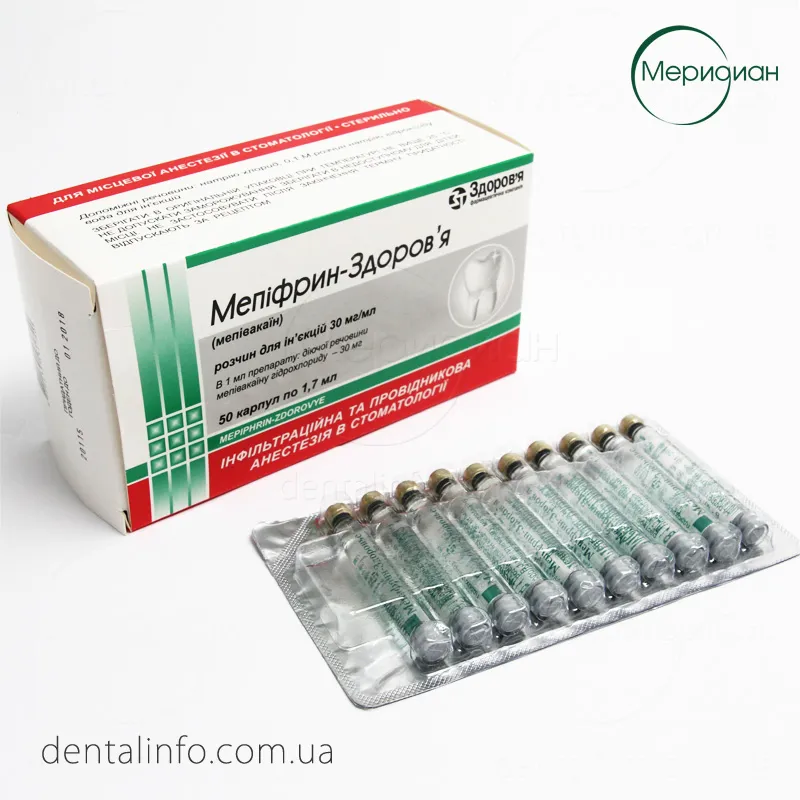
Table of Contents
INSTRUCTIONS FOR MEDICAL USE OF THE MEDICINAL PRODUCT MÉPIFRIN-ZDOROV'YA (MEPIPHRIN-ZDOROVYE)
Composition:
Active substance: mepivacaine hydrochloride;
1 ml of solution contains mepivacaine hydrochloride 30 mg;
Excipients: sodium chloride, sodium hydroxide, water for injections.
Pharmaceutical form. Injection solution.
Main physicochemical properties: clear, colorless solution.
Pharmacotherapeutic group. Local anesthetics. Mepivacaine. ATC code N01BB03.
Pharmacological properties.
Pharmacodynamics.
Mepivacaine hydrochloride is an amide-type local anesthetic with a rapid onset of anesthesia, due to reversible inhibition of nerve impulse conduction in autonomic, sensory, and motor nerve fibers, as well as cardiac conduction. It is used in dentistry. Characteristic features include rapid onset of analgesia (onset time of 1 to 3 minutes), pronounced analgesic effect, and good local tolerance. The mechanism of action involves blockade of voltage-gated sodium channels in the nerve fiber membrane. The drug initially penetrates the nerve membrane into the nerve cell as a base; however, the active form is the mepivacaine cation formed after re-association of a proton. At low pH levels, such as in inflamed tissues, only a small fraction exists in the base form, which may reduce the anesthetic effect.
The duration of action in pulpal anesthesia is at least 20–40 minutes; in soft tissue analgesia, it lasts from 45 to 90 minutes.
Pharmacokinetics.
Mepivacaine is rapidly and extensively absorbed. Plasma protein binding ranges from 60% to 78%. The half-life (T½) is approximately 2 hours.
After intravenous administration, the volume of distribution is 84 L and clearance is 0.78 L/min.
Mepivacaine is primarily metabolized in the liver; metabolites are excreted by the kidneys.
Clinical characteristics.
Indications.
Infiltration and conduction anesthesia in dentistry. Simple tooth extractions, as well as cavity preparation and tooth stump treatment for restorations and orthopedic constructions.
The drug is also used in patients for whom vasoconstrictor agents are contraindicated.
Contraindications.
- Hypersensitivity to mepivacaine, any component of the drug, or allergy to amide-type local anesthetics;
- Malignant hyperthermia;
- Cardiac conduction system disorders (II and III degree AV block, documented bradycardia), atrioventricular conduction disturbances not supported by a cardiac pacemaker;
- Acute heart failure;
- Severe arterial hypotension;
- Medication-uncontrolled epilepsy;
- Porphyria.
Special precautions.
Risk associated with accidental intravascular injection
Accidental intravascular injection (e.g., unintentional intravenous injection into systemic circulation, unintentional intravenous or intraarterial injection into the head or neck area) may be associated with serious adverse reactions, such as seizures followed by central nervous system (CNS) and cardiorespiratory depression, coma, progressing to respiratory arrest due to a sudden high level of mepivacaine in systemic circulation.
An aspiration test should be performed to ensure that the needle has not entered a blood vessel, especially during nerve block.
The injection should be administered slowly, performing an aspiration test in at least two planes (rotating the needle 180º) to avoid intravascular administration.
However, the absence of blood in the syringe does not guarantee prevention of intravascular injection.
Risk associated with intraneural injection
Accidental intraneural injection may result in retrograde movement of the drug along the nerve.
To prevent intraneural injection and avoid nerve injury during nerve block, the needle should be slightly withdrawn if the patient experiences an electric shock sensation or particularly painful injection.
If nerve injury occurs due to needle trauma, the neurotoxic effect may be enhanced by the potential chemical neurotoxicity of mepivacaine, as this may impair perineural blood supply and prevent drug clearance from the injection site.
Concomitant use of other medicinal products requires careful monitoring.
Interaction with other medicinal products and other types of interactions.
Local anesthetics. The use of local anesthetics is characterized by additive toxicity. This is not highly significant considering the dose of the drug used for local anesthesia and the drug concentration in the blood, but should be taken into account when administering to children.
The total dose of mepivacaine must not exceed the maximum recommended dose.
H2-histamine receptor blockers (cimetidine). Increased plasma levels of amide anesthetics have been reported after concomitant administration with cimetidine.
β-adrenergic blockers and calcium channel blockers. Enhance myocardial conduction depression and myocardial contractility suppression.
Sedatives (central nervous system depressants). If sedatives are used in a patient, the anesthetic dose should be reduced, as both the anesthetic and sedatives depress the central nervous system (CNS).
Anticoagulants/antiplatelet agents. During treatment with drugs that reduce blood coagulation, the risk of bleeding increases (see section «Special precautions»).
Antiarrhythmic drugs. Enhanced adverse reaction manifestations have been observed after drug administration.
Narcotic analgesics, sedatives, and anesthetic agents (chloroform, ether, thiopental). Data indicate that toxic synergy may occur when used concomitantly with local anesthetics.
Special precautions for use.
FOR PROFESSIONAL USE IN DENTAL PRACTICE ONLY.
Administration of low doses may result in inadequate anesthesia and may lead to increased blood levels of the drug due to accumulation of the drug or its metabolites.
If necessary, benzodiazepines may be used for premedication.
The dose of mepivacaine should be reduced in cases of hypoxia, hyperkalemia, or metabolic acidosis.
Accidental intravascular injection (see section "Administration and dosage") and injections into infected or inflamed tissues (which reduce the effectiveness of local anesthesia) should be avoided due to reduced local anesthetic effect.
Athletes should be informed that this medication contains an active ingredient that may result in a positive doping test.
There is a risk of unintentional trauma due to biting, especially in children (lips, cheeks, mucous membranes, and tongue); patients should be warned not to chew while anesthesia is in effect.
The product contains sodium chloride and sodium hydroxide. One cartridge/ampoule contains less than 1 mmol (23 mg) of sodium; i.e., it is practically sodium-free.
The drug should be used with caution in the following patient groups.
Patients with cardiovascular disorders:
- Peripheral vascular disease;
- Arrhythmias, particularly of ventricular origin;
- Heart failure;
- Arterial hypotension.
The drug should be used cautiously in patients with cardiovascular diseases, as they have a reduced ability to compensate for functional changes associated with prolonged atrioventricular conduction caused by medications.
Patients with epilepsy
All local anesthetics should be used with caution due to the potential risk of seizures.
The drug is contraindicated in pharmacologically uncontrolled epilepsy.
Patients with hepatic and renal disorders
Since amide-type local anesthetics are primarily metabolized in the liver and excreted by the kidneys, the drug should be used cautiously in patients with hepatic or renal impairment. In hepatic insufficiency, the dose of mepivacaine should be reduced.
The smallest effective dose required to achieve adequate analgesia should be used (see section "Administration and dosage").
Patients taking anticoagulants/antiplatelet agents
Increased attention should be paid to patients taking anticoagulants. When performing oral or maxillofacial surgery, it should be considered that in patients taking anticoagulants (e.g., heparin or acetylsalicylic acid (aspirin)), accidental puncture of a blood vessel during local anesthetic administration may lead to severe bleeding and increased bleeding risk. In patients taking anticoagulants, careful monitoring of the international normalized ratio (INR) is required.
Patients with hemorrhagic diathesis
The drug should be used with caution in patients with hemorrhagic diathesis caused by needle puncture/anesthetic technique/surgical intervention.
Elderly patients
Lower doses should be used in patients over 70 years of age (due to insufficient clinical data).
Patients with diabetes mellitus
The drug should be used cautiously in patients with diabetes mellitus.
The drug should be used with particular caution in the following cases:
- Severe hepatic or renal dysfunction;
- Angina pectoris (chest tightness);
- Arteriosclerosis;
- Injection into inflamed tissue;
- Significant impairment of blood coagulation.
Precautionary measures
The following medications and therapeutic measures should be available every time a local anesthetic is administered:
- Anticonvulsants (medications for treating seizures, e.g., benzodiazepines or barbiturates), muscle relaxants (medications that reduce tension in voluntarily contracting muscles), atropine, vasoconstrictors (medications for treating low blood pressure), or adrenaline for acute allergic or anaphylactic reactions;
- Resuscitation equipment (especially oxygen sources) for artificial ventilation if necessary;
- Careful and continuous monitoring of cardiovascular and respiratory parameters (adequacy of respiration) and the patient's level of consciousness after each local anesthetic injection.
Restlessness, anxiety, tinnitus, dizziness, blurred vision, tremors, depression, or drowsiness are the first signs of CNS toxicity (see section "Overdose").
Use during pregnancy or breastfeeding.
Pregnancy
There are no clinical studies on the use of the drug during pregnancy, and no information is available on the treatment of pregnant women with mepivacaine hydrochloride 30 mg/mL solution. Animal studies have not provided sufficient data on the potential effects of mepivacaine hydrochloride on reproductive toxicity.
Mepivacaine hydrochloride crosses the placental barrier. Compared to other local anesthetics, the use of mepivacaine during the first trimester of pregnancy cannot exclude an increased risk of fetal malformations. Mepivacaine may be used in early pregnancy only if other local anesthetics cannot be used.
However, as a precautionary measure, it is advisable to avoid using the drug during pregnancy.
Period of breastfeeding
No clinical studies have been conducted in breastfeeding women.
Literature data indicate no risk of lidocaine transfer into breast milk. However, it is unknown in what quantity mepivacaine hydrochloride passes into breast milk. Due to insufficient data, the potential risk to the newborn cannot be completely excluded. If administration of mepivacaine is necessary during breastfeeding, breastfeeding may be resumed approximately 24 hours after administration.
Fertility
No data are available. There are no adequate studies on the potential effects of the drug on fertility in parents or on postnatal development of offspring after pre- and postnatal exposure to mepivacaine hydrochloride.
Animal studies did not reveal any toxic effects of mepivacaine on fertility.
Ability to influence the speed of reaction while driving or operating machinery.
The drug may have a minor influence on the ability to drive or operate machinery. Dizziness, visual disturbances, and fatigue may occur after administration. Therefore, patients should remain in the dentist's office for at least 30 minutes after injection.
Method of Administration and Dosage
FOR DENTAL ANESTHESIA ONLY.
Intended for adults and children aged 4 years and older.
Dosage Recommendations
To ensure effective anesthesia, the minimum necessary amount of solution should be used.
Adults: A dose of 1–4 mL is usually sufficient.
Children aged 4 years and older: For children weighing 20–30 kg, a dose of 0.25–1 mL is sufficient; for children weighing 30–45 kg, 0.5–2 mL. The amount administered should be determined based on the child's age, body weight, and duration of the procedure. The average dose is 0.75 mg of mepivacaine per kg of body weight (0.025 mL of solution per kg of body weight).
In elderly patients, plasma levels of mepivacaine may be elevated due to impaired metabolism and reduced volume of distribution. The risk of mepivacaine accumulation increases, especially with repeated injections (e.g., supplemental injection). A similar effect may occur in patients with general debilitation, as well as in severe hepatic or renal impairment. In such cases, dosage reduction is recommended (administer the minimum amount of solution required for adequate anesthesia).
Mepivacaine dosage should also be reduced in patients with certain conditions (e.g., angina pectoris, arteriosclerosis).
Maximum Recommended Dose
Adults
The maximum dose of mepivacaine for healthy adults is 4 mg/kg body weight, equivalent to 0.133 mL of solution per kg of body weight. This means that a 70 kg patient may receive up to 300 mg of mepivacaine, corresponding to 10 mL of solution.
Children aged 4 years and older
The amount administered should be determined based on the child’s age, body weight, and duration of the procedure. Do not exceed an equivalent of 3 mg of mepivacaine per kg of body weight (0.1 mL of solution per kg of body weight).
Administration Method
For administration, cartridges should be used with special reusable cartridge syringes. Before use, visually inspect the medicinal product for the presence of particles and container damage. Do not use the cartridge or ampoule if such signs or defects are present.
Immediately before use, disinfect with alcohol the rubber stopper of the cartridge, which is pierced by the injection needle and sealed with an aluminum cap.
Under no circumstances should cartridges be immersed in any solutions.
The injectable solution must not be mixed with any other drug in the same syringe.
To avoid intravascular injections, always perform an aspiration test in at least two planes (rotating the needle by 180°), although a negative aspiration result does not exclude inadvertent and undetected intravascular injection.
The injection rate should not exceed 0.5 mL per 15 seconds, i.e., one cartridge or ampoule per minute.
Systemic reactions resulting from accidental intravascular injection can usually be avoided in most cases by proper injection technique: after aspiration, inject 0.1–0.2 mL slowly, then administer the remainder slowly no sooner than 20–30 seconds later.
Cartridges or ampoules containing residual solution after completion of the dental procedure must be destroyed. Do not use cartridges or ampoules with residual solution for other patients.
Children
Use in children aged 4 years and older.
Overdose
Cases of overdose with local anesthetics are most commonly described as:
- Absolute overdose;
- Relative overdose, such as accidental injection into a blood vessel, abnormally rapid absorption into systemic circulation, or delayed metabolism and elimination of the drug.
Symptoms caused by the active substance mepivacaine are dose-dependent, and their severity progresses over time, beginning with neurological disturbances, followed by cardiovascular and respiratory toxicity, and ultimately cardiac toxicity.
Main signs of overdose include metallic taste, tinnitus, dizziness, nausea, vomiting, restlessness, tachypnea.
Other possible symptoms include drowsiness, altered consciousness, restlessness, tremor, muscle twitching, tonic-clonic seizures, coma, respiratory center paralysis, hypotension, conduction disturbances, bradycardia, and cardiac arrest.
Adverse effects indicating high blood concentrations of local anesthetic may occur immediately due to inadvertent intravascular injection or may result from altered absorption, for example, following injection into inflamed tissue or highly vascularized areas. Overdose may also result from administration of a large volume of anesthetic solution.
Treatment
Resuscitation equipment must be available before initiating dental anesthesia with local anesthetics.
If early signs of adverse reaction or toxic effects occur during administration, stop the injection immediately and place the patient in a supine position.
In case of respiratory impairment, administer oxygen according to the severity of the condition; if necessary, apply artificial respiration (mouth-to-nose) or tracheal intubation combined with controlled ventilation.
In case of cardiac arrest, initiate cardiopulmonary resuscitation immediately.
Monitor pulse, blood pressure, respiratory rate, and level of consciousness; ensure support or restoration of vital functions of respiration and circulation, oxygen access, and intravenous administration of medications.
Arterial hypertension: Position the patient with the head slightly elevated; if necessary, administer sublingual nifedipine.
Seizures: Protect the patient from potential injury; if necessary, administer intravenous diazepam.
Arterial hypotension: Supine position; if necessary, intravenous infusion of electrolyte solutions and vasoconstrictors (e.g., epinephrine, cortisone intravenously).
Bradycardia: Intravenous administration of atropine.
Anaphylactic shock: Call emergency services immediately; simultaneously place the patient in a supine position with legs slightly elevated, ensure intravenous infusion of electrolyte solutions, and if necessary, administer epinephrine and cortisone intravenously.
Cardiogenic shock: Elevate the upper body and call emergency services.
Cardiovascular collapse: Artificial ventilation of the lungs, external cardiac massage, and resuscitation measures.
Adverse Reactions
Adverse reactions following administration of mepivacaine are similar to those observed with other amide-type local anesthetics.
Generally, these adverse effects are dose-related and may occur due to elevated plasma levels resulting from excessive dosage, rapid absorption, inadvertent intravascular injection, or reduced metabolism. They may also arise from increased sensitivity, idiosyncrasy, or reduced tolerance of the patient to the drug.
Serious adverse reactions are usually of systemic nature.
Nervous system: neuropathy, neuralgia (neuropathic pain), paresthesia (burning, tingling, itching, pricking, localized sensation of warmth or cold without visible physical cause) of oral and perioral structures; hypoesthesia, numbness (oral and perioral), dysesthesia (oral and perioral), including dysgeusia (metallic taste, disturbances of taste sensation), ageusia (loss of taste sensation); central nervous system excitation and/or depression, dizziness, headache, restlessness, disturbance of consciousness, nystagmus, tremor, depression and paralysis, respiratory arrest, pre-syncope (presyncope), syncope (fainting), psychosis, disorientation, vertigo, speech disorders (dysarthria, logorrhea), weakness/excitation, coordination disturbances (balance disorders), somnolence. Profound CNS depression: seizures (including tonic-clonic), loss of consciousness, coma.
If these signs occur, the patient should be placed in a supine position and oxygen ventilation should be administered. Continuous monitoring of the patient is essential to prevent possible worsening, such as seizures followed by CNS depression. Signs of excitation may be very brief or may not occur at all; in such cases, somnolence may be the first sign, progressing to unconsciousness and respiratory arrest. Somnolence following mepivacaine administration is usually an early sign of elevated blood levels of the drug and may result from rapid absorption.
Psychiatric disorders: nervousness, anxiety, euphoria.
Eye disorders: visual acuity disturbances, blurred vision, accommodation disorders. Horner's syndrome: eyelid ptosis, enophthalmos, diplopia (paralysis of extraocular muscles), amaurosis, blindness, mydriasis, miosis.
Ear disorders: discomfort and tinnitus, hyperacusis.
Cardiovascular system: cardiovascular depression; tachycardia; bradycardia; bradyarrhythmia; tachyarrhythmia (including ventricular arrhythmias (extrasystoles and fibrillation)); atrial flutter; angina pectoris; arterial hypotension, which may lead to collapse; arterial hypertension; cardiac conduction disturbances (atrioventricular block); arrhythmia; vasodilation; cardiovascular failure, which may lead to cardiac arrest. These symptoms of cardiovascular depression are usually the result of a vasovagal reaction, especially if the patient is in an upright position. Occasionally, they may result from the direct effect of the drug. Failure to recognize prodromal signs such as sweating, dizziness, weakness, and pulse changes may lead to progressive cerebral hypoxia and seizures or severe cardiovascular disturbances.
The patient should be placed in a supine position and oxygen ventilation should be administered. Intravenous infusions should be performed if necessary, and, if not contraindicated, vasoconstrictor agents (e.g., ephedrine) should be administered.
Respiratory system: respiratory depression; tachypnea; bradypnea, which may lead to apnea (respiratory arrest); yawning; dyspnea; hypoxia (including cerebral); hypercapnia; dysphonia (hoarseness).
Immune system disorders: hypersensitivity reactions, including skin rashes; urticaria; anaphylactic/anaphylactoid reactions; anaphylactic shock; angioneurotic edema (face, tongue, lips, gums, throat, larynx, periorbital); elevated body temperature; bronchospasm; asthma.
Gastrointestinal disorders: nausea, vomiting, ulcers or desquamation of the mucous membrane of the gums or oral cavity; swelling of the tongue, lips, gums, stomatitis, glossitis, gingivitis.
Skin and subcutaneous tissue disorders: skin redness, rash, itching, facial swelling.
Musculoskeletal and connective tissue disorders: muscle twitching, chills (trembling).
General disorders and administration site conditions: injection site swelling, local swelling, chest pain, fatigue, asthenia (weakness), feeling of warmth, pain at injection site, hyperthermia.
Injury, poisoning, and procedural complications: nerve injury.
If adverse effects occur following local anesthetic administration, administration should be discontinued immediately.
Reporting of suspected adverse reactions
Reporting of suspected adverse reactions following the use of a medicinal product is of great importance. It allows continuous monitoring of the benefit-risk balance of the medicinal product. Healthcare professionals are requested to report any adverse reactions.
Shelf life. 3 years.
Storage conditions. Store in the original packaging at a temperature not exceeding 25 °C. Do not freeze. Keep out of reach of children.
Incompatibilities. The drug should not be mixed with other medicinal products.
Packaging. 1.7 ml in cartridges: 10 (10×1), 50 (10×5) in blisters in a box; 1.7 ml in ampoules: 10 in a box, 10 (5×2) in blisters in a box.
Prescription status. Prescription only.
Manufacturer. LIMITED LIABILITY COMPANY "CORPORATION "ZDOROVIYA".
Limited Liability Company "FARMEKS GROUP".
Manufacturer's address and place of business. Ukraine, 61013, Kharkiv region, city of Kharkiv, Shevchenko Street, 22.
(LIMITED LIABILITY COMPANY "CORPORATION "ZDOROVIYA")
Ukraine, 08301, Kyiv region, city of Boryspil, Shevchenko Street, 100.
(Limited Liability Company "FARMEKS GROUP")