Menovalen
Ukraine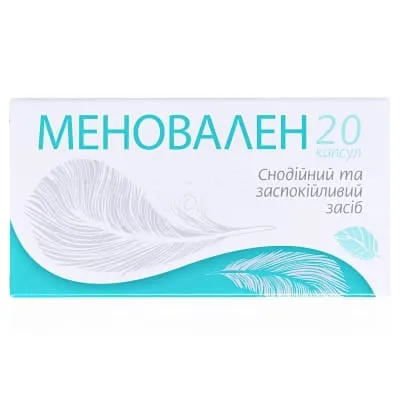
Table of Contents
INSTRUCTIONS FOR MEDICAL USE OF THE MEDICINAL PRODUCT MENOVALEN (MENOVALEN)
Composition:
Active substances: valerian lipophilic complex ((10-15):1) (Valerianae radices extractum spissum) and peppermint lipophilic complex ((10.8-14.8):1) (Menthae piperitae extractum spissum);
Each capsule contains: valerian lipophilic complex ((10-15):1) (Valerianae radices extractum spissum), calculated as dry substance – 50 mg; peppermint lipophilic complex ((10.8-14.8):1) (Menthae piperitae extractum spissum), calculated as dry substance – 25 mg;
Excipients: microcrystalline cellulose, potato starch, colloidal anhydrous silicon dioxide, light magnesium carbonate. The capsule cap contains the colorant Diamond Black BN (E 151).
Pharmaceutical form. Capsules.
Main physicochemical properties: hard gelatin capsules of cylindrical shape with hemispherical ends, with a green cap and a white body. The contents of the capsules are a greenish-brown powder or granulated powder with a weak characteristic odor.
Pharmacotherapeutic group. Sedatives and hypnotics. ATC code N05CM.
Pharmacological properties.
Pharmacodynamics.
A combined herbal preparation with mild sedative effects, determined by the actions of its components – valerian and peppermint. It exerts a mild calming effect and is indicated to reduce mild transient nervous tension associated with mental stress, excited states, and irritability.
Valerian provides sedative action and positively affects well-being in symptoms of irritability such as restlessness, excitement, and tension due to nervous overstrain. The preparation promotes faster onset of sleep.
Peppermint has traditionally been used in combination with valerian in calming preparations.
The drug is used in neuroses when administration of potent sedatives is inappropriate.
Pharmacokinetics.
Not studied.
Clinical characteristics.
Indications.
Neuroses accompanied by the following symptoms:
- nervous excitement;
- restlessness;
- decreased attention span;
- sleep disorders.
Contraindications.
- Hypersensitivity to valerian, peppermint, or other components of the drug;
- pronounced arterial hypotension;
- depression or other conditions associated with suppression of central nervous system activity, pronounced drowsiness.
Interaction with other medicinal products and other types of interactions.
The drug may enhance the effects of tranquilizers (including chlordiazepoxide, diazepam), sedatives, hypnotics (including phenobarbital, zopiclone, zolpidem), anxiolytics, spasmolytic agents, centrally-acting antihypertensive agents, analgesics, neuroleptics, ethyl alcohol, nootropic agents, anesthetic agents, and curare-like muscle relaxants.
Concomitant use with synthetic sedative drugs is not recommended.
Concomitant use of ethanol should also be avoided.
Special precautions for use.
Do not exceed the recommended doses of the drug.
Alcoholic beverages should be avoided during use of this drug.
Caution should be exercised when administering the drug to patients with severe hepatic impairment or a history of severe liver disease, as well as to patients with cholelithiasis.
Since peppermint is an ingredient of the drug, patients with gastroesophageal reflux, achlorhydria, or hiatal hernia should avoid using the drug due to the possible exacerbation of disease symptoms. Use with caution in bronchial asthma.
Valerian may exert a moderate depressant effect; therefore, concomitant use of this drug with synthetic sedatives is not recommended due to potential potentiation of the effect.
The drug may be used in cases of pronounced atherosclerosis of cerebral vessels only under medical supervision.
The cap and body of the capsule contain the dye Diamond Black BN (E 151), which may cause allergic reactions.
Specific sensitivity to the odor of valerian and mint may occur.
Use during pregnancy or breastfeeding.
The use of this drug is not recommended during pregnancy or breastfeeding due to insufficient data on safety during these periods.
Ability to affect reaction speed when driving or operating machinery.
Due to the sedative effect of the drug, patients should refrain from driving vehicles or operating machinery while taking this medication.
Dosage and Administration.
Adults and children aged 12 years and older should take Menovalen 1 capsule three times daily, taken half an hour before meals.
For initial insomnia symptoms, take 1–2 capsules 1–1.5 hours before bedtime.
The duration of treatment is determined individually by a physician, but usually lasts 3–4 weeks.
If there is no improvement in condition within 14 days from the start of treatment, consult a doctor.
Children.
Do not administer to children under 12 years of age.
Overdose.
Symptoms: possible increased fatigue, general weakness, photosensitivity, headache, dizziness, drowsiness, abdominal cramps and pain, nausea, sensation of chest tightness, tachycardia/bradycardia, hand tremors and dilated pupils, reduced hearing and visual acuity, and intensification of other adverse reactions.
Treatment: discontinue the drug and seek immediate medical advice.
If necessary, perform gastric lavage, administer activated charcoal, and provide symptomatic therapy.
Side effects.
Nervous system: headache, dizziness, lethargy, drowsiness, suppression of emotional responses, depression, general weakness, reduced mental and physical performance, difficulty concentrating; in individual cases – psychic excitement, anxiety, insomnia.
Cardiovascular system: arterial hypotension, chest tightness, palpitations, chest pain, cardiac arrhythmias (including bradycardia, tachycardia).
Gastrointestinal tract: dyspeptic symptoms, heartburn, nausea, diarrhea, abdominal spasms and pain; with prolonged use, possible suppression of digestive processes, constipation.
Hepatobiliary system: possible signs of hepatotoxicity.
Immune system: possible manifestations of hypersensitivity reactions, including skin rashes, itching, urticaria, hyperemia, swelling, dyspnea, bronchial asthma.
Adverse reactions are rare, reversible, usually develop during prolonged use or significant exceeding of recommended doses.
If any adverse reactions occur, discontinue use of the drug and consult a physician immediately.
Shelf life. 2 years.
Do not use the medication after the expiry date stated on the package.
Storage conditions.
In the original packaging at a temperature not exceeding 25 °C.
Keep out of reach of children.
Packaging.
10 capsules in a blister; 2 blisters per carton.
Availability. Over-the-counter.
Manufacturer.
Public Joint-Stock Company "Scientific-Production Center "Borshchagovskiy Chemical-Pharmaceutical Plant".
Manufacturer's address and place of business.
17, Miru Street, Kyiv, 03134, Ukraine.