Menopur
Ukraine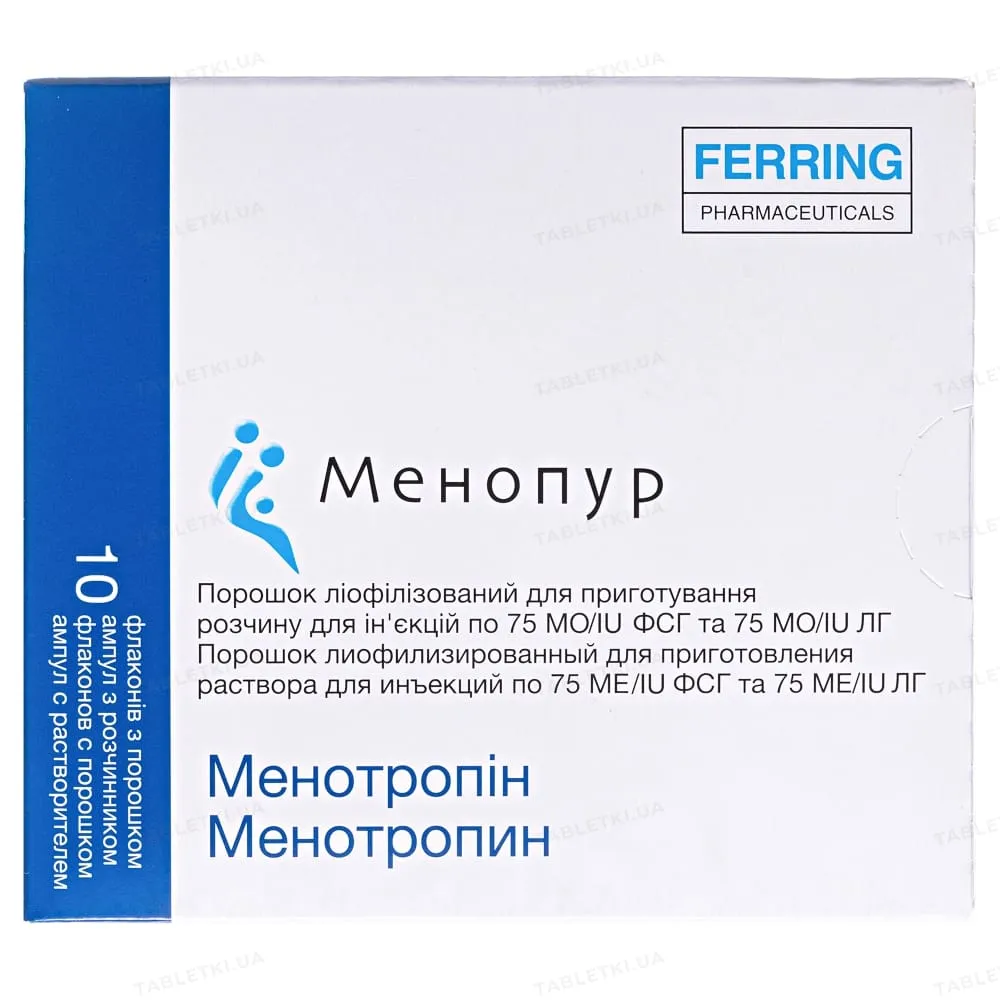
Table of Contents
INSTRUCTIONS FOR MEDICAL USE OF THE MEDICINAL PRODUCT MENOPUR (MENOPUR®)
Composition:
Active substance: 1 vial contains: menotropin (highly purified human menopausal gonadotropin, hMG), containing follicle-stimulating hormone (FSH) 75 IU and luteinizing hormone (LH) 75 IU;
Excipients: lactose monohydrate, polysorbate 20, sodium hydroxide, hydrochloric acid;
Solvent: 0.9% sodium chloride solution, diluted hydrochloric acid, water for injections.
Pharmaceutical form. Lyophilized powder for solution for injection.
Main physicochemical properties:
1 vial contains a lyophilisate in the form of a white to almost white cake;
1 ampoule of solvent contains a clear, colorless liquid.
Pharmacotherapeutic group.
Gonadotropins and other ovulation stimulants. Human menopausal gonadotropin.
ATC code G03GA02.
Pharmacological properties.
Pharmacodynamics.
Menopur contains menotropin (hMG), which consists of follicle-stimulating hormone (FSH) and luteinizing hormone (LH). In addition, Menopur contains human chorionic gonadotropin (hCG), a hormone derived from postmenopausal urine that contributes to LH activity.
Menotropin, which has both FSH and LH activity, stimulates follicular growth and development as well as the production of sex steroid hormones in women who do not have primary ovarian failure. FSH is the primary factor determining recruitment of the follicular cohort and early follicular growth during the initial phase of folliculogenesis, while LH is important for ovarian steroidogenesis and preovulatory follicular maturation. FSH can stimulate follicular growth in the complete absence of LH (e.g., in hypogonadotropic hypogonadism), but this is associated with abnormal follicular development, which may be accompanied by low estradiol levels and inadequate follicular maturation.
Consistent with the action of LH in increasing sex steroid hormone production, estradiol levels during treatment with Menopur are higher compared to those observed with recombinant FSH preparations in IVF/ICSI cycles with down-regulation. This phenomenon should be taken into account when monitoring the patient's response to treatment based on estradiol levels. No differences in estradiol levels have been observed during the use of low-dose ovulation induction protocols in anovulatory patients.
Pharmacokinetics.
The pharmacokinetic profile of FSH in Menopur has been documented. After 7 days of repeated administration of 150 IU Menopur for down-regulation in healthy female volunteers, the maximum plasma concentration of FSH (adjusted for baseline values) (mean ± standard deviation (SD)) was 8.9 ± 3.5 IU/L and 8.5 ± 3.2 IU/L following subcutaneous and intramuscular administration, respectively. Maximum FSH concentrations were reached within 7 hours for both routes of administration. After repeated administration, FSH was eliminated with a half-life (mean ± SD) of 30 ± 11 hours and 27 ± 9 hours following subcutaneous and intramuscular administration, respectively. Although individual LH concentration-time curves show an increase in LH concentration after administration of Menopur, available data were too sparse to allow pharmacokinetic analysis.
Menotropin is primarily eliminated via the kidneys.
The pharmacokinetics of Menopur in patients with renal or hepatic impairment has not been studied.
Clinical characteristics.
Indications.
- Female infertility due to anovulation (including polycystic ovary syndrome (PCOS)) in women who do not respond to clomiphene citrate treatment.
- Controlled ovarian stimulation for the induction of multiple follicular development in the context of assisted reproductive technologies (ART) (including in vitro fertilization/embryo transfer, gamete intrafallopian transfer (GIFT), and intracytoplasmic sperm injection (ICSI)).
Contraindications.
Menopur is contraindicated in women with the following conditions:
- Pituitary or hypothalamic tumors;
- Ovarian, uterine, or breast carcinoma;
- Pregnancy or lactation;
- Gynecological bleeding of unknown origin;
- Hypersensitivity to the active substance or to any of the excipients of the product;
- Enlarged ovaries or ovarian cysts not related to polycystic ovary syndrome (PCOS).
Treatment with Menopur is not expected to yield a positive outcome in the following cases, and therefore should not be administered:
- Primary ovarian failure;
- Genital tract abnormalities incompatible with pregnancy;
- Uterine fibrotic formations incompatible with pregnancy.
Interaction with other medicinal products and other forms of interaction.
Drug interaction studies with Menopur have not been conducted.
Despite the lack of clinical experience, concomitant use of Menopur and clomiphene citrate is expected to accelerate follicular maturation. When used in combination with gonadotropin-releasing hormone (GnRH) agonists for pituitary desensitization, higher doses of Menopur may be required to achieve the desired ovarian response.
Special precautions for use.
Menopur has potent gonadotrophic activity, which may lead to adverse reactions ranging from mild to severe. Therefore, the drug should be administered only under the supervision of physicians experienced in the management of infertility.
Treatment with gonadotrophins is time-consuming and requires regular monitoring of ovarian response by ultrasound or a combination of ultrasound and serum estradiol measurements. There is considerable variability in response to menotrophin administration, and some patients may exhibit a very weak response. To achieve the treatment objective, the lowest effective dose of the drug should be used.
The first injection of Menopur should be administered under strict medical supervision.
Before initiating treatment, both partners should be evaluated to determine the causes of infertility, and a medical examination should be performed to rule out possible contraindications. In particular, female patients should be assessed for hypothyroidism, adrenocortical insufficiency, hyperprolactinemia, or pituitary or hypothalamic tumors, and appropriate treatment for these conditions should be initiated.
In women undergoing follicular stimulation as part of treatment for anovulatory infertility or assisted reproductive technologies (ART), ovarian enlargement or hyperstimulation may occur. These risks can be minimized by strict adherence to recommended dosing and administration regimens, as well as careful monitoring of therapy. Assessment of follicular development must be performed by a physician experienced in interpreting the relevant tests.
Ovarian hyperstimulation syndrome (OHSS)
OHSS is a distinct medical condition, different from uncomplicated ovarian enlargement. It is a syndrome that may progressively worsen in severity. OHSS is characterized by marked ovarian enlargement, elevated levels of sex steroid hormones, and increased vascular permeability, which may lead to fluid accumulation in the peritoneal cavity, pleural space, and, in rare cases, the pericardial cavity.
In severe cases of OHSS, symptoms may include abdominal pain, abdominal distension, significant ovarian enlargement, weight gain, dyspnea, oliguria, and gastrointestinal symptoms such as nausea, vomiting, and diarrhea. Clinical examination may reveal hypovolemia, hemoconcentration, electrolyte imbalances, ascites, hemoperitoneum, pleural effusion, hydrothorax, acute respiratory distress syndrome, and episodes of thromboembolism.
Excessive ovarian response to gonadotrophin therapy may rarely lead to OHSS, particularly when human chorionic gonadotrophin (hCG) is administered as an ovulation trigger. Therefore, in cases of ovarian hyperstimulation, administration of hCG should be avoided, and patients should be advised to abstain from sexual intercourse or use barrier contraception for at least 4 days. OHSS may progress rapidly (within 24 hours to several days) and become a serious medical condition. Thus, patients should remain under medical supervision for at least 2 weeks following hCG administration.
Adherence to the recommended dosage and administration schedule of Menopur, along with careful monitoring during treatment, helps minimize the risk of ovarian hyperstimulation and multiple pregnancy. In assisted reproductive technology (ART) programs, aspiration of all follicles prior to ovulation may help reduce the risk of hyperstimulation.
OHSS may become more severe and prolonged if pregnancy occurs. OHSS typically develops after discontinuation of hormonal therapy and reaches its peak severity approximately 7–10 days after treatment ends. In most cases, OHSS resolves spontaneously with the onset of menstruation.
In severe cases of OHSS, gonadotrophin administration should be discontinued, and the patient should be hospitalized for specific treatment.
OHSS occurs more frequently in women with polycystic ovarian syndrome.
Multiple pregnancy
Multiple pregnancy, especially with a high number of fetuses, increases the risk of complications for both mother and fetus during the perinatal period.
Women who ovulate as a result of gonadotrophin therapy have a higher incidence of multiple pregnancies compared to naturally conceived pregnancies. Most multiple pregnancies resulting from such treatment lead to twin births. Careful monitoring of ovarian response is essential to minimize the risk of multiple pregnancy.
In women undergoing ART procedures, the risk of multiple pregnancy is primarily related to the number of embryos transferred, embryo quality, and the patient's age.
Patients should be informed before treatment initiation about the possibility of multiple pregnancy.
Pregnancy loss
The incidence of pregnancy loss, including miscarriage and spontaneous abortion, is higher in women undergoing follicular stimulation or ART procedures compared to naturally conceived pregnancies.
Ectopic pregnancy
Women with a history of tubal disease are at increased risk of ectopic pregnancy, regardless of whether conception occurs spontaneously or as a result of infertility treatment. The rate of ectopic pregnancy following in vitro fertilization (IVF) is 2–5%, compared to 1–1.5% in the general population.
Reproductive tract neoplasms
Cases of both benign and malignant neoplasms of the ovaries and other reproductive organs have been reported in women who have undergone multiple cycles of infertility treatment. It is currently unknown whether gonadotrophin therapy increases the baseline risk of such tumors in infertile women.
Congenital malformations
The prevalence of congenital malformations in offspring following ART may be slightly higher than in naturally conceived pregnancies. This is believed to be related to parental factors (e.g., maternal age, sperm characteristics) and multiple pregnancies.
Thromboembolic events
Women with recognized risk factors for thromboembolic complications—such as personal or family history of thromboembolism, severe obesity (body mass index > 30 kg/m²), or thrombophilia—may have an increased risk of venous or arterial thromboembolism during or after gonadotrophin therapy. The benefit-risk ratio of using gonadotrophins should be carefully evaluated in such patients. Additionally, it should be noted that pregnancy itself is associated with an increased risk of thromboembolic complications.
Use of Menopur may result in a positive doping test.
The use of Menopur as a doping agent may impair health.
Menopur contains less than 1 mmol (23 mg) of sodium per dose and is essentially considered a sodium-free preparation.
Use during pregnancy or breastfeeding
Menopur is contraindicated during pregnancy and breastfeeding.
Effect on ability to drive and use machines
No studies have been conducted on the effect of Menopur on the ability to drive or operate machinery. However, the likelihood of Menopur affecting such abilities is considered very low.
Method of Administration and Dosage
Treatment with Menopur must be initiated under the supervision of a physician experienced in the management of reproductive disorders.
Menopur is intended for subcutaneous or intramuscular administration. The powder must be reconstituted immediately before use with the diluent provided. Up to 3 vials of Menopur powder may be dissolved in 1 mL of diluent. Do not shake. The solution should not be used if it contains particles or is not clear.
Dosage regimens are identical for subcutaneous and intramuscular administration.
Ovarian response to exogenous gonadotropins varies widely, making standardized dosing regimens inappropriate. Therefore, doses should be individualized according to ovarian response to treatment. Menopur may be used alone or in combination with gonadotropin-releasing hormone (GnRH) agonists or antagonists. The recommended dosage and duration of treatment depend on the treatment protocol applied.
Anovulation (including polycystic ovary syndrome): The goal of Menopur treatment is the development of a single Graafian follicle, from which an oocyte will be released due to the action of hCG.
Menopur should be initiated within the first 7 days of the menstrual cycle. The recommended initial dose is 75–150 IU per day, which should be maintained for at least 7 days. Subsequent treatment should be individualized based on results of regular clinical monitoring (including ultrasound, preferably combined with estradiol level assessment). Dose adjustments should not be made more frequently than once every 7 days. The recommended single dose increase is 37.5 IU and should not exceed 75 IU. The maximum daily dose should not exceed 225 IU. If there is an inadequate response after 4 weeks of treatment, the cycle should be discontinued and a new treatment cycle initiated with a higher starting dose.
Once optimal response is achieved, a single dose of hCG (5000–10000 IU) should be administered the day after the last Menopur injection. Sexual intercourse is recommended on the day of hCG administration and the following day. Alternatively, intrauterine insemination may be performed. In case of excessive response to Menopur, treatment should be discontinued and hCG should not be administered; patients should abstain from sexual intercourse or use barrier contraception until the start of the next menstrual cycle.
Controlled ovarian hyperstimulation for the induction of multiple follicular development in the context of assisted reproductive technologies (ART):
In protocols involving down-regulation using a gonadotropin-releasing hormone (GnRH) agonist, treatment with Menopur should be initiated approximately 2 weeks after starting the agonist.
In protocols using a GnRH antagonist, treatment with Menopur should be initiated on day 2 or 3 of the menstrual cycle.
The recommended initial dose of Menopur, to be maintained for at least the first 5 days of treatment, is 150–225 IU per day. Subsequent treatment should be individualized based on results of regular clinical monitoring (including ultrasound combined with estradiol level assessment); any single dose increase should not exceed 150 IU. The maximum daily dose of Menopur should not exceed 450 IU. In most cases, treatment should not last longer than 20 days.
After achieving optimal stimulation, a single injection of hCG (5000–10000 IU) should be administered to complete follicular maturation and trigger oocyte release. Patients should remain under close medical supervision for at least 2 weeks following hCG administration. If excessive response to Menopur occurs, treatment should be discontinued and hCG should not be administered. The patient should use barrier contraception or abstain from sexual intercourse until the onset of the next menstruation.
Children. Not to be used in children.
Overdose.
The effects of overdose are unknown; ovarian hyperstimulation syndrome may occur. Treatment is symptomatic.
Adverse Reactions
During clinical studies with the medicinal product Menopur, the most commonly observed adverse effects were ovarian hyperstimulation syndrome (OHSS), abdominal pain, headache, abdominal distension, and injection site pain. The incidence of any of these reactions did not exceed 5%. The main adverse effects of Menopur observed in women receiving treatment in clinical trials are listed below. Adverse effects are categorized by system organ class and frequency of occurrence. The adverse reactions are classified by frequency as follows: common (≥ 1/100 to < 1/10), uncommon (≥ 1/1000 to < 1/100), rare (≥ 1/10000 to < 1/1000), and frequency not known. The frequency of adverse effects observed during the post-marketing period is specified as not known.
Eye disorders: frequency not known – visual disturbancesa.
Gastrointestinal disorders: common – abdominal pain, abdominal distension, nausea; uncommon – vomiting, abdominal discomfort, diarrhoea.
General disorders and administration site conditions: common – injection site reactionsb; uncommon – fatigue; frequency not known – pyrexia, malaise.
Immune system disorders: frequency not known – hypersensitivity reactionsc.
Investigations: frequency not known – weight increase.
Musculoskeletal and connective tissue disorders: frequency not known – musculoskeletal paind.
Nervous system disorders: common – headache; uncommon – dizziness.
Reproductive system and breast disorders: common – OHSSe, pelvic painf; uncommon – ovarian cysts, breast disordersg; frequency not known – ovarian torsione.
Skin and subcutaneous tissue disorders: rare – acne, rash; frequency not known – pruritus, urticaria.
Vascular disorders: uncommon – hot flushes; frequency not known – thromboembolisme.
a Isolated cases of transient amaurosis, diplopia, mydriasis, scotoma, photopsia, floaters, blurred vision, and visual disorders have been reported as visual disturbances during the post-marketing period.
b Injection site reactions were most frequently reported as injection site pain.
c There have been reports of isolated cases of localized or generalized allergic reactions, including anaphylactic reactions, accompanied by corresponding symptoms.
d Musculoskeletal pain includes arthralgia, back pain, neck pain, and limb pain.
e During clinical trials with Menopur, gastrointestinal symptoms associated with OHSS such as abdominal distension, discomfort, nausea, vomiting, and diarrhoea have been reported. Cases of severe ascites associated with OHSS, fluid accumulation in the pelvis, pleural effusion, dyspnoea, oliguria, thromboembolic events, and ovarian torsion have been reported as rare complications.
f Pelvic pain includes pain in the ovarian and fallopian tube area.
g Breast disorders include breast pain, tenderness, discomfort, breast swelling, and nipple pain.
Unwanted multiple pregnancies occur more frequently during treatment with human menopausal gonadotrophin (hMG).
Pregnancies resulting from infertility treatment with gonadotrophins such as Menopur are more likely to end in spontaneous abortion than normal pregnancies.
Shelf life.
Shelf life of the powder: 2 years.
Shelf life of the solvent: 3 years.
Storage conditions.
Store below 25 °C in a place protected from light and inaccessible to children.
Do not use the medicinal product after the expiry date stated on the packaging.
Incompatibilities.
Menopur must not be administered in the same injection with other medicinal products except for urofollitropin Bravel 75 IU produced by Ferring. Studies have shown that co-administration of Menopur and urofollitropin does not significantly alter the expected bioactivity.
Packaging.
10 vials of powder and 10 ampoules of solvent (1 ml each) in a cardboard pack.
Prescription category. Prescription only.
Manufacturer.
Ferring GmbH, Germany.
Address of the manufacturer and location of its manufacturing site.
Wittland 11, 24109 Kiel, Germany.